Here you can browse through my blog posts prior to February 2022. Currently I'm sharing my travel experiences, candid opinions, and what's on my mind solely on my Facebook page. — Rick

Daily Dose of Europe: The Camino de Santiago — A Medieval Pilgrimage in Modern Times 

If there’s any European travel experience that might actually be safe in the age of coronavirus, it’s walking the Camino de Santiago…which was always all about solitude, well before anyone heard the phrase “social distancing.”

Even if we’ve had to postpone trips to Europe, I believe a daily dose of travel dreaming can actually be good medicine. Here’s another one of my favorite travel memories — a reminder of what’s waiting for you in Europe at the other end of this crisis.

Standing on the main square of Santiago de Compostela, in front of the towering and gleaming granite facade of its cathedral, a giddy old man whose cuffs are as frayed as his walking stick lays down on the stony pavement and waves his arms and legs — as if making a snow angel. And I’m right there, sharing the joy of pilgrims who’ve completed the Camino de Santiago (Spanish for “Way of St. James”). With sunburned faces and tattered walking sticks, they triumphantly end their long trek by stepping on a scallop shell carved into the pavement in front of the city’s magnificent cathedral.

For over a thousand years, this cathedral in the far northwest corner of Spain has been the ritualistic last stop for pilgrims who’ve hiked here from churches in Paris and all over Europe. And for a thousand years, pilgrims — standing before this towering cathedral — have been overcome with joy and jubilation.

St. James, Santiago’s namesake and symbol, was a Christian evangelist — one of Jesus’ original “fishers of men.” But judging from the way he’s portrayed here, his main activity was beheading Muslims with his busy sword. Propagandistic statues of James are all over town — riding in from heaven to help the Spaniards defeat the Muslim Moors.

Considering how St. James is depicted taking such joy in butchering Muslims and the importance of Santiago for Christians, it’s no wonder police guard the square. Security here has been tight ever since 9/11.

Historians figure the “discovery” of the remains of St. James in Spain was a medieval hoax. It was designed to rally Europe against the Muslim Moors, who had invaded Spain and were threatening to continue deeper into Europe. With St. James — a.k.a. “the Moor Slayer” — buried in Iberia and that beloved tomb now in Muslim hands, all of Europe would rise up to push the Moors back into Africa…which, after a centuries-long “Reconquista,” they finally did in 1492.

All this commotion dates back about 1,200 years to a monk who followed a field of stars (probably the Milky Way) to this distant corner of Europe and discovered what appeared to be the long-lost tomb of St. James. Church leaders declared that St. James’ relics had been found, built a church, and named the place Santiago (St. James) de Compostela (campo de estrellas, or “field of stars”).

Walking the Way of St. James has changed little over the centuries. The gear still includes a cloak, a floppy hat, a walking stick, a gourd (for drinking from wells), and a scallop shell (symbolizing where you’re going).

In recent years, the route has enjoyed a huge renaissance of interest, with nearly 100,000 pilgrims trekking to Santiago last year. Today, most take a month to walk the 450 miles from the French border town of Saint-Jean-Pied-de-Port. The walk itself is a kind of hut-hopping. At regular intervals along the route, humble government-subsidized hostels called albergues provide pilgrims a place to rest for the night (bunks are generally free, though a small donation is requested).

In the midst of the Camino, out on a dusty trail pilgrims have trod for a thousand years, I meet pilgrims of all types. Prepackaged groups have clean, matching T-shirts. Each hiker is issued a mass-produced walking stick with a decorative gourd tied to the top and the requisite dangling scallop shell with a brightly painted cross of St. James.

Other pilgrims are part of humbler, ragtag church groups from distant Catholic lands. Resting on a bluff, I’m passed by an otherworldly group that has shuffled all the way from Lithuania to the rhythm of its raspy, amplified chant-leader. Along with their rucksacks, the group carries an old boom box, various statues, and a 10-foot-tall cross. With their intentionally monotonous chant, they trudge slowly out of sight and then out of earshot.

Later, I stop in a medieval village — like so many ghostly quiet villages pilgrims pass all along the route. Its only “shop” is a vending machine cut into a stone wall. An old woman scrubs her laundry, bent over a convenient creek-side spot as her ancestors have for centuries. She ignores a shepherd herding his gangly flock over a narrow bridge.

In this idyllic corner, pilgrims are eager to share their experiences. I meet a New Yorker who has just hiked for days across the vast Spanish plain and learned nothing about life or himself. He is, in his words, “a little pissed off with it all.” Then comes a bouncy flower child from Berlin — a 20-year-old girl hiking alone, singing to herself, and radiant with appreciation for this personal journey. She speaks to me as if she were a real saint come to Earth. Talking with her, I feel I’ve entered a Botticelli painting (and don’t want to leave).

An Englishman I meet is doing the trail in three successive years because he can’t get enough time away from his 9-to-5 job to do it in one 30-day stretch. While he walks, he reflects on simplicity. Everyone I meet (except for the one pissed-off guy) is having a richly rewarding time. I keep thinking how a standard RV vacation — with its clever abundance of comforts — couldn’t be more different than this chance to be away from the modern world with all that it entails.

Because the last overnight stop on the Camino is just two miles away from the city of Santiago, most pilgrims arrive at the cathedral late in the morning, in time for the midday Mass.

Like a kid follows a parade, I follow the pilgrims as they approach the cathedral. I try to imagine the mindset of a medieval pilgrim, so exhausted yet so triumphant. You’ve just walked from Paris — about a thousand miles — to reach this holy spot. Your goal: to request the help of St. James in recovering from an illness. Or maybe you’ve come to honor the wish of a dying relative…or to be forgiven for your sins. Whatever the reason, you know the pope promised that any person who walked to Santiago in a Holy Year, confessed their sins, and took communion here would be forgiven.

After weeks of hiking, the spires of the cathedral come into view and jubilation quickens your tired pace. Finally, you stand upon that shell in the pavement to gaze up at the awe-inspiring cathedral. Stepping inside, you squint down the nave and see the statue of St. James that marks his tomb.

Kneeling at the silver tomb, you pray and make your request. Then you climb the stairs behind the altar up to the saint’s much-venerated statue — gilded and caked with precious gems. Embracing him from behind while gazing thankfully out over the cathedral, you have completed the Camino de Santiago.

Whether you hike the entire route or just the last stretch, it’s an experience that will stay with you forever. And, if you need an excuse to be thankful, consider that — unlike your medieval counterpart — you don’t need to hike back to Paris.

(This story is excerpted from my upcoming book, For the Love of Europe — collecting 100 of my favorite memories from a lifetime of European travel. It’s coming out in July, and available for pre-order. And you can also watch a video clip related to this story: Just visit  Rick Steves Classroom Europe  and search for Camino.)

Daily Dose of Europe: The French Restaurant — A Spa for Your Taste Buds 

Because my travel roots are as a budget backpacker (where a good picnic is the answer to a prayer), it took me decades to recognize the value of a fine meal. Now I can enthusiastically embrace a long, drawn-out dinner splurge as a wonderful investment of both time and money. Nowhere is this truer than in France. I can’t wait to get back there for another blowout dinner.

Even if we’ve had to postpone trips to Europe, I believe a daily dose of travel dreaming can actually be good medicine. Here’s another one of my favorite travel memories — a reminder of what’s waiting for you in Europe at the other end of this crisis.

My friend and co-author Steve Smith and I head to a fine restaurant in Amboise, in the midst of France’s château-rich Loire Valley. Some Americans are intimidated when they go to a fine French restaurant, but they needn’t be. Many waiters speak English and are used to tourists. It’s helpful to know what to expect.

In France, you can order off the menu, which is called la carte, or you can order a multi-course, fixed-price meal, which, confusingly, is called le menu. Steve orders a basic menu and I go top end, ordering off la carte.

French service is polished and polite, but not chummy. Waiters are professionals who see it as their job to help you order properly for the best possible dining experience. If you get a cranky waiter…you’re not alone. Even the French love to complain about grouchy service.

Aurore, our waitress, is no grouch. She smiles as I order escargot for my first course. Getting a full dozen escargot rather than the typical six snails doubles the joy. Eating six, you’re aware that the supply is very limited. Eating 12, it seems for the first eight like there’s no end to your snail fun. For the full experience, match your snails with a good white wine.

With my crust of bread, I lap up the homemade garlic-and-herb sauce while asking Aurore how it could be so good. With a sassy chuckle she says, “Other restaurateurs come here to find the answer to your question.” Then she adds, “It’s done with love.” While I’ve heard that line many times, here I believe it.

In France, slow service is good service. After a pleasant pause, my main course arrives: tender beef with beans wrapped in bacon. Slicing through a pack of beans in their quiver of bacon, I let the fat do its dirty deed. A sip of wine, after a bite of beef, seems like an incoming tide washing the flavor farther ashore.

My crust of bread, a veteran from the escargot course, is called into action for a swipe of sauce. Italians brag about all the ingredients they use. But France is proudly the land of sauces. If the sauce is the medicine, the bread is the syringe. Thanks to the bread, I enjoy one last saucy encore, a tasty echo of the meat and vegetables I’ve just savored.

Shifting my chair to stretch out my legs, I prepare for the next course: a selection of fine cheeses. It sounds like a lot of food but portions are smaller in France. What we typically cram onto one large plate they spread out over several courses.

Aurore brings out her cheese platter, a cancan of moldy temptations on a rustic board, the mellow colors promising a vibrant array of flavors. With the cheeses is a special extra item: raisins soaked in Armagnac brandy. The lovingly sliced selection of cheeses arriving on my plate makes me want to sing — but in consideration for other diners, I just mime my joy silently.

Then comes dessert. Mine is a tender crêpe papoose of cinnamon-flavored baked apple with butterscotch ice cream, garnished with a tender slice of kiwi. That doesn’t keep me from reaching over for a snippet of Steve’s lemon tart with raspberry sauce.

Even though we’ve finished our dessert, Aurore doesn’t rush us. In France your server will not bring your bill until you ask for it. When I’m in a rush, here’s my strategy: When I’m done with dessert, and the waiter asks if I’d like some coffee, I use it as the perfect opening to ask for the bill.

Our entire meal costs us about $60 each. I consider it $20 for nourishment and $40 for three hours of bliss…a spa for my taste buds. I can’t imagine a richer travel experience, one that brings together an unforgettable ensemble of local ingredients, culture, pride, and people.

(This story is excerpted from my upcoming book, For the Love of Europe — collecting 100 of my favorite memories from a lifetime of European travel. It’s coming out in July, and available for pre-order. And you can also watch a video clip related to this story: Just visit  Rick Steves Classroom Europe  and search for “French Meal”.)

Coronavirus Reports from Our Guides in Europe — Week 6

Through the ongoing coronavirus crisis, we’re looking for bright spots. And one of the brightest comes in the form of updates from our tour guides around Europe. Hearing from our European friends is a great reminder that we are all in this together — and we will be together again, when the crisis is over.

Continuing our weekly series, here’s what we’ve been hearing from our guides this week:

In Athens, Filippos Kanakaris describes the Orthodox Easter celebration that took place in Greece earlier this week:

“In Greece, we have been on a very strict lockdown for the last four weeks, which includes a certain procedure in order to be allowed to go out. That includes specifying the reason (which you send in a text to a relevant authority) and always carrying a valid form of identification with you in case the police stops you in one of the very frequent random checks that are being performed on a daily basis. The whole country has gone into an eerie silent mode, and empty streets have turned the urban centers into ghost towns. I take some very empty photographs when I take my bike on authorized trips.

“Churches have also been closed to the public for weeks now, and for the first time in centuries, Easter celebrations were confined within the premises of our apartments without any guests allowed. This has been unthinkable for the Greeks, considering the intensity of Easter celebrations in the country — which include the consumption of a lot of traditional food such as lamb on a spit.

“Despite all these unusual times we all live in, the mayors of Athens and other large communities went ahead with the fireworks associated with the occasion. (Fireworks and loud noises represent the loud victory of life over death that happened through the resurrection of Jesus.) I’m not religious at all, but the experience of the fireworks was a rather spiritual one. It worked as a symbolic reinstatement of the belief that there is light somewhere at this end of this very long tunnel.”


In Switzerland, Mirjam Grob writes:

“In January, I moved to a very small village in the countryside of French-speaking Switzerland. Especially in these days, I am very happy to live here. The solidarity between people here is great: We take care of each other, check in regularly (especially with the elderly), and keep on singing and playing music together at safe distances and around campfires in the evening, so nobody becomes too isolated.

“I have also been busy taking care of my garden. Together with three other women of the little village, we garden almost every day. It is very likely that prices for vegetables will increase a lot this summer, as Swiss farmers were not able to get the farm workers from other countries as usual (who were paid far less than Swiss workers and made it possible to sell the vegetables for the lower prices we were used to during the past decades). As I also lost almost all my income — with museums being closed and translation work also becoming scarce — I am very happy that I will have at least a lot of vegetables from my garden!

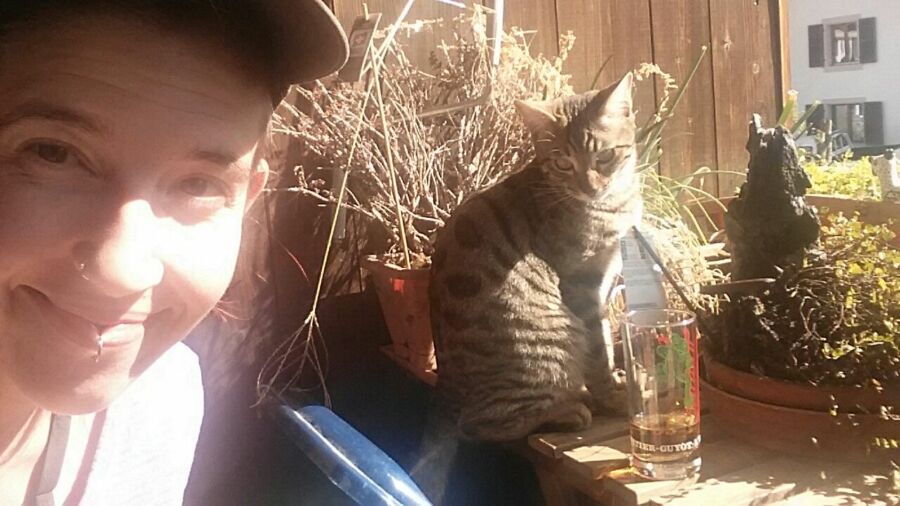
“I also enclose a little pictures of my lovely cat, who is very happy to have me spending more time with him, sitting on one of the jigsaw puzzles that I have been doing a lot of recently.”

In France, Arnaud Servignat posted this musical video playing along with Vivaldi’s “Nisi Dominus — Cum Dederit”:

In Turkey, Lale Sürmen Aran wrote to tell us about the very important national celebration that took place earlier this week and how it was modified because of coronavirus concerns:

“April 23 is both Turkey’s national holiday and Children’s Day. In fact, this year was the 100th anniversary of the Turkish National Assembly. Under normal circumstances, every year, Turkey invites hundreds of children from around the world to celebrate with Turkish children. Children fill up stadiums and celebrate. There are parades and fireworks. This year, instead, we all went out to our balconies, or stood in front of open windows, and sang the national anthem exactly at 21:00. And to make up for the cancelled celebrations, they streamed a concert in which Beethoven’s Ode to Joy, and important Turkish music, were performed in striking locations.”

Lale also wrote that her family had a scary week: Her 12-year-old son began running a fever of over 105 degrees. He was taken to the hospital, where hazmat-suited medical staff gave him tests for various diseases — including COVID-19 (all covered by the national healthcare system). Fortunately, he tested negative and is feeling better now. Lale notes that one big challenge was isolating him at home while they waited for results: “In Istanbul, isolation is not easy in the condominiums that most of us live in.” They were also contacted by members of the Ministry of Health’s “tracking crew” — contact tracers assigned with investigating possible COVID-19 cases.

In Italy, Susanna Perrucchini writes about another big celebration happening this week, which is causing her to re-evaluate an old holiday through new eyes:

“This Saturday, April 25th, is Italy’s Liberation Day — in fact, it’s the 75th anniversary of the liberation from Nazi occupation and the fascist regime. This year, that holiday is taking on a new importance. Today we are fighting a virus that is already decimating many of our older people — including those who were born before or during World War II. With them, we are losing parents, grandparents, dear loved ones, and our legacy…our link to a recent past.

“Only one year ago, many Italians would have celebrated this holiday by taking a few extra days off work to fare il ponte — ‘make a bridge’ between the April 25 and May 1 holidays. Many of us would have had a picnic or a day trip to the countryside or the sea. But instead we are all at home, feeling a sense of impotence and great tragedy. We are just starting to realize how our lives have been turned upside-down…just like that, almost in the blink of an eye.

“Because of the ‘Eternal Lockdown,’ our celebrations will be virtual, starting at 11:00 with the National Anthem (for details, see www.25aprile2020.it). Reading about the celebrations, these words struck me: ‘On April 25, liberty is reborn. This year, on the 75th anniversary of the Liberation, we need, more than ever, to celebrate our freedom, to look at the future with hope and courage.’

“I don’t see these words as easy rhetoric. I see them, maybe for the first time in my life, with a strong need to go back to our deep roots and values. As Italians, we have never been very patriotic. Italy started World War II allied with Hitler and finished on the other side, with the winners — quite an achievement! We always felt a bit silly declaring our love and pride for our country. We believed that criticizing and blaming others (politicians, local authorities, public servants, you name it) was the only way to face our deep frustrations and anger for being born in a country that’s so beautiful and yet so inefficient and corrupt.

“But I decided that today I want to be optimistic, because we need that now more than ever. This epidemic may give us all a chance for personal growth, and maybe for a new global awareness of our true needs as human beings. I never longed so much for a walk in a park, with trees and flowers and fresh air. Being confined in my flat, I feel I am losing my inner balance — and being close to the sea, countryside, or nature is the best medicine.

“I looked at those black-and-white pictures of April 25th, 1945, and I saw cheering crowds in the streets of Italy: men and women hugging, kissing, and dancing with wide smiles on their faces. War was over, and so was death, hunger, and misery. They needed to believe they were facing the dawn of a new, bright era with no starvation and violence.

“Those images will help me remember that losing hope is the worst we can all do. Seventy-five years ago, from the ruins, rubble, and debris of the past, they started to build — stone by stone, brick by brick — a new country. Endurance and resilience are needed. And we can look at our recent past to find them in our people.”

And finally, from Naples, Alfredo Cafasso Vitale offers this essay, which he calls “Pane e Camorra” (loosely translated as “Bread and the local Mafia family”):

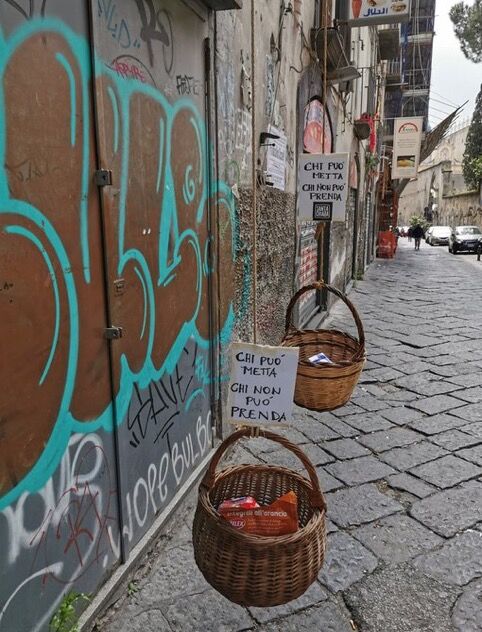
The baskets shown in the picture below — called panaro solidale, ‘supportive basket’ — have been posted, tweeted, shared, and printed all over the world. Stars like Madonna have chosen to share these images, to highlight to their followers how good-hearted and creative the Italians can be in moments of need. This spontaneous initiative by two locals, living along the Spaccanapoli, is however, only one of many in Naples, and its people have initiated to fight the increasing poverty and distress occurring to families during the COVID-19 lockdown.

“The sign reading Chi può metta, chi non può prenda (‘If you can, put in something; if you need, take something out’) is a wonderful motto created by a doctor, Giuseppe Moscati (sainted by Pope John Paul II in 1987), who used to cure poor Neapolitans for free in the early 1900s. In these days of COVID-19, when doctors and health-care personnel are on the front line of the fight against this deadly virus, the motto resonates perfectly.

“Apart from the obvious humanitarian response to assist those in desperate need, there is another underlying need for these initiatives: to counter the efforts of the Camorra, the Neapolitan mafia, which is trying to take advantage of people’s distress.

“In the words of judge Catello Maresca, who coordinated the capture of the Camorra boss Michele Zagaria in 2011 and today is heading one of the food distribution initiatives: ‘They pretend to be your friend, lending money to people in need, or buying them food or other primary needs. But tomorrow, once the emergency over, they will hand them a heavy bill. When they will ask a housewife or a retired person to hide drugs in their homes, who will be able to refuse?’

“Some might have heard of the caffè sospeso (‘spended coffee’), which is a unique Neapolitan feature.  A customer in a bar will take a coffee, but will sometimes pay for two. This coffee ‘credit’ can then be passed on to someone who cannot afford to pay for one. The COVID-19 version of this feature is now spesa sospesa — ‘suspended shopping.’ When shopping in a neighborhood grocery, butcher or bakery, one can pay for something to leave for people in need, on the same principle as the coffee.

“The familiar hum and whine of scooters is an integral part of the noise of life in the central historic neighborhoods as anything else. Silenced at the beginning of the lockdown, these scooters have now found another function: distributing food boxes, prepared both from the municipalities and from associations (like the evangelical Tabita Onlus). The Red Cross has also distributed more than three thousand food boxes during these lockdown weeks.

“Other initiatives involving citizens, municipalities, the Catholic Church, and NGOs include food vouchers, tables outside buildings collecting food, distribution of free books, and all kinds of other services offered to the those in need, in a network of solidarity unseen  in the last decades of globalized economy.

“Napoli has a unique mixture of social, economic, and cultural classes, all sharing the same spaces, which are mainly, but not exclusively in the historic center of the city — neighborhoods like Quartieri Spagnoli, Vergini, Sanità, and Pallonetto a Santa Lucia.

“The ground floors of the (ancient) buildings, called palazzi, are made up of bassi, the one-room, ground floor apartments where the poorest inhabitants live. The higher floors house the more spacious apartments of the signori, the much wealthier citizens live. These two diverse groups of people continue to share the same building in an everyday dynamic unknown in any other city in the world.

“The streets of the Quartieri used to be the domain of the scugnizzi, the poor and aggressive yet sweet-hearted street kids, who are part of the iconography of Neapolitan art and cinema.

“Today, a more varied population — made up of Neapolitans and immigrants from African, Asian, and Eastern European countries — shares life in the bassi, and today’s signori are mostly Neapolitan intellectuals and young professionals that find here beautiful, historic apartments, often with breathtaking views, at reasonable prices.

“The people of the bassi and the signori share more than just housing. They share, in fact, everyday life, with the same open-air markets, and the difficulties of living in a city where often legal and illegal practices live side by side.

“Naples is indubitably a complex and contradictory city, and, as a result, it has generated a series of misconceptions: It is not easy to distinguish the traits of the Neapolitan identity from the stereotypes, and it is difficult for non-Neapolitans to fully grasp the delicate balance between legality and what here is called arte di arrangiarsi — ‘the art of making do’ — that often collides with the Camorra and for sure with a parallel, untaxed economical system.”

It’s clear that each country and region — and each individual — is dealing with their own challenges during this time. And yet, it’s also clear that we are all in this together.

Daily Dose of Europe: Naples — Bella Chaos 

European travel is a sensory experience…especially Italy, and especially Naples. And in these sensory-deprived times, I find myself thinking back on happy memories in one of Italy’s most vivid, most intense, and most sensory cities.

Even if we’ve had to postpone trips to Europe, I believe a daily dose of travel dreaming can actually be good medicine. Here’s another one of my favorite travel memories — a reminder of what’s waiting for you in Europe at the other end of this crisis.

Strolling through Naples, I remember my first visit to the city as a wide-eyed 18-year-old. My travel buddy and I had stepped off the train into vast Piazza Garibaldi. A man in a white surgeon’s gown approached me and said, “Please, it is very important. We need blood for a dying baby.” Naples was offering a dose of reality we weren’t expecting on our Italian vacation. We immediately made a U-turn, stepped back into the station, and made a beeline for Greece.

While that delayed my first visit by several years, I’ve been back to Naples many times since. And today, even with its new affluence and stress on law and order, the city remains appalling and captivating at the same time. It’s Italy’s third-largest city, as well as its most polluted and crime-ridden. But this tangled urban mess still somehow manages to breathe, laugh, and sing with a joyful Italian accent. Naples offers the closest thing to “reality travel” in Western Europe: churning, fertile, and exuberant.

With more than two million people, Naples has almost no open spaces or parks, which makes its ranking as Europe’s most densely populated city plenty evident. Watching the police try to enforce traffic sanity is almost comical. But Naples still surprises me with its impressive knack for living, eating, and raising children with good humor and decency. There’s even a name for this love of life on the street: basso living.

In Naples, I spend more time in the local neighborhoods than the palaces and museums. Since ancient Greek times, the old city center has been split down the middle by a long, straight street called Spaccanapoli (“split Naples”). Just beyond it, the Spanish Quarter climbs into the hills. And behind the Archaeological Museum is perhaps the most colorful district of all, Sanità.

Walking through the Spaccanapoli neighborhood, I venture down narrow streets lined with tall apartment buildings, walk in the shade of wet laundry hung out to dry, and slip into time-warp courtyards. Couples artfully make love on Vespas while surrounded by more fights and smiles per cobblestone than anywhere else in Italy. Black-and-white death announcements add to the clutter on the walls of buildings. Widows sell cigarettes from plastic buckets.

I spy a woman overseeing the action from her balcony on the fifth floor. I buy two carrots as a gift and she lowers her bucket to pick them up. One wave populates six stories of balconies, each filling up with its own waving family. A contagious energy fills the air. I snap a photo and suddenly people in each window and balcony are vying for another. Mothers hold up babies, sisters pose arm in arm, a wild-haired pregnant woman stands on a fruit crate holding her bulging belly, and an old, wrinkled woman fills her paint-starved window frame with a toothy grin.

On a nearby street I run across a small niche in the wall dedicated to Diego Maradona, the fabled soccer star who played for Naples in the 1980s. Locals consider soccer almost a religion, and this guy was practically a deity. This little Chapel of Maradona includes a “hair of Diego” and a teardrop from the city when he went to another team for more money. It’s these little eccentric passions that make exploring Naples such fun.

Around the corner there’s an entire street lined with shops selling tiny components of fantastic manger scenes, including figurines caricaturing politicians and local celebrities — should I want to add a Putin or a Berlusconi to my Nativity set.

The abundance of gold and silver shops here makes me think this is where stolen jewelry ends up. But I’ve learned that’s not quite true. According to locals, thieves quickly sell their goods and the items are melted down immediately. New pieces go on sale as soon as they cool.

Paint a picture with these thoughts: Naples has the most intact ancient Roman street plan anywhere. Imagine life here in the days of Caesar, with street-side shop fronts that close up to become private homes after dark. Today is just one more page in a 2,000-year-old story of city activity: meetings, beatings, and cheatings; kisses, near misses, and little-boy pisses.

The only predictable elements of this Neapolitan mix are the boldness of mopeds — concerned residents will tug on their lower eyelid, warning you to be wary — and the friendliness of shopkeepers.

To cap my walk, I pop into a grocery and ask the man to make me his best ham-and-mozzarella sandwich. I watch, enthralled, as he turns sandwich-making into a show. After demonstrating the freshness of his rolls with a playful squeeze, he assembles the components, laying on a careful pavement of salami, bringing over a fluffy mozzarella ball as if performing a kidney transplant, slicing a tomato with rapid-fire machine precision, and lovingly pitting the olives by hand. He then finishes it off with a celebratory drizzle of the best oil. Six euros and a smile later, I find the perfect bench upon which to enjoy my lunch while watching the Neapolitan parade of life.

An older man with a sloppy slice of pizza joins me. Moments later, a stylish couple on a bike rolls by — she sits on the handlebars, giggling as she faces her man, hands around his neck as he cranes to see where they’re going.

I say, “Bella Italia.”

My bench mate says, “No, bella Napoli.”

I say, “Napoli…is both beautiful and a city of chaos.”

He agrees, but insists, “Bella chaos.”

“Tell me, what is Napoli in one word?” I ask.

Turning his head, he watches a woman stride by. Then, with a long string of mozzarella stretching between his mouth and what remains of his pizza, he chews for a moment, pauses, and says, “Abbondante.”

I agree. “Abundant.”

(This story is excerpted from my upcoming book, For the Love of Europe — collecting 100 of my favorite memories from a lifetime of European travel. It’s coming out in July, and available for pre-order. And you can also watch a video clip related to this story: Just visit  Rick Steves Classroom Europe  and search for “urban Naples.”)


Daily Dose of Europe: Esperanza in Évora

Europe’s remote corners are a delight. And when in Portugal, I love to head to Alentejo, and a fine little town called Évora.

With so many of us stuck at home for the foreseeable future, I believe a daily dose of travel dreaming can actually be good medicine. Here’s another one of my favorite travel memories — a reminder of what’s waiting for you in Europe at the other end of this crisis.

Alentejo is a vast and arid land — the bleak interior of Portugal, where cork seems to be the dominant industry. The rolling hills are covered with stubby cork trees. With their bark peeled away, they remind me of St. Bartolomeo, the martyr who was skinned alive. Like him, these trees suffer in silence.

The people of Alentejo are uniformly short. They seem to look at tourists with suspicion and are the butt of jokes in this corner of Europe. Libanio, my guide, circles the words “arid” and “suspicious” in my guidebook and does his best to turn my chapter into a promo for his dusty and downtrodden region. He says, “Must you say ‘arid’? Actually, in April, it is a lush countryside.” Then he adds, “But I won’t argue with ‘suspicious.’”

Libanio says it is a mark of a people’s character to laugh at themselves. He then tells me of an Alentejo man who nearly succeeded in teaching his burro to live without eating. He was so excited…until his burro died.

Libanio asks me, “How can you tell a worker is done for the day in Alentejo?” I say, “I don’t know.” He says, “When he takes his hands out of his pockets.” My guide continues more philosophically: “In your land, time is money. Here in Alentejo, time is time. We take things slow and enjoy ourselves.”

While this corner of Portugal is humble, there’s a distinct pride here. Every country has its Appalachia. I’m impressed when a region that others are inclined to insult has strong local pride, though I often wonder if it’s genuine pride, or just making the best of the cards they’re dealt.

For Alentejanos, quality and authenticity require the respect of tradition. The finest restaurants simply do not embellish a standard rustic dish. And they love their sweets so much that they seem to know the history of each tart.

Many pastries are called “convent sweets.” Portugal, with its vast empire, once had access to more sugar than any other European country. Even so, sugar was so expensive that only the aristocracy could afford to enjoy it routinely. Historically, many daughters of aristocrats who were unable to marry into suitably noble families ended up in high-class convents. Life there was comfortable, yet carefully controlled. Instead of sex, they could covet cakes and indulge in sweets. Over time, the convents became famous as keepers of wondrous secret recipes for exquisite pastries generally made from sugar and egg yolks (which were leftovers from the whites used to starch their habits). Barrigas de Freiras (Nuns’ Tummies) and Papos de Ango (Angel’s Breasts) are two such fancies.

Évora, the workaday capital of the region, is a fine place to taste the delights of Alentejo — both edible and historic, as well as musical and social.

Évora has barely any buildings over three stories high, but it is crowned by the granite Corinthian columns of a stately yet ruined ancient Roman temple. And just outside of town stand 92 stones three times as old as that, erected to make a Stonehenge-type celestial calendar.

I’m happy to find a romantic little restaurant that offers live fado music three nights a week. Esperanza, the woman who runs the place, explains that she likes the diners to be finished by 10 p.m. so the musicians can perform without waiters wandering around. I am impressed by her commitment to the art.

I sit in the back, enjoying the ambience. It’s been a long day, so during some applause, I sneak back out and head home. When I’m half a block away, Esperanza runs out the door and charges after me. I worry that she’s angry that I left without paying a cover charge, or that the door made too much noise, or that I had insulted the musicians. Like a guilty little boy, I nearly duck down an alley and run away. Then I decide to turn back and face the music.

She apologizes for not welcoming me and begs me to come back for a glass of port and to meet the musicians. The rest of the evening is a plush experience — complete with nuns’ tummies and angel’s breasts. Esperanza — whose name means “hope” — keeps the art of fado singing alive in Évora.

(This story is excerpted from my upcoming book, For the Love of Europe — collecting 100 of my favorite memories from a lifetime of European travel. It’s coming out in July, and available for pre-order.)