Here you can browse through my blog posts prior to February 2022. Currently I'm sharing my travel experiences, candid opinions, and what's on my mind solely on my Facebook page. — Rick

Daily Dose of Europe: Rothenburg’s Night Watchman 

As we starve this virus by staying home, I keep imagining Europe in the Middle Ages as it suffered through repeated plagues. In a town like Germany’s Rothenburg, after dark, when the streets are lonely, you can imagine those “take out your dead” days when up to a third of the population (mostly the poor) died. The first symptom? Usually a sneeze. (That’s when people first started saying “bless you” after an ah-choo.) Thankfully, today’s pandemic is nothing like the Great Plague, and I’m confident that we’ll soon be back on those enchanting streets of towns like Rothenburg after dark. For a sneak preview, join me now in one of my favorite towns in Germany as we follow the “night watchman” on his entertaining rounds at twilight.

Even if we’ve had to postpone trips to Europe, I believe a daily dose of travel dreaming can actually be good medicine. Here’s another one of my favorite travel memories — a reminder of what’s waiting for you in Europe at the other end of this crisis.

The walled town of Rothenburg, midway between Frankfurt and Munich, offers the best look possible at medieval Germany. And in this theme park of a town, the best ride is the night watchman’s town walk. Each night through the tourist season, with his eyebrows frozen in a raised position, the night watchman listens to the clock tower clang nine times. Then he winks, picks up his hellebarde (long-poled axe), and lights his lantern. Welcoming the English-speaking group gathered in 15th-century Rothenburg, he looks believably medieval in his black robe, long curly hair, and scraggly beard. But the twinkle in his eyes admits, “I’m one of you.”

With an insider’s grin he begins: “It was a bad job, being medieval Rothenburg’s night watchman — low esteem, low pay, dangerous work. Only two jobs were lower: the grave digger and the executioner. Yes, this was a dangerous job. All the good people were off the streets early. He would sing the ‘all’s well’ tune at the top of the hour through the night. You didn’t want to hear the night watchman at three in the morning, but you were glad he was still alive.

“These days, the job’s more respectable: People take photos of me,” he continues. “And it’s no longer dangerous, because you’re all coming with me.” The night watchman’s camera-toting flock of 30 tourists, already charmed, follows his bobbing lantern down the narrow, cobbled lane.

Stopping under a sign announcing Kriminal Museum, we watch the rusted old dunking cage swing in the breeze. The night watchman walks over to the stocks that stand empty next to the museum door and says, “If you know what’s good for you, tomorrow you’ll visit our Kriminal Museum.”

He opens the top half of the stocks then slams it shut, saying, “A naughty boy might be put in the stocks. We rub salt on his soles and bring the goats. But inside, you’ll learn about more gruesome tools of torture and more embarrassing tools of humiliation.”

Pausing to survey the group, he adds, “Like a metal gag for nags.”

He scans the group again. His eyes stop on me and he asks, “Are you from Rothenburg?”

“Nein,” I say.

“Very good,” he says. “Please come here.”

As I move to the front he continues. “We were 6,000 here in Rothenburg. In those days, around here, only Nürnburg and Augsburg were bigger. The Kaiser made us a free Imperial City. Such a city was given special privileges. The top privilege: We had our own court of justice. Rothenburg’s citizens must be tried by their own court.”

Shaking his head sadly, he puts his robed arm on my shoulder. “And you are not protected by our court,” he announces. “We get a half day off when there’s a hanging. Do you know anything about Herr Baumann’s missing beehive?”

Again I say, “Nein.”

“You have no rights here, and we could use a half day off. You, my friend, have a problem. Local authorities might just allow a hanging.”

In the good old days, death sentences started with your basic execution and then got worse. The legal concept of “cumulation” meant a criminal’s punishments would multiply with his crimes. While that petty beehive thief might simply be hung, an adulterous beehive-thieving murderer could be dragged to the place of execution with painful stops along the way for pinching with red-hot tongs. If he were guilty of more crimes, he’d be tied to stakes over timbers so a big guy could bounce a wagon wheel on his arms and legs, breaking all his bones. Thoroughly “broken by the wheel,” he would then be woven through the spokes of that wheel and hoisted high for all to see. Finally, his hanging could be fast or slow. It depended on the verdict.

Sometimes even death wasn’t harsh enough. In cases when two capital offenses were committed, a criminal’s corpse would be “quartered” by four horses heading out in different directions.

A town’s gallows, a medieval symbol of justice, was placed high for more spectacle. The most important criminals were hung on higher platforms in anticipation of greater crowds. Bodies of particularly dishonorable criminals were left out to rot. Some were left in a cage so birds could get to their bodies…but relatives couldn’t.

Looking at me again, the night watchman says thoughtfully, “So, you’re not from Rothenburg.” Then, turning abruptly, he walks down the street. Mesmerized, we follow.

He stops under an old-fashioned streetlight and says, “It was a dirty time.” Pointing with his boot to a gutter in the cobbles, he continues, “All the garbage — from the people and from the animals, too — it went into the road. They had this ditch in the middle of the street. People tried to hit the ditch. This was not a good system. Summer was stinking. The rich left for countryside homes. Back then it wasn’t the Romantic Road. It was the Filthy Road. And this filth gave us the plague. The plague was a big killer. In one terrible year, in Rothenburg…one out of every three people died.”

We follow him farther to the ramparts at the edge of town. Overlooking the valley, the watchman says, “Rothenburg was never conquered until 1631. There was a siege. The armory, which was along this wall, blew up. Double disaster: We had a hole in the wall and no ammunition to make a defense. To be looted by 40,000 mercenaries was no fun. They were Catholics, so it was even worse.

“Our town was broken. And for the rest of the Thirty Years’ War, Rothenburg lay wide open, undefended. We were sacked many times. Between lootings we suffered plagues.”

Popping from an alley back onto the main square, our hooded friend concludes, “From 1648 — when the war and plagues stopped — time stood still in Rothenburg. Centuries of poverty…and nothing changed. Rothenburg’s misfortune put the town into a deep sleep. And that is why you are here today. Now I must sing the ‘all’s well.’”

After finishing his short melody, he blows a long haunting tone on his horn. Then he ends by saying, “You, my friends, should hurry home. Bed is the best place for good people at this hour.”

(This story is excerpted from my upcoming book, For the Love of Europe — collecting 100 of my favorite memories from a lifetime of European travel. It’s coming out in July, and available for pre-order. And you can also watch a video clip related to this story: Just visit  Rick Steves Classroom Europe  and search for Rothenburg.)

Daily Dose of Europe: Mysterious Britain 

On my next trip to Britain, I’ll linger a bit longer at its many mysterious sights.

Even if we’ve had to postpone trips to Europe, I believe a daily dose of travel dreaming can actually be good medicine. Here’s another one of my favorite travel memories — a reminder of what’s waiting for you in Europe at the other end of this crisis.

On my first trip to Dartmoor National Park, back when I was a student, word of the wonders lurking just a bit deeper into the moors tempted me away from my hostel in Gidleigh. I was told of an especially rewarding hike that would lead me to the mysterious Scorhill Stone Circle. Climbing over a hill, surrounded by ominous towers of craggy granite, I was swallowed up by powerful, mystical moorland. Hills followed hills followed hills…green growing gray in the murk.

Where was that 4,000-year-old circle of stone? I wandered in a scrub-brush world of greenery, white rocks, eerie winds, and birds singing unseen. Then the stones appeared. It seemed they had waited for centuries, still and silent, for me to visit.

I sat on a fallen stone and my imagination ran wild, pondering the people who roamed England so long before written history documented their stories. I took out my journal, wanting to capture the moment… the moor, the distant town, the chill, this circle of stones. I dipped my pen into the cry of the birds and wrote.

That experience, 40 years ago, kicked off decades of my fascination with mysterious Britain. Dartmoor, Stonehenge, the Holy Grail, Avalon…there’s an endlessly intriguing side of Britain steeped in lies, legends, and at least a little truth. Haunted ghost walks and Loch Ness Monster stories are profitable tourist gimmicks, but the cultural soil that gave us Beowulf, King Arthur, and Macbeth is fertilized with a murky story that goes back over 5,000 years — older, even, than Egypt’s pyramids. With a little background, even skeptics can appreciate Britain’s historic aura.

There are countless stone circles, forgotten tombs, man-made hills, and figures carved into hillsides whose stories will never be fully understood. Britain is crisscrossed by lines, called ley lines, connecting these ancient sites. Prehistoric tribes may have transported these stones along a network of ley lines, which some think may have functioned together as a cosmic relay or circuit.

Two hours west of London, Glastonbury is located on England’s most powerful ley line. It gurgles with a thought-provoking mix of history and mystery. For the views, hike up the 500-foot-tall Glastonbury Tor (a grassy, conical clay hill capped with an old church tower), and you’ll notice the remains of the labyrinth that made climbing the hill a challenge some 5,000 years ago.

In AD 37, Joseph of Arimathea, Jesus’ wealthy tin-merchant uncle, supposedly brought a vessel containing the blood of Christ to Glastonbury, and with it, Christianity to England. (Joseph’s visit is plausible because back then, merchants from the Levant came here to trade with the local miners.)

While that story is supported by fourth-century writings and accepted by the Church, the King Arthur and Holy Grail legends it inspired are not. Those medieval tales were cooked up when England needed a morale-boosting folk hero to inspire its people during a war with France. They pointed to the ancient Celtic sanctuary at Glastonbury as proof of the greatness of the fifth-century warlord, Arthur. In 1911, his supposed remains, along with those of Queen Guinevere, were dug up here, and Glastonbury was woven into the Arthurian legends. The Camelot couple was reburied in the abbey choir and their gravesite is a kind of shrine today. Many believe the Grail trail ends at the bottom of the Chalice Well, a natural spring at the base of the tor.

In the 16th century, Henry VIII, on a rampage against the power of the monasteries, destroyed Glastonbury Abbey. For emphasis, he hung and quartered the abbot, sending his body on four national tours… at the same time. Two centuries later Glastonbury rebounded. In an 18th-century tourism campaign, thousands signed affidavits stating that water from the Chalice Well healed them, putting Glastonbury on the tourist map.

Today, Glastonbury is a center for searchers. It’s too out there for the mainstream church, but just right for those looking for a place to recharge their crystals. Since the society that built that labyrinth worshipped a mother goddess, the hill, or tor, is seen by many today as a symbol of the Sacred Feminine.

Along with its history, the geology contributes to the mystery of this land. Southern England’s shoreline is lined by famed white chalk cliffs. And that same white chalk is just below a thin layer of topsoil all across the region. Eons ago, all it took was a shovel and a little hard work to peel away the soil and transform rolling hillsides into works of art — or messages.

Travelers to this day are entertained by giant white figures popping out of these grassy green slopes. Many are creations of 18th- and 19th-century Romantics acting out against the coldness of the Industrial Age, but a few of these figures have, as far as history is concerned, always been there. One figure is particularly eye-catching: The Cerne Abbas Giant, armed with a big club and an erection, is hard to ignore. For centuries, people fighting infertility would sleep on Cerne Abbas. As my English friend explained, “Maidens can still be seen leaping over his willy.”

And fixed like posts into that same chalk subsoil are stone circles, more souvenirs of England’s misty, distant past. The most famous stone circle, Stonehenge, is an hour’s drive from Glastonbury. Built in phases between 3000 and 1000 BC with huge stones brought all the way from Wales, it still functions as a remarkably accurate celestial calendar.

A study of more than 300 similar circles in Britain found that each was designed to calculate the movement of the sun, moon, and stars, and even predict eclipses. These prehistoric timekeepers helped early societies know when to plant, when to harvest, and when to party. Even in modern times, when the summer solstice sun sets in just the right slot at Stonehenge, pagans boogie.

Curiously, some of the particular “blue stones” used in Stonehenge were found only in distant Wales. Why didn’t the prehistoric builders use what seem like perfectly adequate stones nearby? Consider those ley lines. Perhaps a particular kind of stone was essential for maximum energy transmission. How might these massive stones have been transported in a pre-industrial age? Various practical explanations have been suggested, but there’s no consensus among experts. Imagine instead congregations gathering here 5,000 years ago, raising thought levels and creating a powerful life force transmitted along the ley lines. Maybe the stones were levitated in Wales and rocketed a hundred miles to this spot. Maybe psychics really do create powerful vibes. Maybe not. It sounds unbelievable, but at one time, so did electricity.

Not far away, the stone circle at Avebury is 16 times the size of Stonehenge and about one-sixteenth as touristy. Visitors are free to wander among 100 stones, ditches, and mounds, and ponder these curious patterns from the past. Near Avebury is the 130-foot-high pyramid-shaped Silbury Hill. More than 4,000 years old, this man-made mound of chalk is a reminder that you’ve only scratched the surface of Britain’s fascinating prehistoric and religious landscape.

More Neolithic wonders lurk in England’s moors. While they inspire exploration, beware: you can get lost in these stark, time-passed commons. Directions are difficult to keep. It’s cold and gloomy, as nature rises like a slow tide against anything human-built. A crumpled castle loses itself in lush overgrowth. A church grows shorter as tall weeds eat at the stone crosses and tilted tombstones. Over the centuries, the moors have changed as little as the longhaired sheep that still seem to gnaw on moss in their sleep.

One of England’s wildest and most remote regions is in the southwest corner of the country. It’s Dartmoor — that wonderland of powerfully quiet rolling hills that inspired me long ago. Near the Cornwall Peninsula in the county of Devon, it’s crossed by only three main roads. Most of this area is either unused or shared by its 34,000 villagers as a common grazing land — a tradition that goes back to feudal days. Ordnance Survey maps show that Dartmoor is peppered with bits of England’s mysterious past, including more Bronze Age stone circles and enigmatic megaliths than any other chunk of England. It’s perfect for those who dream of enjoying their own private Stonehenge without barbed wire, police officers, parking lots, tourists, or port-a-loos.

Returning to Dartmoor on my last trip, I sat peaceful and alone on the same mossy stone I warmed the day I first experienced Scorhill Stone Circle in 1978. I recalled that day, at the age of 23, when I realized how many wonders in Europe were still undiscovered…hidden and unheralded. I remembered how, hiking home that evening, I decided that my calling was to find these places and to share them. That was the day I became a travel writer.

(This story is excerpted from my upcoming book, For the Love of Europe — collecting 100 of my favorite memories from a lifetime of European travel. It’s coming out in July, and available for pre-order. And you can also watch a video clip related to this story: Just visit  Rick Steves Classroom Europe  and search for “mysterious Britain”.)

Daily Dose of Europe: Lago di Como — Where Italians Honeymoon 

When traveling in Italy, I find Lake Como the most relaxing place to take a break. Join me there now on a mental break from self-isolation and coronavirus crisis.

Even if we’ve had to postpone trips to Europe, I believe a daily dose of travel dreaming can actually be good medicine. Here’s another one of my favorite travel memories — a reminder of what’s waiting for you in Europe at the other end of this crisis.

Stretched over two chairs atop the skinny passenger deck of a 10-car ferry as it shuttles across Lago di Como, I look south into the haze of Italy. I’m savoring the best of my favorite country with none of the chaos and intensity that’s generally part of the Italian experience. Looking north, into a crisp alpine breeze, I see snowcapped Alps.

I’m just minutes from Switzerland…but it’s clear I’m in Italy. The ferry workers are Italian, with that annoying yet endearing and playful knack for underachieving. Precision seems limited to the pasta: exactly al dente. Rather than banks and public clocks (which inundate nearby Swiss lake resorts, such as Lugano), the lanes that tumble into this lake come with lazy cafés and hole-in-the-wall shops, brimming with juicy fruits and crunchy greens.

In this romantic Lakes District in the shadow of the Alps, wistful 19th-century villas are seductively overgrown with old vines that seem to ache with stories to tell. Stunted palm trees look as if held against their will in this northern location. And vistas are made to order for poets. In fact, it was Romantic-age nature lovers who wrote and painted here that put this region on the tourism map in the 1800s.

The million-euro question: Which lake to see? Little Orta has an offbeat, less-developed charm. Maggiore has garden islands and Stresa, a popular resort town. Garda is a hit with German windsurfers. But for the best mix of scenery, old aristocratic romance, and wisteria charm, my choice is Como.

Sleepy Lago di Como, just an hour north of Milan by convenient train, is a good place to take a break from the obligatory turnstile culture of Italy. It seems half the travelers I meet have tossed their itineraries into the lake and are actually relaxing.

Today, the hazy lazy lake’s only serious industry is tourism. Many lakeside residents travel daily to nearby Lugano, in Switzerland, to find work. The area’s isolation and flat economy have left it pretty much the way those 19th-century Romantics painted it.

The self-proclaimed “Pearl of the Lake,” Bellagio is the leading Lago di Como resort, a classy combination of prim tidiness and Old World elegance. If you don’t mind feeling like a “tramp in the palace,” it’s a fine place to surround yourself with the more adventurous of the posh travelers. Arcades facing the lake are lined with shops. The heavy curtains hanging between the arches keep VIP visitors and their poodles from sweating. While the fancy ties and jewelry sell best at lake level, the locals shop up the hill.

Lago di Como is famous among Italians for its shape: like a stick figure of a man with two legs striding out. Bellagio is located where the two legs come together (which makes it the subject of funny, if crude, local rhymes you can learn when you visit). I wander from the town right on out to the crotch, following the view of the lake. At Punta Spartivento (literally “the point that divides the wind”), I find a Renoir atmosphere, perfect for a picnic while gazing north and contemplating the place where Italy is welded to the Swiss Alps.

I head to the town of Varenna (another 10-minute hop on the ferry), which is my home base. Narrow stepped lanes climb almost invisibly from the harbor to the ancient arterial road that runs parallel to the lake along the top of town. Varenna packs its 800 residents into a compact townscape — tight as 50 oysters overloading a too-small rock. Individual homes are defined only by their pastel colors.

With Varenna’s dwellings crowding the lake, the delightful passerella (boardwalk) arcs from the ferry dock to the tiny harbor past private villas guarded by wrought iron and wisteria. Two centuries ago, the harborfront was busy with coopers expertly fitting their chestnut and oak staves into barrels, stoneworkers carving and shipping prized black marble, and characteristic wooden boats heading out to catch the lake’s unique missoltino — freshwater “sardines” still proudly served by local chefs. Today, the harbor’s commerce is little more than the rental of paddleboats and a gelateria run by a guy named Eros.

Other than watch the ferries come and go, there’s wonderfully little to do in Varenna. At night, it whispers luna di miele — honeymoon. And strolling its passerella, passing by those wisteria-drenched villas where caryatid lovers are pressed silently against each other, I’m reminded of the importance of choosing the right travel partner.

(This story is excerpted from my upcoming book, For the Love of Europe — collecting 100 of my favorite memories from a lifetime of European travel. It’s coming out in July, and available for pre-order. And you can also watch a video clip related to this story: Just visit  Rick Steves Classroom Europe  and search for “Lake Como”.)

Daily Dose of Europe: Poland’s Historic, Captivating Kraków 

We had big plans for Poland in 2020: Filming two TV shows there this summer, and launching our inaugural Poland tour this fall. While both projects may have to wait (we’re still deciding), I’ve got Poland on the brain.

Even if we’ve had to postpone trips to Europe, I believe a daily dose of travel dreaming can actually be good medicine. Here’s another one of my favorite travel memories — a reminder of what’s waiting for you in Europe at the other end of this crisis.

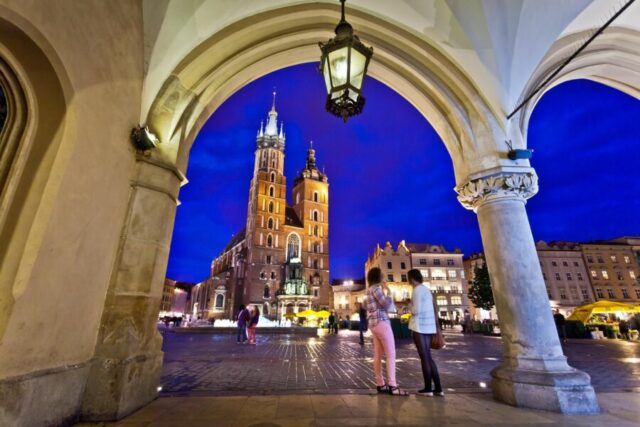
My first impression of Kraków is that it feels like it must have been really important a long time ago. In fact, it was Poland’s capital from the 11th through the 16th century. Within its medieval walls, I wander the Old Town, which converges on the Main Market Square, lined with cafés and gorgeous architecture.

Vast as it is, the square has a folksy intimacy. It bustles with street musicians, cotton-candy vendors, and the lusty coos of pigeons. A folk band, swaggering in colorful peasant costumes, gives me a private concert. Feeling flush — not unusual with the low prices in Poland — I tip them royally. Perhaps too royally. That big tip gets me “The Star-Spangled Banner.”

Moments after the band moves on, I hear a bugle call. Glancing around, I pan up to see a trumpet poking out of the tallest tower of the hulking, red-brick St. Mary’s Church. Just as I spot the sun glinting off the trumpet’s bell, the song stops abruptly and the crowd below applauds appreciatively. I learn that this tune, which is performed every hour on the hour, comes with a legend. During the 1241 Tatar invasion, a watchman saw the enemy approaching and sounded the alarm. Before he could finish, an arrow pierced his throat — which is why even today, the music stops, a bloody subito, partway through.

This is just one example of Kraków’s long history. With the city’s power waning, the capital was moved to more centrally located Warsaw in the late 1500s. In the 1800s, Poland was partitioned by neighboring powers. Warsaw ended up as a satellite of oppressive Moscow, the capital of imperial Russia, while Kraków became a poor provincial backwater of Vienna. Austria’s comparatively liberal climate helped Kraków become a haven for intellectuals and progressives — including a young Russian revolutionary named Vladimir Lenin.

Kraków emerged from World War II virtually unscathed. But when the communists took over, they decided to give intellectual — and therefore potentially dissident — Kraków an injection of good Soviet values in the form of heavy industry. They built Nowa Huta, an enormous steelworks on the city’s outskirts, dooming it to decades of smog.

I’m thankful that Kraków is now much cleaner — and freer — than it was a generation ago. But I’m also thankful that one charming souvenir of communist times does survive: the milk bar (bar mleczny). And that’s my next stop. The communist government subsidized the food at these cafeterias to provide working-class Poles with an affordable meal out. The tradition continues today, as capitalist Poland still subsidizes milk-bar meals. I head to the counter, point to what I want, and get a quick, hearty, and very cheap meal. The soup is just a dollar. I’m happy to discover that while communist-era fare was gristle and gruel, today’s milk-bar cuisine — while still extremely cheap — is much tastier.

Needing something with a little more kick, I wander into Staropolskie Trunki (“Old Polish Drinks”), a friendly little place with a long bar and countless local vodkas and liquors — each one open and ready to be sampled. For $5, I get a complete vodka education from a cheery bartender who talks me through five different tastes.

After my private vodka tour, which makes me uncharacteristically giddy so early in the day, I continue walking and end up on Wawel Hill, considered sacred ground as a symbol of Polish royalty and independence. I step into Wawel Cathedral, a stony jungle of memorials that houses the tombs of the country’s greatest rulers and historic figures. (While I keep thinking “this is like the Westminster Abbey of Poland,” I’m also struck by the ethnocentricity of my Western orientation. I recognize lots of names on the tombs in England and almost none here in Poland.)

Beyond Wawel Hill, I eventually wander into Kazimierz, the city’s historic Jewish Quarter. At one time, most of Europe’s Jews lived in Poland. Kraków was their social and political base. This is where the big events of World War II intersected with ordinary, everyday lives. Businessman Oskar Schindler ran his factory here, saving the lives of more than a thousand of his Jewish workers. Now his building houses an excellent museum that tells the story of Schindler’s list and the painful era of Nazi occupation.

While most travelers come to see Kazimierz’s historic museums and synagogues during the day, I stay long enough to see how the neighborhood changes after the sun sets. Throngs of young clubgoers and an ever-changing array of bohemian-chic food trucks and restaurants bring the streets to life after dark.

Reflecting on my day, I think of the ten million Americans who trace their roots to Poland. Those who visit their ancestral homeland must feel at home right away. But today, I realized that you don’t have to be Polish to fall in love with Kraków.

(This story is excerpted from my upcoming book, For the Love of Europe — collecting 100 of my favorite memories from a lifetime of European travel. It’s coming out in July, and available for pre-order. And you can also watch a video clip related to this story: Just visit  Rick Steves Classroom Europe  and search for “historic Poland”.)

Daily Dose of Europe: In Search of Edelweiss 

When this pandemic is all over, I can’t wait to get back to Europe. And the first hike I’d like to take is high above the Lauterbrunnen Valley, in Switzerland, with my friend Olle. I’ve been thinking back on one of my favorite such hikes.

Even if we’ve had to postpone trips to Europe, I believe a daily dose of travel dreaming can actually be good medicine. Here’s another one of my favorite travel memories — a reminder of what’s waiting for you in Europe at the other end of this crisis.

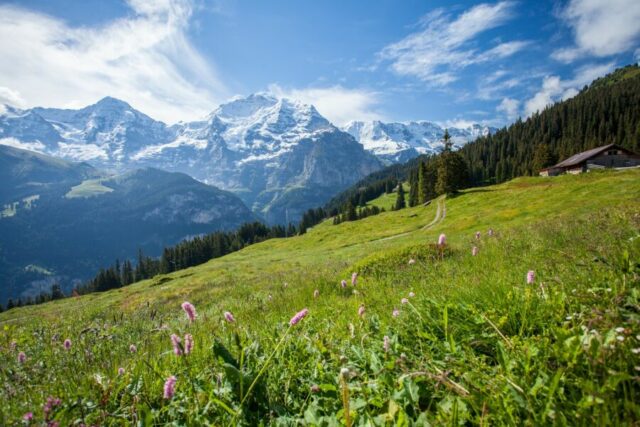
It’s a glorious Swiss Alps morning. I’m spending my day walking with my schoolteacher friend, Olle, exploring the alpine landscape surrounding his home in Gimmelwald. Before we’re too far along, I realize I’m getting a blister.

Opening his rucksack on a rock, Olle asks me to take off my shoe and sock. Muttering that he can’t believe how tourists tackle these mountains without good hiking boots, he fits some moleskin around my tender toe. As Olle works, I lie back on the rugged tufts of grass growing through the pebbly shale.

We continue on, following a faint path along the ridge. I stop every few steps to enjoy vast views of the Schilthorn on our left and the Jungfrau on our right. Olle takes on his teacher’s voice: “We respect nature more than the tourists do. When there’s an avalanche warning, we take the gondola down. Tourists continue sledding. There are many accidents. In Lauterbrunnen, maps show red flags for places of mountain injuries and black ones for deaths.” Pointing to the towering rock cliff of the mountain over the valley directly ahead of us, he says, “The Eiger is solid black.”

As I squint up at a wasp-like helicopter, Olle answers my question before I ask it. “Those are mostly sightseeing trips. But even sightseeing trips are related to mountain rescue. As they show a tourist around, they are practicing for emergency rescues.”

“Are there really dead climbers hanging from ropes on the Eiger?” I ask.

“Yes,” says Olle. “It’s sad when bodies are finally recovered. They look like they did when we saw them last, except with a very light beard. You can tell from the beard how long they lived. The family has to identify them.”

The weather can turn at any time. Just last month, a storm hit fast. Within a few minutes, five people died: three mountaineers on the Eiger, one on the Mönch, and one in the air — a paraglider.

I tell Olle of a harrowing experience I had back in my youth-hostel days. We’d hike up the Schilthorn from the hostel with a plastic bag, sit on the bag, and slide down the glacier — breathtaking fun. As a reckless young tour guide, I’d lead my groups down the mountain in the same way.

One day, late in the season, sliding on an icy but smaller-than-usual sliding field, I started going out of control. Hurtling directly toward the rocky edge, I didn’t know what to do, but I did know I had to do something. After almost too much time to consider my options, I dug my hands like brakes into the rocky ice. Going through several degrees of burn in a matter of seconds, I ground to a halt with blackened, blistered, and bleeding hands — and a bloody butt.

My group heralded me as a hero. But in the doctor’s office in Mürren, I was scolded as a fool, the whipping boy for all the stupid tourists who disrespect the power of the mountain. The doctor didn’t even bother to clean my hands. He lectured me, sprayed something on my wounds, and bandaged me. I left knowing that the little bits of Schilthorn embedded in my palms would come out only in the pus of a later infection.

Olle nods, as if in support of the doctor, and says, “This happens many times.”

He tells me that even cows become victims of the mountains, occasionally wandering off cliffs. Alpine farmers expect to lose some of their cows in “hiking accidents.” These days, cows are double the weight of cows a hundred years ago and no less stupid. If one wanders off a cliff in search of greener grass, the others follow. Farmers tell their sons about the time at the high Alp above Gimmelwald when a dozen cows performed this stunt…and died like lemmings. Helicopters recover the dead cows, flying them out, but because the meat must be drained of blood immediately for human consumption, it’s wasted. It’s meat fit only for dogs.

As we continue our walk, a pastel carpet of flowers trims the scene: golden clover, milk kraut, bellflowers, daisies. “For me, it’s like meeting old friends when the flowers come out again in the spring,” Olle says. All but abandoning me for the flowers, he rummages through his rucksack and pulls out a weathered handbook describing the local flora. “My bible,” he says. “When the cows eat this grass with all these flowers…it is a good mix for the milk.”

“Okay, Rick, you will now risk your life for a flower.” He leaves the trail and creeps over an edge and out of sight to find an edelweiss. Loose rocks, huge drop, no helicopter in sight…I don’t really care about finding edelweiss.

Then I hear Olle holler, “Yes, I found some! Come around.”

Feeling fat and clumsy, I leave the trail. Pulling gingerly at weed handholds, I work my way around a huge rock and across a field of loose shale. Olle comes into view, looking younger than he did a moment ago. “There are three edelweiss here. But this is a secret for only you and me. This spot must not go in your guidebook.” At this point I am not concerned about my guidebook, only my survival. Olle grabs my hand with hands that have grown strong and tough after 14 years of high-altitude village life.

As if to pump up the drama, he whispers, “For me, it would not be a hike without a little danger.”

“That’s why your school is so small,” I whisper under my breath.

“Edelweiss. It means ‘noble white.’ In the valley, it’s noble gray. Only at high elevations do they get this white. UV rays give all flowers brighter colors at this altitude.” Creeping with me to the ledge, Olle gently bends three precious edelweiss toward the sun. Pinching off a petal, he assures me, “This will not affect reproduction.”

Petting a petal gently, I note that it feels like felt.

“Yes, like felt,” Olle agrees. “This protects the plants from dehydration. I collect and press flowers but have never pressed an edelweiss. Edelweiss has been picked nearly to extinction.”

As we struggle back to the trail, Olle talks on. “Here in Switzerland we are getting serious about our environment. Twenty years ago, our rivers and lakes were very polluted. Today you can nearly drink out of Lake Thun. Now we understand. You don’t pee in your living room, do you?”

I assure him that I do not.

Finally reaching the safety of the trail, we walk more quickly, with ease. “Do farmers mind if we walk through their property?” I ask.

“This is a human right — to walk through the land,” Olle says. His environmental passion crescendos with his voice. “When I was in Boston, I asked, ‘How can I get to the lake?’ They told me, ‘You can’t, it is private.’ That is for me perverse. This is unthinkable here in Switzerland. We are guests of this Earth.” Like welcome guests, we make ourselves at home, stopping at a peak that stands dramatically high above Gimmelwald. Olle shares a snack as we sit quietly to savor our perch.

Switchbacking steeply back down, we pass through a thick forest and step out at the top end of Gimmelwald. We’re cheered on by a fragrant finale…a field vibrant with flowers, grasshoppers, bees, crickets, moths, and butterflies.

Olle says, “This year farmers obeyed tradition and not their eyes. They waited too long and had to take cows directly to the high Alps. They skipped this lower field. For these flowers, it is a fine year — no hungry cows.”

Switzerland embraces its traditions with such gusto that locals like Olle fear visitors think it’s an underdeveloped nation. It’s certainly not. And the good news: The traditional alpine culture survives most heartily — like edelweiss — in its most remote corners.

(This story is excerpted from my upcoming book, For the Love of Europe — collecting 100 of my favorite memories from a lifetime of European travel. It’s coming out in July, and available for pre-order.)