Here you can browse through my blog posts prior to February 2022. Currently I'm sharing my travel experiences, candid opinions, and what's on my mind solely on my Facebook page. — Rick

Athens — Great Food, Big Economic Questions, and Hair on Fire

Every year it seems I go to places partly because naive and gullible Americans, whose worldview is fed by a diet of hysterical commercial TV news, are avoiding those places for supposed safety reasons. Of course, Greece has its economic crisis. But that doesn’t mean the 10 million people who live there aren’t living life with creativity and gusto.


boys eating.jpgI love to see students on the road. These two George Washington University students (enjoying a semester abroad) discovered the Karamanlidika by Fanis restaurant just like I did.


drakma.jpgThe big question on people’s minds here: Will Greece stick with the euro or return to the drachma? There’s a monument to Greece’s historic currency next to the mayor’s residence. For Greeks, the problem with being on the euro is that their currency is lashed to Germany, when instead it should have the flexibility to rise and fall in value as needed. Yet locals fear that if they go back to the drachma overnight, the value of their savings will drop by more than half. I wouldn’t want to count on a retirement here, but as a tourist you barely notice any economic crisis.


graffiti hair on fire.jpgAthens is not a pretty city. In fact, in conventional terms, it’s pretty ugly. But for locals, the graffiti is just there. They hardly see it. Given that graffiti is a reality, I do my best to enjoy it rather than ignore it.


street artist.jpgThere’s an unwritten rule among street artists/taggers that if a building is already painted they won’t mess it up. So, many businesses (like this insurance company) actually hire street artists to pre-emptively paint their storefronts.

Athens Yesterday and Today

It’s great traveling in Greece during the shoulder season — the days are lovely and warm (not hot) and the crowds are few. I’m here in historic, bustling Athens, home of the world’s top ancient site: the Acropolis. Athens, like Rome, went from being a major city in ancient times to nearly a ghost town, and then (partly because of its Classical heritage) grew into a major city again with a population of several million.

19th c athens.jpgAs a tour guide, it’s hard to describe Athens at the dawn of the modern age. This 19th-century Romantic etching does it well. Back then, the city was little more than a small town (today’s Plaka) built around its ancient ruins.


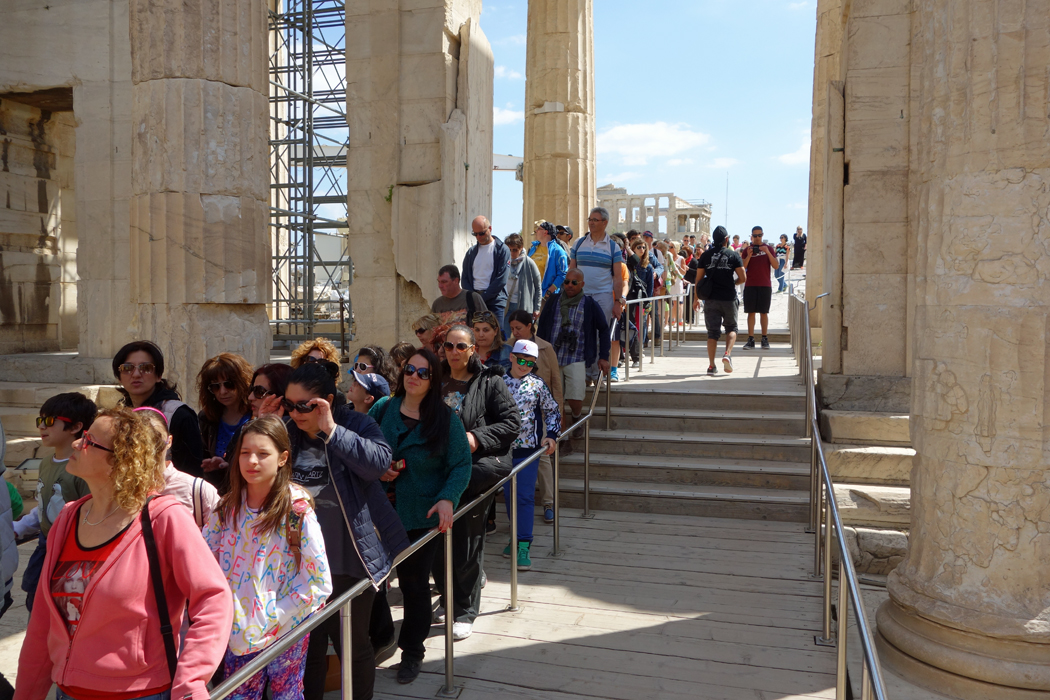
acropolis lines.jpgIn the city of Athens, even with its booming tourist trade, must-see sights, and cruise-ship crowds, there is only one sight where lines are a concern — and that’s the Acropolis. The good news: The Acropolis ticket is a combo-ticket that you can pick up at a number of other sights in town. Buy the ticket elsewhere and then use it to walk straight into the Acropolis. The cruise-ship groups get there first thing, but when I arrived around noon, the cruise-crowd rush hour was heading in the opposite direction.


arcopolis museum.jpgThe Acropolis experience is complete with a visit to the amazing Acropolis Museum. It basically takes all the surviving bits of carved marble (that didn’t end up in London) and sorts them out in a setting that is the size of the Parthenon. You look out the window and see the remains of the actual temple above and then, with great comfort, lighting, and information, you enjoy the art — quasi in situ.


talking to art.jpg Our challenge as travelers is to actually talk with the art.

Dining Discovery in Athens Dishes Up a Positive Vibe

Stepping out of my hotel during my first hour in Athens, I stumbled onto a great restaurant. This video clip illustrates perfectly how Athens is regaining some positive energy. Here’s my guidebook write-up:

Karamanlidika by Fanis, close to the Psyrri neighborhood and near the Central Market, is my favorite in the area. It’s a quality meat and cheese shop that doubles as a restaurant. Delivering authentic Byzantine and Cappadocian tastes, aged cheese, and cured meats, it’s a tasty testament to the many Greek Turks expelled from Turkey in the 1920s who settled in Athens — bringing their Anatolian cuisine with them. With friendly service by Maria and her gang, you’ll enjoy delicious plates for €5-7 (Mon-Sat 12:00-23:00, closed Sun, a block off Athinas at Evripidou 52, tel. 210-325-4184).

Stay tuned for a new and much-improved edition of my Rick Steves Greece guidebook. (Every year we invest literally hundreds of days lovingly researching our guidebooks to ensure that they are the most accurate and up-to-date guides available.)

Monemvasia’s Cliff-Top View Would Make Even Butterflies Nervous

Monemvasia is a Gibraltar-sized rock on the Peloponnesian coast of Greece. It’s connected to the mainland by a narrow causeway, has a town at its base, and the scant remains of a town and mighty fortress across the summit. As the wind howled on top (pardon that buffeting), we walked to the very edge of a cliff next to an old Byzantine church. From there it’s a sheer drop of what seems like a couple thousand feet — and no railing. You know that feeling you get when peering tentatively over a cliff — worried that a freak gust will end your trip? (Or do you? Share your most memorable cliff-top stir-the-butterflies-in-your-belly perch.)

This Greek Welcome Really Packs a Punch

When in Greece, hospitality comes with ouzo. And when in remote corners and hardscrabble villages (like here on the Mani Peninsula), where historically hospitality is a matter of life and death, the welcome drink is tsipouro — a brandy-like firewater that’s about 40 percent alcohol and makes ouzo seem like kid stuff. In this clip, I have a hard time holding the camera steady as I take “going local” with my guides to a very tasty extreme. Gia mas!