Here you can browse through my blog posts prior to February 2022. Currently I'm sharing my travel experiences, candid opinions, and what's on my mind solely on my Facebook page. — Rick

Daily Dose of Europe: Going Dutch…in Holland’s Polder Country

On a recent visit to the Netherlands, my longtime Dutch friends Hans and Marjet drove me through polder country. In these vast fields reclaimed from the sea, cows graze, narrow canals function as fences, and only church spires and windmills interrupt the horizon.
Even if we’ve had to postpone trips to Europe, I believe a daily dose of travel dreaming can actually be good medicine. Here’s another one of my favorite travel memories — a reminder of what’s waiting for you in Europe at the other end of this crisis.

Hans is behind the wheel. He injects personality-plus into all he does, whether running a B&B or guiding Americans around Holland. Bouncy Marjet has a head of wispy strawberry-blonde hair, red tennis shoes, and a talent for assembling a Salvation Army-chic outfit for under $20.

As he drives, Hans talks about how people, including himself, call the entire country “Holland” when Holland actually comprises just two of the 12 provinces that make up the Netherlands. He says, “That’d be like me calling America ‘Texas.’” I bring up that most of America’s cliché images of the Netherlands come from the region properly referred to as Holland.

Looking out at the polder country, I remember that the word “Netherlands” means “lowlands.” This country occupies the low-lying delta near the mouth of three of Europe’s large rivers, including the Rhine. In medieval times, inhabitants built a system of earthen dikes to protect their land from flooding caused by tides and storm surges. The fictional story of the little Dutch boy who saves the country by sticking his finger in a leaking dike summed up the country’s precarious situation. Many Americans know this story from a popular 19th-century novel, but Hans says few Dutch people have ever heard of it. In 1953, severe floods breached the old dikes, killing 1,800 and requiring a major overhaul of the system.

Chatting as we drive, I’m struck by how 10 minutes from Amsterdam, you can be in this wide-open polder land. It’s early summer, and the landscape is streaked with yellow and orange tulip fields.

Hans points out a quaint windmill along a sleepy canal. An old mill like this was used to turn an Archimedes screw in order to pump the polders dry. After diking off large tracts of land below sea level, the Dutch harnessed wind energy to lift the water up and out of the enclosed area, divert it into canals, and drain the land. They cultivated hardy plants that removed salt from the soil, slowly turning marshy estuaries into fertile farmland. The windmills later served a second purpose for farmers by turning stone wheels to grind their grain.

This area, once a merciless sea, is now dotted with tranquil towns. Many of the residents here are actually older than the land they live on, which was reclaimed in the 1960s. The old-time windmills, once the conquerors of the sea, are now relics, decorating the land like medallions on a war vet’s chest. Today, they’ve been replaced with battalions of sleek, modern wind turbines.

Several other Dutch icons came directly from the country’s flat, reclaimed landscape. Wooden shoes (klompen) allowed farmers to walk across soggy fields. They’re also easy to find should they come off in high water because they float. Tulips and other flowers grew well in the sandy soil near dunes.

We head seaward, driving past sprawling flower-mogul mansions, then through desolate dunes. The little road dwindles to a sandy trailhead. Hans parks the car and we hike to a peaceful stretch of North Sea beach. Pointing a stick of driftwood at a huge seagoing tanker, Hans says, “That ship’s going to the big port at Rotterdam. We’re clever at trade. We have to be — we’re a small country.”

The Netherlands welcomes the world’s business, but the country is not designed for big shots. Hans explains, “Being ordinary is being prudent. We Dutch say a plant that grows above the grains gets its head cut off. Even our former queen prefers to do her own shopping.”

While Hans and I talk, Marjet skips ahead of us on the beach, collecting shells with the wide-eyed wonder of a 10-year-old. “Cheap souvenirs,” Hans teases. One cliché the Dutch don’t dispute is their frugality. Hans quizzes me: “Who invented copper wire?”

I know that one. “Two Dutch boys fighting over a penny.”

Hans points up the coast at a huge arc of mud shooting up from a ship. “We’re moving mountains of sand and mud to make our dikes stronger against the sea.” The frugal Dutch are, at heart, pragmatic. They spend their money smartly. In this era of global warming and rising sea levels, the Dutch are spending billions to upgrade their dikes and bulk up their beaches to hold back the sea. All this technological tinkering with nature reminds me of a popular local saying: “God made the Earth, but the Dutch made Holland.” They made it and they’re determined to keep it.

Marjet scuffs through the sand, her pockets full of seashells, her scarf flapping in the wind like a jump rope. Under big, romping white clouds, I think, “Everything’s so…Dutch.”

(This story is excerpted from my upcoming book, For the Love of Europe — collecting 100 of my favorite memories from a lifetime of European travel. It’s coming out in July, and available for pre-order. And you can also watch a video clip related to this story: Just visit  Rick Steves Classroom Europe  and search for polder.)

Daily Dose of Europe: Alsace and Colmar — France and Germany Mix It Up 

Can’t decide between France and Germany for your next trip? Why not do both at once…in Alsace.

Even if we’ve had to postpone trips to Europe, I believe a daily dose of travel dreaming can actually be good medicine. Here’s another one of my favorite travel memories — a reminder of what’s waiting for you in Europe at the other end of this crisis.

Biking down a newly paved but skinny one-lane service road through lush vineyards, I notice how the hills seem to be blanketed in green corduroy.

My Alsatian friend hollers at me, “Germany believes the correct border is the mountains behind us. And we French believe the Rhine — you can almost see it ahead — is the proper border. That’s why Alsace changes sides with each war. That’s why we are a mix of France and Germany.”

I yell back, “And that’s why you are called Jean-Claude Schumacher.”

The French province of Alsace is a region of Hansel-and-Gretel villages, ambitious vineyards, and vibrant cities. It stands like a flower-child referee between France and Germany, bound by the Rhine River on the east and the well-worn Vosges Mountains on the west. It has changed hands between the two countries several times because of its location, natural wealth, and naked vulnerability. Centuries as a political pawn have given Alsace a hybrid culture. Natives (with names like Jacques Schmidt or Dietrich Le Beau) who curse do so bilingually. Half-timbered restaurants serve sauerkraut and escargot.

Jean-Claude and I are exploring Alsace’s Wine Road. This Route du Vin is an asphalt ribbon tying 90 miles of vineyards, villages, and feudal fortresses into an understandably popular tourist package. The dry, sunny climate has produced good wine and happy travels since Roman days.

All along the road, dégustation signs invite us into wine caves. We drop by several. In each case, the vintner serves sips of all seven Alsatian wines from dry to sweet, with educational commentary.

There’s more to Alsace than meets the palate. Centuries of successful wine production built prosperous, colorful villages. Alsatian towns are historic mosaics of gables, fountains, medieval bell towers, ancient ramparts, churches, and cheery old inns.

Colmar, my favorite city in Alsace, offers heavyweight sights in a warm, small-town setting. This well-pickled town of 70,000 sees relatively few American tourists but is popular with the French and Germans.

Historic beauty was usually a poor excuse to be spared the ravages of World War II, but it worked for Colmar. Thankfully, American and British military were careful not to bomb the half-timbered old burghers’ houses, characteristic red- and green-tiled roofs, and cobbled lanes of the most beautiful city in Alsace.

Today, Colmar is alive with colorful buildings, impressive art treasures, and enthralled visitors. Schoolgirls park their rickety horse carriages in front of City Hall, ready to give visitors a clip-clop tour of the old town. Antique shops welcome browsers, and hoteliers hurry down the sleepy streets to pick up fresh croissants in time for breakfast.

By the end of the Middle Ages, the walled town was a bustling trade center filled with the fine homes of wealthy merchants. The wonderfully restored tanners’ quarter is a quiver of tall, narrow, half-timbered buildings. Its confused rooftops struggle erratically to get enough sun to dry their animal skins. Nearby, “La Petite Venise” comes complete with canals and gondola rides.

Colmar combines its abundance of art with a knack for showing it off. The artistic geniuses Grünewald, Schongauer, and Bartholdi all called Colmar home. Frédéric-Auguste Bartholdi, who created our Statue of Liberty a century ago, adorned his hometown with many fine, if smaller, statues. The little Bartholdi Museum offers a good look at the artist’s life and some fun Statue of Liberty trivia.

Four hundred years earlier, Martin Schongauer was the leading local artist. His Madonna in the Rose Garden is sublime. Looking fresh and crisp, it’s set magnificently in a Gothic Dominican church. I sit with a dozen people, silently, as if at a symphony, as Schongauer’s Madonna performs solo on center stage. Lit by 14th-century stained glass, its richness and tenderness cradles me in a Gothic sweetness that no textbook can explain.

The Unterlinden Museum, housed in a 750-year-old convent, holds the highlight of the city — Matthias Grünewald’s gripping Isenheim altarpiece. It’s actually a series of paintings on hinges that pivot like shutters. Designed to help people in a hospital suffer through their horrible skin diseases (long before the age of painkillers), the main panel — the Crucifixion — is one of the most powerful paintings ever. I stand petrified in front of it and let the vivid agony and suffering drag its fingers down my face. Just as I’m ready to sob with those in the painting, I turn to the happy ending: a psychedelic explosion of Resurrection joy. We know very little about Grünewald except that his work has played tetherball with human emotions for 500 years.

A hard-fought land on the conflicted border of Europe’s two leading powers, Alsace is also a powerful example of the high culture, cuisine, and art that results when two great nations mix it up.

(This story is excerpted from my upcoming book, For the Love of Europe — collecting 100 of my favorite memories from a lifetime of European travel. It’s coming out in July, and available for pre-order.)

Daily Dose of Europe: The Italian Love of Eating 

I’m using my quarantine time learning how to cook. One thing is clear: I’m nowhere near as good as the Italians. But I can dream of those “meals of a lifetime” that seem almost routine in Italy.

Even if we’ve had to postpone trips to Europe, I believe a daily dose of travel dreaming can actually be good medicine. Here’s another one of my favorite travel memories — a reminder of what’s waiting for you in Europe at the other end of this crisis.

Spending a month in Italy, the thought of eating anything other than Italian food never occurs to me. Other than France, I doubt there’s another country in Europe that could hold my palate’s interest so completely. One reason I don’t tire of going local here is that this land of a thousand bell towers is also the land of a thousand regional cuisines. And I celebrate each region’s forte.

Tuscany is proud of its beef, so I seek out a place to sink my teeth into a carnivore’s dream. My favorite steakhouse is in Montepulciano. The scene in a stony cellar, under one long, rustic vault, is powered by an open fire in the far back. Flickering in front of the flames is a gurney, upon which lays a hunk of beef the size of a small human corpse. Like a blacksmith in hell, Giulio — a lanky, George Carlin look-alike in a T-shirt — hacks at the beef, lopping off a steak every few minutes. He gets an order and then it’s whop!…leave it to cleaver.

In a kind of mouthwatering tango, he prances past boisterous tables of eaters, holding above the commotion the raw slabs of beef on butcher paper. Giulio presents the slabs to my friends and me, telling us the weight and price and getting our permission to cook it. He then dances back to the inferno and cooks the slabs: seven minutes on one side, seven on the other. There’s no asking how you’d like it done; this is the way it is done. Fifteen minutes later, we get our steaks.

In Italy, the cuisine is revered — and the quality of the ingredients is sacred. Italians like to say, “La miglior cucina comincia dal mercato.” (“The best cuisine starts from the market.”) They care deeply about what’s in season.

One night in Florence, I’m dining with my friend Cincia at her favorite trattoria when the chef comes out to chat with her. They get into an animated debate about the ingredients: “Arugula is not yet in season. But oh, Signora Maria has more sun in her backyard, and her chickens give her a marvelous fertilizer.”

Then the topic changes to the cuisine turmoil caused by erratic weather. Vignarola, the beloved stew consisting of artichokes, peas, and fava beans, is on the menu before its normal season. Cincia, seeming traumatized, says, “Vignarola, how can it be served so early? I’ve never seen it on a menu before Easter.” The chef, who only makes it for a few weeks each spring during a perfect storm of seasonality when everything is bursting with flavor, has to convince her that the season has changed and it’s on the menu because this is the new season.

Enjoying the commotion, I explain to Cincia that this is the kind of restaurant I seek out in Italy. It ticks all the boxes: It’s personality-driven — a mom-and-pop place — and run by people enthusiastic about sharing their love of good cooking. It’s a low-rent location, with lots of locals. The menu is small because they’re selling everything they’re cooking. It’s in one language, Italian, because they cater to locals rather than tourists. And it’s handwritten because it’s shaped by what’s fresh in the market today.

Cincia then takes control, telling me to put away my notepad and stop being a travel writer. She says, “Only a tourist would rush a grappa or pull the fat off the prosciutto. Tonight, we eat with no notes. We eat my way.” Reviewing the options, she says to the chef simply, “Mi faccia felice” (Make me happy).

And he does.

(This story is excerpted from my upcoming book, For the Love of Europe — collecting 100 of my favorite memories from a lifetime of European travel. It’s coming out in July, and available for pre-order. And you can also watch a video clip related to this story: Just visit  Rick Steves Classroom Europe  and search for “Italian farm culture”.)

Daily Dose of Europe: Greece’s Underrated Peloponnese Peninsula 

The Greek Islands are famous and beautiful. But the next time I can make it back to Greece, I’m heading to its heartland, for less glitz, lower prices, and more substantial sightseeing.

Even if we’ve had to postpone trips to Europe, I believe a daily dose of travel dreaming can actually be good medicine. Here’s another one of my favorite travel memories — a reminder of what’s waiting for you in Europe at the other end of this crisis.

At a beachside restaurant, with my chair and table lodged in the sand, I hear a repetitive beat and feel a faint but refreshing spritzing. Looking around for the source, I see a tough young Greek man in a swimsuit the size of a rat’s hammock. He’s tenderizing an octopus by whipping it like a wet rag, over and over, on a big flat rock. That octopus will be featured soon for dinner…someone else’s dinner.

I order moussaka and — to be emphatically Greek — a glass of Greece’s infamous, resin-flavored retsina wine. It makes me want to sling a patch over one eye and say, “Argh!” It’s like drinking wood. A vintner once told me there’s no such thing as a $50 bottle of fine Greek wine. I asked him, “What should I buy if I want to spend $30?” He paused, shrugged, and said, “Three bottles.”

Taking another sip of retsina, I think that, like its wine, the Peloponnese is rough, but with a complex history. I’m pondering where to go next. Hordes of tourists flock to the Greek islands, unaware of the salty pleasures awaiting right here, on this peninsula — without requiring a ferry ride or flight. Stretching southwest from Athens and studded with antiquities, this ancient land offers plenty of fun in the eternal Greek sun, with pleasant fishing villages, sandy beaches, bathtub-warm water, and none of the tourist crowds.

I could go to the charming port town of Nafplio. It’s small, cozy, and strollable, with great pensions, appealing restaurants, a thriving evening scene, and inviting beaches nearby. As the first capital of an independent Greece, it’s historically important, and it’s a handy base for touring the ancient sites at Mycenae and Epidavros.

Nafplio’s harbor is guarded by a castle capping a tall cliff above the city. It’s an old Venetian outpost, built in the days when Venice was the economic ruler of this end of the Mediterranean. On my last visit, I looked down from its highest ramparts, spying distant islands and peering deep into the mountainous interior of the Peloponnese. Looking down at the town, I noticed that the locals weren’t climbing the castle steps; they were drinking tall iced coffees called frappés. Evidently, they had decided that the best-preserved castle of its kind in Greece is well-worth the thousand steps…once.

East of Nafplio, Epidavros has the most magnificent theater from the ancient world. It was built nearly 2,500 years ago to seat 15,000. Today, it’s kept busy with tourists by day and reviving the greatest plays of antiquity at night. The theater’s marvelous acoustics are best enjoyed in near solitude. On my last visit, I sat in the most distant seat as my partner stood on the stage. I could practically hear the retsina rumbling in her stomach.

Just north of Nafplio are the ruins of Mycenae. This was the capital of the Mycenaeans, who won the Trojan War and dominated Greece 1,000 years before its Golden Age. That means that for 3,000 years, people have stood before this stony citadel and gaped at its fabled Lion’s Gate. It was made with stones so huge that it was long believed that no man could have built it. It must have been the work of the Cyclopes — so it was called “Cyclopean architecture.” Nearby, the tholos tomb, built in 1500 BC, stands like a giant stone igloo, with a smooth subterranean dome nearly 50 feet tall and wide. Standing alone under that dome, I realized that the people who built it were as ancient and mysterious to Socrates and Plato as Socrates and Plato are to us.

Another possibility is ancient Olympia. Modern tourists just can’t resist lining up for photos on the original starting block from the first Olympic Games in 776 BC. The games were held as part of a religious festival, but also served a political purpose: to develop a Panhellenic (“cross-Greek”) identity. Every four years, wars between bickering Greeks were halted for a sacred one-month truce, when leading citizens from all corners would assemble to watch the athletes compete. It was a hard-fought competition with strict rules. Drinking animal blood — the Red Bull of the day — was forbidden. Official urine drinkers tested for this ancient equivalent of steroids.

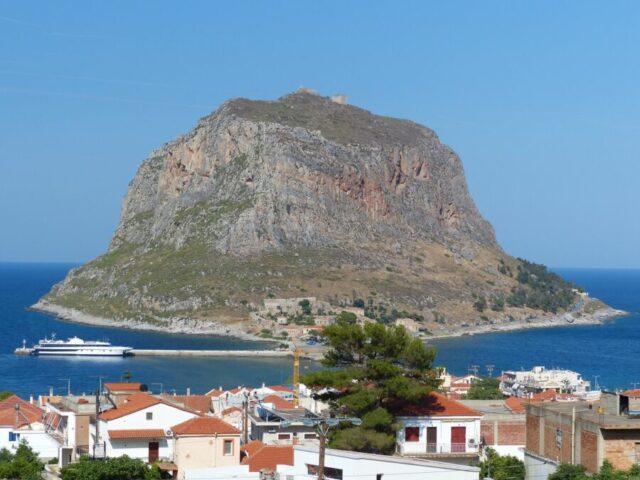
Further on, the Peloponnese boasts impressive remnants of Byzantine rule. Monemvasia, a colossal Gibraltar-like rock jutting up from the sea, has a romantic walled town at its base and ruins sprawling across its summit. In its 14th-century heyday, Monemvasia was one of the great commercial centers of the Byzantine Empire. The walled town is so well-preserved that, until I actually visited, I was convinced an aerial view I saw featured on a postcard was a computer-produced fantasy.

Wiping the salty spray from my glasses, I realize I haven’t made much progress in deciding where to go next. I’m worried: The retsina is starting to taste good. I’m finishing my third glass, entering the danger zone. If I drink any more, I’ll reek of it tomorrow…and never get around to tasting the other charms of the Peloponnese.

(This story is excerpted from my upcoming book, For the Love of Europe — collecting 100 of my favorite memories from a lifetime of European travel. It’s coming out in July, and available for pre-order.)

Coronavirus Reports from Our Guides in Europe — Week 7

On many days, the first thing I read — while I’m still in bed — are emails from our tour guides all across Europe, many in countries more locked down than mine. It’s touching and fascinating to learn what their lives have been like for the last two months. Earlier this week, I sent them all a video message reassuring them that our company is financially strong and determined to weather this storm. Like them, we are eager for this crisis to be over, so we can all get back to guiding our Rick Steves tour groups around Europe. But in the meantime, it’s great to be in touch.

Here’s a recap if this week’s communiques from guides.

Jana Horovska sent these eerie images of empty Prague, including some of the most crowded places in town:

Karlova Street, which we usually make a point to avoid with our tour members because it’s so jammed.

Charles Bridge, normally clogged with visitors.

And the Old Town Square.

In the Netherlands, Ellen Janzing writes:

“This time after Easter is a festive period for us, with our National Holiday, or King’s Day, on 27 April (our King Willem-Alexander’s birthday), plus Memorial Day on May 4 and Liberation Day on May 5 coming up. The commemoration of these have all changed drastically now because of the coronavirus crisis.

“Usually on King’s Day there are car boot sales everywhere, people go out in droves (dressed in orange!), and there are festivals, bands playing, parties, and so on. This year, everyone celebrated at home — together with our king, who was at home, too, and checked in with people online.

“The day began at 10 a.m. with the national anthem being played by the members of the Concertgebouw Orchestra from their homes, with people around the country invited to join in. And they did! (With the notable exception of Amsterdam, the city that traditionally has a love-hate relationship with the monarchy.) Here’s a clip:

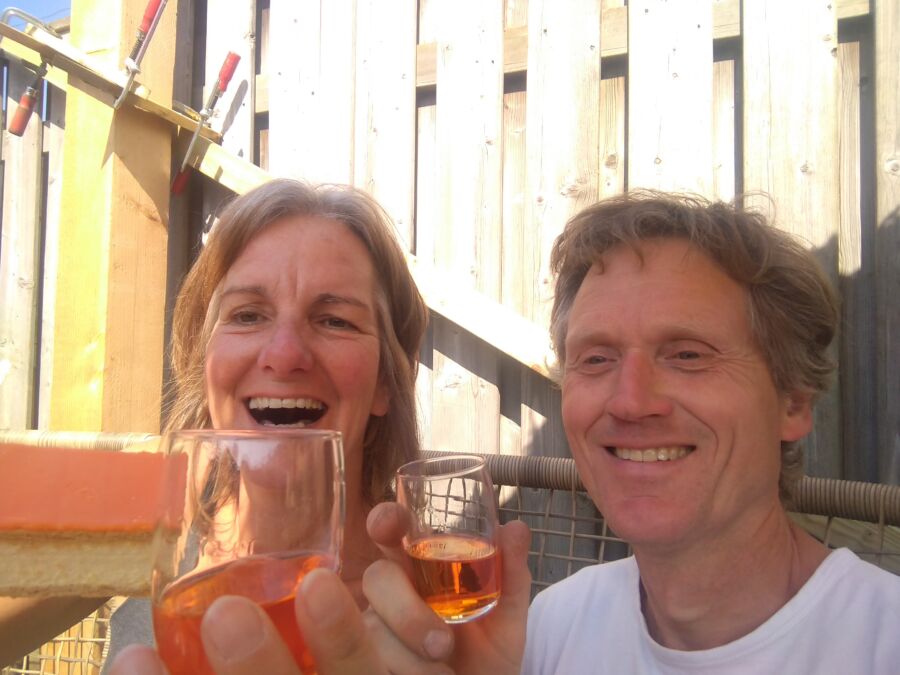
“At 4 p.m., the day was concluded with a toast from the king, and my husband and I joined in from our garden with the traditional, orange drink: Oranjebitter and an orange tompouce cake.

“Here’s the king’s toast:

“In the last week, I also had the chance to go to Amsterdam. I know, we’ve all seen the quiet streets of otherwise buzzing cities, but to me personally it was shocking, memorable, and emotional to see this vibrant city so quiet now. What remains of a city when people have left it? I filmed it for my tour guide colleagues:

“You’ll see Central Station, the Red Light District, Dam Square, a coffeeshop, the Homomonument, and the Anne Frank House. And yes, I talk too much and show too little — I’m no professional vlogger, sorry!”

Stephen McPhilemy — not in Ireland, but in Switzerland — writes:

“I’ve been isolating in the silent, blissful, and safe Swiss Alps for about three months now. My two American friends, Patrick and Cyrus, and I have always daydreamed of buying a little hotel in Switzerland as we love hiking in the Alps each summer. In mid-February, this dream came true. We took over the keys from Mark and Ursula, celebrated, and sat back for a blissful life as Swiss hoteliers in one of the most beautiful spots on earth, the Lauterbrunnen Valley.

“The lads headed back to life in California, and my Brazilian wife, Rubia, joined me, leaving her best friend Vera to watch our three huge Irish wolfhounds at Milltown House in Dingle. The plan was to stay in Lauterbrunnen for a month, get things ready here for the busy summer season, and then return home to Dingle to our wolfhounds…and for me to begin my 20th summer on the road guiding Rick Steves Heart of Ireland tours.

“Oh how our world has changed.

“We are now approaching our third month in the Alps. Summer has arrived, and Switzerland is still in an obedient and disciplined lockdown. Financial support from the Swiss government has been swift and relatively generous. So although, in retrospect, the timing of our hotel purchase was abysmal, we are secure and ready to reopen when it is safe to do so and the Swiss Federal Council gives us the go-ahead.

“My wife and I have become vegetarian, after an initial month of Rösti and bratwurst! Vegetables and herbs grow wonderfully in the strong alpine sun. We are cycling every day along beautiful trails with not a tourist crowd in sight. And I’m learning German! Then the even wilder Swiss German…here’s a clip of my best efforts.

“Our Irish wolfhound pack is being well taken care of in Dingle with poor Veramuza from Brazil — little did she know what she was letting herself in for when she volunteered to dogsit!

“We are safe and happy here in our isolation. I’m dreaming of the day when we tour guides can be ‘on the road again.'”

In Sarajevo, Amir Telibećirović shares the Bosnian perspective on life in self-isolation, with his characteristically dry sense of humor:

“As a very small country, often almost forgotten but socially and culturally vibrant, Bosnia is struggling through the ongoing international crisis. While we are dealing with similar issues as in other European countries, I am finding that people who lived through the siege, war, and/or expulsion in the 1990s are a bit more resilient than younger people. They are handling this collective isolation with more patience.

“In order to avoid the stereotype of ‘do you want the good news or the bad news first?’, let’s make a sandwich of the ‘good’ list divided in two, with ‘bad’ in between.

“Good News, Part 1: According to a 2015 Gallup poll, 96% of all Bosnian citizens wash their hands with soap and water after going to the toilet. That puts Bosnia on the top of European countries. Before this global state of emergency, this number didn’t seem like a big deal. But now many people in Bosnia are reminding ourselves that we have already been following WHO advice to wash hands carefully, for generations, with or without the pandemic.

“Another suggestion on hygiene from the authorities is to take shoes off before entering a home or other indoor space, as a precaution against the virus. That’s another tradition deeply rooted in Bosnia.

“While people around the world have been buying enormous amounts of toilet paper, that’s been done at a lesser scale in Bosnia. At first, Bosnians did some stocking up out of fear of shortages, but soon we remembered our own hygienic tradition. It’s simple: Water is more important, more significant, and more effective than toilet paper. Water and soap first, and then paper, but not paper alone.

“Bad News: The economy, which was already in bad shape even before this crisis, is about to collapse. A lot of people are losing their jobs. The ongoing political crisis is more visible, especially with corruption on a local level.

“Also, the governments of neighboring countries — Croatia, Serbia, and Montenegro — are taking advantage of the crisis to Bosnia’s detriment. They are sending illegal immigrants across the border into Bosnia, and Croatia has announced plans to dump nuclear waste on the Bosnian border, with many Bosnians living just downriver.

“Good News, Part 2: Ordinary people are closer to each other, helping their neighbors. Young volunteers are self-organizing to help older and disabled people who can’t go out for their supplies. People are spending more time with their relatives. And people are turning more to agriculture, in order to rely on their own production, like their ancestors.

“We’re greeting each other in a similar way to what Native Americans used to do: with an elbow and a small bow for respect. There is more humbleness now in greetings — more modesty, less formalism. It looks odd at first, but traditions are there to be changed, to evolve into new traditions, to be adjusted. The rest is history, as long as people respect each other.”

And in London, Jeanie Carmichael takes a “stiff upper lip” approach to finding things to be positive about through this crisis:

“Even though the news seems increasingly grim from all around the globe, I have been playing on repeat Ian Drury and the Blockheads’ fantastic 1970s song ‘Reasons to Be Cheerful’:

“And there are, in fact, many of them to be found — first and best the incredible Captain Tom Moore, who decided to celebrate his 100th birthday by walking 100 laps of his garden, to raise funds for our wonderful National Health Service. He had hoped to raise £1,000 at best — his inspiring story went viral, and so far he has raised over £30 million! He has also recorded a song with Michael Ball and the NHS Choir which has gone to number 1 in the charts (our oldest chart-topper ever) and on his actual birthday, April 30, the Royal Air Force did a fly-past over his home, as a thank-you to this gallant and inspirational gentleman.

“Every Thursday at 8 p.m., we have ‘Thankful Thursday’ and we hang out of our windows, clap, cheer, and bang saucepans to thank the NHS — this week it was for him, too.

“Other inspiring elderly folk from Britain, the Rolling Stones, have released the brand-new single ‘Living in a Ghost Town,’ which is great stuff and good for dancing around the kitchen:

“Our museums and art galleries have wonderful online tours to enjoy — and how marvellous to be able to enjoy all these treasures with no one else around to get in the way!

“The National Theatre, Shakespeare’s Globe, and many other theatres are streaming terrific productions for free, and I am settling down with a glass of something lovely and a plate of cheese, in my own private theatre every night. It just doesn’t get any better…

“This situation has really brought out the Blitz Spirit in Londoners: Armies of volunteers are every day helping neighbours and housebound folk, with the result that we are meeting people we never knew before. I deliver medicines for my local pharmacy and have endured endless teasing from my chums, calling me ‘The Local Drug Mule.’ But I have the last laugh as I get more outdoor exercise than is normally allowed, and get to chat to neighbours, and best of all, feel useful.

“This strange situation in which we all find ourselves has given us all plenty of time to think and re-evaluate many things — and it’s been interesting to discuss with family and friends, what is the first thing we will do when we are finally let out of lockdown. I want to head straight for Westminster Abbey, just to sit and soak up the beauty, and to think of all the troubles and struggles which that loveliest of buildings has helped people endure for a thousand years…I am not a very religious person but I do think that courage, faith, art, and the lessons of history will get us through.

“Chin up, everyone, and remember what Churchill said: ‘When you’re going through Hell, KEEP GOING.’”