Here you can browse through my blog posts prior to February 2022. Currently I'm sharing my travel experiences, candid opinions, and what's on my mind solely on my Facebook page. — Rick

Eating Up My Guidebook Research Duties in Provence

Researching my guidebooks in France comes with very good eating. Each night my co-author Steve Smith and I blitz the town’s restaurant scene (often with a local food expert in tow) — checking atmospheric squares, visiting places already in our book, and checking in on highly recommended new places. Then comes our little reward: At about 9:45 or 10:00, we sit down to eat at our favorite of all the places we visited. This is some of the most rewarding work for our guidebook…and enjoyable, too!
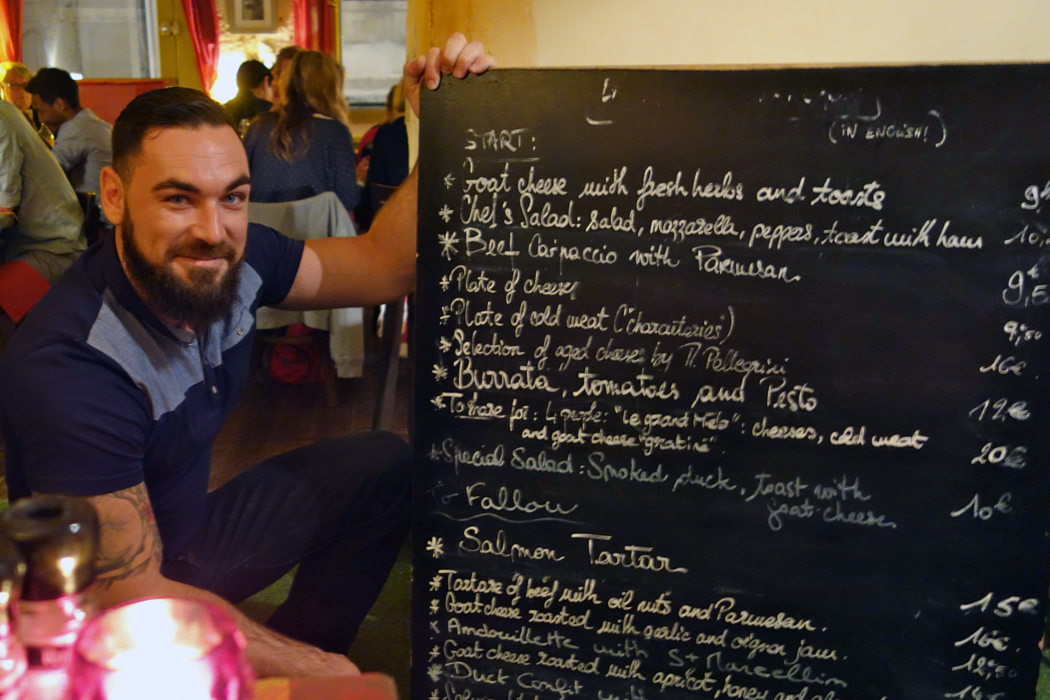
French blackboard menu

This photo typifies the scene in so many towns throughout Europe: a young, creative restaurateur serving fun and tasty local dishes for €10 to €15 each. I love the ritual of bringing over the big blackboard. These days, you’ll often find two versions — one in French and one in English.

Avignon food tour

All over Europe, food tours are trendy. I take many of them in hopes of finding ones to recommend in our guidebooks, and also to learn fun new angles on the local food scene. Some tours are too slow and expensive. Others are fast-paced and reasonably priced. Steve and I enjoyed a morning food tour with Avignon food guide Aurelie, which had the bonus of a small group size. (A nice thing about food tours is that, because they’re squeezing into small shops and restaurants, they max out at only eight or ten people and can depart with as few as three — the size of our group on this morning.) Here’s how I wrote up the tour for our guidebook:

The Avignon Gourmet Walking Tour is a wonderful experience if you like to eat. Charming and passionate Aurelie meets small groups daily (except Sun and Mon) at the TI at 9:15 for a well-designed, three-hour, eight-stop walk. Her tour is filled with information and tastes of top-quality local foods and drinks, and finishes in the market hall (€55, 2-8 people per group, book in advance on her website, www.avignongourmetours.com).
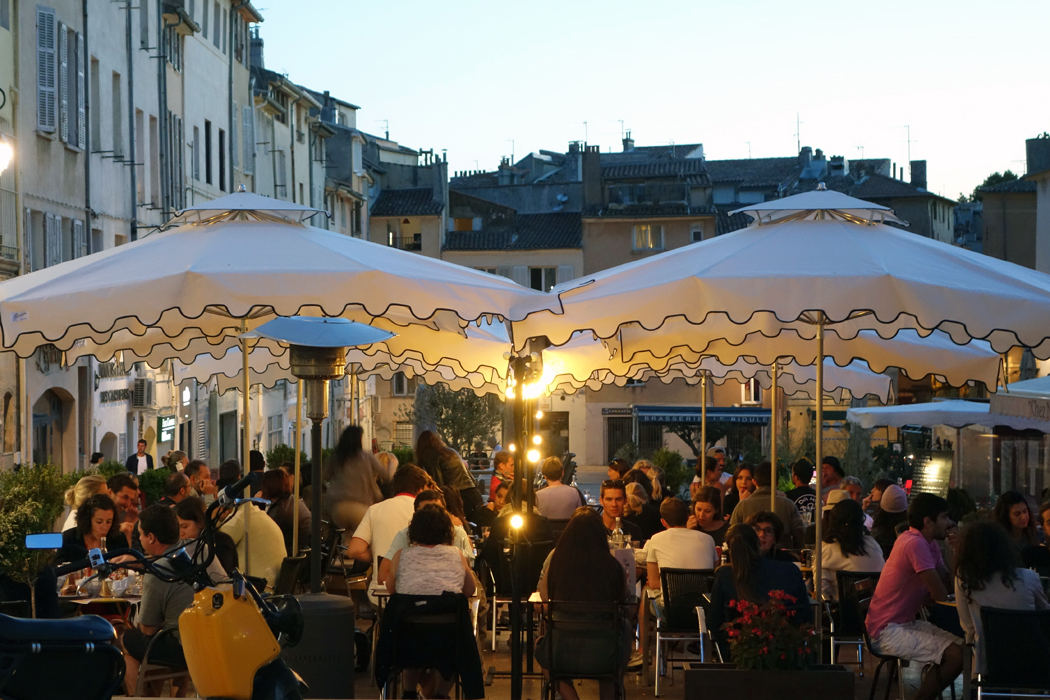
Restaurant scene in Aix-en-Provence

Well-preserved medieval quarters of towns in the South of France all have charming squares filled with charming restaurants. These days, a place with no outdoor seating might as well not open on a hot night, when everyone wants to eat outdoors. Many places have two zones — inside and outside — and only open one or the other each evening.

La Fontaine restaurant in Aix

Out and about with a healthy appetite, it’s hard to know which delightful scene to sit down and eat in. Aix-en-Provence may not have any blockbuster sights, but its old center offers a postcard square around every corner.

Provence’s Pont du Gard and the Greatness of Ancient Rome

Throughout the ancient world, aqueducts were like flags of stone that heralded the greatness of Rome. A visit to the Pont du Gard (the most famous and impressive surviving Roman aqueduct, near Avignon) shows how these structures still proclaim the wonders of that age. This impressively preserved Roman aqueduct was built in about 19 B.C. The Pont du Gard is actually a bridge over the Gardon River — the most scenic surviving link of that 30-mile structure supporting a small canal which, by dropping one inch for every 100 yards, supplied nine million gallons of water per day (about 100 gallons per second) to Nîmes, one of ancient Europe’s largest cities. Though most of the aqueduct is on or below the ground, at Pont du Gard it spans a canyon on a massive bridge — one of the most remarkable surviving Roman ruins anywhere.

Pont du Gard Aqueduct

In July and August, there are six tours a day through the water channel at the top of the Pont du Gard (€4, pay the guide directly, tour is in French and English and takes 30 minutes — 10 minutes intro and 20 minutes hiking with commentary, generally starts at the bottom of the hour from 10:30 — times are posted at the museum and entry, be sure to check). There are no reservations; just wait at the metal gate on top of the bridge, on the side opposite the museum. The first 33 people get in. If you do this tour, notice the massive calcium buildup lining the channel from over 400 years of flowing water.

Inside the Pont du Gard aqueduct

I love to cap my Pont du Gard visit in the city of Nîmes, where you can see the castellum: a modest-looking water distribution tank that was the grand finale of the 30-mile-long aqueduct. The water needs of Roman Nîmes grew beyond the capacity of its local springs. Imagine the jubilation on the day (in A.D. 50) that this system was finally operational. Suddenly, the town had an abundance of water — for basic needs, as well as for cool extras like public fountains. You can see a little social compassion designed into the water-distribution holes. The lower channel served top-priority needs, providing water via stone and lead pipes to the public wells that graced neighborhood squares. The higher holes — which got wet only when the supply was plentiful — routed water to the homes of the wealthy, to public baths, and to nonessential fountains.

Castellum water distribution tank

Also, in my Travelers Café, Cameron reports on the glitzy Expo Milano 2015 world’s fair.

Walking in Van Gogh’s Footsteps in Arles

Visiting Arles, travelers tune into the story of Vincent van Gogh. And the city makes it easy. Here’s a little excerpt from our Rick Steves’ Provence & the French Riviera guidebook (and an example of how great it is to have Gene Openshaw’s help in our art coverage):

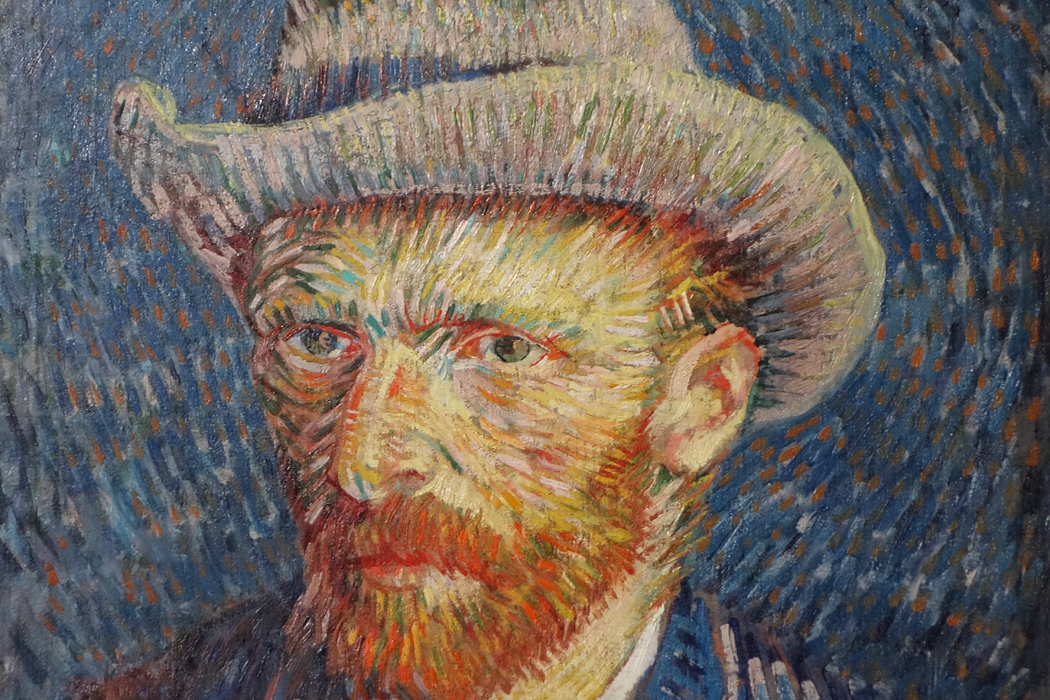
Van Gogh Self Portrait with Hat

In the dead of winter in 1888, the 35-year-old Dutch artist Vincent van Gogh left big-city Paris for Provence, hoping to jump-start his floundering career and social life. He was as inspired as he was lonely. Coming from the gray skies and flat lands of the north, Vincent was bowled over by everything Provençal: the sun, bright colors, rugged landscape, and raw people. For the next two years, he painted furiously, cranking out a masterpiece every few days.

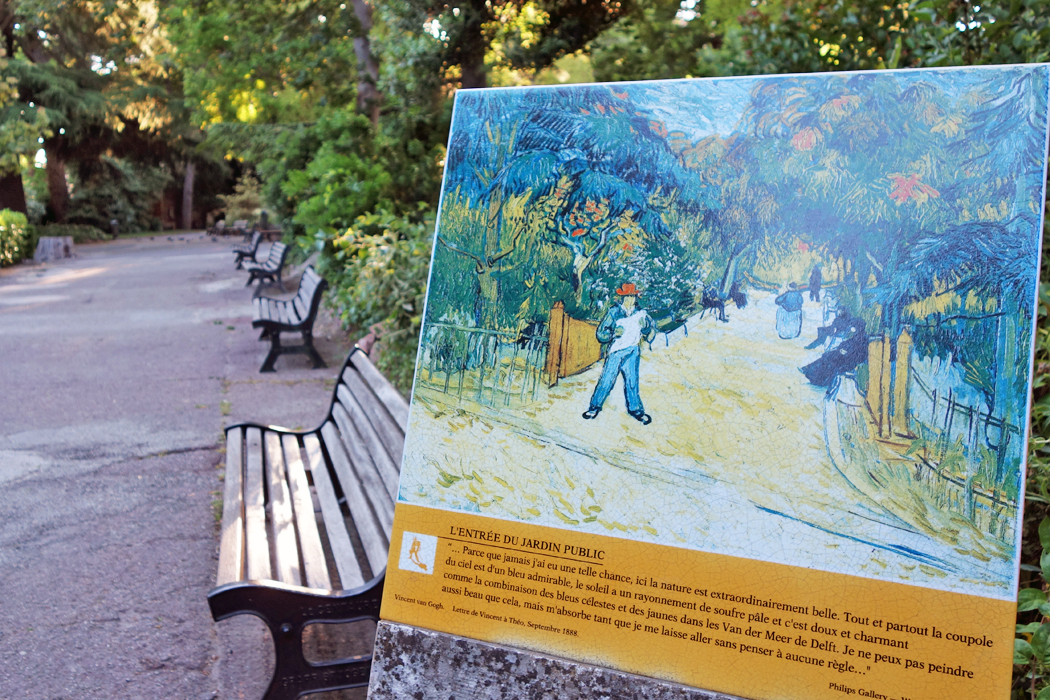
Only a few of the 200-plus paintings that Van Gogh did in the south can be found today in the city that so moved him. But in Arles, you can walk the same streets he knew and see places he painted, marked by about a dozen steel-and-concrete “easels,” with photos of the final paintings for then-and-now comparisons. Here are two examples, accompanied by the text from our book.

Van Gogh Yellow House

The Yellow House Easel
Vincent arrived in Arles on February 20, 1888, to a foot of snow. He rented a small house on the north side of Place Lamartine. The house was destroyed in 1944 by an errant bridge-seeking bomb, but the four-story building behind it — where you see the brasserie — still stands (find it in the painting). The house had four rooms, including a small studio and the cramped trapezoid-shaped bedroom made famous in paintings. It was painted yellow inside and out, and Vincent named it…“The Yellow House.” In the distance, the painting shows the same bridges you see today, as well as a steam train — which was a rather recent invention in France, allowing people like Vincent to travel greater distances and be jarred by new experiences. (Today’s TGV system continues that trend.) Today’s train line survives but is overgrown as the bridge over the river was destroyed in WWII.

Freezing Arles was buttoned up tight when Vincent arrived, so he was forced to work inside, where he painted still lifes and self-portraits — anything to keep his brush moving. In late March, spring finally arrived. In those days, a short walk from Place Lamartine led to open fields. Donning his straw hat, Vincent set up his easel outdoors and painted quickly, capturing what he saw and felt: the blossoming fruit trees, gnarled olive trees, peasants sowing and reaping, jagged peaks, and windblown fields, all lit by a brilliant sun that drove him to use ever-brighter paints.

Van Gogh Easel in the Park

Jardin d’Eté Easel
Vincent spent many a sunny day painting the leafy Jardin d’Eté. In a letter to his sister, Vincent wrote, “I don’t know whether you can understand that one may make a poem by arranging colors…In a similar manner, the bizarre lines, purposely selected and multiplied, meandering all through the picture may not present a literal image of the garden, but they may present it to our minds as if in a dream.”

Vincent never made real friends, though he desperately wanted to. He palled around with (and painted) his mailman and a Foreign Legionnaire. (The fact that locals pronounced his name “vahn-saw van gog” had nothing to do with his psychological struggles here.)


Also, in my Travelers Café, Cameron just posted a tragically funny (and all too true) tale about keeping the entry for The Last Supper up to date in my guidebook.

The Legacy of the French Revolution in Arles

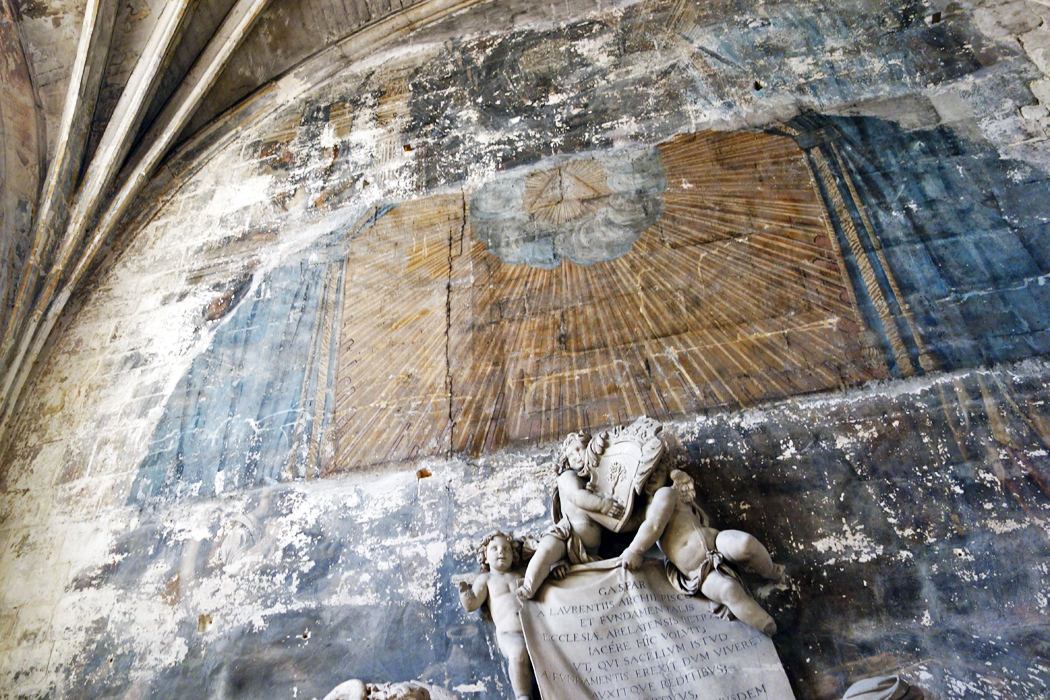
St. Trophime Church in Arles, France

As a student of history, I’ve long been fascinated by the fanaticism of the French Revolution (1789), which challenged every aspect of French society with “the test of reason.” If something wasn’t logical, it was swept away. For example, the calendar — rather than 7-day weeks, with months of 30 or 31 days (not to mention the weird February thing) — was turned into 12 months of 30 days each (divided into three ten-day weeks), with five days left over for service to your country.

Also during the Revolution, churches were turned into “temples of reason.” I’d never actually seen a tangible sign of this. But recently in Arles — checking, fine-tuning, and beefing up my coverage of the town’s sights for our France guidebook — I stepped into St. Trophime Church in search of another dimension. In a side chapel was this faded painting from 1789: a triangle within a sunburst, celebrating reason rather than religion.

It’s so fascinating to actually see the layers of history here. Has anyone seen other examples of this in France?

St. Trophime Church in Arles, France

Arles, Where Walls Are Unpainted On Purpose

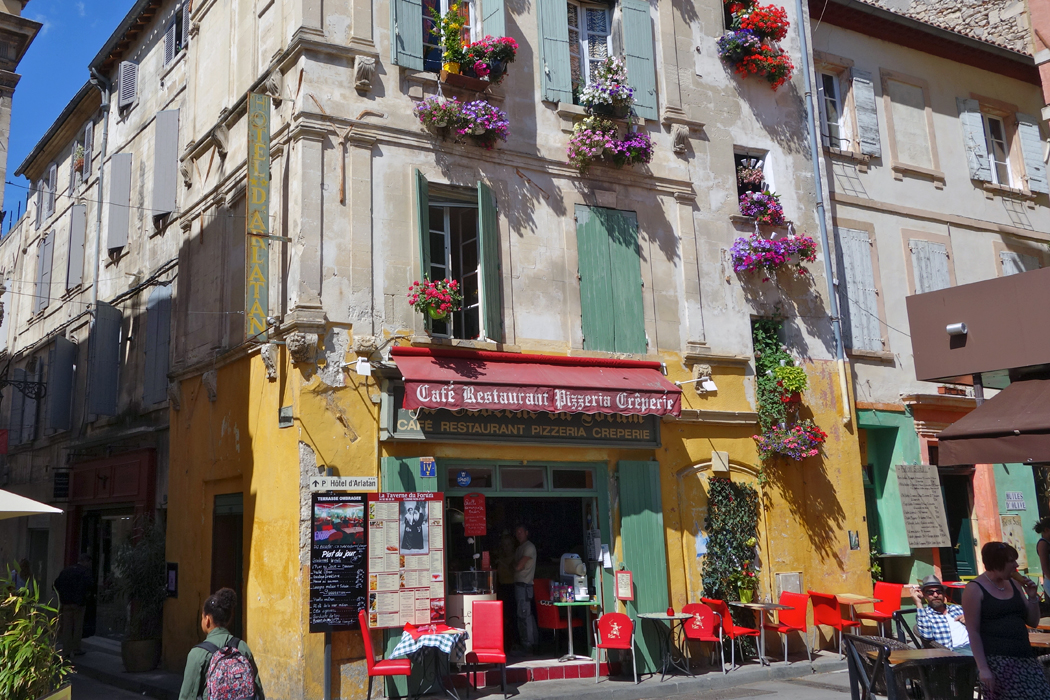
Arles, in the South of France, is not as rich as Avignon or as trendy as Aix-en-Provence. But it feels gritty and real, with a patina of life that I find very seductive. When I saw this gorgeous wall, as if awaiting a painter’s attention, I asked if it was an initiative of the town or tourist board. My guide said, “No, that’s just the way we like it.”

Arles, France street cafe

Also, Cameron is highlighting lesser-known Milan in my Travelers Café.