Here you can browse through my blog posts prior to February 2022. Currently I'm sharing my travel experiences, candid opinions, and what's on my mind solely on my Facebook page. — Rick
It’s beautiful to think of how much history Westminster Abbey has seen — both good times and bad. And through it all, Britain’s top church offers solace to its people.
Even if we’ve had to postpone trips to Europe, I believe a daily dose of travel dreaming can actually be good medicine. Here’s another one of my favorite travel memories — a reminder of what’s waiting for you in Europe at the other end of this crisis.
Wearing a red robe and a warm smile, Eddie works as a verger at London’s Westminster Abbey. As a church official, he keeps order in this space — which is both very touristy and very sacred.
I tell him I’m working on a Rick Steves guidebook, and he says, “I’d like a word with that Rick Steves. He implies in his guidebook that you can pop in to worship or pay respects to the Unknown Soldier in order to get a free visit to the abbey.”
Showing him my photo on the back cover, I say, “Well, I am Rick Steves.”
I’m really charmed by Eddie, who explains that it’s his responsibility to sort out believers (who get in free to pray), tourists (who must pay the entrance fee), and scammers who fold their hands reverently, hoping to avoid paying. Together, we agree on a new tactic: Rather than promote deception for the sake of free entry, I’ll encourage my readers to attend a free worship service. The musical evensong service is a glorious experience that occurs several times a week. Everyone is welcome, free of charge.
Proving it helps to have friends in holy places, Eddie takes me into a room where no tourist goes: the Jerusalem Chamber, where scholars met from 1604 to 1611 to oversee the translation of the Bible from ancient Greek and Hebrew into English, creating the King James Version.
Appreciating the danger of translating the word of God from dead ancient languages into the people’s language and the importance of these heroic efforts in the 16th and 17th centuries, I get goose bumps. When visiting Germany’s Wartburg Castle, I felt goose bumps when stepping into the room where Martin Luther translated the Bible for the German-speaking world. And I enjoyed a little goose-bump déjà vu here when Eddie let me slip into the Jerusalem Chamber.
Eddie then escorts me to the abbey and I quickly become immersed in the history that permeates it. This is where every English coronation since 1066 has taken place. At a coronation, the Archbishop of Canterbury stands at the high altar. The coronation chair is placed before the altar on the round, brown pavement stone, which represents the Earth. After a church service, the new king or queen sits in the chair, is anointed with holy oil, and then receives a ceremonial sword, ring, and cup. The royal scepter is placed in the new ruler’s hands, and — dut-dutta-dah — the archbishop lowers the crown onto the royal head.
As I walk, I listen to the audio tour narrated by actor Jeremy Irons. With his soothing voice in my ear, I enjoy some private time with remarkable artifacts. The marble effigy of Queen Elizabeth I was made from her death mask in 1603 and is considered her most realistic likeness. The graves of literary greats of England are gathered, as if for a posthumous storytelling session, around the tomb of Geoffrey Chaucer (Mr. Canterbury Tales). Poppies line the tomb of Britain’s Unknown Soldier, with the US Medal of Honor (presented by General John J. Pershing in 1921) hanging from a neighboring column. More recently, the statue of Martin Luther King, Jr. has been added as an honorary member of this heavenly English host.
My favorite stained-glass window features saints in robes and halos mingling with pilots in parachutes and bomber jackets. It’s in the Royal Air Force Chapel, a tribute to WWII flyers who “earned their angel wings” in the 1940 Battle of Britain. Hitler’s air force seemed to rule the skies in the early days of the war, bombing at will and threatening to snuff Britain out. While determined Londoners hunkered down, British pilots in their Spitfires and Hurricanes took advantage of newly invented radar systems to get the jump on the more powerful Luftwaffe. These were the fighters about whom Churchill said, “Never…was so much owed by so many to so few.” The book of remembrances lists the names of each of the 1,497 pilots and crew members who died.
Grabbing a pew to ponder this grand space, I look down the long and narrow center aisle of the church. It’s lined with Gothic arches, providing a parade of praying hands and glowing with colored light from the windows. It’s clear that this is more than a museum. With saints in stained glass overhead, heroes in carved stone all around, and the bodies of England’s greatest citizens under the floor, Westminster Abbey is more than the religious heart of England — it’s the national soul as well.
(This story is excerpted from my upcoming book, For the Love of Europe — collecting 100 of my favorite memories from a lifetime of European travel. It’s coming out in July, and available for pre-order. And you can also watch a video clip related to this story: Just visit Rick Steves Classroom Europe and search for Westminster.)
I have a ritual when in Paris. I ask my cabbie to take me around the Arc de Triomphe two times, then drop me off to stroll down the city’s grand boulevard, the Champs-Elysées.
Even if we’ve had to postpone trips to Europe, I believe a daily dose of travel dreaming can actually be good medicine. Here’s another one of my favorite travel memories — a reminder of what’s waiting for you in Europe at the other end of this crisis.
We plunge into the grand traffic circle where a dozen venerable boulevards converge on the mightiest of triumphal arches. Like referees at gladiator camp, traffic cops are stationed at each entrance to this traffic circus, letting in bursts of eager cars.
In the mid-19th century, Baron Haussmann set out to make Paris the grandest city in Europe. The 12 arterials that radiate from the Arc de Triomphe were part of his master plan: the creation of a series of major boulevards, intersecting at diagonals, with monuments (such as the Arc de Triomphe) as centerpieces. As we careen around the chaotic circle, I wonder what Haussmann would think of the scene today.
Each visit here reminds me of the greatness of France. As the marble relief of Lady Liberty scrambles up the arch Napoleon ordered built, heroically thrusting her sword and shrieking at the traffic, all of Paris seems drawn into this whirlpool. Being immersed in this scene with my cabbie so in control always makes me laugh out loud.
The commotion of cars fights to get to the arch at the center as if to pay homage to the national spirit of France. Cars entering the circle have the right-of-way; those already in the circle must yield. Parisian drivers navigate the circle like roller derby queens. Tippy little Citroën 2CVs, their rooftops cranked open like sardine lids, bring lumbering buses to a sudden, cussing halt. It’s a game of fender-bender chicken.
On this visit, after barely avoiding an accident, my cabbie calms me, saying, “In Paris, a good driver gets only scratches, not dents.” Groping for the lost end of my seatbelt, I say, “There must be an accident here every few minutes.” He explains, “In the case of an accident here, each driver is considered equally at fault. This is the only place in Paris where the accidents are not judged. No matter what the circumstances, insurance companies split the costs 50-50.” While we’re momentarily stalled on the inside lane, I pay and hop out.
I’m ready for my stroll on the Champs-Elysées. I like to say it out loud: shahn-zay-lee-zay. This grandest of boulevards is Paris at its most Parisian: sprawling sidewalks, stylish octogenarians caked in makeup, concept cars glimmering in showroom windows, and pastel macarons in grand cafés.
Paris’ characteristic love of strolling (a stately paced triathlon of walking, window-shopping, and high-profile sipping) dates from the booming 19th century, with its abundance of upper-class leisure time and cash. Donning an aristocratic air, I amble gently downhill to the immense and historic square called the Place de la Concorde.
Even small-town French kids who haven’t traveled beyond a TV screen know that this boulevard is their country’s ultimate parade ground, where major events unfold: the Tour de France finale, Bastille Day parades, and New Year’s festivities.
In 1667, Louis XIV opened the first stretch of the Champs-Elysées: a short extension of the Tuileries Gardens leading to the palace at Versailles. Many consider this moment to be the birth of Paris as a grand city. The Champs-Elysées soon became the place to cruise in your carriage. It still is today — traffic can be jammed up even at midnight.
A century after Louis XIV, the café scene arrived. Cafés were ideal for both Parisian pleasure-seekers and thinkers, conspiring to share ideas and plot revolutions. That coffee-sipping ambience survives today, amid pop-clothing outlets and music megastores. Two cafés, Le Fouquet’s and Ladurée, are among the most venerable in Paris.
Le Fouquet’s started as a coachman’s bistro. Then it gained fame as the hangout of French biplane pilots during World War I, when Paris was just a few nervous miles from the Western Front. Today, it’s pretty stuffy — unless you’re a film star. The golden plaques at the entrance honor winners of France’s version of our Oscars, the Césars. While I find the interior intimidating, the people-watching from the sidewalk tables makes the most expensive espresso I’ve found in Paris a good value.
You’re more likely to see me hanging out at Ladurée, working delicately through an Oreo-sized macaron with fine silverware. This classic 19th-century tea salon and pastry shop has an interior right out of the 1860s. The bakery makes traditional macarons with a pastel palette of flavors, ranging from lavender and raspberry to rose. Get a frilly little gift box to go, or pay the ransom and sit down and enjoy the Champs-Elysées show in sweet style.
Until the 1960s, the boulevard was pure Parisian elegance, lined with top-end hotels, cafés, and residences. Locals actually dressed up to stroll here. Then, in 1963, the government, wanting to pump up the neighborhood’s commercial metabolism, brought in the Métro to connect the Champs-Elysées with the suburbs. Suddenly, the working class had easy access. And bam — there goes the neighborhood.
The arrival of McDonald’s was another shock. At first it was allowed only white arches painted on the window. Today, the hamburger joint spills out onto the sidewalk with café-quality chairs and stylish flower boxes.
As fast food and pop culture invaded and grand old buildings began to fall, Paris realized what it was losing. In 1985, a law prohibited the demolition of the classy facades that once gave this boulevard a uniform grace. Consequently, many of today’s modern businesses hide behind 19th-century facades.
The nouvelle Champs-Elysées, revitalized in 1994, has new street benches, lamps, and an army of green-suited workers armed with high-tech pooper scoopers. Two lanes of traffic were traded away to make broader sidewalks. And plane trees (a kind of sycamore that thrives despite big-city pollution) provide a leafy ambience.
As I stroll, I notice the French appetite for a good time. The foyer of the famous Lido, Paris’ largest cabaret, comes with leggy photos and a perky R-rated promo video.
The nearby Club Med building is a reminder of the French commitment to vacation. Since 1936, France’s employees, by law, have enjoyed one month of paid vacation. The French, who now have five weeks of paid vacation, make sure they have plenty of time for leisure.
On the Champs-Elysées, the shopping ends and the park begins at a big traffic circle called Rond-Point. From here, it’s a straight shot down the last stretch of the boulevard to the sprawling square called the Place de la Concorde. Its centerpiece was once the bloody guillotine but is now the 3,300-year-old Obelisk of Luxor. It was shipped here from Egypt in the 1830s, a gift to the French king.
I stand in the shadow of that obelisk with my back to the Louvre, once Europe’s grandest palace, and now its grandest museum. Looking up this ultimate boulevard to the Arc de Triomphe, I can’t help but think of the sweep of French history…and the taste of those delightful macarons.
(This story is excerpted from my upcoming book, For the Love of Europe — collecting 100 of my favorite memories from a lifetime of European travel. It’s coming out in July, and available for pre-order.)
I’m thinking back on my favorite European memories, and my favorite Europeans…including Herr Jung, the German schoolteacher who passed away not long ago. When I close my eyes, I can still imagine Herr Jung walking me around his hometown…
Even if we’ve had to postpone trips to Europe, I believe a daily dose of travel dreaming can actually be good medicine. Here’s another one of my favorite travel memories — a reminder of what’s waiting for you in Europe at the other end of this crisis.
Cruising down the romantic Rhine River, we dodge the treacherous reefs that spelled disaster for ancient sailors distracted by the fabled Lorelei siren. We dock at the half-timbered town of Bacharach, where I jump out. Bacharach, wearing a castle helmet and a vineyard cape, is a typical Rhine village. It lines the river and fills its tiny tributary valley with a history you can hook arms within a noisy Weinstube.
“Bacharach” means “altar to Bacchus.” The town and its wine date from Celtic and Roman times. Local vintners brag that the medieval Pope Pius II preferred Bacharach’s wine and had it shipped to Rome by the cartload. Today, tourists drink it on the spot.
For each wine festival, Bacharach installs an honorary party mayor. He’s given the title of Bacchus. The last Bacchus, one of the best wine gods in memory, died a year ago. Posters left up as a memorial, it seems, show his pudgy highness riding a keg of Riesling, wearing a tunic, and crowned with grapes as adoring villagers carry him on happy shoulders. Bacharach’s annual wine fest is the first weekend of October, just before the harvest. Its purpose is to empty the barrels and make room for the new wine, a chore locals take seriously.
The festival is months away, but the dank back alleys of Bacharach smell like the morning after. I drop my bag at Hotel Kranenturm, then head back to the boat dock. I’ve arranged a private walk through town with Herr Jung, Bacharach’s retired schoolmaster.
The riverfront scene is laid-back. Retired German couples, thick after a lifetime of beer and potatoes, set the tempo at an easy stroll. I gaze across the Rhine. Lost in thoughts of Bacchus and Roman Bacharach, I’m in another age…until two castle-clipping fighter jets from a nearby American military base drill through the silence.
The Rhine Valley is stained by war. While church bells in Holland play cheery ditties, here on the Rhine they sound more like hammers on anvils. At bridges, road signs still indicate which lanes are reinforced and able to support tanks. As the last of the World War II survivors pass on, memories fade. The war that ripped our grandparents’ Europe in two will become like a black-and-white photo of a long-gone and never-known relative on the mantle.
I pause at Bacharach’s old riverside war memorial. A big stone urn with a Maltese cross framed by two helmets, it seems pointedly ignored by both the town and its visitors. Even when it was erected to honor the dead of Bismarck’s first war in 1864, its designer sadly knew it would need to accommodate the wars that followed: Blank slabs became rolls of honor for the dead of 1866, 1870, and 1914–18.
Herr Jung arrives and I ask him to translate the words carved on the stone.
“To remember the hard but great time…” he starts, then mutters, “Ahh, but this is not important now.”
Herr Jung explains, “We Germans turn our backs on the monuments of old wars. We have one day in the year when we remember those who have died in the wars. Because of our complicated history, we call these lost souls not war heroes but ‘victims of war and tyranny.’ Those who lost sons, fathers, and husbands have a monument in their heart. They don’t need this old stone.”
Rolf Jung is an energetic gentleman whose glasses seem to dance on his nose as he weaves a story. When meeting my tour groups for guided walks, he greets them as he did his class of fifth-graders decades ago, singing like a German Mr. Rogers: “Good morning, good morning, to you and you and you…” Like so many Europeans, he has a knack for finding dignity and pride in his work, no matter how grand or small the job. A walk with Herr Jung always makes me feel good about Europe.
As I ponder the memorial, he quotes Bismarck: “Nobody wants war, but everyone wants things they can’t have without war.”
Herr Jung looks past the town’s castle, where the ridge of the gorge meets the sky and says, “I remember the sky. It was a moving carpet of American bombers coming over that ridge. Mothers would run with their children. There were no men left. In my class, 49 of the 55 boys lost their fathers. My generation grew up with only mothers.
“I remember the bombings,” he continues. “Lying in our cellar, praying with my mother. I was a furious dealmaker with God. I can still hear the guns. Day after day we watched American and Nazi airplanes fighting. We were boys. We’d jump on our bikes to see the wreckage of downed planes. I was the neighborhood specialist on war planes. I could identify them by the sound.
“One day a very big plane was shot down. It had four engines. I biked to the wreckage, and I couldn’t believe my eyes. Was this a plane designed with a huge upright wing in the center? Then I realized this was only the tail section. The American tail section was as big as an entire German plane. I knew then that we would lose this war.”
The years after the war were hungry years. “I would wake in the middle of the night and search the cupboards,” he says. “There was no fat, no bread, no nothing. I licked spilled grain from the cupboard. We had friends from New York and they sent coffee that we could trade with farmers for grain. For this I have always been thankful.
“When I think of what the Nazis did to Germany, I remember that a fine soup cooked by 30 people can be spoiled by one man with a handful of salt.”
Herr Jung takes me on a historic ramble through the back lanes of Bacharach. Like any good small-town teacher, he’s known and admired by all.
Then we climb through the vineyards above town to a bluff overlooking a six-mile stretch of Rhine. “I came here often as a boy to count the ships,” he says. “I once saw 30 in the river in front of Bacharach.”
We look out over the town’s slate rooftops. Picking up a stone, he carves the letters “Rick” into a slate step and tells me, “Now you are here, carved in stone…until the next rain.”
Ever a teacher, he explains, “Slate is very soft. The Rhine River found this and carved out this gorge. Soil made from slate absorbs the heat of the sun. So, our vines stay warm at night. We grow a fine wine here on the Rhine.
“Today the vineyards are going back to the wild. Germans won’t work for the small pay. The Polish come to do the work. During the Solidarity time I housed a guest worker. After 11 weeks in the fields, he drove home in a used Mercedes.”
We pass under the fortified gate and walk back into town, cradled safely in half-timbered cuteness. My teacher can sense what I’m thinking: that Bacharach was never good for much more than inspiring a poem, selling a cuckoo clock, or docking a boat. Stopping at a bench, Herr Jung props his soft leather briefcase on his knee and fingers through a file of visual aids, each carefully hand-colored and preserved in plastic for rainy walks. He pulls out a sketch of Bacharach fortifications intact and busy with trade to show how in its heyday, from 1300 to 1600, the town was rich and politically important.
“Medieval Bacharach had 6,000 people. That was big in the 15th century,” he says. “But the plagues, fires, and religious wars of the 17th century ended our powerful days. Bacharach became empty. It was called ‘the cuckoo town.’ Other people moved in the way a cuckoo takes over an empty nest. For 200 years now, our town has been only a village of a thousand.”
In the mid-19th century, painters and poets like Victor Hugo were charmed by the Rhineland’s romantic mix of past glory, present poverty, and rich legend. They put this part of the Rhine on the Grand Tour map. And the “Romantic Rhine” was born.
A ruined 15th-century chapel hangs like a locket under the castle and over the town. In 1842, Victor Hugo stood where Herr Jung and I now stand. Looking at the chapel, he wrote, “No doors, no roof or windows, a magnificent skeleton puts its silhouette against the sky. Above it, the ivy-covered castle ruins provide a fitting crown. This is Bacharach, land of fairy tales, covered with legends and sagas.”
While military jets soar, Roman towers crumble. Herr Jung has since passed away. But the Lorelei still sings its siren song. Bacharach is a town with a story that I would never have known without a friend and a teacher like Herr Jung.
(This story is excerpted from my upcoming book, For the Love of Europe — collecting 100 of my favorite memories from a lifetime of European travel. It’s coming out in July, and available for pre-order. And you can also watch a video clip related to this story: Just visit Rick Steves Classroom Europe and search for Bacharach.)
Even though my Mom, June Steves, passed away in 2011, she remains a huge presence. When I think of how my Mom catapulted me into the wonderful life I’ve enjoyed, it was she who first took me to Europe. While my Dad was busy doing business with European piano-builders (he imported pianos), Mom was my first travel partner. (Dad was the big personality — the lead character in most stories in our family lore. But it was Mom who made sure we caught the plane, had our documents, stayed safe, and were well-fed.)
Back when I was a 14-year-old who had hardly set foot on an airplane, together we were immersed in the wonders of Europe. On that first dip into Europe, Mom and I stood in front of our first hotel in the Netherlands watching bicyclists gather at a stoplight on the way to the fields — wooden shoes filling their little handlebar baskets. Mom helped me collect a cigar box full of artfully designed beerhall coasters, tiny coins with donut holes, and sugar cubes wrapped with advertising from the restaurants we visited all over Europe. Together we collected souvenir pins to ornament my Bavarian felt hat.
In Paris, pondering the grand monuments, Mom and I puzzled at buildings that looked both new and ancient — built in the Neoclassical style…the style of ancient Rome, but dating only from the age of Napoleon. Venturing into our first subway ride ever, we found our way to a stop called Trocadéro, emerged, turned the corner, and simultaneously set eyes for the first time on the jaw-dropping Eiffel Tower. Like playmates in a wonderous park, we spontaneously held hands and ran toward that towering icon…as if entering a dream come true.
When friends in Germany gave us a tin of white asparagus, we poked at it and marveled together at what looked like a rare albino vegetable. And, with Norwegian relatives, we traveled to the fjord where we found the actual house from where my mother’s mother left for the “New Land” — in her case, Canada.
On that first trip, I was attached to my Mom — literally — as back then a mother and her child could share the same passport. And flying home from that first foreign adventure, I have a hunch my Mom had a hunch she had helped plant in me a seed that would sprout into a lifelong passion for travel.
One of my favorite photos is of me and my Mom with our hosts in Austria in a dusty village on the border of communist Hungary. It was 1969, and Mom had just introduced me a man (far left) who claimed to have witnessed the assassination of Archduke Franz Ferdinand in 1914, which kicked off World War I. Whether he actually saw it or not, the story he told had me wide-eyed — and when I look back on it, I think it was a pivotal moment in my life that directed me toward my history degree and a passion for learning and teaching through thoughtful travel.
My Mom — who, on her first trip ever to Europe, took better care of me than herself — gave me the gift of making the world, past and present, my friend through travel. Thanks, Mom. While I’d love more than ever to share a trip with you right now, I’ll always pack you along in spirit. I love you.
For today’s Daily Dose of Europe, we’re getting the scoop straight from our European friends. Like most of the US, much of Europe is still in some version of lockdown…but things are slowly opening up. This installment of our weekly guide reports roundup offers a look at Europe emerging from its cocoon.
In Spain, Jorge Román sent us some stunning photos of the annual patio decorating festival in Córdoba — a treasured late-spring tradition that is still happening amidst the pandemic:
In Scotland, James Macletchie posted the poetic essay “A Dream in a New World,” with gorgeous photographs from the Outer Hebrides, and his thoughts on self-isolation.
In Bulgaria, Stefan Bozadzhiev has been leading “virtual tours” around Sofia. Here’s a sample:
And here in Seattle, Sarah Murdoch has been teaching cooking lessons and interviewing our guides across Europe on her “Adventures with Sarah” Facebook page.
In Orvieto, Italy, David Tordi is staying busy with his musical act, Bartender. On Saturday (May 9), at 7:30 p.m. Italy time (that’s 10:30 a.m. on the West Coast, 1:30 p.m. on the East Coast), they will be premiering a new song that they recorded on their most recent visit to Seattle. The band will be available live to talk about the new song and answer questions:
But the big theme this week was “Italy Emerges from Lockdown.” As of May 4, Italy entered Phase 2 — the first step toward a gradual re-opening. For the first time in more than 50 days, Italians are allowed to leave their homes to go for a walk or visit a park (while maintaining social distance and wearing masks).
On her blog, Lisa’s Dolce Italia, Lisa Anderson has written beautiful posts about weathering lockdown in Piedmont. Here’s an excerpt:
“Tomorrow is beginning of the path to freedom, fase due, Phase 2, after this long quarantine. The first thing we will be allowed to do is walk again…fare due passi. Those of you who never lost the right to take walks probably can’t imagine what this is like and I would encourage you to go 600 feet from home in every possible direction just to see what this space feels like.”
In Verona, Italy, Sarah Corfield wrote this account of being an explorer in her own city:
“I’m an American who’s been living in Verona for the last seven years. For me, Verona has the perfect combination of what I love about Italy. H.V. Morton called it “elegant, dignified, and beautiful” when he wrote A Traveler in Italy in the 1960s, and I completely agree today. I love living in a city where history is all around me, from Roman times to more recent periods.
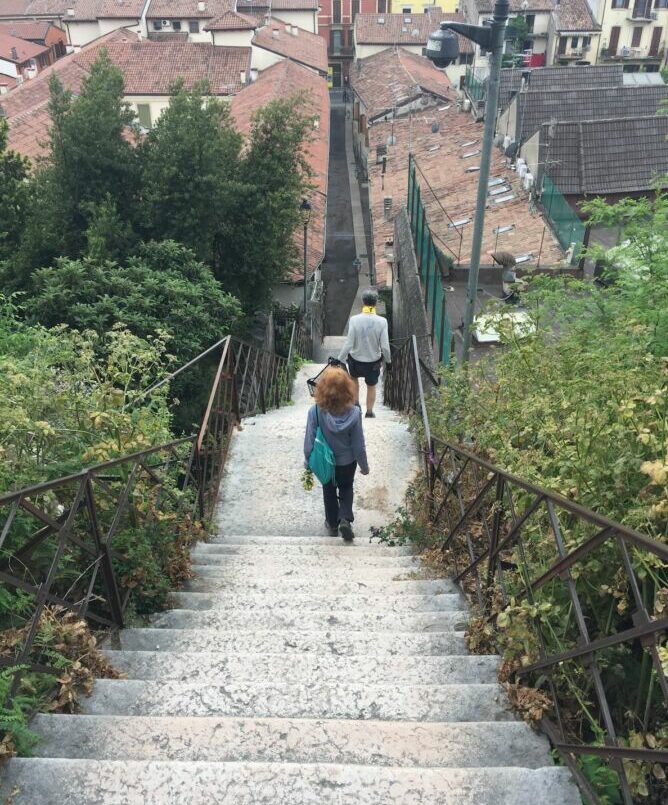
“With new permission to exercise within my own municipality, I headed for the hills with two friends, wearing our masks and being careful to stay at least six feet apart.
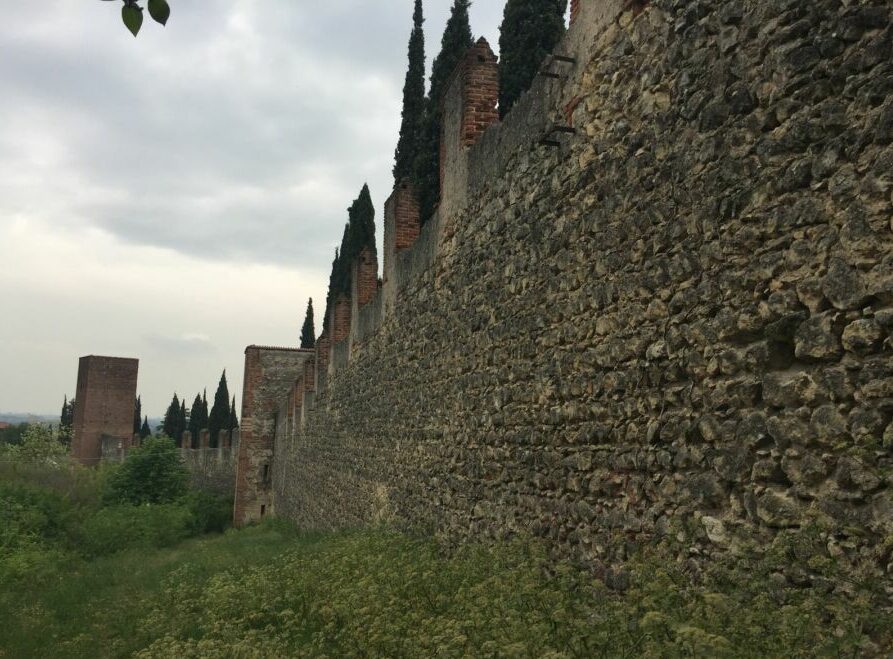
“Our walk started at the walls around the city that were originally built in the 13th century. As you walk along the walls, you realize that some parts are made from very distinct shapes of stone that interlock perfectly together. This is from a reinforcement made by the Austrian Habsburgs in the 19th century. As the Habsburgs developed Verona into an important military city, they not only reinforced the walls, but also constructed many forts in these hills to protect the city from the threat of invasion — first from the French and then from the newly formed Italian kingdom. These fortresses remain, in various states of abandonment or restoration.
“As I got further out from the city, I thought of how the wondrous landscape I was immersed in would remind most people of Tuscany with its vineyards, olive trees, and tall cypresses, magnificently growing on gently sloping hills. And now it’s clearly spring, with warmer temperatures for several weeks now, everything is GREEN!
“After my three-hour walk, I was back in my neighborhood of Veronetta, located across the river from the historic center and known mostly for its laid-back atmosphere and the university that’s located here. Since late February, we haven’t seen any students around since the university was closed for the virus emergency. Everything has been quieter, except for the birds and neighbors chatting from their balconies.
“One of the buildings in Veronetta that was magnificently restored just five years ago is now used by the economics and law departments of the university. This was originally built by the Austrians in 1863 — but not as a fort. It was a massive military bakery and grain storage facility that provided up to 50,000 troops with daily bread as they fought to ward off the new Italian kingdom from entering the city. In the basement is an exhibition with some of the old breadmaking machines and historic photos from the era.
“You can’t visit the complex now. It’s closed due to the COVID-19 emergency. But it will reopen one day, just like all the other more familiar sights in Verona: Juliet’s balcony, the Roman Theater, and our grand Roman amphitheater, the Arena, which has been hosting opera performances since 1913. If you’d like to check out what’s going on in Verona, you can view the city’s webcams. You might not see much more than a few pigeons at the moment. But sooner or later, tourists will return. I know we all are looking forward to the day when we can plan our next tour. Let’s stay positive and embrace what we can experience and learn virtually about our dream destinations in the meantime!”
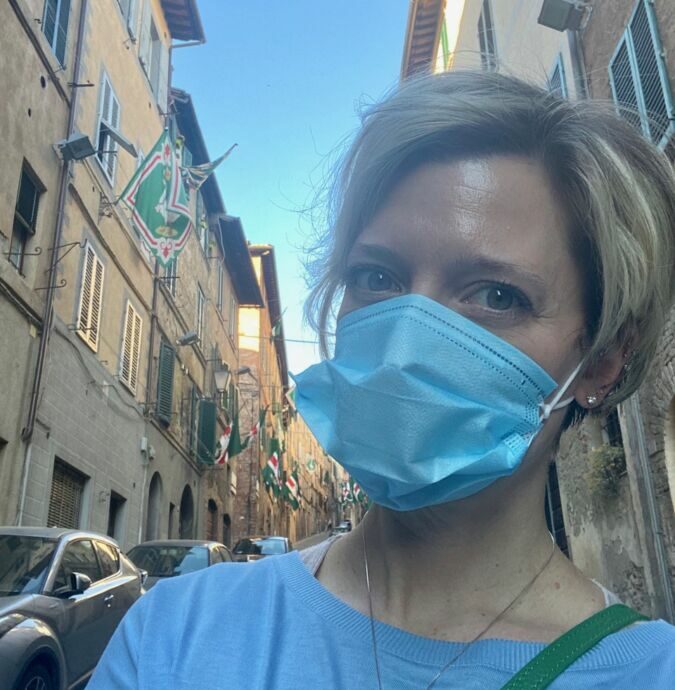
In Siena, Anna Piperato explains how Phase 2 is just the first step of a much longer and more complicated recovery ahead:
“Things are changing a bit here in Italy as we enter into Phase 2. The next decree will be issued on 18 May, which should include a provision for the reopening of museums. However, we guides have been utterly forgotten about and we have no idea if we can lead small tours (say 1-5 people) in those museums, or even offer walking tours where social distancing would be much easier to uphold. I need to figure out how to earn a living because I am receiving no support from the government. Being an independent contractor always comes with risks, but I did think that paying into Social Security for 25 years and now paying into the Italian State would provide me with a bit of assistance, but no. ‘Oh, just teach online,’ they say, but it’s hard to find paying work! Still, I shall not give up. I’m taking an online art history course and have started a YouTube channel (and am finally learning how to use iMovie!). If you are interested, here is my latest coronavirus update:
In Rome, Nina Bernardo sent us this uplifting story of venturing out for the first time in 55 days:
“On Monday in Italy we were allowed our first taste of freedom. After 55 days of a very strict lockdown I went and walked along the banks of the Tiber. The sky was blue and the vegetation seemed wilder than I remembered it. As I walked, I passed cyclists and runners and instead of the usual sadness, oppression, and sometimes fear that I perceived standing in line at the supermarket (my only forays into the outdoors until then), as I walked there seemed to be joy and liberation in the air.
“Today I met a very good friend and we walked through the center (keeping our social distance). I live alone and seeing someone I love dearly up close, talking (not via a screen), being stimulated by the outdoors, speaking to people we passed and sharing our perceptions was revitalizing and for the first time since all of this started I felt hope. The world is bigger than the walls of my apartment. I want to explore that world again.”
And in Rome,Francesca Caruso wrote this beautiful essay (entitled “The Longest Journey Begins with the First Step”) about how, when you’ve been locked inside for weeks, a visit to a park is high adventure:
“May 4 has arrived, Phase 2 has begun, and we are finally allowed to walk in the park for exercise. We still cannot see our friends and it is not clear whether we can go downtown for a stroll, but after more than 50 days alone at home, I will take what I can get. I went to the Parco della Caffarella, over 300 acres of public green area, part of the Regional Park of the Appia Antica.
“I leave the concrete and the asphalt, the straight lines and right angles of the city that have been my fixed view for the last 50 days, and I walk into the park. It’s in a valley and it feels like plunging into the sea to swim. At every step knots unravel, the oppressiveness that has been lodged in my chest, gray and thick like fog, dissolves. My senses take over and they feel newly minted, sharp, polished, and eager. I am alive, I am here, and what I am feeling is unmistakably joy.
“Everything calls to me: the tender green of Spring, the enamel quality of Rome’s cloudless blue sky, the bright red of the poppies, the oily sleekness of a starling’s feathers. I walk in the tall grass and marvel at how it whips at my ankles (why had I never noticed that?).
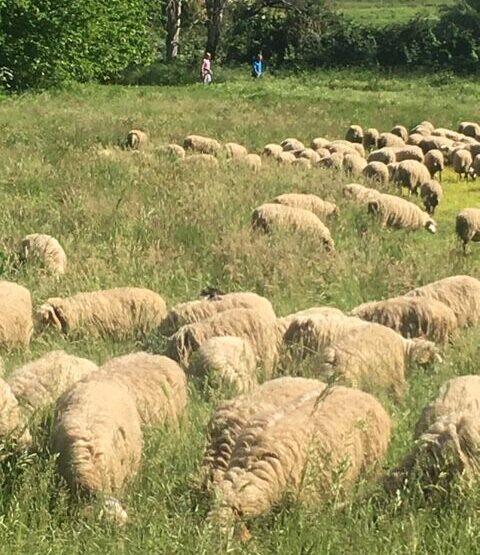
“And the sounds: the melodious warbling of a blackbird, the buzzing of the bees, the ‘singing’ of a rooster from the nearby farm (that’s what they do in Italian — they ‘sing’), a flock of sheep crossing a little bridge over a brook, their hooves against the loose wooden planks, snippets of conversation, a child passing on a bike: Ciao pecora come stai oggi? (‘Hello sheep, how are you doing today?’) And: Mamma! Mi ha risposto, hai sentito? (‘Mom! She answered me, did you hear that?’)
“A couple walks by, wearing masks but holding hands, my mind races to my loved ones, so far away right now, to my partner on the other side of the world: When will I hold his hand again? But then my mind comes back and settles into the moment. I need to be here, now.
“What does this first walk really feel like? It feels like cold spring water when one is parched. What is it though? Is it Nature, the scale of its beauty and power that don’t even acknowledge what has turned our lives upside down? Yes, but what it is really about today, for me, is moving in a shared space, a space made up and lived in by others: trees, birds, and people. Not the space of my apartment that speaks just about me and my solitude, that looks like the inside of my mind and nothing else. I recovered a sense of community, of belonging to something more vast not just than me, but vaster and more powerful than the hardship of this moment.
“And as I walk in the park, I realize too that that is exactly what I miss about guiding: offering Rome, its complex beauty and resilience as a place we can all share in and connect with. And Rome is there, always there, like the trees and the sky, and one of these days we will be able to feel her embrace again.”