I nearly skipped Blenheim Palace this year, thinking that on a gorgeous Sunday in July this palace near Oxford would be a mob scene. It was nearly empty. In fact, I booked a special tour of the private apartments, giving me a 30-minute, behind-the-scenes look at the workings of the palace (£5). I was all alone with my excellent guide. This really is the number-one stately home to see in Britain.
Here you can browse through my blog posts prior to February 2022. Currently I'm sharing my travel experiences, candid opinions, and what's on my mind solely on my Facebook page. — Rick
Oxford vs Cambridge? I’ve Changed My View
I enjoy having strong opinions when it comes to hard itinerary decisions and rating various European destinations. And I enjoy reassessing. Twenty years ago I visited Oxford and Cambridge and got it lodged in my mind that Cambridge was much better to visit than Oxford. Since then, in my lectures, I’ve made the point that, “If you have less than a month to tour Britain, don’t do both great university towns. Do one or the other and save up time for something entirely different (like North Wales or the Cumbrian Lake District). And…Cambridge is better than Oxford.” I’ve spent the last three days enjoying both towns and comparing each — and I need to change my assessment. Here’s how I wrote it up for the next edition of my England guidebook:
England is home to two world-renowned universities: Oxford and Cambridge. Seeing one is enough. And the big question for many is which one? Cambridge is easier and more charming — with its lovely gardens along the River Cam. Oxford is more substantial with lots more to see and do. If you’re choosing between them, consider this: Cambridge feels like a lazy, easygoing small town; Oxford has more urban energy and more stately buildings than its rival. Cambridge is not really on the way to anywhere (and weak in hotels), making it better as a side-trip from London than as a stopover. Oxford can keep you busy sightseeing for a longer time and has plenty of good hotels — so it’s worth a longer stop. Both are convenient to London (with an hour’s train ride). And Oxford is in a much more interesting neighborhood as it sits near the Cotswolds, Stratford-upon-Avon, Warwick, and Blenheim Palace. If you can’t choose, do both (there’s a great bus connection).
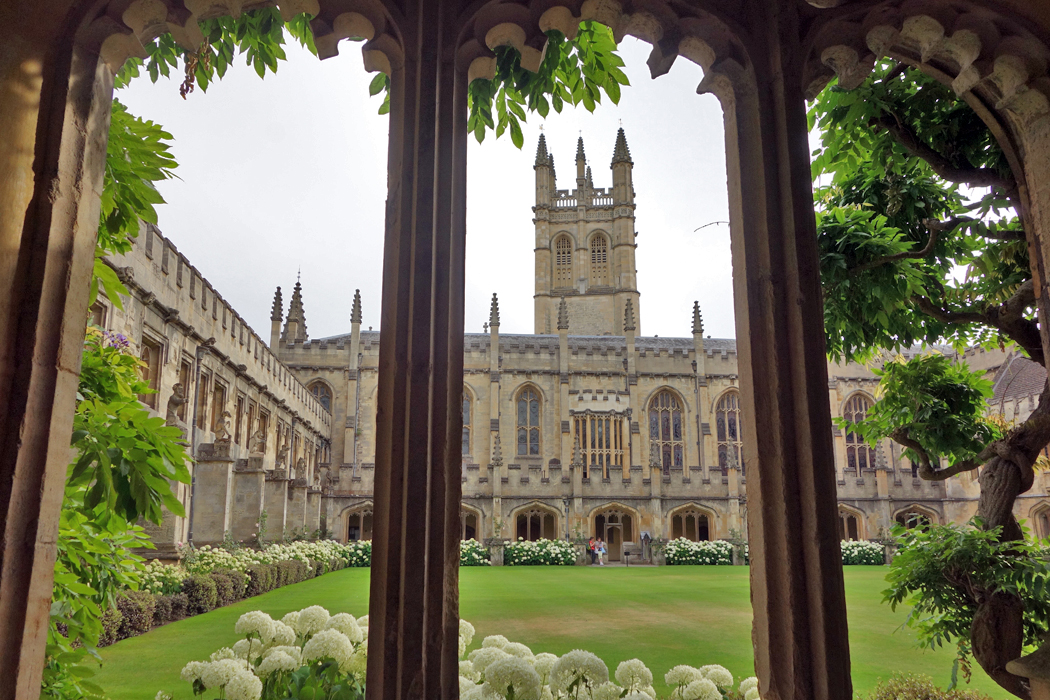
The universities of Oxford and Cambridge each consist of many venerable colleges sprinkled through town. And most have a fine central courtyard (called a “court” in Cambridge and a “quad” in Oxford). This is a particularly beautiful quad at Oxford’s Magdalen College.

Oxford and Cambridge each use the “collegiate system” where the colleges are mixed throughout the town; there’s no sense of an intact campus like you’d expect at many American universities. To explain the fascinating mix of town and gown, each city’s tourist board offers fine guided tours (2 hours, £10).
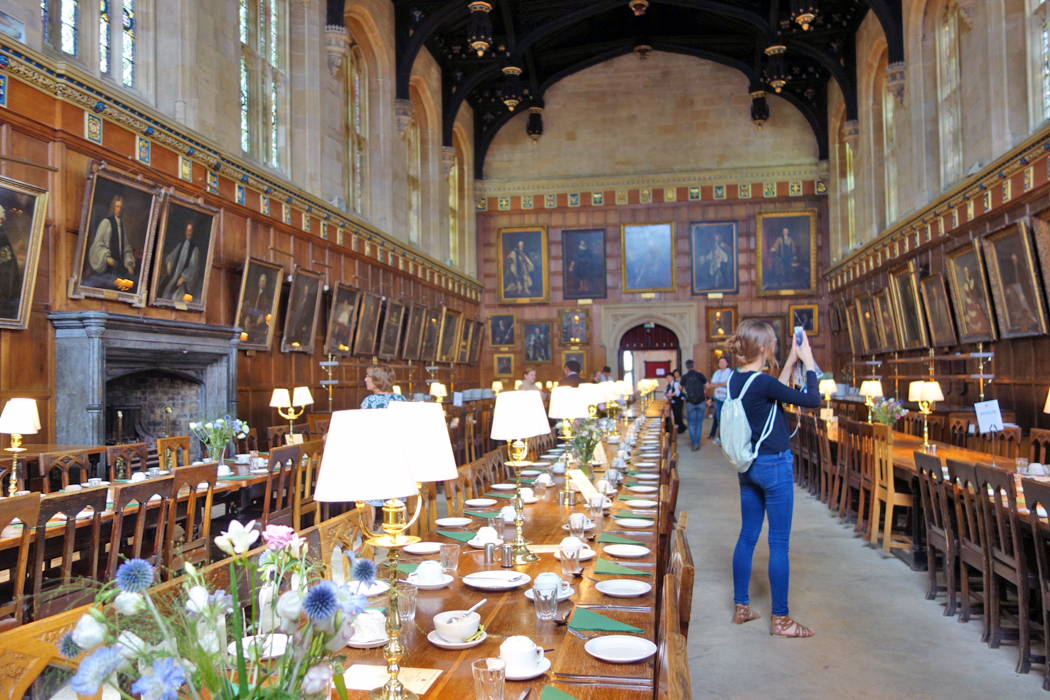
If you haven’t read a lot of novels, visiting Oxford and Cambridge can be frustrating. Each city is bursting with literary references and treats its hometown authors like pop stars — such as C.S. Lewis, E.M. Forster, Lewis Carroll, or J.R.R. Tolkien. If you haven’t read their stuff, you won’t feel a lot of the excitement. Both college towns have also been featured in hit movies. This dining hall at Oxford’s Christ Church College is a huge hit with “Harry Potter” fans since it was the inspiration for Hogwarts’ Great Hall in the films.
Oxford — Always Five Minutes Late
Finally…I learned why that White Rabbit was always late: It’s because Oxford is almost comically full of tradition. One of the preeminent colleges of the 38 that make up the university, Christ Church is particularly loyal to its traditions — it even has its own time zone. Before the advent of trains made it important that everyone be on the same time — hence Greenwich Mean Time — different towns routinely had their own times. Oxford, being 60 miles west of Greenwich, was longitudinally 5 minutes different. To this day, the clock tower at Christ Church runs five minutes later than official British time. My guide tied that to the fact that Lewis Carroll taught there — so it was natural that the author of “Alice in Wonderland” would create a character that was always late.
Revisiting One of the Greatest Cities on Earth
Spending a few days in London updating my guidebook, it was fun to reconnect with one of the greatest cities on earth. The many massive new buildings seem to have been given permits on the condition that they’d provide public spaces, especially if they might obstruct views of historic buildings. For example, the big and glassy New Change Building (just east of St. Paul’s) has a little park high above street level reached by a sleek elevator that offers a free and amazing view of the cathedral and the skyline.

London’s Tube, as the Underground is called (saying “subway” means a pedestrian underpass to a Brit), feels more efficient than ever. The Oyster Card is the standard pass — you buy it for a refundable £5 and put as much money on it as you like. You swipe in and swipe out and ride anywhere in town for about half the normal fare. If you forget to swipe, you’ll be charged for the longest ride possible — but you can never pay in a day more than the cost of a one-day pass (about $15). A feature I like is that you can swipe it at a ticket machine (shown here) and it tells you everywhere you’ve gone by bus and Tube with a full accounting and the resulting balance.

As a rising tide of affluence sweeps through London, I see a lot of pubs becoming victims of progress — torn down for new construction. It got me thinking that there are more pubs in poorer towns and neighborhoods than in wealthier ones for a reason. The venerable English pub filled (and still fills) a big need for the working class. For workers — historically with humble domestic quarters and no money for vacation — a beer on the corner was the closest they’d get to a comfortable living room, a place to entertain, and a vacation. As people get wealthier, the importance of the corner pub diminishes.

That’s One Big Pickle
While updating my Rick Steves’ London guidebook this week, I was struck by the construction and the changing skyline. With my local guide, Gillian Chadwick, I marveled at the energy of new London, as it seems intent on building itself out of any economic recession. While most people don’t know the formal names of the most striking skyscrapers — or which companies inhabit them — everyone knows the nicknames…inspired by what they look like: the Cheese Grater, the Shard, and the Pickle…I mean the Gherkin.