Here you can browse through my blog posts prior to February 2022. Currently I'm sharing my travel experiences, candid opinions, and what's on my mind solely on my Facebook page. — Rick

Daily Dose of Europe: Géricault’s Raft of the Medusa

A glimmer of hope in a time of crisis…this painting feels made for our current time.

The coronavirus can derail our travel plans…but it can’t stop our travel dreams. And I believe a daily dose of travel dreaming can actually be good medicine. One of the great joys of travel is seeing art masterpieces in person. Here’s one of my favorites.
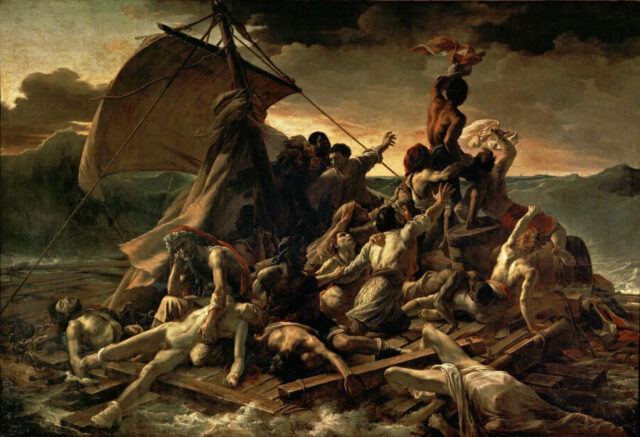
In 1816, the French ship Medusa went down off the coast of Africa, and the tragedy gripped the nation. Accounts poured in of the unspeakable hardships these French citizens suffered.

In Paris, the young artist Théodore Géricault began chronicling the tragic event. Like a method actor, he immersed himself in the project. He interviewed survivors and honed his craft sketching dead bodies in the morgue and the twisted faces of lunatics in asylums. He shaved his head and worked alone, wallowing in the very emotions he wanted to portray.

He captured the moment when all hope seemed lost.

Clinging to a raft in the midst of a storm-tossed sea is a tangle of bodies sprawled over each other. The scene is alive with agitated, ominous motion — the ripple of muscles, churning clouds, and choppy waves. The rickety raft is nearly swamped. The dark colors — dull green seas, dark brown raft, and ghostly flesh — are as drained of life as the survivors’ spirits. On the right is a deathly green corpse dangling overboard. Of the 150 people who originally packed onto the raft, only these few remained. They floated in the open seas for almost two weeks — suffering unimaginable hardship and hunger, even resorting to cannibalism. The face of the old man on the left, cradling his dead son, says it all — it’s hopeless.

But wait!

There’s a stir in the crowd. Someone has spotted something. The bodies rise up in a pyramid of hope. The diagonal motion culminates in a waving flag. They wave frantically, trying to catch the attention of something on the horizon, their last desperate hope. It’s a tiny ship — the ship that did finally rescue them and bring the 15 survivors home.

For months, Géricault worked feverishly on this giant canvas. When he emerged, it captured the traumatized mood of a French nation still in mourning. Géricault had also revolutionized art, paving the way for a bold new style — Romanticism. His contemporaries were still following the Neoclassical tradition of idealized gods and Greek-statues-on-canvas. Géricault shattered the mold, adding a gritty realism and super-ultra-mega-heightened emotion. What better story than this shipwreck to shock and awe the public? In the artistic war between hearts and minds, Géricault’s Romantic style went straight to the heart. He used rippling movement, strong shadows, and powerful colors to catch us up in the excitement. If art controls your heartbeat, this is a masterpiece.

It also sounded another trumpet of the Romantic movement. Ultimately, it championed the godlike heroism of ordinary people who rise above their suffering to survive.

This art moment — a sampling of what we try to incorporate in our tours — is an excerpt from the full-color coffee-table book Europe’s Top 100 Masterpieces by Rick Steves and Gene Openshaw. Please support local businesses in your community by picking up a copy from your favorite bookstore, or you can find it at my online Travel Store. To enhance your art experience, you can find a clip related to this artwork at Rick Steves Classroom Europe; just search for Lourve.

Daily Dose of Europe: Rigaud’s Louis XIV

In this age of austerity, the opulence of the Palace of Versailles seems more over-the-top than ever. And that’s all because of the giant ego and extravagant personal style of one man: Louis XIV.

The coronavirus can derail our travel plans…but it can’t stop our travel dreams. And I believe a daily dose of travel dreaming can actually be good medicine. One of the great joys of travel is seeing art masterpieces in person. Here’s one of my favorites.

The official portrait of the King of France shows a 63-year-old man at the peak of his power. He wears the coronation robe — a luxuriant blue, white, and gold garment — and stands amid the royal regalia: the red-canopied throne, the crown, and the sword of Charlemagne on his hip. This is the ultimate image of a divine-right ruler — a king who could rule unchecked by the laws of man, and whose authority came directly from God.

It’s the year 1701, when France was Europe’s most powerful country. Louis’ lavish palace of Versailles trumpets his divine power. Louis is the “Sun King,” tracing his divine authority back even to the classical god Apollo. He’s Europe’s king of kings, the absolute example of an absolute monarch. Louis summed it up best himself with his famous rhyme, “L’état, c’est moi!” (lay-tah say mwah): “The state, that’s me!”

Rigaud captures all the splendor, but he also gives a peek at the flesh-and-blood man beneath the royal robe. Louis, striking a jaunty pose, turns out to meet the viewer’s gaze. He puts one hand on his hip and balances the other nonchalantly atop his cane — oh wait, that’s actually the royal scepter, which he’s playfully turned on its head. Louis tosses his robe over his shoulder, revealing his athletic legs. Louis loved to dance, and even as an old man, he looked good in tights.

In fact, Louis’ subjects adored him. He was polite and approachable, and could put commoners at ease with a joke. He was everything a man could aspire to be: good-looking, an accomplished guitar player, a fine horseman, witty conversationalist, statesman, art lover, and lover of women.

Rigaud shows Louis at his best. The painting is nine feet tall, so Louis is fully life-size, and positioned so this not-so-tall man (5’5”) can literally look down on us. Louis’ robed body forms an imposing pyramid turned at three-quarter angle, placed in the center of a rectangular frame. Louis’ face is age-appropriate: handsome, but realistically doughy and double-chinned. Every detail is immaculate, from the texture of the fabrics to the ruffled curtains to his jeweled necklace. Rigaud’s painting was so realistic, it served as Louis’ body-double in the throne room whenever the king was away.

Louis is dressed to kill. He was Europe’s great trendsetter. His blue robe, embroidered with gold fleur-de-lis, is turned out to show off the white ermine lining. His “everyday” clothes were soon seen throughout Europe: a delicate lace cravat (on his chest), matching lace cuffs, poofy breeches for pants, silk stockings, and square-toed shoes with Louis’ fashion signature — red heels.

And the hair! Louis once had flowing curls down his shoulders, but as he aged, he took to wigs — more than 300 of them. This one has twin peaks parted down the middle, and it stretched to his waist. Thanks to Louis, big-hair wigs became trendy. (“Bigwigs” everywhere wore them.)

Even this portrait by Rigaud set trends. Louis-wannabe’s in palaces throughout Europe struck similar poses with similar clothes. But none could match the original Sun King. Louis XIV was the fullest expression of the divine monarch: an accomplished man who embodied a god on earth.

This art moment — a sampling of what we try to incorporate in our tours — is an excerpt from the full-color coffee-table book Europe’s Top 100 Masterpieces by Rick Steves and Gene Openshaw. Please support local businesses in your community by picking up a copy from your favorite bookstore, or you can find it at my online Travel Store. To enhance your art experience, you can find a clip related to this artwork at Rick Steves Classroom Europe; just search for Louis.

Daily Dose of Europe: Michelangelo’s Last Judgment in the Sistine Chapel

Even just a few months ago, travelers were complaining about the crowds in the Sistine Chapel. Today many of us wish we could be in that crowded room (safely) again. But for now, this virtual visit will have to do.

The coronavirus can derail our travel plans…but it can’t stop our travel dreams. And I believe a daily dose of travel dreaming can actually be good medicine. One of the great joys of travel is seeing art masterpieces in person. Here’s one of my favorites.

Twenty-three years after doing the Sistine ceiling, the pope asked Michelangelo to return to the Sistine to paint the wall behind the altar. He had painted the story of creation on the ceiling. Now, he set out to complete his Christian history of the world by painting the world’s final event — the end of time.

The mood of Europe was completely different from when Michelangelo had last painted here. Conflict between Catholics and Protestant Reformers was raging across Europe, and the Renaissance spirit of optimism was fading. Michelangelo himself — once the champion of humanism — was questioning the innate goodness of mankind.

It’s Judgment Day, and Christ has come down to find out who’s been naughty and who’s been nice. Christ is a powerful figure in the center, raising his arm to smite the wicked. Beneath him, a band of angels blows its trumpets Dizzy Gillespie-style, giving a wake-up call to the sleeping dead. The dead — in the lower left — leave their graves and prepare to be judged. The righteous ones, on Christ’s right hand, are carried up to the glories of heaven. The wicked, on the other hand, are hurled down to hell, where demons await to torture them.

It’s a grim picture. No one is smiling, not even the saved souls in heaven. Meanwhile, over in hell, the wicked are tortured by gleeful demons. One of the damned (the crouched-down guy to the right of the trumpeting angels) has an utterly lost expression, like, “Why did I cheat on my wife?!” Two demons grab him around the ankles to pull him down to the bowels of hell, condemned to an eternity of constipation.

Overseeing it all is the terrifying figure of Christ dominating the scene. This is not your “love-thy-neighbor” Jesus anymore. He’s come for justice. His raised arm sends a ripple of fear through everyone. Even his own mom, Mary, crouched beneath his arm, turns away. When The Last Judgment was unveiled in 1541, the pope is said to have dropped to his knees and cried, “Lord, charge me not with my sins!”

This fresco changed the course of art. The complex composition, with more than 300 figures swirling around Christ, was far beyond traditional Renaissance balance. The tumbling bodies made it a masterpiece of 3-D illusion. And the sheer over-the-top drama of the scene was unheard of for the time. Michelangelo had “Baroque-en” all the rules of the Renaissance, signaling a new era of emotional art.

The Last Judgment also marks the end of Renaissance optimism. In the Sistine ceiling’s Creation of Adam, he was the wakening man-child of a fatherly God. Here, in The Last Judgment, man cowers in fear and unworthiness before a terrifying, wrathful deity.

Michelangelo himself must have wondered how he’d be judged — had he used his God-given talents wisely? Look at St. Bartholomew, the bald, bearded guy at Christ’s foot. Bartholomew holds a flayed skin. In the flayed skin you can see a barely recognizable face — the twisted self-portrait of a self-questioning Michelangelo.

This art moment — a sampling of what we try to incorporate in our tours — is an excerpt from the full-color coffee-table book Europe’s Top 100 Masterpieces by Rick Steves and Gene Openshaw. Please support local businesses in your community by picking up a copy from your favorite bookstore, or you can find it at my online Travel Store.  To enhance your art experience, you can find a clip related to this artwork at Rick Steves Classroom Europe; just search for Sistine.

Daily Dose of Europe: Bernini’s Apollo and Daphne

In a palace in Rome’s leafy Borghese Gardens stands this dramatic statue, displayed in the very room Bernini sculpted it for.

The coronavirus can derail our travel plans…but it can’t stop our travel dreams. And I believe a daily dose of travel dreaming can actually be good medicine. One of the great joys of travel is seeing art masterpieces in person. And I’m currently featuring 10 of my favorites — including this one.

When you visit the Borghese Gallery in person, the statue reveals itself exactly as Bernini intended. Starting from behind, you see only a man’s backside. But as you begin circling around the side, you realize it’s the god Apollo, running at full speed, his cloak whipping behind him. He’s chasing after a beautiful woman, the nymph Daphne. Apollo is starry-eyed, having been struck by Cupid’s arrow, making him crazy in love with Daphne. But Daphne’s running away, horrified. Apollo is catching up — he reaches out to grab her by the hip. Desperate, Daphne calls out to her father, a river god, to save her.

It’s only when you circle around to the front that Bernini reveals the story’s surprise ending. Magically, Daphne is saved from Apollo’s embrace by turning into a tree. In good Baroque fashion, Bernini captures the dramatic split second when the terrified nymph’s fingers begin to sprout leaves, her toes become roots, and Apollo is in for one rude surprise.

This striking statue by the twenty-something Bernini was a tour de force of sculpting. He was a master of marble, carving supple flesh out of hard stone: you can see Daphne’s love handles, and Apollo’s fingers press in as if it were real skin. Bernini used only the finest Carrara marble — renowned for its softness and creamy, ivory hue. Bernini chipped away to reveal the most delicate of features — the statue is almost more air than stone. Apollo’s back leg defies gravity. The exquisitely carved marble leaves at the top ring like crystal when struck.

The statue is just one of a handful of works Bernini did for the luxury-loving cardinal who owned the Villa Borghese. This palace-in-a-garden was a showcase for his fine art while wining and dining the VIPs of his age. It was a multimedia, multi-era extravaganza of great art: Baroque frescoes on the ceiling, Greek statues lining the walls, Roman mosaics on the floor…and Bernini’s statues in the center.

With his chisel, young Bernini — who virtually invented the Baroque style — was establishing some of its early features: He makes this supernatural event seem realistic. He captures the scene at its most dramatic, emotional moment. The figures move and twist in unusual poses. Apollo’s cape billows behind him. It’s not just a statue you stand and look at. It’s interactive — you have to walk around it to fully experience it. With Apollo and Daphne, Bernini turned a static sculpture into a charged scene — a piece of theater-in-the-round.

This art moment — a sampling of what we try to incorporate in our tours — is an excerpt from the full-color coffee-table book Europe’s Top 100 Masterpieces by Rick Steves and Gene Openshaw. Please support local businesses in your community by picking up a copy from your favorite bookstore, or you can find it at my online Travel Store. To enhance your art experience, you can find a clip related to this artwork at Rick Steves Classroom Europe; just search for Bernini.

Daily Dose of Europe: Dürer’s Self-Portrait

Italian Renaissance artists get all of the attention. But don’t miss the huge talents of the Northern Renaissance — especially Albrecht Dürer.

The coronavirus can derail our travel plans…but it can’t stop our travel dreams. And I believe a daily dose of travel dreaming can actually be good medicine. One of the great joys of travel is seeing art masterpieces in person. And I’m currently featuring 10 of my favorites — including this one.

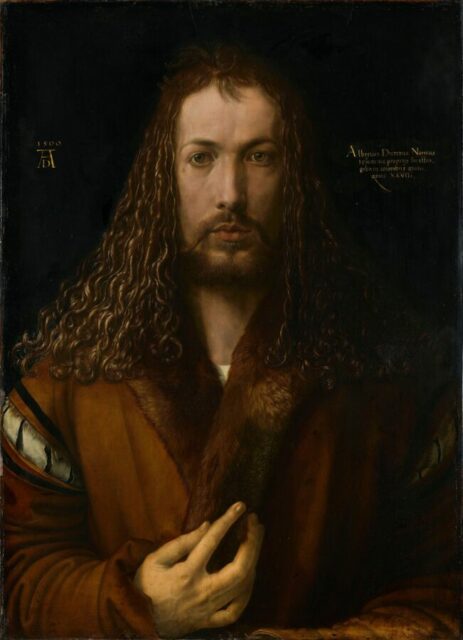
Albrecht Dürer was the first artist to paint a self-portrait. Here he stares out intensely — you can’t avoid his gaze. He’s decked out in a fancy fur-lined coat and perfectly permed hair. Dürer had recently returned from Italy and wanted to impress his fellow Germans with his sophistication. Dürer wasn’t simply vain. He’d grown accustomed, as an artist in Renaissance Italy, to being treated like a prince.

Dürer marks this snapshot with an exact place and time. To the left of his face is the year — “1500.” To the right is a Latin inscription saying “I, Albrecht Dürer from Nürnberg, painted myself with indelible colors at XXVIII years” (age 28).

Though still a young man, Dürer was now the most famous artist in Europe. His woodcut prints and engravings had been shared with thousands, thanks to the newly invented mass medium of the printing press. This painting has an engraver’s attention to detail. The hair is intricately braided into cascading ringlets. The skin texture is shaded just right. His well-cropped beard and finely curved lips are those of a handsome man. In the fur collar, you can see every individual hair. Dürer’s eyes radiate intelligence. It’s a very personal portrait of a real flesh-and-blood human being.

Portraits of real people were just coming into their own. During medieval times, only Christ and the saints were worth painting. Oh, a few kings and dukes got portraits, but these were usually photoshopped to show them in the best light. Artists never painted themselves. They were low on the societal totem pole, anonymous, considered blue-collar craftsmen who worked with messy paints.

But Dürer had visited Renaissance Italy, where he saw a revolution underway. Ordinary citizens were now deemed worthy to be depicted in all their everyday glory, warts and all. And artists — like Botticelli, Michelangelo, and Titian — were rock stars.

Dürer returned to Germany and created Europe’s first true selfies. This is a life-size, stand-alone portrait of himself, as rich and monumental and serious as any saint or king. In fact, look closely at Dürer’s intense, full-frontal gaze and raised hand. He looks exactly like a Christ from a medieval altarpiece, raising his hand in solemn blessing. This was the ultimate humanist statement. It focused on a man, not a saint, portraying him almost like Christ on earth — the artist as an instrument of God, carrying on his creation.

After Dürer, self-portraits became a thing. Raphael photobombed his own masterpiece, The School of Athens. Michelangelo painted his twisted self-portrait in The Last Judgment. Rembrandt’s self-portraits show the artist’s evolution — from unsure young man, to confident careerist, to brooding old man. Van Gogh added even more psychological intensity, and Picasso gave a backstage peek at his work process. Each artist’s self-portrait shows his emotional state, a glimpse at how beauty is born.

But ultimately, Dürer’s self-portrait is not a statement or a symbol, but just what it appears to be — a photorealistic snapshot of a very remarkable man. To hammer home his personal imprint, the artist signed the work with his distinct signature — a letter A arching over a D: Albrecht Dürer.

This art moment — a sampling of what we try to incorporate in our tours — is an excerpt from the full-color coffee-table book Europe’s Top 100 Masterpieces by Rick Steves and Gene Openshaw. Please support local businesses in your community by picking up a copy from your favorite bookstore, or you can find it at my online Travel Store. To enhance your art experience, you can find a clip related to this artwork at Rick Steves Classroom Europe; just search for Durer.