Here you can browse through my blog posts prior to February 2022. Currently I'm sharing my travel experiences, candid opinions, and what's on my mind solely on my Facebook page. — Rick

Hooray! Today Europe Re-Opens to Travelers (…Except for Americans)

As of today, the European Union has controlled the coronavirus well enough to open its doors to travelers from a list of countries that have been patient and disciplined in responsibly quelling the outbreak. Nearly all European countries, plus Canada, Japan, Australia, and even China, have qualified. Sadly, a few countries lacking in discipline, national leadership, and an embrace of science are not welcome — including Brazil, Russia, and the USA.

The permitted nations employed strict lockdowns, compulsory use of masks, and a careful and gradual reopening dictated by testing and contact tracing. In the United States, many individuals, mayors, and governors did their best to do the same. But nationally, we’ve had a patchwork response with virtually no federal leadership and a too-fast reopening driven more by impatience and economic concerns than by public health. And now, as Europe has things under control, in much of the US new cases are surging.

On the same day the EU announced their reopening plans, my tour company cancelled all remaining 2020 departures. We had been hoping that autumn might bring a return of Americans to Europe…but now it’s clear that we’re not yet ready for that privilege.

We’re still dreaming of Europe in 2021. But to make that happen, Americans need to come together and act more conscientiously and collectively to get our outbreak under control. The EU will reconsider which nations are welcome for non-essential visits every two weeks by measuring cases per 100,000 of population. Currently the EU reports 16 cases per 100,000, while rates in the US are 107 per 100,000 (nearly 7 times as high).

Happy travels, Canadians, Australians, Japanese, and Europeans! (And as for Americans…until we take this virus more seriously, we’ll have to settle for “visiting” Europe by streaming episodes of my TV show.)

For more details and commentary, my co-author Cameron Hewitt recently shared his perspective on how the coronavirus has impacted travel for Americans in Europe.
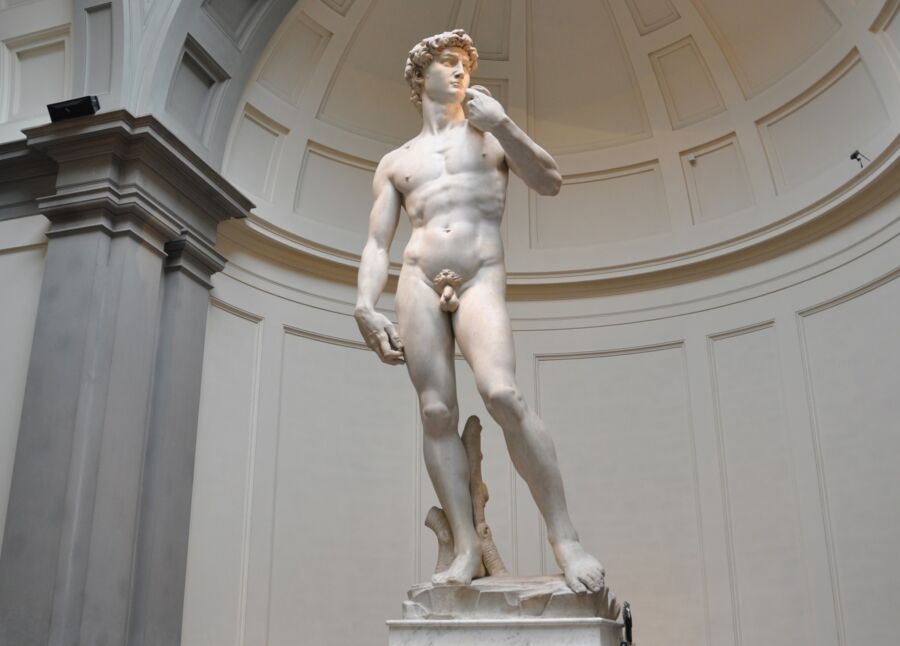
Daily Dose of Europe: Michelangelo’s David

When you look into the eyes of Michelangelo’s David, you’re looking into the eyes of Renaissance man.

As America continues to suffer crisis upon crisis, it has never been more important to broaden our perspectives and learn about the people and places that shape our world. And for me, one of the great joys of travel is seeing art masterpieces in person. Learning the stories behind great art can shed new light on our lives today. Here’s one of my favorites.

This six-ton, 17-foot-tall symbol of divine victory over evil represents a new century and a whole new Renaissance outlook. It’s the age of Columbus and Classicism, Galileo and Gutenberg, Luther and Leonardo — of Florence and the Renaissance.

In 1501, Michelangelo Buonarroti, a 26-year-old Florentine, was commissioned to carve a large-scale work for Florence’s cathedral. He was given a block of marble that other sculptors had rejected as too tall, shallow, and flawed to be of any value. But Michelangelo picked up his hammer and chisel, knocked a knot off what became David’s heart, and started to work.

He depicted a story from the Bible, where a brave young shepherd boy challenges a mighty giant named Goliath. David turns down the armor of the day. Instead, he throws his sling over his left shoulder, gathers five smooth stones in his powerful right hand, and steps onto the field of battle to face Goliath.

Michelangelo captures David as he’s sizing up his enemy. He stands relaxed but alert, leaning on one leg in the classical contrapposto pose. In his left hand, he fondles the handle of the sling, ready to fling a stone at the giant. His gaze is steady — searching with intense concentration, but also with extreme confidence. Michelangelo has caught the precise moment when David is saying to himself, “I can take this guy.”

David is a symbol of Renaissance optimism. He’s no brute. He’s a civilized, thinking individual who can grapple with and overcome problems. He needs no armor, only his God-given physical strength and wits. Look at his right hand, with the raised veins and strong, relaxed fingers — many complained that it was too big and overdeveloped. But this is the hand of a man with the strength of God on his side. No mere boy could slay the giant. But David, powered by God, could…and did.

Though the statue was intended to stand atop the cathedral, it long stood in an even more prominent spot — guarding the entrance of Town Hall. Renaissance Florentines identified with David. Like him, they considered themselves God-blessed underdogs fighting their city-state rivals. In a deeper sense, they were civilized Renaissance people slaying the ugly giant of medieval superstition, pessimism, and oppression. They were on the cusp of our modern age.

Today, David is displayed safely indoors at the Accademia, under a glorious dome at the end of a church-like nave lined with other statues by Michelangelo. You can approach as a camera-toting tourist or as a pilgrim finding inspiration in this “cathedral of humanism.” David stands as the ultimate symbol of the Renaissance — of optimism, humanism, and all that’s good in the human race.

This art moment — a sampling of how we share our love of art in our tours — is an excerpt from the new, full-color coffee-table book Europe’s Top 100 Masterpieces by Rick Steves and Gene Openshaw. Please support local businesses in your community by picking up a copy from your favorite bookstore, or you can find it at my online Travel Store.  To enhance your art experience, you can find a clip related to this artwork at Rick Steves Classroom Europe; just search for Accademia.

Daily Dose of Europe: Bosch’s Garden of Earthly Delights

Five centuries of scholars have puzzled, pondered, and pontificated over the meaning of this cryptic triptych. Whatever it ultimately means, the large three-panel painting, with its wonderland of eye-pleasing details, is a garden of artistic delights.

As America continues to suffer crisis upon crisis, it has never been more important to broaden our perspectives and learn about the people and places that shape our world. And for me, one of the great joys of travel is seeing art masterpieces in person. Learning the stories behind great art can shed new light on our lives today. Here’s one of my favorites.

Today, the triptych is a highlight of Madrid’s famous art gallery, El Prado. The basics are pretty similar to other more traditional altarpieces. Hieronymus Bosch painted the story of mankind, from the innocence of creation (left panel), to the sensual pleasures of life on Earth (center), to the fate of sinners in hell after the Last Judgment (right panel).

The left panel is a fantasy Garden of Eden. The world is fresh, everything is in its place, the animals behave virtuously, and even God looks young. Adam and Eve — naked and innocent — get married, with God himself performing the ceremony.

The central panel depicts the Garden of Earthly Delights (that gives the whole work its name). It’s a riot of naked men and women, black and white, on a perpetual spring break — eating exotic fruits, dancing, kissing, cavorting with strange animals, and contorting themselves into a Kama Sutra of sensual positions. In the background rise the fantastical towers of a medieval Disneyland. It’s seemingly a fantasy land of pleasures and earthly delights. But where does it all lead? Men on horseback ride round and round, searching for but never reaching the elusive Fountain of Youth. People frolic in earth’s “Garden,” seemingly oblivious to where they came from (left) and where they may end up…

Now, go to hell. It’s a burning Dante’s Inferno-inspired wasteland where genetic-mutant demons torture sinners. Everyone gets their just desserts, like the glutton who is eaten and excreted into the bowels of hell, the musician strung up on his own harp (a symbol of lust), the gamblers with their table forever overturned, and the sexual harasser hit on by a pig-faced nun. In the center, hell is literally frozen over. Dominating it all, a creature with a broken eggshell body and tree-trunk legs stares out — it’s the face of Bosch himself.

So what does it all mean? So little is known about the Flemish painter Hieronymus Bosch (c. 1450–1516) that it’s hard to guess his intent. The basic message is that the pleasures of earthly life are fleeting. But if so, is it a condemnation of those “earthly delights” (which lead to hell) or a celebration (to enjoy them while you can)? The frolicking figures of the central panel sure look like they’re having a great time, like innocent kids at play, exploring their bodies and the wonders of the world with no sense of shame. Even the gruesome imagery of hell has a certain black humor to it. It could be that Bosch, who painted numerous standard altarpieces, made this as a kind of secular altarpiece for his sophisticated Burgundian patrons. Or, with its infinitely imaginative innovations, it could be nothing less than an 85-square-foot window into the strange mind of Hieronymus Bosch.

This art moment — a sampling of how we share our love of art in our tours — is an excerpt from the new, full-color coffee-table book Europe’s Top 100 Masterpieces by Rick Steves and Gene Openshaw. Please support local businesses in your community by picking up a copy from your favorite bookstore, or you can find it at my online Travel Store. To enhance your art experience, you can find a clip related to this artwork at Rick Steves Classroom Europe; just search for Prado.

Daily Dose of Europe: Klimt’s The Kiss

Need a break from the headlines? Spend a few moments lingering over this beautiful painting of a couple in love.

As America continues to suffer crisis upon crisis, it has never been more important to broaden our perspectives and learn about the people and places that shape our world. And for me, one of the great joys of travel is seeing art masterpieces in person. Learning the stories behind great art can shed new light on our lives today. Here’s one of my favorites.

A couple kneels on the edge of a grassy precipice. The man bends down to kiss the woman on the cheek. Their bodies intertwine: He cups her face in his hands; she presses against him and wraps one arm around his neck while touching her other hand to his. The two lovers are wrapped up in the colorful gold-and-jeweled cloak of bliss. It’s just the two of them, lost in the golden glow of the moment.

The Austrian painter Gustav Klimt was channeling the erotic spirit of turn-of-the-century Vienna. The city was wealthy and sophisticated, but also the capital of a fading Old World empire — making it a splendid laboratory of decadence and hedonism. To Klimt, all art was erotic art. He loved painting alluring women and embracing couples. (Some suggest the man in The Kiss is Klimt himself.) Though he gained a bad-boy reputation for wallowing in the degenerate side of sensuality, Klimt made The Kiss all about sweetness: the innocent affection of two people in love.

Klimt’s technique reinforces The Kiss’ romantic side. He used real gold and silver (along with traditional oil paints) to give it the radiant glow of desire. He emphasizes the man’s masculinity with a robe of sturdy geometrical shapes, while the woman is all flowery femininity. The couple comes together in a harmony of color. The shimmering patterns on the robes — flowers, vines, swirls, and rectangles — are similar to what Art Nouveau interior decorators were putting on chairs, dishes, and bedroom walls in sumptuous Viennese apartments. Klimt sets the whole scene of The Kiss inside a perfectly square frame, enclosing the lovers in a world of their own.

The Kiss stands on the cusp between traditional 19th-century art and 20th-century Modernism. On the one hand, it’s a pretty realistic scene of two people. But there’s no background giving it 3-D depth, and the whole scene flattens out into a 2-D cardboard-cutout of patterns and colors — foreshadowing abstract art.

But The Kiss is about passion, not analysis. The couple glows with an inner radiance, lost in a world full of pollen and pistils. The only thing that emerges from this 2-D pattern of paint is the woman’s face. She turns out, and we can see her reaction: Her eyes close, her cheeks flush, a faint smile paints her lips, and she squirms in pleasure, as she succumbs to the pleasure of The Kiss.

This art moment — a sampling of how we share our love of art in our tours — is an excerpt from the new, full-color coffee-table book Europe’s Top 100 Masterpieces by Rick Steves and Gene Openshaw. Please support local businesses in your community by picking up a copy from your favorite bookstore, or you can find it at my online Travel Store. To enhance your art experience, you can find a clip related to this artwork at Rick Steves Classroom Europe; just search for Klimt.

Daily Dose of Europe: Giotto’s Scrovegni Chapel

One thing I miss about traveling in Europe is stepping into a gorgeous space slathered with fine art. And the Scrovegni Chapel, in the Italian town of Padua, is one of my favorite lesser-known examples.

As America continues to suffer crisis upon crisis, it has never been more important to broaden our perspectives and learn about the people and places that shape our world. And for me, one of the great joys of travel is seeing art masterpieces in person. Learning the stories behind great art can shed new light on our lives today. Here’s one of my favorites.

Wallpapered with Giotto’s beautifully preserved cycle of 38 frescoes, the glorious Scrovegni Chapel depicts the life of Jesus with unprecedented realism. Painted around 1305, two full centuries before the High Renaissance, it’s considered to be the first piece of “modern” art. Europe was breaking out of the Middle Ages, and Giotto was painting real people in real scenes, expressing real human emotions.

The walls of this long, narrow chapel were Giotto’s canvas to tell the three-generation history of Jesus. Giotto’s storytelling style is straightforward, and anyone with knowledge of the episodes of Jesus’ life can read the chapel like a comic book.

It begins in the chapel’s upper corner with a heartbreaking episode that draws the viewer right in. Jesus’ grandpa, Joachim, is humiliated because he can’t produce a child. He returns dejectedly home, where miraculously, his wife gives birth to Mary, the mother of Jesus.

From this humble start, the story spirals clockwise around the chapel, from top to bottom: We see Jesus being born in a manger, baptized by John the Baptist, performing miracles, and so on. “Turning the page” to the chapel’s other wall, Giotto begins Jesus’ traumatic final days: the Last Supper, Jesus’ arrest, and the Crucifixion. The story concludes on the rear wall with a giant fresco of Jesus reigning at the Last Judgment. And all this unfolds beneath a blue, starry sky overhead on the chapel ceiling.

Jesus’ life was so eventful that Giotto had to crystalize the story into just a few evocative scenes. He captures all the drama of the Passion in the Betrayal of Christ panel — a.k.a. Il Bacio, or “The Kiss.” Amid the chaos of battling soldiers, Giotto directs your eye to the crucial action in the center. There, Judas ensnares Jesus in his yellow robe (the color symbolizing envy), establishes meaningful eye contact, and kisses him. Jesus’ stone-faced response to his supposed friend says it all.

At age 35, at the height of his powers, Giotto tackled the Scrovegni, painting the entire chapel in 200 working days.

His frescoes were groundbreaking: more realistic, 3-D, and human than anything seen in a thousand years. Giotto set his religious scenes in the everyday world of rocks, trees, and animals. So, when Joachim returns home, his faithful dog leaps up to greet him, frozen realistically in mid-air. Giotto’s people, with their voluminous, deeply creased robes, are as sturdy and massive as Greek statues. They exude stage presence. Their gestures are simple but expressive: A head tilted down says dejection, clasped hands indicate hope.

Giotto’s Scrovegni Chapel represents a turning point not only for European art, but also for a whole new way of thinking. It was Humanism — away from scenes of heaven and toward a more down-to-earth view, with man at the center.

This art moment — a sampling of how we share our love of art in our tours — is an excerpt from the new, full-color coffee-table book Europe’s Top 100 Masterpieces by Rick Steves and Gene Openshaw. Please support local businesses in your community by picking up a copy from your favorite bookstore, or you can find it at my online Travel Store. To enhance your art experience, you can find a clip related to this artwork at Rick Steves Classroom Europe; just search for Scrovegni.