Here you can browse through my blog posts prior to February 2022. Currently I'm sharing my travel experiences, candid opinions, and what's on my mind solely on my Facebook page. — Rick

Daily Dose of Europe: Venice’s Cicchetti Crawl

Venice may be empty of tourists this summer. But in normal times, the city entertains millions of visitors each year. On a recent trip, a Venetian friend told me that almost every restaurant caters to the tourists. Then, with a sly smile, he added, “But there are still the cicchetti bars.”

Even though we’re not visiting Europe right now, I believe a daily dose of travel dreaming can be good medicine. I just published a collection of my favorite stories from a lifetime of European travels. My new book is called “For the Love of Europe” — and this story is just one of its 100 travel tales.

Cicchetti (pronounced chi-KET-tee) are the local appetizers that line the counters of little pubs all over Venice at the end of each workday. My favorite meal is what I call “The Stand-Up Progressive Venetian Pub-Crawl Dinner.” In a town with canals and no cars, pub-crawling is easy and safe — perhaps safer if you know how to swim. Tonight I’ll visit a series of these characteristic hole-in-the-wall pubs, eating ugly-looking morsels on toothpicks, and washing it all down with little glasses of wine. I look forward to the local characters I’ll meet along the way. Cicchetti bars have a social standup zone with a cozy gaggle of tables. In some of the more popular places, the crowds spill happily into the street.

Venetians call this pub crawl the giro d’ombra. Giro means “stroll,” and ombra — slang for a glass of wine — means “shade.” It dates back to the old days, when a portable wine bar scooted with the shadow of the Campanile bell tower across St. Mark’s Square. That wine bar is long gone, but the cicchetti bars remain, tucked away in the perpetual shade of the back streets.

While Venice is, it seems, sinking in tourist crowds, I’d bet 90 percent of those tourists gather along the glitzy shopping streets between the Rialto Bridge and St. Mark’s Square. To find a characteristic cicchetti bar, you have to wander. I don’t worry about getting lost — in fact, I get as lost as I can. I remind myself, “I’m on an island and I can’t get off.” Even though there generally aren’t street names, when I want to find my way, I simply look for small signs on the corners directing me to the nearest landmark (e.g., “per Rialto”).

The cicchetti selection is best early, so I start my evening at 6 p.m. It’s in the far reaches of Venice that I bump into the thriving little bacari (as the local pubs are called). I ask for “un piatto classico di cicchetti misti da otto euro” and get a classic plate of assorted appetizers for €8. I sample deep-fried mozzarella cheese, gorgonzola, calamari, and artichoke hearts. Crostini (small pieces of toasted bread with a topping) are also a favorite, as are marinated seafood, olives, and prosciutto with melon. Meat and fish (pesce) munchies can be expensive, but veggies (verdure) are cheap. Bread sticks (grissini) are free for the asking.

Part of the attraction is the funky decor. There are photos of neighborhood friends here for a family party; St. Mark’s Square the morning after a wild Pink Floyd concert; Carnevale masks evoking a more mysterious past; and of old-time Venice, proving that people may change but the buildings remain essentially the same.

Venetians kick off the experience with an aperitivo, a before-dinner drink. Know your options. A blackboard usually lists several fine wines that are uncorked and available by the glass. Most nights, I get a small glass of house red or white wine (ombra rosso or ombra bianco). Tonight, I’m in the mood for an Aperol spritz — it makes me feel more local.

A man asks me, “Le dispiace se mi siedo qui?” (Do you mind if I sit here?) before sitting down next to me. It occurs to me that’s a handy, polite phrase for making new friends. He orders a drink and food. When his plate of fish arrives, he picks up one of the tiny fish, delicately tied in a loop. Holding it by the toothpick that harpoons it, he looks at it lovingly, says, “Sei il mio piu bel ricordo” (“You are my most beautiful souvenir”), and pops it happily into his mouth. Pushing over his plate, he offers one of the fish to me.

Connecting with people makes a pub crawl more fun: You can meet an Italian, learn some Italian, eat better…and collect your own beautiful souvenirs.

This story appears in my newest book, For the Love of Europe — collecting 100 of my favorite memories from a lifetime of European travel. Please support local businesses in your community by picking up a copy from your favorite bookstore, or you can purchase it at my online Travel Store. You can also find a clip related to this story at Rick Steves Classroom Europe; just search for Cicchetti.
Daily Dose of Europe: The Castles of Boyhood Dreams

The magic of Europe can make any traveler feel like a kid again. And one of my favorite places for that “king-of-the-castle” feeling is in the Bavarian and Tirolean Alps.

Even though we’re not visiting Europe right now, I believe a daily dose of travel dreaming can be good medicine. I just published a collection of my favorite stories from a lifetime of European travels. My new book is called “For the Love of Europe” — and this story is just one of its 100 travel tales.

South of Munich in the foothills of the Alps is Hohenschwangau Castle. It was “Mad” King Ludwig’s father’s castle — and Ludwig’s boyhood summer home. When his father died, Ludwig became king. He was just a boy, 19 years old. And rather than live with the frustrations of a modern constitution and a feisty parliament in Munich reining him in, King Ludwig II spent his next years lost in Romantic literature and operas…hanging out here with composer Richard Wagner as only a gay young king could.

The king’s bedroom was decked out like a fairy tale. The walls were painted in 1835 by a single artist, who gave the place a romantic, Tolkien fantasy feel. Lounging nymphs still flank the window and stars twinkle from the ceiling. A telescope stands as it did for the king, trained on a pinnacle on a distant ridge where Ludwig dreamed of building his ultimate castle fantasy: Neuschwanstein. On my first visit here, squinting through that telescope at Neuschwanstein (which had also inspired a boy named Walt Disney), I could relate to the busy young king. Bound by schoolwork and house rules rather than a constitution and parliament, with a stretched-out turtleneck and zits rather than crowns and composer friends, I too built a castle.

What I had that Ludwig lacked was a father who imported pianos. Shipped from Germany, they came encased in tongue-in-groove pine, sealed in a thick envelope of zinc sheeting. My wooden tree house was my castle: walls decorated with romantic 1968 magazines, the nails shining through the ceiling just long enough to bloody intruding bullies taller than me. Taking full advantage of those sliding pine boards, I could see who was coming. With a shiny zinc roof, my palace was the envy of other little kings. There was no tree house like it. Then, someone purchased the vacant lot next to our house, and I had to tear my tree castle down. At the time, I considered it the worst day of my life. Not long after, I embarked on my first no-parents trip to Europe. Touring Neuschwanstein, I relived my loss.

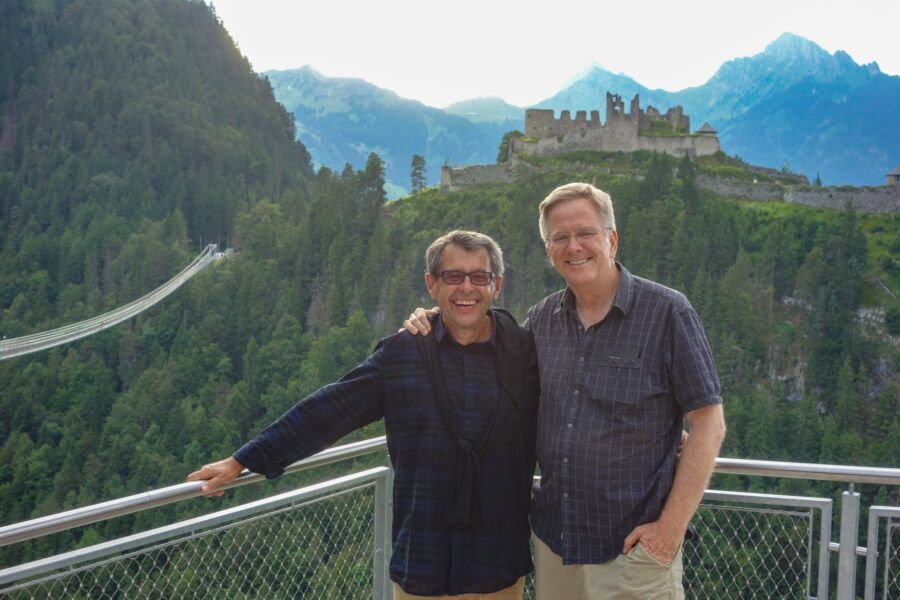
On that same trip, just over the border in Austria near the town of Reutte, I found another castle: the brooding ruins of the largest fort in Tirol — Ehrenberg. This impressive complex was built to defend against the Bavarians and to bottle up the strategic “Via Claudia” trade route that cut through the Alps here, connecting Italy and Germany. One castle crowned its bluff while another was high above on the next peak. Exploring the ruins, I climbed deep into a misty forest littered with meaningless chunks of castle wall — each pinned down by pixy-stix trees and mossy with sword ferns. This once strategic and powerful fortress had somehow fallen apart and was slowly being eaten by the forest.

My friend Armin Walch, an archaeologist who lives in Reutte, had a vision to bring these ruins to life. He was born the same year as me and pursued his project like the Indiana Jones of castle scholars. Today, with European Union funding, he’s cut away the hungry forest to reveal and renovate what he calls the castle ensemble. And it’s open for business, enabling countless children to live out their medieval fantasies, leaping from rampart to rampart with sword ferns swinging.

On my last visit, I was honored for bringing so many visitors to this remote corner of Austria over the years. With Armin as the jovial master of ceremonies, the town’s hoteliers and tourism folks gathered in the castle like a council of medieval lords. Together we ate smoked game and rustic cheese with coarse bread. We swilled wine and clinked pewter mugs. I gave an impromptu speech about the wonders of Americans climbing through history far from home. Then I knelt before a man in armor who drew a shiny sword with my name etched upon it, and was knighted — Sir Rick, first knight of Ehrenberg.

The sword was my gift. It was solid and sparkled with sentiment. I loved how it felt in my hand as I swung it back and forth, cutting through the air — and how it symbolically wove together my tree-house childhood, my love of history, my longtime connection with Reutte, and Armin’s vision. But the last thing I needed was to be packing a big sword through the rest of my trip. So I requested that my sword stay in the museum as a special exhibit on the castle-loving boy from Seattle who fell in love with the Ehrenberg ruins and then grew up to bring decades of American travelers to Reutte with his guidebooks.

On the way back to my hotel, Armin took me to his house for a drink. As a talented architect, he had cleverly hidden his sleek, futuristic, and creative pad behind a humble old-town facade. It was a royal domain for his family — two kids cozy on the carpet and a beautiful wife. Armin had bedazzled her at the university in Vienna and brought her here to remote Reutte with promises of a queenly life and a bitchin’ castle.

Armin and I climbed boyishly to his rooftop — a perch he designed to view Ehrenberg. Together we shared a glass of schnapps flavored with local herbs and peered through his telescope at our favorite castle complex — now illuminated by powerful floodlighting. In his youth — before he excavated it — almost no one knew about the fortress that hid beneath the trees on the mountain. Nudging me aside, Armin took his turn squinting through his telescope. Happy as two boys in a tree house, like two Romantic Age princes, we marveled at this castle of his dreams.

This story appears in my newest book, For the Love of Europe — collecting 100 of my favorite memories from a lifetime of European travel. Please support local businesses in your community by picking up a copy from your favorite bookstore, or you can purchase it at my online Travel Store. You can also find a clip related to this story at Rick Steves Classroom Europe; just search for Neuschwanstein and Ehrenberg.

Daily Dose of Europe: Renoir’s “Dance at the Moulin de la Galette”

This painting captures the joyful beauty of France’s belle époque, when Paris was a global center of prosperity, technology, opera, ballet, and high fashion. Artists flocked there to catch the magic on canvas.

As America continues to suffer crisis upon crisis, it has never been more important to broaden our perspectives and learn about the people and places that shape our world. And for me, one of the great joys of travel is seeing art masterpieces in person. Learning the stories behind great art can shed new light on our lives today. Here’s one of my favorites.

On Sunday afternoons, working-class Parisians would dress up and head for the bucolic hill overlooking Paris called Montmartre. They’d gather in outdoor cafés to dance, drink, and eat little crêpes (called galettes) until dark. Renoir would go there, too, to paint the common Parisians living and loving in the afternoon sun.

In Renoir’s glowing scene, the sunlight filters through the trees, creating a kaleidoscope of colors, like a 19th-century disco ball throwing darts of light onto the dancers. Renoir conveys the dappled light with quick blobs of yellow paint. The light speckles the ground, the men’s jackets, and the sun-dappled straw hats. You can almost smell the fragrant powder on the ladies’ faces. The painting glows with bright colors. Even the shadows on the ground, which should be gray or black, are colored a warm blue. The paint is thin and translucent, and the outlines are soft, so the figures blend seamlessly with the background. Like a photographer who uses a slow shutter speed to show motion, Renoir paints a waltzing blur.

Along with his good friend Claude Monet, Renoir embraced Impressionism. Stifled by the stuffy atmosphere of the conventional art scene in Paris, they took as their motto, “Out of the studio and into the open air.” They grabbed their berets and scarves (and their newly invented tubes of premixed paint) and set up their easels right on the spot — on riverbanks, hillsides, cafés…or in the fields of Montmartre. Gods, goddesses, nymphs, and fantasy scenes were out. Common people in their everyday lives were in. The result? Light! Color! Vibrations! You don’t hang an Impressionist canvas — you tether it.

Renoir features Impressionism’s trademark bright colors, easygoing open-air scenes, spontaneity, broad brushstrokes, and the play of light. He made this canvas shimmer with a simple but revolutionary technique. Look at the dancing woman to the left, in a “pink” dress. If you look real close, you’d see that the dress is actually a messy patchwork of individual brushstrokes of different colored paint. But as you back up…Voilà! The colors blend in the eye. So while your eye is saying “pink,” your subconscious is shouting, “Red! White! Gray! Blue! Yes!”

Renoir always painted things that were unabashedly pretty — happy scenes of rosy-cheeked women, rendered in a warm, inviting style. As Renoir liked to say, “There are enough ugly things in life.”

This art moment — a sampling of how we share our love of art in our tours — is an excerpt from the new, full-color coffee-table book, “Europe’s Top 100 Masterpieces,” by Rick Steves and Gene Openshaw. Please support local businesses in your community by picking up a copy from your favorite bookstore, or you can find it at my online Travel Store. To enhance your art experience, you can find a clip related to this artwork at Rick Steves Classroom Europe; just search for Renoir.

Daily Dose of Europe: Cold War Memories in Budapest

Staying close to home this summer has got me nostalgic for recent trips…and for long-ago ones, too. Back during the Cold War, I had some eye-opening travels to communist Hungary.

Even though we’re not visiting Europe right now, I believe a daily dose of travel dreaming can be good medicine. I just published a collection of my favorite stories from a lifetime of European travels. My new book is called “For the Love of Europe” — and this story is just one of its 100 travel tales.

Back in the 1980s, on a train heading for Budapest, I stood in the aisle with my elbows on the edge of an open window, enjoying the moonlit countryside rushing by. I was soon joined by a Czech woman who was doing the same thing. She told me she was on her first trip out of her country. I asked her if she was excited about visiting Budapest. She said she was most excited about eating a McDonald’s hamburger. The buzz throughout Eastern Europe was that Hungary had just opened a branch of the American chain.

If communism was a religion during the Cold War, Budapest was Eastern Europe’s sin city, offering tourists from communist countries a taste of the decadent West: rock concerts, Adidas sports gear, and the first McDonald’s east of the Iron Curtain. Back then, eating a Big Mac was an act of defiance. There was nothing fast or cheap about Western “fast food.” A Happy Meal was a splurge. People traveling from other communist countries to Hungary waited in lines that stretched around the block for a burger, fries, and a Coke. Ronald McDonald stood on the street corner like a heretic prophet, cheering on the downtrodden proletariat, while across the street, wannabe capitalists drooled over window displays featuring running shoes that cost two months’ wages.

As I visit Budapest today, it’s clear that the younger generation of Eastern Europeans has no memory of the communist era. Enough time has passed that former Warsaw Pact nations can take an honest look at the period.

My first stop on this trip is the House of Terror, long the headquarters of communist Hungary’s secret police. When the Communists moved into Budapest after World War II, their secret police took over the Nazis’ secret police headquarters. It was here that Hungarians suspected of being “enemies of the state” were given sham trials, tortured, and routinely executed. The museum’s atrium features a Soviet tank and a vast wall plastered with portraits of victims. Exhibits cover gulag life, Social Realist art, and propaganda. A labyrinth built of pork-fat bricks reminds old-timers of the harsh conditions in the 1950s, when lard on bread was the standard dinner.

I enter the elevator to continue into the museum. As it slowly descends, a guard on video explains the execution process. When the door opens, I step into the basement chambers of torture and death. In 1956, the blood was hosed away and this cellar was made a clubhouse for the local communist youth club. In the museum today, it has been restored to its condition circa 1955, with chilling prison cells instead of ping-pong tables and chess sets.

In the museum’s poignant finale, the “walls of victimizers” are lined with the photos and biographical information of members and supporters of both the Nazi and communist secret police — many of whom are still living and were never brought to justice. The House of Terror must be a particularly powerful experience for elderly Hungarians who actually knew many of the victims of the secret police…and who remain neighbors of the victimizers.

When regimes fall, so do their monuments. Across Eastern Europe, statues of Stalin, Lenin, and their local counterparts came crashing to the ground. In Budapest, these stony reminders of communist tyranny are collected in Memento Park, where tourists flock to get a taste of the communist era. I head over for a lesson in Social Realism, the art of communist Europe. Under the communists, art wasn’t just censored. It was acceptable only if it furthered the goals of the state. Aside from a few important figureheads, individuals didn’t matter. Statues featured the generic working man or working woman. Everyone was a cog in the machine — unquestioning servants of the nation.

Wandering through Memento Park, I’m entertained by the jumbled collection of once fearsome and now almost comical statues. While they seem to preach their ideology to each other, locals and tourists take funny photos mocking them. The gift shop hawks a fun parade of communist kitsch. I pick up a Stalin vodka flask and a CD featuring 20 patriotic songs — The Greatest Hits of Communism. It occurs to me that Stalin — whose estate gets no royalties for all the merchandise featuring his dour mug — must be spinning in his communist grave.

This story appears in my newest book, For the Love of Europe — collecting 100 of my favorite memories from a lifetime of European travel. Please support local businesses in your community by picking up a copy from your favorite bookstore, or you can purchase it at my online Travel Store. You can also find a clip related to this story at Rick Steves Classroom Europe; just search for Budapest.

Daily Dose of Europe: Seaside Traditions in Portugal’s Nazaré

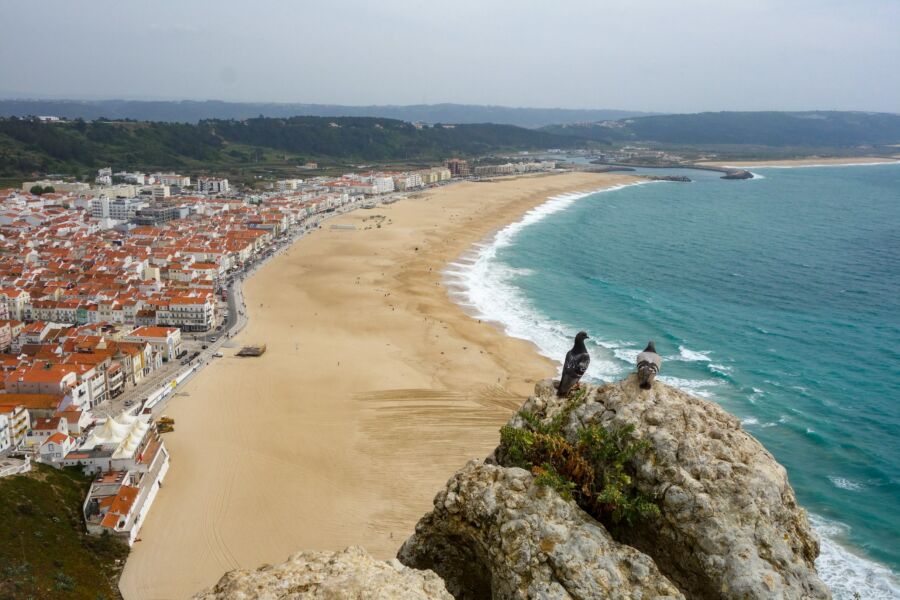
Perched on a far corner of Europe, a bit like these two birds, Nazaré is one of my favorite beach towns anywhere. It greets me with the energetic applause of the surf, widows with rooms to rent, and fishermen mending nets.

Even though we’re not visiting Europe right now, I believe a daily dose of travel dreaming can be good medicine. I just published a collection of my favorite stories from a lifetime of European travels. My new book is called “For the Love of Europe” — and this story is just one of its 100 travel tales.

This fishing-town-turned-tourist-retreat, set between cork groves and eucalyptus trees and the open sea, is a place to relax in the sun. In Nazaré, I join a world of ladies in petticoats and men who still stow cigarettes and fishhooks in their stocking caps.

Settling into a grungy fishermen’s bar, I order a plate of barnacles. Yes, barnacles — called percebes here. My waiter is happy to demonstrate how to eat them: dig your thumb between the shell and the leathery skin to rip the skin off. The meat stays attached to the shell. Bite that off victoriously and wash it down with local beer. Fresh barnacles are expensive, as they cling to rocks in the turbulent waves along the coast and are difficult and dangerous to harvest. Savoring my plate of barnacles at sundown, I gaze out at the surf attacking that stark bluff. Because I know that’s where they were gathered just hours ago, investing in a plate of barnacles feels like money well spent. I’m enjoying the endearing charms of unassuming Nazaré being itself.

Though many locals seem older than most of its buildings, the town feels like a Portuguese Coney Island — humming with young people who flock here for the beach. Off-season, it’s almost tourist-free — the perfect time to take in the wild surf and get a feel for a traditional way of life.

The town’s layout is simple: a grid of skinny streets with sun-bleached apartment blocks stretching away from an expansive beach. The beach — in many places as wide as a soccer field — sweeps from the new harbor in the south to stark cliffs in the north.

It seems that most of Nazaré’s 15,000 inhabitants are in the tourist trade. But somehow traditions survive and it’s not hard to find pockets of vivid and authentic culture. I stroll through the market and wander the back streets where people happily trade ocean views for a little shade. Laundry flaps in the wind, kids ride plastic trikes, and fish sizzle over tiny curbside hibachis.

Nazaré is famous for its traditionally clad women who — at least according to local lore — wear skirts with seven petticoats. Is that one for each day, or for the seven colors of the rainbow, or…? Make up your own legend. While the story you’ll hear may be an invention for the tourists, it contains an element of truth. In the old days, women would wait on the beach for their fishermen to sail home. To keep warm in the face of a cold sea wind, they’d wear several petticoats so they could fold layers over their heads, backs, and legs as needed. Even today, older and more traditional women wear skirts made bulky by several — but maybe not seven — petticoats. The ensemble — with boldly clashing colors — is completed with house slippers, a hand-embroidered apron, woolen cape, head scarf, and flamboyant jewelry, including chunky gold earrings (often passed down from mother to daughter).

People-watching here is like going to a living art gallery. The beach, tasty seafood, and a funicular ride are the bright lights of my lazy memories. The funicular — which leads from the beach up to the Sitio neighborhood atop the cliffs — was built in 1889, the same year as the Eiffel Tower (and was designed by a disciple of Eiffel).

Sitio, with its own church, museum, and main square, feels like a separate village. Marking a rocky viewpoint high above Nazaré, a stone memorial honors the explorer Vasco da Gama, who stopped here before leaving Europe for India. Next to that, a little chapel marks the spot where a much-venerated statue of the Black Madonna was hidden in the rocks throughout four centuries of Muslim Moorish rule before it was rediscovered during the 12th-century Christian Reconquista. (When it comes to enjoying legends like these, gullibility is a skill that serves me well.)

Back down along the beach, a local folk-music group plays and dances. This troupe — with petticoats twirling to the beat of a percussion section of bongo gourds and extra-large pinecones grating against each other — has been kicking up sand since 1934.

When these dancers were younger, the vast beach was littered with colorful fishing boats that were hauled in by oxen or teams of fishermen. But ever since a new harbor was built south of town, the working boats have been moored out of sight. Today, only a few historic vessels remain, ornamenting the sand. On the boardwalk — an artful and traditional mosaic pavement of black and white stones — squadrons of sun-dried and salted fish are stretched out on nets left under the midday sun. Locals claim they’re delicious…but I’d rather eat barnacles.

This story appears in my newest book, For the Love of Europe — collecting 100 of my favorite memories from a lifetime of European travel. Please support local businesses in your community by picking up a copy from your favorite bookstore, or you can purchase it at my online Travel Store. You can also find a clip related to this story at Rick Steves Classroom Europe; just search for Nazaré Portugal.