Here you can browse through my blog posts prior to February 2022. Currently I'm sharing my travel experiences, candid opinions, and what's on my mind solely on my Facebook page. — Rick
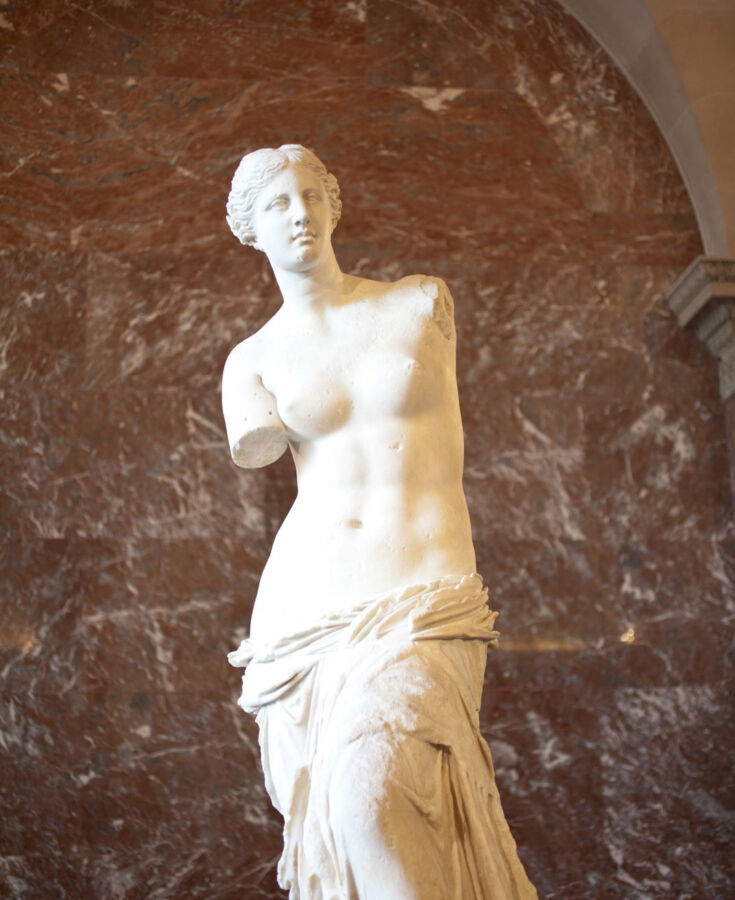
The Venus de Milo — the goddess of love, sculpted in about 100 BC — sums up all that ancient Greece stood for.
As America continues to suffer crisis upon crisis, it has never been more important to broaden our perspectives and learn about the people and places that shape our world. And for me, one of the great joys of travel is seeing art masterpieces in person. Learning the stories behind great art can shed new light on our lives today. Here’s one of my favorites.
The Venus de Milo created a sensation when it was discovered in 1820, on the Greek island of Milos. Europe was already in the grip of a classical fad, and this statue was a hit. The ancient Greeks pictured their gods in human form — which meant that humans are godlike. Venus’ well-proportioned body embodied the balance and orderliness of the Greek universe.
Split Venus down the middle from nose to toes and see how the two halves balance each other. Venus rests on her right foot (that contrapposto pose so popular with classical sculptors). She then lifts her left leg, setting her whole body in motion. It’s all perfectly realistic: As the left leg rises, her right shoulder droops down. And as her knee points one way, her head turns the other. Despite all this motion, the impression is one of stillness, as Venus orbits slowly around a vertical axis. The twisting pose gives a balanced S-curve to her body. The balance between fleeting motion and timeless stability made beauty.
Other opposites balance as well, like the smooth skin of the upper half of her body that sets off the rough-cut texture of her dress. She’s actually made from two different pieces of stone plugged together at the hips (you can see the seam). The face, while realistic and anatomically accurate, is also idealized — like a goddess, she’s too generic and too perfect. This isn’t any particular woman, but Everywoman — all the idealized features that appealed to the Greeks.
The statue became famous for a number of reasons. Venus’ classic beauty was seen as the ideal of female grace. The statue is a rare Greek original, not a Roman copy. Its sudden discovery (by a humble Greek farmer) made great news copy.
Most of all, Venus brought with her an air of mystery. Who was this beautiful woman? She’s probably Venus, but no one knows for sure. What is she thinking? Her expression is alluring yet aloof. Her dress dangles suggestively; she’s both modestly covering her privates but hinting at more.
And what were her arms (which were never found) doing? No one knows. Some say her right arm held her dress, while her left arm was raised. Others think she was hugging a statue of a man or leaning on a column. I say she was picking her navel.
Regardless, though Venus’ arms have been lost over the centuries, her eternal beauty remains intact.
This art moment — a sampling of how we share our love of art in our tours — is an excerpt from the new, full-color coffee-table book, “Europe’s Top 100 Masterpieces,” by Rick Steves and Gene Openshaw. Please support local businesses in your community by picking up a copy from your favorite bookstore, or you can find it at our online Travel Store. To enhance your art experience, you can find a clip related to this artwork at Rick Steves Classroom Europe; just search for Louvre.
Homebound now rather than exploring Europe, I’ve been thinking a lot about places that pry open my hometown blinders…places that rearrange my cultural furniture…that make me a bit less self-assured about the best ways to run a society. You actually realize smart and caring people deal with the great moral challenges that confront us all differently. And while for some, that is a good reason to stay home, for me, that is one of the great joys of exploring our world. In so many ways, when we leave home and are exposed to other cultures, we actually learn more about our own homes. We see our hang-ups, taboos, and “self-evident truths” in a broader perspective. This lets us reaffirm our stances…or reconsider what we always thought was “normal.” Imagine being changed by our travels. Now that’s my kind of souvenir!
With all that in mind, let me steer your daily dose of Europe to the Netherlands and to Amsterdam: a laboratory of progressive living, bottled inside Europe’s finest 17th-century city.
Even though we’re not visiting Europe right now, I believe a daily dose of travel dreaming can be good medicine. I just published a collection of my favorite stories from a lifetime of European travels. My new book is called “For the Love of Europe” — and this story is just one of its 100 travel tales.
Like Venice, Amsterdam is a patchwork quilt of elegant architecture and canal-bordered islands anchored upon millions of wooden pilings. But unlike its dwelling-in-the-past, canal-filled cousin, Amsterdam sees itself as a city of the future, built on good living, cozy cafés, great art, street-corner jazz…and a persistent spirit of live-and-let-live.
During its Golden Age in the 1600s, Amsterdam was the world’s richest city, an international sea-trading port, and a cradle of capitalism. Wealthy burghers built a planned city of tree-shaded canals lined with townhouses topped with fancy gables. The atmosphere they created attracted a high-energy mix of humanity: Immigrants, Jews, outcasts, and political rebels were drawn here by its tolerant atmosphere. Sailors — so famously hard-living and rowdy — were needed to man the vast fleet of merchant ships. And painters like young Rembrandt found work capturing that atmosphere on canvas.
I approach Amsterdam as an ethnologist observing a unique culture. A stroll through any neighborhood is rewarded with slice-of-life scenes that could rarely be found elsewhere. Carillons chime from church towers in neighborhoods where sex is sold in red-lit windows. Young professionals smoke pot with impunity next to old ladies in bonnets selling flowers. Each block has a quirky and informal custom of neighbors looking out for neighbors, where an elderly man feels safe in his home knowing he’s being watched over by the sex workers next door.
Prostitution has been legal since the 1980s (although streetwalking is still forbidden). The sex workers are often entrepreneurs, running their own businesses and paying taxes. They usually rent their space for eight-hour shifts. A good spot costs $150 for a day shift and $250 for an evening. Popular prostitutes charge $50-70 for a 20-minute visit. Many belong to a union called the Red Thread.
The rooms look tiny from the street, but most are just display windows, opening onto a room behind or upstairs with a bed, a sink, and little else. Sex workers are required to keep their premises hygienic, avoid minors, and make sure their clients use condoms. If a prostitute has a dangerous client, she pushes her emergency button and is rescued not by a pimp, but by the police.
The Dutch are a handsome people — tall, healthy, and with good posture. They’re open, honest, refreshingly blunt, and ready to laugh. As connoisseurs of world culture, they appreciate Rembrandt paintings, Indonesian food, and the latest French films, but with a down-to-earth, blue-jeans attitude.
While smoking tobacco is not allowed indoors, the Dutch seem to smoke more cigarettes than anyone in Europe. Yet somehow, they are among the healthiest people in the world. Trim and wiry Dutch seniors sip beers, have fun blowing smoke rings, and ask me why Americans have a love affair with guns and kill themselves with Big Macs.
While the Dutch smoke a lot of tobacco, they smoke less marijuana than the European average. Although hard drugs are illegal, a joint causes about as much excitement here as a bottle of beer. Still, following an ethic of pragmatic harm reduction rather than legislating morality and pushing incarceration, the government allows the retail sale of pot. The Dutch think the concept of a “victimless crime” is a contradiction in terms. If a tipsy tourist calls an ambulance after smoking too much pot, medics just say, “Drink something sweet and walk it off.”
Throughout Amsterdam, you’ll see “coffeeshops” — pubs selling marijuana — with menus that look like the inventory of a drug bust. Most of downtown Amsterdam’s coffeeshops feel grungy and foreboding to American travelers who aren’t part of the youth-hostel crowd. But the places in local neighborhoods and small towns around the countryside feel much more inviting to people without piercings and tattoos.
Paradox is the most gezellig (cozy) coffeeshop I’ve found in Amsterdam — a mellow, graceful place. The managers, Ludo and Wiljan, and their staff are patient with descriptions. With each visit, they happily walk me through their menu. The juice is fresh, the music is easy, and the neighborhood is charming.
It’s become a ritual for me now to drop by Paradox and check in with Ludo and Wiljan with each visit to Amsterdam. I grab a wicker chair just outside their door. Framed in the jungle of lush vines that decorates the storefront, I sit and observe the metabolism of the neighborhood. I think about how challenging societal norms — with a pinch of shock here and a dash of tolerance there — leads to progress. I’m grateful that this city’s bold experiment in freedom continues.
This story appears in my newest book, “For the Love of Europe” — collecting 100 of my favorite memories from a lifetime of European travel. Please support local businesses in your community by picking up a copy from your favorite bookstore, or you can purchase it at my online Travel Store. You can also find a clip related to this story at Rick Steves Classroom Europe; just search for Amsterdam.
Few places in Europe have the over-the-top romance of Italy’s Amalfi Coast. When international travel opens back up, I’ll be heading right back to Europe for a romantic break…and that’s where you’ll find me.
Even though we’re not visiting Europe right now, I believe a daily dose of travel dreaming can be good medicine. I just published a collection of my favorite stories from a lifetime of European travels. My new book is called “For the Love of Europe” — and this story is just one of its 100 travel tales.
Along the heights of the Amalfi Coast, every inch is terraced, connected by steep stony staircases that tempt visitors with twinkling but treacherous Mediterranean views. Climbing through terraced orchards of lemon trees, I’m hot and thirsty, fantasizing about fresh-squeezed lemonade.
And then, just like the fairy tale, I come upon the daughter of a farmer who seems to be waiting for a lost and parched American traveler. She welcomes me to her terrace to join her for a little slicing and squeezing. Then, as if teaching me a very important life skill, she demonstrates how you halve your lemon, stab it with a knife, and then — cupping the fruit with one hand — you wiggle the knife with the other, and watch the juice fill your glass. She adds lots of sugar, gives it a good stir, and hands me a glass of lemonade I’ll never forget. As I drink, she quizzes me about my journey. It’s one of those moments you travel for.
I’m staying in Sorrento, a town wedged on a ledge between the mountains and the sea. An hour south of wild and crazy Naples, Sorrento feels like its opposite: calm and genteel.
Crowding onto the early bus for the ride along the Amalfi Coast, I sit on the right, primed for the big coastal views and bracing myself for one of Italy’s great thrill rides. The trip gives me respect for the engineers who built the road — and even more respect for the bus drivers who drive it. Maybe I’m just hyperventilating, but I’m struck by how the Mediterranean, a sheer 500-foot drop below, twinkles. Cantilevered garages, hotels, and villas cling to the vertical terrain. Exotic sandy coves tease from far below, out of reach. Traffic is so heavy that in the summer, locals are only allowed to drive only every other day — even-numbered license plates one day, odd the next. Buses and tourists foolish enough to drive here are exempt from this system.
My first stop, the town of Positano, hangs halfway between Sorrento and Amalfi town on the most spectacular stretch of coastline. Most of the Amalfi Coast towns are pretty but touristy, congested, overpriced, and an exhausting daily hike from their tiny beaches. Specializing in scenery and sand, Positano is no exception. A three-star sight from a distance, Positano is a pleasant if pricey gathering of women’s clothing stores and cafés, with an inviting beach. There’s little to do here other than eat, shop, and enjoy the beach and views…and for most visitors, that’s just fine.
For lunch, rather than paying resort prices in a restaurant, I find a rosticceria — a deli selling roasted meats and antipasti. Using one of my handier Italian phrases, I request my food “da portare via” (“for the road”), then take my meal down to the pebbly beach. Grabbing a nice perch, I munch while watching the scene as it unfolds. Colorful umbrellas fill the beach while boats shuttle visitors in and out. Young Romeos — inspired by the older boys working the beach — polish their girl-hustling craft. I ponder what to do the next day, though, for many, the choice seems obvious — repeat and enjoy.
Early the next morning, riding the 30-minute ferry from Sorrento, I head for the enchanting isle of Capri. I think of the rich and famous who’ve headed to the same island over the centuries. Capri was the vacation hideaway of Roman emperors and centuries later became a favorite stop for Romantic Age aristocrats on their Grand Tour of Europe. Later, it was the safe haven of Europe’s gay cultural elite — back when being openly gay often meant being dead.
Today, Capri is expensive and glitzy — and a world-class tourist trap. Landing on the island, I’m met with a greedy line of white convertible taxis, eager to sweep me away. Zigzagging up the cliff with the top down, I think that despite its crowds and commercialism, Capri is still flat-out gorgeous. Chalky white limestone cliffs rocket boldly from the shimmering blue and green surf. Strategically positioned gardens, villas, and viewpoints provide stunning vistas of the Sorrentine peninsula, Amalfi Coast, and Mt. Vesuvius.
To give my Capri visit an extra dimension, I take the scenic boat trip around the island. It’s cheap and comes with good narration. Riding through the pounding waves, I work on my sunburn as we circle the island, marveling at a nonstop parade of staggering cliffs and listening to stories of celebrity-owned villas. There are also some quirky sights: a solar-powered lighthouse, statues atop desolate rocks, and caves in the cliffs with legends reaching back to the time of Emperor Tiberius.
The last stop is the highlight: the fabled Blue Grotto, with its otherworldly azure water. At the mouth of the grotto, a covey of dinghies jockeys to pick up arriving tourists, who need to disembark from their larger transports. The grotto’s entrance hole is small, so only these little rowboats can fit through. If the tide’s too high or the chop too rough, dinghies can’t get in, and visitors are turned back. Nervous that the waves will close it down, I gingerly climb into my dinghy and my raffish rower jostles his way to the tiny entry. He knows enough English to explain to me that if I don’t scrunch down below the gunwales, I’ll smash my skull on the rock and, as I’ve already paid, that was no concern of his. (I think this is intended as a joke.) Taking a moment to feel the rhythm of the swells and anticipating the instant when the dinghy reaches the low point, he pulls hard and fast on the old chain, and we squeeze — like birthing in reverse — into the grotto.
Inside, it takes my eyes a moment to adjust to the brilliant blue of the cave’s water (an effect caused by sun reflecting off the limestone at the bottom). As my man rows me around, singing a little “O Sole Mio,” I enjoy the iridescent magic of the moment.
Beaches, boutiques, blue grottos, and fresh-squeezed lemonade — it all combines to make clear why, for centuries, holiday-goers have chosen this corner of Italy to make their Mediterranean travel dreams come true.
This story appears in my newest book, “For the Love of Europe” — collecting 100 of my favorite memories from a lifetime of European travel. Please support local businesses in your community by picking up a copy from your favorite bookstore, or you can purchase it at my online Travel Store. You can also find clips related to this story at Rick Steves Classroom Europe; just search for Amalfi.
As we wait for travel to open up again, our European tour guides are finding creative ways to share their passion for teaching. We’re highlighting these opportunities — many of them free — on our Guides’ Marketplace, a little “market square” that connects homebound travelers with our team of talented guides. Each week we’re highlighting the delicious variety of cultural fun, storytelling, and other forms of travel inspiration available from our guides. Our goal: to connect travelers with tour guides who are bursting with energy and eager to share, even if those experiences are just virtual for now.
Mark Seymour runs tours in the United Kingdom and writes stories of British life on his blog, Seymour Travels. Mark often shares magical travel moments as well, such as this one from North Wales:
“Sometimes as a tour guide, you can make something magical happen. On a beautiful evening, several years ago, I climbed the mountains overlooking the Menai Straits of North Wales, with a man who has become a good friend, since then. His name is Gareth Wyn Jones, a local farmer with an intense passion for his lifestyle and his land. He wanted to show me (and my tour members) the wild horses that roam freely in the mountains That was an intense moment. But then we drove up to the cliffs and it occurred to me that we needed a song, and what better song than the Welsh national anthem. I didn’t know the words and I can’t sing, but knowing that every Welshman who was ever born has a magnificent voice, I encouraged Gareth to sing out loud…he did! And the reason why I fell in love with Wales was created.
“Over the years, I’ve stayed in contact with Gareth, his wife Rhiann and their family. I even take Rick Steves groups up there for a barbecue and a sheepdog exhibition, but for me the enjoyment comes when he and I or a couple of other friends take off over the hills with a bottle of Penderyn and enjoy the spectacular views as the sun sets.
“I’m very privileged to be a guide, and I love every minute of it, but these magical moments are the fuel that keeps me going and the fire that keeps me burning.”
Heading south across the English Channel, we rendezvous with two France guides — Véronique Savoye and Arnaud Servignat — in Cergy, less than an hour north of Paris by train.
Before returning to Europe in 2019, Véronique (or Véro for short) spent many years in the United States, calling Seattle home. She now lives in Paris, and her blog, French Girl in Seattle (Takes France), shares fun stories of getting reacquainted with life in her native France. Recently, Véro described her visit with friend and fellow Rick Steves tour guide, Arnaud, in his hometown of Cergy on the river Oise:
“When you have been confined in 265 square feet with no social interaction for several months, you want that first weekend out of town to be a special one. I was lucky: More than 100 days after my last adventure (a birthday celebration in Bourges), I headed out to meet a friend north of Paris. Better yet, that friend lives on a houseboat.
“Cergy is a town that ranges from ultra-modern architecture and grands ensembles (large developments) to the quaint and peaceful village and port de Cergy, the harbor where Arnaud’s boat is docked.
“Arnaud and I rode bikes around the Cergy-Pontoise Ile de Loisirs. From water sports to picnic areas, an accrobranche (tree climbing) course, miles of scenic trails along local ponds or the Oise river, there’s plenty there to keep locals entertained in the great outdoors.
“When I was on my own, I loved exploring Cergy-Village. There, I had another one of my ‘I-am-back-in-France’ moments: The main square is named ‘Place de la République.’ The Café-Tabac faces the memorial honoring locals fallen during WWI. Nearby, Saint Christophe church and its magnificent Renaissance gate greeted me on my way to the local boulangerie. Peaceful streets are lined with former farms, village houses or more affluent homes telling stories of a (not so) recent past.”
When Arnaud isn’t skippering his wooden houseboat, the Actarus, he leads Rick Steves tours in France and offers accommodations and customized cruises. This summer, Véronique continues to share her love of France and documents her travels in Western France daily in social media while teaching French online from the road.
Rick Steves tour guide and Stockholm native, Åsa Danielsson, is not in France…though from this photo, you might think she was:
“Lavender fields somewhere in Provence, France?” Åsa asks readers of Åwesome Travels with Åsa on Facebook.
“Nope, by the ruins of Alvastra abbey, founded 900 years ago when the Swedes had recently turned away from the old Norse gods to become Catholic. Saint Birgitta (Bridget), Patron Saint of Europe and Sweden’s only approved saint, received many of her visions here in the middle of the 1300s. Two centuries later the abbey was closed when the reformation came in 1527, and Sweden became the first Protestant Lutheran country in the world. A beautiful and evocative place!”
Åsa leads Rick Steves Scandinavia tours and offers trip-planning services for Sweden and throughout Scandinavia. She shares local insights as well as an inviting gallery of photos on her website, Åwesome Travels.
From Europe’s far north to its far south — just beyond the toe of Italy’s boot — we meet Tomasso Pante. Tommaso leads Rick Steves Sicily tours and offers accommodations, trip planning, and genealogy research services in Sicily. He’s also found a way to give homebound travelers a taste of Italy, by sharing some traditional Sicilian recipes from his “Mamma Pina”:
“Three thousand years, three thousand delights — Sicily is an island of great allure, fertile and sun-drenched in the heart of the Mediterranean. The island possesses all the colors in God’s creation: from the green of the coast, to the yellow of the countryside, to the blue of the sea, to the black of the lava and obsidian. Its history speaks the languages of the Greeks, Arabs, Normans, Spanish, and Italians who came here, willingly and not. They were brought by wars, shipwrecks, commerce, or a desire for knowledge, and all gave their colors and flavors to the cuisine.
“I have the honor of introducing Real Sicilian Cuisine with these delicious and simple recipes, with easy-to-find ingredients. All of these recipes are from the kitchen of Mamma Pina, my mother. Surely you know that we Sicilian men never cook because our mothers always cook delicious food for us (and also for our sisters, those modern young women). Yes, we are spoiled!”
On Tomasso’s website, you can explore recipes for all sorts of Sicilian dishes. Arancini (deep-fried rice balls), anyone?
Some of our guides are doing video blogs. For example, Pål Bjarne Johansen, Scandinavia guide and blogger, creates videos featuring his life and travels in Norway. After a month-long sailing trip in Scandinavia, from Norway to Sweden to Denmark and back again, Pål created this short and sweet montage:
Spain-based bloggerMargaret Monnier recently shared this visit to small-town Portugal:
And in Bulgaria, Stefan Bozadzhiev guides you through the many layers of the historic Boyana church, on the outskirts of Sofia:
I know that many of our travelers care as deeply about our guides, as we do. We are friends. And supporting them in their creative business ventures during this crisis, as we await the day we can all travel again, is a wonderful way for friends to help friends. That’s what our Guides’ Marketplace is all about.
The Pantheon gives you a feel for the magnificence and enlightened spirit of ancient Rome better than any other monument.
As America continues to suffer crisis upon crisis, it has never been more important to broaden our perspectives and learn about the people and places that shape our world. And for me, one of the great joys of travel is seeing art masterpieces in person. Learning the stories behind great art can shed new light on our lives today. Here’s one of my favorites.
The Pantheon was a Roman temple dedicated to all (pan) of the gods (theos). It was a one-stop-worship place for ancient pagans who could come here to honor Jupiter, Venus, Mars, or any of the thousands of other Roman gods — the god of bread-making, of fruit trees, even the god of manure.
The temple was built by the Emperor Hadrian around AD 120. Hadrian was a voracious traveler, sophisticated scholar, and amateur architect, and he may have personally helped design it. Hadrian loved Greece, and gave the Pantheon the distinct look of a Greek temple — columns, crossbeams, and pediment.
The facade’s enormous columns — 40 feet tall, 15 feet around, and 55 tons — are each made of a single piece of red-and-gray granite. They were quarried in faraway Egypt, shipped across the Mediterranean, then carried overland to this spot, where they were lifted into place using only ropes, pulleys, and lots of sweaty slaves. It’s little wonder that the Romans — so organized and rational — could dominate their barbarian neighbors.
But what makes the building so unique is what’s on the inside — a soaring interior dome. Stepping inside, your eye is drawn upward, where the dome completely fills your field of vision. The dome was the ancient world’s largest, a testament to Roman engineering. It’s exactly as high as it is wide — 142 feet from floor to rooftop, 142 feet from side to side. You can put it into an imaginary box that’s a perfect cube. Even if you’re not a mathematician, the perfection and symmetry of the building makes a strong subconscious impression. Modern engineers still admire how the Romans built such a mathematically precise structure without computers, fossil fuels, or electricity.
The dome is made from concrete, a Roman invention. The dome gets lighter and thinner as it rises to the top — from 20-foot-thick walls at the bottom to five feet thick at the top, made with light volcanic stone. The square indentations, or coffers, reduce the weight as well. At the top of the dome is an opening 30 feet across. This sunroof is the building’s only light source. So what happened when it rained? They got wet.
With perhaps the most influential dome in art history, the Pantheon was the model for Brunelleschi’s dome in Florence, Michelangelo’s at St. Peter’s, and even the Capitol Building in Washington, DC.
As ancient Rome crumbled, the Pantheon was spared. This pagan temple to “all the gods” was converted to a Christian church to “all the martyrs.” Over the centuries, it became a revered burial spot for “secular saints” like the artist Raphael and Italy’s first modern king.
The Pantheon is the only ancient building in Rome continuously used since its construction. Visitors from around the world pack the place to remember the greatness of classical Rome. And the Pantheon contains the world’s greatest Roman column: the pillar of light, shining through the sunroof, spanning the entire 142 feet, connecting heaven and earth.
This art moment — a sampling of how we share our love of art in our tours — is an excerpt from the new full-color coffee-table book, “Europe’s Top 100 Masterpieces,” by Rick Steves and Gene Openshaw. Please support local businesses in your community by picking up a copy from your favorite bookstore, or you can find it at our online Travel Store. You can also view bonus content online with short clips that give context and dimension to the art at Rick Steves Classroom Europe; just search for Pantheon.