Here you can browse through my blog posts prior to February 2022. Currently I'm sharing my travel experiences, candid opinions, and what's on my mind solely on my Facebook page. — Rick

Daily Dose of Europe: Van Eyck’s “Arnolfini Wedding”

Sometimes dubbed “The Shotgun Wedding” (for the bride’s seemingly pregnant state), this painting depicts a well-heeled Italian businessman and his wife in their upscale apartment in the cosmopolitan city of Bruges, Belgium.

As America continues to suffer crisis upon crisis, it has never been more important to broaden our perspectives and learn about the people and places that shape our world. And for me, one of the great joys of travel is seeing art masterpieces in person. Learning the stories behind great art can shed new light on our lives today. Here’s one of my favorites.

The painting is likely a wedding portrait. Jan Van Eyck (c. 1390–1441) meticulously paints the couple’s rich trappings: their brass chandelier, Oriental carpet, canopied bed, and imported oranges on the windowsill. He highlights their incredibly expensive clothes — made of luxurious fabrics, with rich colors, and trimmed with rare fur. No wonder. Giovanni Arnolfini was a cloth merchant, living in the city that was Europe’s main producer and exporter of high-fashion couture.

The realism is astonishing. It’s a masterpiece of down-to-earth details. Van Eyck has built a virtual dollhouse, inviting us to linger over the furnishings. Feel the texture of the fabrics, count the hairs of the couple’s terrier, trace the shadows generated by the window. Each object is painted at an ideal angle, with the details you’d see if you were standing right next to it. The string of beads hanging on the back wall are as crystal clear as Mrs. Arnolfini’s bracelets.

To top it off, look into the round mirror on the far wall — the whole scene is reflected backward in miniature, showing the loving couple and a pair of mysterious visitors. Is one of them Van Eyck himself at his easel? Has the artist painted you, the home viewer, into the scene?

This seemingly simple picture was groundbreaking in the world of art. It’s (arguably) the first modern oil painting, made by dissolving pigments in vegetable oil, rather than tempera (which uses egg yolk). Van Eyck could lay down, say, a patch of brown, then apply a second layer of translucent orange, then another. The colors bleed through to create the figure — like the Arnolfinis’ meticulously detailed terrier.

This portrait of a Bruges power couple is one of history’s first paintings that wasn’t of a saint, king, pope, or miraculous event. Van Eyck was glorifying ordinary people, signaling the advent of humanism. He created the first slice of everyday life.

The exact meaning of the portrait isn’t clear. Van Eyck left clues that lead people to conclude this represents a marriage vow of some sort. The chandelier with its one lit candle likely symbolized love — how it keeps shining even in daylight. The fruit on the windowsill was fertility, and the dangling whisk broom was the new wife’s domestic responsibilities. And the terrier? He’d be Fido — fidelity.

Van Eyck proudly signed the work (above the mirror) “Jan van Eyck was here, 1434.” It’s as if he was asserting to be an eyewitness to the event, and he captured that exact moment, just as it was, for posterity.

By the way, the woman likely was not pregnant. The fashion of the day was to gather up the folds of one’s full-skirted dress. At least, that’s what they told her parents.

This art moment — a sampling of how we share our love of art in our tours — is an excerpt from the new, full-color coffee-table book, “Europe’s Top 100 Masterpieces,” by Rick Steves and Gene Openshaw. Please support local businesses in your community by picking up a copy from your favorite bookstore, or you can find it at my online Travel Store. To enhance your art experience, you can find video clips at Rick Steves Classroom Europe. 

Daily Dose of Europe: 800 Finnish Singers March into Battle

The far fringes of Europe are rich with vivid memories. I was planning a trip back to Helsinki this summer. While that trip will have to wait, I’m enjoying reliving some Finnish memories.

Even though we’re not visiting Europe right now, I believe a daily dose of travel dreaming can be good medicine. I just published a collection of my favorite stories from a lifetime of European travels. My new book is called “For the Love of Europe” — and this story is just one of its 100 travel tales.

There’s a definite energy on the streets of Helsinki tonight. My friend Hanne explains, “We call Wednesday our ‘little Friday.’”

People are filling up the city’s main boulevard, named Boulevardi. (It was given that grandiose title 200 years ago, when the concept of a grand boulevard in Helsinki, then Europe’s newest capital, was somewhere between wishful thinking and absurdity. But the name stuck.)

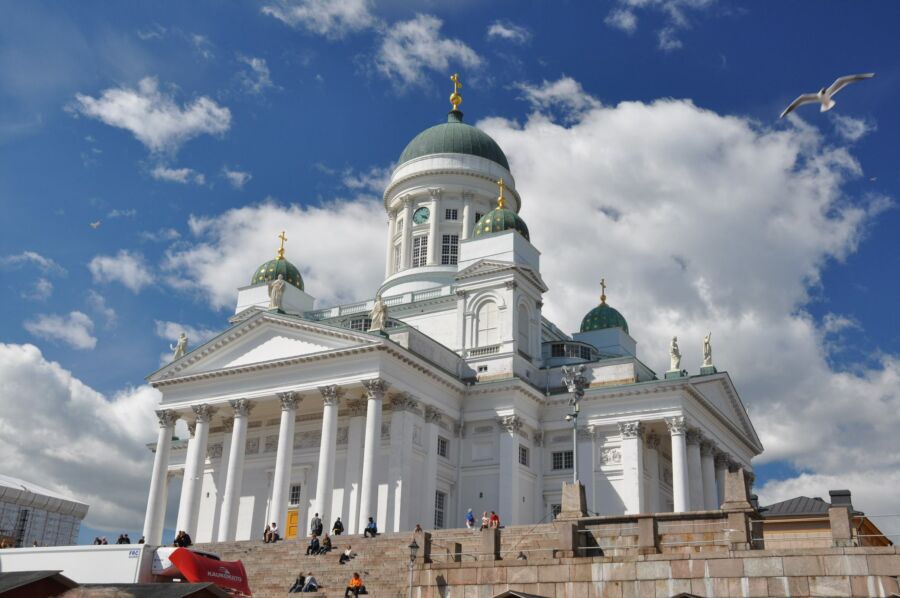
There are so many people that I wonder if it’s some kind of demonstration. Then I see their robes and sheets of music and realize that these are choral groups, each represented by a placard. From all corners of the country, some 800 singers converge on the massive steps of the Lutheran Cathedral, overlooking the Neoclassical Senate Square. Crowds gather, enthusiastic to hear this annual massing of the choirs.

The crowd quiets and the singers begin a rousing series of hymns. While I can’t understand a word, the songs are sung with such a stirring air that I imagine they tell both of their hard-fought history, their solid faith, and their gratitude to be who they are — the people of Finland. As the last hymn ends, balloons are freed, and the singers disperse, kicking off a festive initiative called “Art Goes to the Pubs.” The city’s watering holes are about to be filled with song.

Leaving the square, Hanne and I pass a poster of a demonic-looking rock band. “Hell froze over that year,” she explains. Europe’s biggest TV event is the annual Eurovision Song Contest, most famous as the event that launched ABBA in 1974 with their breakout song, “Waterloo.” Perennial losers in the event, Finns have long said, “Hell will freeze over before Finland wins the Eurovision Song Contest.” In 2006, Finland’s Kiss-inspired heavy-metal band Lordi won with a rocking, gravelly voiced number called “Hard Rock Hallelujah.”

At the curb, there’s no traffic, so I jaywalk across the street. I get halfway across Boulevardi before looking back for Hanne, who is still waiting for a walk signal. In defeat, I return to the curb. She says, “In Finland, we wait. It can be two in the morning and not a car in sight, but we wait.”

I note that Germans respect authority, too. Hanne says it’s different in Finland. “We buck authority. But we follow the laws…even little ones. That’s why we have such low crime.”

Hanne points out an elegant restaurant with a dining hall that was perfectly preserved from the 1930s. Its Alvar Aalto-designed Functionalism is the kind of straight design and practical elegance Finns love. A private office party is raging — specifically, a crayfish party. Crayfish are in season, but at $10 each, they are hardly a budget meal. But all over town Finns are doing the crayfish tango: Suck and savor a red mini-lobster, throw down a glass of schnapps, sing a song, and do it again. The “99 Bottles of Beer” repetition just gets more fun with each round.

Hanne shows me the table where Gustaf Emil Mannerheim always sat. He was the heroic George Washington of modern Finland, who led the feisty resistance against the USSR. Many Finns consider him personally responsible for keeping their country free during and after World War II. No Finnish military leader will ever again hold Mannerheim’s rank of “Field Marshal.” But anyone can sit at his favorite table…and suck a crayfish.

We continue walking, ending up back on the grand Senate Square. The city seems a tale of two cultures. The late-setting sun gleams on both the Lutheran Cathedral and the golden onion domes of the Russian Orthodox Church. They seem to face off, symbolizing how east and west have long confronted each other here in Finland. Europe’s second-mightiest sea fortress — after Gibraltar — fills an island in the harbor…which allowed the village of Helsinki to grow into a booming capital.

Finns have a fun-loving confidence and seem to live well. I ask how Nordic Europe can be so prosperous when only Norway has oil.
Hanne responds, “Norway has oil — Finland has Nokia. It’s like Microsoft for you in Seattle.”

“So what’s Sweden’s trick?” I ask.

Hanne sighs, showing the standard Scandinavian envy of the regional powerhouse. “They never get in a war. They’re always rich…just collecting money all the time. The Swedes are like our big brother. They always win. Like in ice hockey. We won only once…back in the 1990s. The Swedes — assuming they’d win — had already written their victory song. But we won. We Finns still sing this song to give the Swedes a hard time. It’s the only song Finns know in Swedish and every Finn can sing it…even today.”

Our conversation is interrupted by a different song — a rousing hymn. Across the square is a church choir, marching to yet another Helsinki pub as if going to battle in a war for music.

This story appears in my newest book, “For the Love of Europe” — collecting 100 of my favorite memories from a lifetime of European travel. Please support local businesses in your community by picking up a copy from your favorite bookstore, or you can purchase it at my online Travel Store. You can also find a clip related to this story at Rick Steves Classroom Europe; just search for Helsinki.

Daily Dose of Europe: Czech Out Prague

I’m drinking a lot of Pilsner Urquell at home in Seattle during this crisis. It’s great… but it’s nothing like drinking it in its homeland. It seems when my Czech friends take me around Prague, first we see the sights. And then, invariably, we end up in a pub, where my lessons on the country continue over a few mugs of their beloved pilsner.

Even though we’re not visiting Europe right now, I believe a daily dose of travel dreaming can be good medicine. I just published a collection of my favorite stories from a lifetime of European travels. My new book is called “For the Love of Europe” — and this story is just one of its 100 travel tales.

Czech pivo (beer) is a frothy hit with locals as well as tourists. After all, the Czechs invented pilsner-style lager in nearby Plzeň, and the result, Pilsner Urquell, is on tap in many pubs. In Czech restaurants, a beer hits your table like a glass of water does in the US. I’ve learned to be careful — it’s stronger than the beer back home. Pivo for lunch has me sightseeing for the rest of the day on what I call “Czech knees.”

Honza — a young yet professorial guide I’ve known for years — has hair I’ve always envied. I always thought it was Albrecht Dürer hair. Then one evening, realizing it was Jim Morrison hair, I got Honza to take off his shirt and stretch out his arms. He looked just like a Doors album cover.

Honza teaches more emphatically after a couple of beers. I’ll never forget how he slammed his glass mug down on a sticky beer-hall table to announce “Czechs are the world’s most enthusiastic beer drinkers — adults drink an average of 150 liters a year! We couldn’t imagine living without this beer…the Czech pilsner.”

I think the hardest I’ve ever laughed in Europe was when Honza explained the three kinds of Czech drunks. “There’s the sleeper,” he said, putting his head down on the table. “There’s the entertainer,” he exclaimed, while flapping his arms in my face. “And there’s ‘at the dentist,’” he demonstrated, reclining way back on his bar chair with his eyes closed and his mouth wide open.

The joy of having a good time in Prague seems heightened by my physical surroundings and by the heaviness of the country’s recent history. Prague is “the golden city of a hundred spires.” Because this vibrant Baroque capital escaped the bombs of the last century’s wars, it’s remarkably well-preserved. But it didn’t avoid the heavy, deadening economic and political blanket of communism.

It’s hard for today’s visitors to imagine the gray and bleak Prague of the communist era. Before 1989, the city was a wistful jumble of lost opportunities. Sooty, crusty buildings shadowed cobbled lanes. Thick, dark timbers bridging narrow streets kept decrepit buildings from crumbling. Consumer goods were plain and uniform, stacked like bricks on thin shelves in shops where customers waited in line for a beat-up cabbage, tin of ham, or bottle of ersatz Coke. The Charles Bridge was as sooty as its statues, with a few shady characters trying to change money. Hotels had two-tiered pricing: one for people of the Warsaw Pact nations and another for capitalists. This made the run-down Soviet-style hotels as expensive for most tourists as fine hotels in Western Europe. At the train station, frightened but desperate characters would meet arriving foreigners to rent them a room in their flat. They were scrambling to get enough hard Western cash to buy batteries or Levis at one of the hard-currency stores.

Today, that’s all ancient history. The people of Prague are as free and capitalistic as any other citizens of the European Union. They wear their Levis oblivious to how they were once the pants of dreams. The city is fun — slinky with sumptuous Art Nouveau facades, offering tons of cheap Mozart and Vivaldi, and still brewing some of the best beer in Europe.

With every visit, to get oriented, I head for the vast Old Town Square. It’s ringed with colorful pastel buildings and dotted with Baroque towers, steeples, and statues. Street performers provide a jaunty soundtrack. Segways dodge horse-drawn carriages crisscrossing the square. At the top of the hour, tourists gather around the towering 15th-century astronomical clock to see a mechanical show of moving figures. With Turks, Jews, bishops, a grim reaper with an hourglass, and a cock crowing, the fears and frustrations of the Middle Ages are on parade every 60 minutes. It must have been an absolute wonder to country folk visiting the big city 500 years ago.

In those days, people were executed for disagreeing with the Catholic Church. The square’s focal point, the Jan Hus Memorial, was unveiled in 1915, 500 years after Hus was burned at the stake for heresy. The statue of the Czech reformer stands tall, as he did against both the pope in Rome and the Habsburgs in Vienna. He has become a symbol of the long struggle for Czech freedom.

I continue a few blocks past the Old Town Square to the centerpiece of modern Prague: Wenceslas Square. Looking around, I realize that the most dramatic moments in modern Czech history played out on this stage. The Czechoslovak state was proclaimed here in 1918. In 1969, this is where Jan Palach set himself on fire to protest the puppet Soviet government. And it was here that massive demonstrations led to the overthrow of the communist government in 1989. Czechs filled the square night after night, 100,000 strong, calling for independence. One night, their message was finally heard and the next morning, they woke up a free nation.

After crossing the much-loved Charles Bridge, which spans the Vltava River and links the Old Town and Castle Quarter, I give it my vote for Europe’s most pleasant quarter-mile stroll. Commissioned by the Holy Roman Emperor Charles IV in the 1350s, the bridge is a chorus line of time-blackened Baroque statues mixing it up with street vendors and buskers.

High above, the hill-topping Prague Castle looks out over the city. The highlight of the castle complex is the cathedral, where locals honor Wenceslas, patron saint of the Czechs, who’s buried here. This “good king” of Christmas-carol fame was not a king at all, but a wise, benevolent Duke of Bohemia — and another beloved symbol of Czech nationalism for this country that’s both new and old.

Every evening, Prague offers tempting reasons to be out and about. Black Light Theater, a combination of illusion, pantomime, puppetry, and modern dance that has no language barrier, is uniquely entertaining. Much like the work of hometown writer Franz Kafka — and, many would say, like the city of Prague itself — Black Light Theater fuses realism, the fantastic, and the absurd. I’ve capped other evenings with live opera, classical, jazz, and pop music. Crowd-pleasing concerts are hosted nightly in the city’s ornate Old Town halls and historic churches, featuring all the greatest hits of Vivaldi, Mozart, and local boys Anton Dvořák and Bedřich Smetana.

What to do after a concert? My Czech friends and I always finish our evening with another mug of that local beer. While I haven’t picked up many Czech words, “Na zdraví!” (“To your health!”) is a must. I always remember it by saying, “Nice driving!” My pronunciation isn’t perfect, but that’s OK. After raising their mugs a few too many times, I’ve heard fun-loving Czechs bellowing “Nádraží!” (which means “Train station!”). Good to know that tipsy Czechs stumble on their words, too.

This story appears in my newest book, “For the Love of Europe” — collecting 100 of my favorite memories from a lifetime of European travel. Please support local businesses in your community by picking up a copy from your favorite bookstore, or you can purchase it at my online Travel Store. You can also find a clip related to this story at Rick Steves Classroom Europe; just search for Prague.

A Report from Bulgaria — Keeping in Touch with Our European Friends

It’s easy to be America-centric when it comes to the hopes, fears, and frustrations of fighting COVID-19. Being in the travel business, we have dear friends in many countries. And when we get reports from them, it seems like the world is playing a kind of virus whack-a-mole right now. All over our planet, power-hungry politicians are putting their needs above public health, taxpayer money is coming to the rescue but not always getting there, and nations think they are getting into the clear and then realize they are still stranded on first base.

Read this report from a dear friend in Bulgaria, tour guide Stefan Bozadzhiev (Down the Road with Stefan) of Lyuba Tours. Bulgaria has a special place in my heart, in part because it’s such a mystery to many Americans. I see it as a feisty, underappreciated underdog of a nation. As you read this, consider the parallels to the American story. I know Stefan well. And, while he was thinking of me and my colleagues when he opened with “Dear Friends”, he believes — as a good tour guide — that those of you who might feel like strangers to him are just friends he’s yet to meet.

Dear Friends,

Greetings from Sofia, Bulgaria! I hope you are doing well and keep yourself healthy in these strange times.
I just wanted to briefly update you on the situation in Bulgaria.

COVID-19:
Unfortunately, as with many other countries from the Balkan region, there has been recently a peak in COVID-19 cases. It’s a pity. We followed all the rules in the early stages of the pandemic and now it seems all those efforts were in vain. Much could be said to explain the situation: how we Bulgarians don’t trust authority, how we are among the nations in the world with highest numbers of people who believe in conspiracies, and so on. Now masks are necessary in public indoor spaces, but many don’t comply with the rules and no one is there to enforce them. The huge problem is that our government lost a grip in handling the pandemic, sometimes even issuing contradictory orders a few hours apart. Unfortunately, more countries have added Bulgaria to their “red list,” which means we can no longer freely enter.

Anti-Government Protests:
It’s a really difficult story here. Our incumbent prime minister, Boyko Borissov, has been in office 10 years. A former firefighter, a personal bodyguard of our last communist dictator, Todor Zhivkov, and of our last king, Simeon II, Borissov made his way to the top of executive power. A populist, a man with close ties to organized crime of the early years of the post-communist period, an alleged drug producer, a man who blatantly broke the embargo on former Yugoslavia during the wars. That’s him. Yet people keep voting him in.

During his time in power, Bulgaria dropped to 111th place in the world ranking on free speech. Corruption became synonymous with my country. In other countries there is organized crime, but in Bulgaria the organized crime owns our country. Borissov is not a single player, but is supported by shady oligarchs and former members of the communist security services. The newly appointed state attorney acts like his personal attorney.

So, we Bulgarians are in the streets, protesting against corruption, against organized crime and oligarchs who stole our parents’ future and are on their way to do the same with our future. The protests have continued for almost a month now, marching in downtown Sofia and other large cities every night, blocking streets, intersections, and country roads, trying to take our state back from the mafia. Unfortunately, in recent days more and more people in police uniforms are spotted, without any numbers and signs, which is unlawful. They are aggressive and constantly receive orders on phones, and not from the regular police channels. Last week our outspoken former prime minister, who is a vocal protester, was attacked by an unknown man and she is now in a hospital, recovering from surgery.

I was for a week at the Bulgaria Black Sea coast, in the port city of Burgas, staying with a few friends of mine there. Even “on vacation,” every night I joined the protests in this city.

For the first time since the pandemic started, amidst ongoing anti-government protests and blocked roads, the Bulgarian prime minister met with professionals from the travel industry. The result: 5 million euros as state support to all 3,500 registered tour operators and travel agents in our country (that’s less than $2,000 per company) — and zero support to tour guides. That’s a disgrace.
I want to thank all of you who found time to show moral support or even found other ways to support me in these challenging times. Thank you all! It means a lot! I wish you all the best in this turbulent year! And may our roads cross again!

Hugs,
Stefan

Stefan’s message is just one way that we’re keeping in touch with our European guides during this crisis. To connect with guides like Stefan directly — and to hear from them in their own words — check out the Rick Steves Guides’ Marketplace, which we’ve designed just for this purpose. There you’ll find out how to follow Stefan’s reports, and the reports of dozens of other guides, all of whom are working hard to stay creative and keep teaching through these challenging times.

Daily Dose of Europe: Ducks, Dung, and Hay in Eastern Turkey

I miss Europe’s big sights. But I also miss exploring off the beaten path. And one of the most vivid places for that is in Eastern Turkey.

Even though we’re not visiting Europe right now, I believe a daily dose of travel dreaming can be good medicine. I just published a collection of my favorite stories from a lifetime of European travels. My new book is called “For the Love of Europe” — and this story is just one of its 100 travel tales.

I’m in Kastamonu, five hours northeast of the Turkish capital of Ankara. It’s a town that has yet to figure out the business of tourism. The business hotel where I’m staying is cheap and comfortable, but not slick. I hand a postcard to the boy at the desk, hoping he can mail it for me. He looks it over a couple of times on both sides, compliments me, and politely hands it back. As I leave, he raises his right hand and says, “Hello.”

While changing money, I’m spotted by the bank manager, who invites me into his office for tea. I am his first American customer, so he wants to celebrate.

Outside, a gaggle of men wearing grays, blacks, and browns is shuffling quietly down the street in a funeral procession. A casket floats over them as each man jostles to the front to pay his respects by “giving it a shoulder.” Turkey is a land of ceremonies. Everyday life here is punctuated with colorful, meaningful events. I’m always on the lookout, traveling with sharp eyes, hoping to add to my knowledge of the folk culture. Who knows, as the dust from the funeral procession clears, I may see a proud eight-year-old boy dressed like a prince or a sultan on a horse — riding to his ritual circumcision.

My plan is to continue driving inland, exploring further into Anatolia. While Istanbul and the western coast get the lion’s share of Turkey’s tourism, I’m looking for maximum cultural thrills, so I know I should head east.

Under 10,000-foot peaks, my guide and I drive up onto the burnt, barren, 5,000-foot-high Anatolian plateau to Erzurum, the main city of eastern Turkey. Life is hard here. Blood feuds, a holdover from justice under the Ottomans, are still a leading cause of imprisonment. Winters are below-zero killers. Villages spread out onto the plateau like brown weeds, each with the same economy: ducks, dung, and hay. But Allah has given this land some pleasant surprises. It’s a harsh land, but gentle at the same time. The parched plain hides lush valleys where rooftops sport colorful patches of sun-dried apricots. You can crack open the sweet, thin-shelled hazelnuts with your teeth. Teenage boys prefer girls who dress modestly and shepherd children still play the eagle-bone flute.

Entering a village, we pass under a banner announcing, “No love is better than the love for your land and your nation.” The town takes us warmly into its callused hands. A man with a donkey cart wheels us on an impromptu tour. Each house wears a tall hat of hay — food for the cattle and insulation for the winter. Mountains of cow pies are neatly stacked, promising warmth and cooking fuel for the six months of snowed-in winter on the way. Veiled mothers strain to look through my camera’s viewfinder to see their children’s mugging faces. The town’s annually elected policeman brags that he keeps the place safe from terrorists. Children scamper around women who are busy beating raw wool with sticks — a rainbow of browns that will one day be woven into a carpet to soften a stone sofa, warm up a mud-brick wall, or serve as a daughter’s dowry.

Driving east from Erzurum, we set our sights on the northeast corner of Turkey, marked by the 17,000-foot summit of Mount Ararat. Villages growing between ancient rivers of lava expertly milk the land for subsistence living. After a quick reread of the flood story in Genesis, I think that this stark, sun-drenched, and windswept land has changed little since Noah docked.

On a ridge high above our car, I can make out the figure of a lone man silhouetted against a bright blue sky waving at us. The sight reminds me that this is a part of West Asia where mighty nations come together, denying the Kurds who live here a land of their own. The lone sentry is one of 10 million Kurdish Turks; many of them would like their own country. The turmoil in Iraq — and the prospect that those Kurds could form an autonomous nation — has reignited this prickly issue. One thing is for sure: Turkey does not want to share a border with an independent Kurdistan.

When I get up early the next morning to see the sun rise over Mount Ararat, I also see a long convoy of Turkish army vehicles. It reminds me that our world is a complicated place in which the daily news is just a shadow play of reality. What’s so often missing is humanity. And to get that, you need to travel.

This story appears in my newest book, “For the Love of Europe” — collecting 100 of my favorite memories from a lifetime of European travel. Please support local businesses in your community by picking up a copy from your favorite bookstore, or you can purchase it at my online Travel Store. You can also find a clip related to this story at Rick Steves Classroom Europe; just search for Turkey.