Here you can browse through my blog posts prior to February 2022. Currently I'm sharing my travel experiences, candid opinions, and what's on my mind solely on my Facebook page. — Rick

In England, Coal is Dead

Ironbridge Gorge

Ironbridge Gorge, England 


When we travel, we see how other countries are dealing with the same issues we are at home. And we better understand the lessons history can teach us. On this trip, I’ve been tuned in to the news, as our president makes headlines almost daily. And — also almost daily — the Europeans I meet ask me how Trump got elected. (From their perspective, it seems astonishing.) I try to explain about people in parts of our country with serious economic challenges who believe things aren’t fair — like the plight of American coal miners, who feel they were given a voice by Trump’s candidacy.

Here in England, they tell me that they dealt with that same challenge back in 1984. That’s when Margaret Thatcher — Britain’s answer to Ronald Reagan, and considered a strong leader by people left and right — confronted England’s coal miners’ union…and crushed them. Her message: Coal mining just didn’t add up anymore. Wandering through England’s fascinating museum of the Industrial Revolution at Ironbridge Gorge, I watched a blacksmith hard at work. And then I stumbled upon this thought-provoking pile of coal next to a silent factory. Progress can be heartless. And in England, the coal industry is not a political issue…but a corner of a museum.

This is Day 99 of my “100 Days in Europe” series. As I travel with Rick Steves’ Europe Tours, research my guidebooks, and make new TV shows, I’m reporting on my experiences across Europe. Still to come: bonus posts from Germany and Switzerland. Thanks for joining me here on my blog and via Facebook.


Battle of Blenheim, 2017

In 1704, John Churchill, 1st Duke of Marlborough, defeated the French at the Battle of Blenheim. A grateful Queen Anne rewarded him with Blenheim Palace, the grandest countryside residence anywhere in Britain. And then, 313 years later, I had my own little Battle of Blenheim.

Scouting the palace during our TV shoot, I was marveling at all the noble bling, and — ding! — I walked into an overhanging staircase. I went down, pretty bloody. (Now I can sympathize with the palace administration’s nervousness about visitors poking around.) The staff was very compassionate but, for legal reasons, couldn’t do anything beyond give me a seat, a compress, and directions to the nearest “MUI” — minor injuries unit.


I joined the crowd of people awaiting their government-provided medical service. After an hour, a nurse cleaned me up and glued me shut. I asked to pay, and she said, “Nope, we have National Insurance here. It’s covered.” Thankfully, my little wound wasn’t visible to the TV camera. I couldn’t get it wet for a few days, but soon, I was good as new. And now, whenever I wince at the hefty VAT (value added tax) tacked on to my purchases in Britain, I’ll feel a bit better…as I’ve helped pay for my own medical treatment.


This is Day 98 of my “100 Days in Europe” series. As I travel with Rick Steves’ Europe Tours, research my guidebooks, and make new TV shows, I’m reporting on my experiences across Europe. Still to come: Germany, Switzerland, and more. Thanks for joining me here on my blog and via Facebook.

Video: My Scottish Guide Shares His Best (Worst?) Dad Jokes

One of the great joys of traveling in Scotland is the endearing accent of the people you meet. Since my guide (Colin Mairs​) and I are wrapping up our time together, I thought I’d share some of the delightfully horrible jokes I’ve had to endure amid all the Highland beauty. Thanks, Colin!

This is Day 97 of my “100 Days in Europe” series. As I travel with Rick Steves’ Europe Tours, research my guidebooks, and make new TV shows, I’m reporting on my experiences across Europe. Still to come: Germany, Switzerland, and more. Thanks for joining me here on my blog and via Facebook.

Dropping in on the Queen

In 1848, Queen Victoria and Prince Albert visited the Scottish Highlands and fell in love with this remote part of Britain. In that same year — as the rest of Europe was ensnared in anti-royalist, pro-democracy revolutions — England’s Queen purchased Balmoral Castle on a vast 50,000-acre estate. The Queen proceeded to embrace the Highland culture, which led to something of a renaissance in the local way of life in this northern part of Scotland.

Today, Queen Elizabeth II and her family still spend a good part of their summers here at Balmoral. And, for much of the season, the palace welcomes the public. However, access is limited: You can roam the gardens, see some exhibits in the stables, and visit a single big room in the palace. The admission fee includes a self-guided audio tour, which I enjoyed.


Visiting Scotland, you’ll inevitably visit a few royal palaces — but consider expanding your sightseeing to the castles of clan nobility. It seems each clan has a “spiritual heart” where ancient artifacts, documents, and lots of battle-dinged weaponry are archived, and much of it accessible to the public. I toured every palace-like castle we came upon, and I enjoyed them all. And if you’re a Mac-this, a Mac-that, or a Campbell, these ancestral homes can be particularly interesting. For example, Inveraray Castle (popular for its Downton Abbey connections — their Christmas special was filmed here) bristles with the weaponry of Clan Campbell.

This is Day 96 of my “100 Days in Europe” series. As I travel with Rick Steves’ Europe Tours, research my guidebooks, and make new TV shows, I’m reporting on my experiences across Europe. Still to come: Germany, Switzerland, and more. Thanks for joining me here on my blog and via Facebook.

Travel Memories Old and New in Scotland

Scotland is really hot in the travel business lately. It’s one of our bestselling tours and one of our bestselling guidebooks. And, after traveling a route pretty close to what we do on our tours (with the luxury of having one of our Scotland guides, Colin Mairs, all to myself), I’m seeing just what the kilt-and-whisky-powered buzz is all about.

Colin knows our Scotland tour itinerary down to the minute, allowing us to ambush a big Rick Steves tour bus of travel joy as it pulled in to Clava Cairns (just outside of Inverness). I got to pop into the bus and say to the happy gang, “Thanks for traveling with us.”

Traveling through Scotland, I’ve been impressed by the variety of sights, and how close together things are. In 12 days, I can’t remember a long, boring drive. There are the big iconic blockbuster sights, and there are the silly Loch Ness monster sights. (Actually, I enjoyed the Loch Ness Exhibition Centre — which analyzes how such a crazy legend could capture the imagination of so many generations of visitors.)

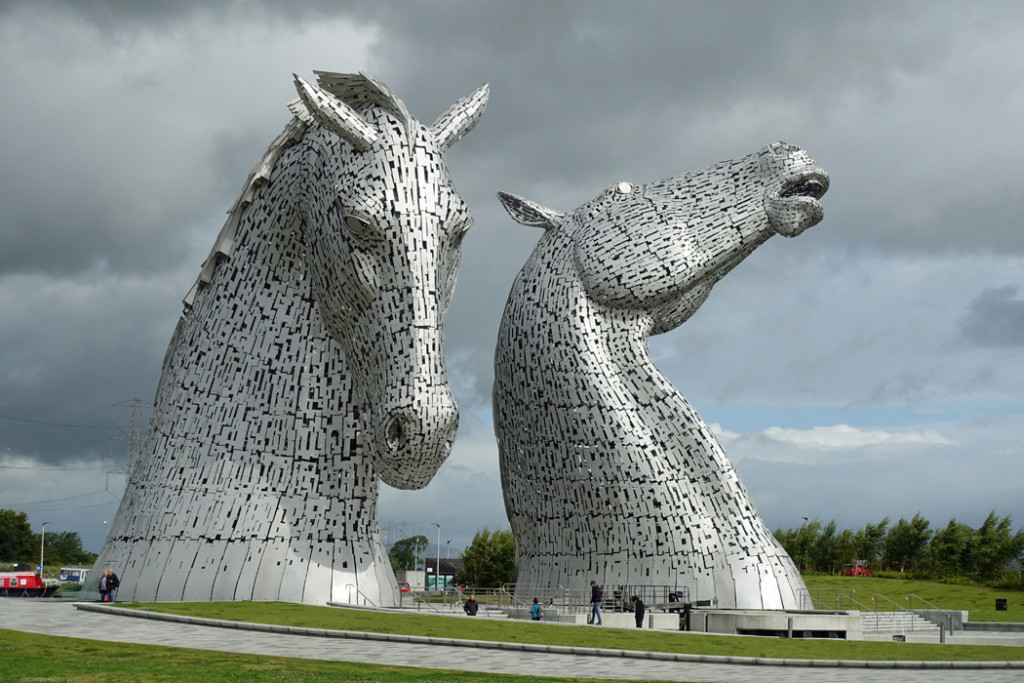
In the last decade or so, two new sights (both near Stirling Castle) have joined the parade of Scottish travel memories: The Falkirk Wheel opened in 2002. Rather than a series of locks, it gracefully raises boats 80 feet from the Forth Canal to the Clyde Canal with an innovative wheel. And a couple of giant steel horse heads, based on the mythic Kelpies, were built in 2014 and have become a symbol of the region around Stirling.

This is Day 95 of my “100 Days in Europe” series. As I travel with Rick Steves’ Europe Tours, research my guidebooks, and make new TV shows, I’m reporting on my experiences across Europe. Still to come: Germany, Switzerland, and more. Thanks for joining me here on my blog and via Facebook.