Here you can browse through my blog posts prior to February 2022. Currently I'm sharing my travel experiences, candid opinions, and what's on my mind solely on my Facebook page. — Rick

Daily Dose of Europe: Bayeux Tapestry

This skinny, 70-yard-long strip of cloth depicts a crucial historical event that helped shape the Europe we know.

As America continues to suffer crisis upon crisis, it has never been more important to broaden our perspectives and learn about the people and places that shape our world. And for me, one of the great joys of travel is seeing art masterpieces in person. Learning the stories behind great art can shed new light on our lives today. Here’s one of my favorites.
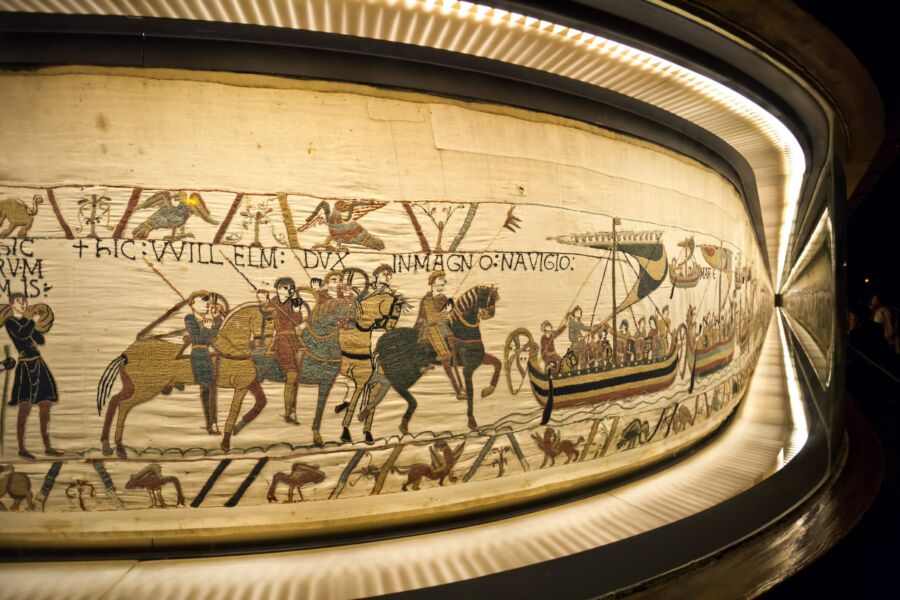
Like a graphic novel, the Bayeux Tapestry tells the mesmerizing story of how William the Conqueror and Harold of England competed for the English crown. The tale culminates in one of the most pivotal battles in history: The Battle of Hastings in 1066.

The story begins in London. In the opening scene — the first of about 60 in the tapestry — the reigning King of England, Edward, is presiding on the throne in his palace. He orders his brother-in-law Duke Harold to ride off to France. At that time, Normandy (northern France) was under English rule. Harold was to announce to all the subjects that Edward had decided who his successor as king would be — a seemingly illegitimate duke called “William the Bastard,” known today as “William the Conqueror.”

The tapestry is realistic enough that even an illiterate peasant could understand what’s happening. The Latin titles reinforce the main characters and key events. Down-to-earth details keep you “reading.” The narrative is framed by a border (top and bottom) with more eye candy — some related to the story, some mere decoration.

The climax of the whole tapestry is the Battle of Hastings, which pitted the invading Normans of France, led by William, against the Anglo-Saxons of England, led by Harold. It was a fierce, 14-hour battle. Knights on horseback charge, swordsmen clash, and archers launch arrows, leaving the battlefield strewn with mangled corpses. According to historical accounts, Harold fell from his horse. He lifts his visor to shout to his men, when suddenly — shoop! — Harold gets hit with an arrow, right in the eye. Finally, an enemy horseman bends down to finish Harold off with a sword. The title above says it all: “Here King Harold is slain.”

The Battle was won by William. The Normans now ruled England. This illegitimate child, until then known as “William the Bastard,” could now call himself “William the Conqueror.” Unfortunately, that’s where the Bayeux tapestry ends, because the final scene is missing, lost to history.

But we know the rest of the story. William marched to London, claimed his throne, and (though he spoke no English) became king of England. This set in motion 400 years of conflict between England and France — not to be resolved until the 15th century. However, on the plus side, the Norman conquest of England brought that country into the European mainstream. Because of the events depicted on the Bayeux tapestry, England got a stable government, contact with the rest of Europe, and a chance to eventually grow into a great European power.

And today, historians and tourists alike can stand in the presence of this precious document, stroll slowly along, and see those momentous events from nearly a thousand years ago unfold before their eyes.

This art moment — a sampling of how we share our love of art in our tours — is an excerpt from the new, full-color coffee-table book, “Europe’s Top 100 Masterpieces,” by Rick Steves and Gene Openshaw. Please support local businesses in your community by picking up a copy from your favorite bookstore, or you can find it at my online Travel Store. To enhance your art experience, you can find clips related to this artwork at Rick Steves Classroom Europe; just search for Bayeux.

Daily Dose of Europe: Velázquez’s Las Meninas

Diego Velázquez spent 30 years painting formal portraits of the Spanish king. Then, deciding to switch things up, he painted his most famous and greatest painting. Instead of showing the king, Las Meninas captures the behind-the-scenes action as the king’s portrait is being painted.

As America continues to suffer crisis upon crisis, it has never been more important to broaden our perspectives and learn about the people and places that shape our world. And for me, one of the great joys of travel is seeing art masterpieces in person. Learning the stories behind great art can shed new light on our lives today. Here’s one of my favorites.

Velázquez stands at his easel, flicks his Dalí moustache, raises his brush, and looks directly out toward the people he’s painting — the king and queen. They’d be standing right where the viewer stands. In fact, you can even see the royal couple reflected in the mirror on the back wall. We’re seeing what the king and queen would have seen: their little blonde-haired daughter Margarita and her “maids,” or meninas, who’ve gathered to watch the sitting.

Velázquez (1599–1660) was a master of candid snapshots. Trained in the unflinching realism of his hometown of Seville, he’d made his name painting wrinkled old men and grimy workers in blue-collar bars.

Here, he catches the maids in an unguarded moment. Margarita is eyeing her parents, while a maid kneels to offer her a drink and another curtsies. To the right is one of the court dwarves, and a little boy playfully pokes the family dog. Just at that moment, in the background, a man pauses at a doorway to look in on the scene. The moment is frozen, but you can easily imagine what these people were doing 30 seconds before or 30 seconds later.

This seemingly simple painting was revolutionary in many ways. Velázquez enjoyed capturing light, and capturing the moment, just as the Impressionists would two centuries later. Also, if you look close, you’ll see that the girls’ seemingly detailed dresses are nothing but a few messy splotches of paint — the proto-Impressionist use of paints that Velázquez helped pioneer.

Velázquez creates a kind of 3-D dollhouse world and induces you to step inside. The figures are almost life-size, and the frame extends the viewer’s reality. The eye unconsciously follows the receding lines of the wall on the right to the far wall, and the painting’s vanishing point — the lighted doorway. The painting’s world stretches from there all the way back to the imaginary space where the king and queen (and the viewer) would be standing. And you are part of the scene, seemingly able to walk around, behind, and among the characters. Considered by many to be the greatest painting ever, this is art come to life.

This art moment — a sampling of how we share our love of art in our tours — is an excerpt from the new, full-color coffee-table book Europe’s Top 100 Masterpieces by Rick Steves and Gene Openshaw. Please support local businesses in your community by picking up a copy from your favorite bookstore, or you can find it at our online Travel Store. To enhance your art experience, you can find clips related to this artwork at Rick Steves Classroom Europe; just search for Prado.

Daily Dose of Europe: Norway — The Old Country and a New Outlook

Norway is a land of intense natural beauty. It’s also the land of my Norwegian relatives. And every time I come to Norway, I’m fascinated — not only by its famously steep mountains and deep fjords, but by its ongoing experiment with modern, progressive governance.

Even though we’re not visiting Europe right now, I believe a daily dose of travel dreaming can be good medicine. I recently published a collection of my favorite stories from a lifetime of European travels. My new book is called “For the Love of Europe” — and this is just one of its 100 travel tales.

I’ll never forget my first trip to Europe. I was a gangly 14-year-old, dragged to the old country by a conspiracy of grandparents and parents solely to visit strangers who happened to be Norwegian relatives. I didn’t want to go. It just made no sense.

Jet lag wasn’t the problem. It was teen culture shock: No Fanta. No hamburgers. Far beyond the reach of my favorite radio station. Their “Top 40” had nothing to do with my “Top 40.” But after a few days I was wild about Solo (Norway’s orange pop), addicted to the long and skinny pølse wieners, and enjoying new music. Noticing stunning women…with hairy armpits…I began to realize that our world is intriguing and exploring it can be endlessly entertaining.

Visiting the house where my great-grandmother was born, I imagined the courage it must have taken to leave Norway and her entire family for America a century ago.

Sitting with my cousins on their living room floor in 1969 to watch the Apollo moon landing, I began to see the world differently. Hearing them translate Neil Armstrong’s words (“Ett lite skritt for et menneske, ett stort skritt for menneskeheten”), it dawned on me: That first big step was more than just an American celebration. It was a human accomplishment.

In Oslo’s Vigeland Park, I was grossed out by the nude statues by sculptor Gustav Vigeland. But I also experienced an important revelation in that same park that I share every chance I get: As I watched towheaded kids splashing with their parents in a fountain, I realized those parents loved their kids as much as mine loved me. This planet is home to billions of equally precious children of God. Travel was causing me to think bigger. And it was prying open my hometown blinders.

The next time we visited Norway, we looked up our ancestral roots. My grandfather, famous in the 1930s in Leavenworth, Washington, as a rowdy ski jumper, was a Romstad. So although my last name is Steves (after a step-grandfather), my blood is Romstad. That branch of my family comes from a scenic valley called Gudbrandsdalen.

These days, I don’t visit Norway just to read my family name on tombstones. The roots I seek are also cultural. It’s stimulating to learn about different social systems (many of which confound Americans). A friend in Oslo introduced me to the ideas of Norwegian philosopher Erik Dammann, who in the 1970s started a movement called “The Future in Our Hands.” His book by the same name lit a political fire in my belly that burns to this day. Dammann argued that a successful society can rise above materialism and that being content with your material wealth is a virtue. Dammann (and Norway) helped me imagine a society where consumption was not the goal. Norwegians are almost evangelical about their belief in organizing society for the benefit of all. City halls here are as grandly and lovingly decorated as churches.

Norwegians are talented linguists. I speak only English. Of all the places in Europe that I’ve traveled and worked, Norway has been the easiest place to communicate. Not long ago, I was at a cousin’s dinner party with a dozen people in Oslo. Out of deference to me, it was agreed: Everyone would speak English.

The topics were fascinating. One man, an author who had just written a book on Franklin D. Roosevelt, talked with me about the intricacies of American post-WWII politics. Two new parents gently debated the various ways to split their paid maternal and paternal leave (standard in Scandinavia where, for the father, it’s use it or lose it). People seemed very content. It was a house full of chatty Norwegians just loving their salmon, shrimp, and goat cheese.

Sure, Norway is an oasis of warmth and love because I’ve got family there. But I also appreciate the chance to rein in my Ameri-centricity. I admire a smart and creative land where well-being is not preceded by the word “material.”

This story appears in my newest book, “For the Love of Europe” — collecting 100 of my favorite memories from a lifetime of European travel. Please support local businesses in your community by picking up a copy from your favorite bookstore, or you can purchase it at my online Travel Store. You can also find clips related to this story at Rick Steves Classroom Europe; just search for Oslo, Norway.

Guide Update: Avid Hikers on a Trail Through Slovenia’s Julian Alps

“It is like finding a path back to ourselves, and to our beginnings. Birds chirp, flowers bloom, and leaves whisper with the help of light winds. Our lungs are full of fresh air and fragrant pastures. Our eyes bathe in the wonderful scenery unfolding in front of us step by step.” That’s how two of our Slovenian guides describe rediscovering long-forgotten alpine hiking trails while staying close to home during this crazy summer.

Within yodeling distance of Italy and Austria, Slovenia is the least visited and most underrated of Europe’s alpine countries. Kissing the Adriatic Coast — where the Germanic, Mediterranean, and Slavic worlds collide — Slovenia is a small country with a big appeal. It’s also home to two of our talented guides, Tina Hiti and Sašo Golub, who lead Rick Steves’ Adriatic tours, offer custom tours of their own, and co-write a blog about all things Slovenian at Private Guide Slovenia.

With the challenges of coronavirus in mind, Tina reports to us from their homeland, sharing how she and Sašo (and their two sons) embrace a healthy combination of outdoor sport and beautiful nature…kicking the couch to the curb and heading for the hills instead. As you join Tina on this hike through Slovenia, imagine all the fun you can have connecting with guides like her on our Guides’ Marketplace — a special website we’ve created to put homebound travelers in touch with their European friends until we can all get traveling together again.

“You crazy Slovenians, do you always need to hike?” This is what I often hear from friends. Whenever they describe us, we always come off as avid hikers, skiers, bikers, or runners, who dress up in waterproof clothes and sports gear daily. And it is so true. If I think of most of my friends, sports is really who we are. I personally come from a sports family, where skiing in the winter, hiking in the summer, and lots of other activities in between were a natural way of life. Raising our sons is not that different — they both play ice hockey and miss every day when practices are not in session. Besides that, we hike, ski, bike, swim, or paddle any other time we have available.

Being active is also something that is helping us in these times of COVID-19. I cannot think of a day in the past months that we were just lying on a couch doing nothing. It is a natural force within us that calls us into nature and kicks us off those couches. Sport is truly something that I would characterize as a part of being Slovenian. Athletes are our biggest heroes and the people we are super proud of. They are the ones who make promotion for our beautiful little country — much better than any of the politicians do.

Summers are exclusively reserved for hiking and biking. While biking takes more stamina, hiking is actually what everybody does. Once in a lifetime you should climb up Mount Triglav, the highest Slovenian mountain (at 2864 meters), to prove you are a true Slovenian. Triglav is also on our national coat-of-arms; this is how serious we are about our mountains. Even when we go on summer vacation somewhere along the coastline, you can recognize a Slovenian — the one hiking, biking, climbing, paddling, canoeing, or windsurfing early in the morning when normal vacationers are still asleep.

The times we are going through are harsh for us from a sports perspective. Everything that we watched on TV was canceled. People who are a part of teams and clubs — and that is a lot of people — were put on hold. No results, no reason to throw a party. And the first two months were hard on us also because we were locked within the boundaries of our small municipalities, and pretty soon we were done with most of the hiking routes in our areas. When the restrictions eased, it wasn’t the bars and terraces that were full, it was the parking spots of the famous hiking destinations.

Since famous spots were full, we had to think of alternate hiking adventures. At first, we were super-happy to hike just above our house. We discovered numerous little paths and areas that we have never walked before. One of our favorites was finding a waterfall called “Devil Washing an Old Lady” — a very funny name and a beautiful spot to do some hiking, without the crowds. Then we started exploring other options and came to Juliana Trail, a beautiful long-distance trail along the edges of the two mountain ranges of Slovenia, the Julian Alps and Karavanke. Parts of it take you through the Triglav National Park area, an immense area full of incredible flora and fauna. Besides discovering pastures, river springs, bigger and smaller waterfalls, enchanting forests, there is also enough history that follows the trail of old miners, writers, poets, musicians, blacksmiths, beekeepers… It sounded so exciting that we decided to do it.

The path’s length is 270 km and runs along 16 stages, starting and finishing in Kranjska Gora. It doesn’t reach any high peaks, but it helps a bit with personal endurance (walking around 20 km per stage, slightly up and slightly down the hill) and gives us a respect for the amazing nature and what our ancestors left for us to cherish. The stage is marked with the letters “J” and “A” on a diamond-shaped sign, with a little spruce at the bottom. The “J” and “A” stand for Julian Alps, because this is where the majority of the trail goes. The Julian Alps — the same mountain range as the Alps that start in France and finish in our country — are the lowest part of the range. This is why Julius Caesar, back in the day, decided to cross right here and has given our part of the Alps its name.

At this moment, we’ve only started with the trail. We gave ourselves time until the end of this summer. The first six stages are completed, and we are overwhelmed by the beauty and charm of the place. On all walks so far, we haven’t encountered other hikers — only a handful of locals and farmers at points where the trail goes through villages and pastures. But we have encountered immense beauty, peace, and tranquility. It is like finding a path back to ourselves, and to our beginnings. Birds chirp, flowers bloom, and leaves whisper with the help of light winds. Our lungs are full of fresh air and fragrant pastures. Our eyes bathe in the wonderful scenery unfolding in front of us step by step. And I am surprised how easy it actually is to walk each of those 20-km stages. Yes, the feet hurt and muscles ache, but the body cannot wait to go on another stage and discover more and more of the beauty our little country has to offer.

To connect with guides like Tina and Sašo directly, and to hear from them in their own words, check out the Rick Steves Guides’ Marketplace, which we’ve designed just for this purpose. There you’ll learn about the many ways our guides — all of whom are working hard to stay creative and keep teaching through these challenging times — have been applying a travel mindset to current times. Many of them, like Tina and Sašo, have engaging blogs that allow you to do a little vicarious travel in Europe. Others are coming up with creative ways to generate some income during this crisis. And all of them celebrate our collective passion for Europe.


Daily Dose of Europe: The Italian Alps — Lounging in the Dolomites

Some of the best mountain thrills can be found on Italy’s rocky rooftop, the Dolomites. But beyond wildflower meadows and pristine views, the Italian Alps offer a bicultural, bilingual taste of Europe.

Even though we’re not visiting Europe right now, I believe a daily dose of travel dreaming can be good medicine. I recently published a collection of my favorite stories from a lifetime of European travels. My new book is called “For the Love of Europe” — and this is just one of its 100 travel tales.

Leaning back in my lounge chair, I enjoy the heat of the sun on my skin. A vibrant sea spreads out before me, but it’s a sea of wildflowers. I’m not at the beach, I’m on a farm, looking out on Europe’s largest high alpine meadow, manicured by munching goats and cows. In the distance, stark snow-dusted peaks tower boldly against the blue sky. These are Italy’s Alps, the Dolomites.

My soundtrack is the happy laughter of Italian children enjoying a petting zoo filled with alpine critters. A few yards away, their parents sip wine on the veranda of their chalet guesthouse — thoroughly enjoying that “dolce far niente” (sweetness of doing nothing)…like me.

The sky-high meadow called the Alpe di Siusi (or “Seiser Alm” in German) seems to float high above the city of Bolzano, separating two of the most famous Dolomite ski-resort valleys, Val di Fassa and Val Gardena. Measuring three miles by seven miles, and soaring 6,500 feet high, Alpe di Siusi is dotted with farm huts and happy hikers enjoying gentle trails. These mountains differ from the rest of the Alps because of their dominant rock type — limestone — which forms sheer vertical walls of white, gray, and pale pink rising abruptly from green valleys and meadows.

At the head of the meadow, the Sasso Lungo mountains provide a story­book Dolomite backdrop. And opposite, the bold, spooky Mt. Schlern stands gazing into the haze of the Italian peninsula. Not surprisingly, the Schlern gave ancient peoples enough willies to spawn legends of supernatural forces. Fear of the Schlern witch, today’s tourist-brochure mascot, was the cause of many a medieval townswoman’s fiery death.

As a nature preserve, the alpine meadow cradled by the peaks is virtually car-free. A cable car whisks visitors up to the park from the valley below. Within the park, buses shuttle hikers to and from key points along the tiny road all the way to the foot of the picturesque Sasso peaks. Meadow walks are ideal for wildflower strolls, while chairlifts serve as springboards for more dramatic and demanding hikes. Mountain bikes are easy to rent, welcome on many lifts, and permitted on the meadow’s country lanes.

The Alpe di Siusi is my favorite stop in the Dolomites because of its quintessential views, but also its easy accessibility and the variety of walks and hikes. There’s also the charm of the neighboring village of Castelrotto (population: 2,000), which I use as my home base.

Castelrotto is also a fun dollop of Germanic culture in Italy: There’s yogurt and yodeling for breakfast…wiener schnitzel and strudel for dinner. The region has long faced north, first as part of the Holy Roman Empire and then firmly in the Austrian Habsburg realm. After Austria lost World War I, its “Südtirol” (South Tirol) became Italy’s “Alto Adige.” Mussolini did what he could to Italianize the region, including giving each town an Italian name (like Castelrotto, also known as Kastelruth).

This hard-fought history has left this northeastern corner of Italy bicultural as well as bilingual. Signs and literature in the autonomous province are in both languages, but there’s an emphasis on der Deutsch. It still feels Austrian, culturally as much as geographically. Germanic color survives in a blue-aproned, ruddy-faced, lederhosen-wearing way. Most locals still speak German first and many feel a closer bond with their Germanic ancestors than with their Italian countrymen. While most have a working knowledge of Italian, they watch German-language TV, read newspapers auf Deutsch, and live in Tirolean-looking villages. The government has wooed cranky German-speaking locals with economic breaks that make this one of Italy’s richest areas.

I love coming home to Castelrotto after a hike in the meadow. It was built for farmers rather than skiers, so it has more character than any town around. Popping into the church, I enjoy the choir practicing. Then, stepping outside the church at 3 p.m., the bells peal as I witness the happy parade of parents bringing home their preschoolers. These idyllic moments may seem like cultural clichés, but they’re authentic, not performances for tourists. It’s moments like these that make it easy to enjoy this high-altitude Germanic eddy in the whirlpool of Italy.

This story appears in my newest book, “For the Love of Europe” — collecting 100 of my favorite memories from a lifetime of European travel. Please support local businesses in your community by picking up a copy from your favorite bookstore, or you can purchase it at my online Travel Store. You can also find clips related to this story at Rick Steves Classroom Europe; just search for Alps.