Best of Blog: The New Tangier Is No Tijuana

I love Morocco. But I’ve always called Tangier the Tijuana of Africa. That has changed. Tangier was a neglected hellhole for a generation. It was an international city — favored by the West and therefore disdained by Morocco’s last king. He made a point to divert all national investment away from his country’s fourth city.

The new king, who took the throne in 1999, believes Tangier should be a great city again. The first city he visited after his coronation was Tangier. The difference — as I just learned — is breathtaking. The place is still exotic…but likeably exotic.

Checking into Hotel Continental, flamboyant Jimmy, who runs the shop, met me. Six or seven years ago, I told him I was from Seattle. He said, “206.” Now I test him again, saying I’m from Seattle. He says, “206, 360, 425…new area codes.” He knows every telephone area code in the USA.

Hotel Continental has you looking for the English Patient. Gramophones gather dust on dressers under mangy chandeliers. A serene woman paints a figure eight in the loose tiles with her mop, day after day, surrounded by dilapidation that never goes away. As I updated the information in my guidebook, I found a rare and nonchalant incompetence. My guidebook listed the hotel’s phone and email data more accurately than their own printed material. It’s a 70-room hotel with not a sheet of paper in its office.
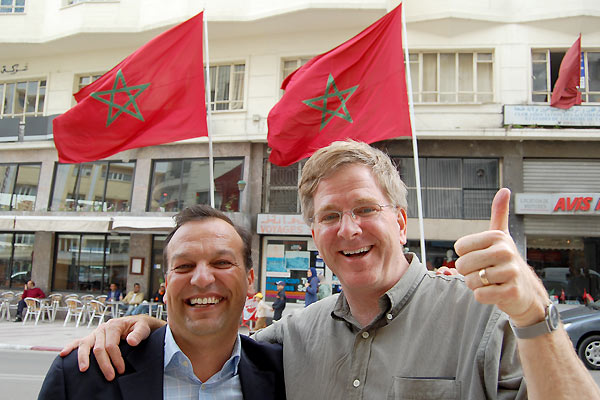
Roosters and the Muslim call to prayer work together to wake me and the rest of that world. When the sun is high enough to send a rainbow plunging into the harbor amid ferries busily coming and going, I stand on my balcony and survey Tangier kicking into gear. Women in colorful, flowing robes walk to sweat shops adjacent the port, happy to earn $8 a day sewing for big-name European clothing lines. Cabbies jostle at the pier for the chance to rip off arriving tourists.

It’s an exciting time in Morocco. The king is modernizing. His queen was a commoner. Moroccans say she’s the first to be seen in public. They have never seen the king’s mother. They actually don’t know what she even looks like. Walking the streets, you see a modest new affluence, lots of vision and energy, and no compromise with being Arabic.

They don’t emulate or even seem to care about the USA. Al Jazeera blares on teahouse TVs — with stirring images of American atrocities inflicted on fellow Muslims. But people seem numb to the propaganda. I felt not a hint of animosity to me as an American, something I was concerned about. There was no political edge to any graffiti or posters.

My guide, Aziz, explained to me the fundamental difference between Islamic and Islamist, and then said Morocco is Islamic.

Wandering — especially after dark —  is entertaining. It’s a rare place where signs are in three languages, and English doesn’t make the cut (it’s Arabic, French and Spanish). Aziz said when he wanted someone’s attention he says, “Hey, Mohammad” (or “Hey, Fatima” for a woman). It’s like our “hey, bub”…but very respectful.

The market scene is a wonderland — of everything but pork. Mountains of brilliant olives, a full palette of spices, children with knives happy to perform for my camera. Each animal is slaughtered in accordance with Halal: in the name of Allah, with a sharp knife, head to Mecca, drained of its blood.
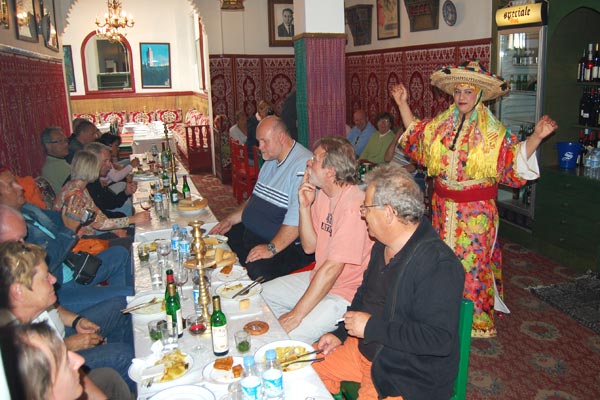
Until now, I’ve recommended that day-trippers from Spain just hold their nose and take the organized tour (with all the groups from Spain’s Costa del Sol). A Tangier guide meets you at the ferry (after the hour-long ride from Spain). They take you on a bus tour of the city, a walk through the old town, lead you to a few staged Kodak moments (camel ride, snake charmer, Atlas mountain tribal musicians) and then you go to a clichéd restaurant where you eat clichéd food with a live band and a belly dancer (which has nothing to do with Moroccan culture, but tourists don’t seem to care). Then you visit a shop.

They must make a healthy commission, because the round-trip ferry ride with the tour cost essentially the same as the round-trip ferry ride without the tour.

During my stay, I met gracious Moroccans eager to talk and share. About the only time I saw other Western tourists was when I crossed paths with one of the many day-tripping tour groups. Those finishing up their tour walk in a tight, single-file formation, clutching their purses and day bags nervously to their bellies like paranoid kangaroos as they bundle past one last spanking line of street merchants, and make it safely back onto the ferry.

I was so comfortable and they were so nervous and embattled. The pathetic scene reminded me of some kind of self-inflicted hostage crisis.

Setting an Ambush in Tangier

I can’t think of any big city in Europe where you wake up literally at “cock crow.” The roosters of Tangier, even more than the minaret’s call to prayer, make sure the city is awake early…and today, my day began at cock crow.

I step to my hotel window and see Europe across the busy strait, and ponder the view. In the distance is the Rock of Gibraltar. Seeing clearly every boat between here and there, I can understand why Britain is determined to keep that strategic piece of rock — and why, through much of the 20th century, Tangier was considered too strategic to be controlled by any one country, and therefore was jointly ruled by the European powers. No boat enters or leaves the Mediterranean without being noticed by Gibraltar or Tangier.

The vast majority of tourists here in Tangier are day-trippers. But, in spite of its “Arabian efficiency” (hotels have lots of doormen and maids, but their printers function more as wrinklers if you happen to be a travel writer in need of a printout), I like to spend the night.

Meeting my TV crew, we catch a taxi up to the kasbah (castle). I hear a tap-tap-tap, look back, and see my back window filled with the toothy grin of a little boy. He leapt onto the cab for the ride, legs and arms spread across its back side with nothing to grip. Seeing a sudden stop about to happen and with nothing to hold onto, his smile disappears and he slinks back, eventually hopping safely off the cab. Later, he and a little girl hop onto the rear bumper of a delivery truck, hitching an exciting ride as it threads through the keyhole gate out of the kasbah and down into the old town.

We’re in Tangier’s kasbah to film the tour groups herded through their predictable series of Kodak moments. I want travelers to side-trip from Spain to Tangier — but also to understand the consequences of opting for the popular bus tour. Waiting in the fortress square for the tour group, I feel like part of an ambush. The snake charmers are poised to turn on the charm. The folkloric musicians have taken their places. The woman at the gift shop stands ready at her door. Little kids organize their postcards. My cameraman locks the camera onto the tripod, which makes that loading-a-shotgun sound you hear in TV westerns. Then, like Apaches coming over the bluff, the tour group appears and follows their guides trustingly into the square. The snake is yanked out of his box, the drum and squawky horn play, and the folkloric three-stringed guitar player gets the tassel on his fez orbiting his head. Some giggling tourist gets a big, lazy reptile for a necklace, and all the group snaps photos. Moments later, the group is gone — rushing to the carpet shop — and the snake is thrown back into the box, lid shut, baking in the midday sun.

I don’t often think about animals. But imagining snakes in dark, hot boxes awaiting tour groups has me noticing the rough lot in life of animals in Tangier. A few minutes later, in the market, I see a writhing burlap bag lashed to the rack atop a beat-up old car— it’s filled with chicken awaiting sale at the market. Then I nearly step on a scrawny cat with a fishtail hanging out its mouth like a Bogart cigarette.

Cats seem to scavenge, stretch, and yawn everywhere. A family of cats fills a crusty doorway. A small truck pulls up, and a man with white gloves grabs five kittens, one by one. With each grab, the little cat stiffens its legs and is tossed ingloriously through a hole into the van. When the man with gloves runs out of kittens, he goes for the mother. She snarls. He jerks back. She scampers. The toothless man who feeds the cats — a fixture on this square — clearly knows that a trip in the white-gloved man’s truck is a death sentence, and shoos away his feline friends. The cats scram as the man in the gloves has a word with the toothless cat-lover.

Then a funeral procession interrupts the scene. Ten men surrounded by a happy commotion of children parade by, singing a religious song with the reverence of “Happy Birthday.” The body, wrapped in a blanket and set in a bed of fresh hay, is jiggled on its wooden rack as all the men jockey to “give the departed one a shoulder,” and the mobile ritual disappears around the bend.

Later, back down by the port, the same tour group passes me, heading down to catch their ferry. I see them clutching their bags and purses, attracting hustlers like flies. Saying no just makes things worse. Just as on my last visit to Tangier, when I encounter groups like this, I can only think, “self-imposed hostage crisis.” And when exploring this travelers’ fantasy on my own, I can only think, “How could anyone be in southern Spain — so close — and not hop over to experience this wonderland?”

Birthday in Tangier

Monday was my birthday, and no one in Morocco knew it. To celebrate, I took a couple of hours alone just floating through the back streets of Tangier…observing.

Looking at a window filled with photos of adorable little boys wearing fezzes and gauzy girls dressed like princesses, I realize why I like the display windows of family photographers throughout the world. They show the cultural ideals to the extreme — the way mothers dream their children might look — and provide insight.

I don’t know if men run the show here, but they outnumber women in the cafés 100 to 1. I want to take a skinny teenage girl’s photo. She giggles with her friends, shows me her wedding ring, and says her husband would have her head if she let me do that. Yesterday my local friend told me, “Moroccan men like their women meaty, not skinny. But that is changing with the young generation and television.”

Old men walk around like sages in robes with pointy hooded jellabas. It makes me wonder whether a teenager might say, “Dad, I know you wear it and Grandpa wore it, but I’m just not going to wear the pointy hood.” Seeing these old men in pointy, rough cloth hooded robes, I keep wanting to ask, “Where’s the gnome conference?”

Wandering through the market, I collect a collage of vivid images. A butcher has made a colorful curtain of entrails, creating mellow stripes of all textures. Camera-shy Berber tribeswomen are in town today selling goat cheese wrapped in palm leaves. A man lumbers through the crowd pushing a ramshackle cart laden with a huge side of beef. He makes a honking sound, and I think he’s just being funny. But it isn’t the comical beep-beep I’d make behind a wheelbarrow. Small-time shipping is his livelihood, the only horn he has is his vocal chords, and he is on a mission.

Wandering deeper into the back lanes, I see henna stencils in plastic wrap — a quick and modern way to stain the designs onto your hands. Another gnome walks by with a pointy hood and a long beard — half white and half hennaed red.

Tiny shops buzz with activity. One small place, no bigger than a small bedroom, has been divided horizontally with a second floor five feet high. It houses a rickety loom on each level, employing four men who wiggle in and out of their workstations each day… all their lives.

Around the corner, the click-click-click of a mosaic maker draws me into another tiny shop, where a man with legs collapsed under himself sits all day chiseling intentionally imperfect mosaic chips (as only Allah is perfect, the imperfection is considered beautiful) to fit a pattern for a commissioned work.

It’s pouring rain, water careens down the stepped brick lane, and, exploring on, I feel like a wet dog. Drenched, I follow a colorfully scarved women into a community bakery. She carries a platter of doughy loaves under a towel ready to be baked into bread. The baker, artfully wielding the broom-handled wooden spatula, receives her loaves. He hardly misses a beat as he pushes and pulls the neighborhood’s baked goods — fish, stews, bread, sunflowers, and cookies — into and out of his oven. After observing the baking action, I’m dry in minutes.

Spending my birthday in Tangier, barely seeing another tourist, I am struck by how the energy here just makes me happy. This Moroccan city is not pro-West or anti-West. It’s simply people making the best of their lives. This society seems to be growing more modern and affluent…and on its own terms. And it’s a joy to experience it.

The New Tangier Is No Tijuana

I love Morocco. But I’ve always called Tangier the Tijuana of Africa. That has changed. Tangier was a neglected hell hole for a generation. It was an international city — favored by the West and therefore distained by Morocco’s last king. He made a point to divert all national investment away from his country’s fourth city.

The new king, who took the throne in 1999, believes Tangier should be a great city again. The first city he visited after his coronation was Tangier. The difference — as I just learned — is breathtaking. The place is still exotic…but likeably exotic.

Checking into Hotel Continental, flamboyant Jimmy, who runs the shop, met me. Six or seven years ago, I told him I was from Seattle. He said, “206.” Now I test him again saying I’m from Seattle. He says, “206, 360, 425…new area codes.” He knows every telephone area code in the USA.

Hotel Continental has you looking for the English Patient. Gramophones gather dust on dressers under mangy chandeliers. A serene woman paints a figure eight in the loose tiles with her mop, day after day, surrounded by dilapidation that never goes away. As I updated the information in my guidebook, I found a rare and nonchalant incompetence. My guidebook listed the hotel’s phone and email data more accurately than their own printed material. It’s a 70-room hotel with not a sheet of paper in its office.

Roosters and the Muslim call to prayer work together to wake me and the rest of that world. When the sun is high enough to send a rainbow plunging into the harbor amid ferries busily coming and going, I stand on my balcony and survey Tangier kicking into gear. Women in colorful, flowing robes walk to sweat shops adjacent the port, happy to earn $8 a day sewing for big-name European clothing lines. Cabbies jostle at the pier for the chance to rip off arriving tourists.

It’s an exciting time in Morocco. The king is modernizing. His queen was a commoner. Moroccans say she’s the first to be seen in public. They have never seen the king’s mother. They actually don’t know what she even looks like. Walking the streets, you see a modest new affluence, lots of vision and energy, and no compromise with being Arabic.

They don’t emulate or even seem to care about the USA. Al Jazeera blares on teahouse TVs — with stirring images of American atrocities inflicted on fellow Muslims. But people seem numb to the propaganda. I felt not a hint of animosity to me as an American, something I was concerned about. There was no political edge to any graffiti or posters.

My guide, Aziz, explained to me the fundamental difference between Islamic and Islamist, and then said Morocco is Islamic.

Wandering — especially after dark — is entertaining. It’s a rare place where signs are in three languages, and English doesn’t make the cut (it’s Arabic, French and Spanish). Aziz said when he wanted someone’s attention he says, “Hey, Mohammad” (or “Hey, Fatima” for a woman). It’s like our “hey, bub”…but very respectful.

The market scene is a wonderland — of everything but pork. Mountains of brilliant olives, a full palette of spices, children with knives happy to perform for my camera. Each animal is slaughtered in accordance with Halal: in the name of Allah, with a sharp knife, head to Mecca, drained of its blood.

Until now, I’ve recommended that day-trippers from Spain just hold their nose and take the organized tour (with all the groups from Spain’s Costa del Sol). A Tangier guide meets you at the ferry (after the hour-long ride from Spain). They take you on a bus tour of the city, a walk through the old town, lead you to a few staged Kodak moments (camel ride, snake charmer, Atlas mountain tribal musicians) and then you go to a clichéd restaurant where you eat clichéd food with a live band and a belly dancer (which has nothing to do with Moroccan culture, but tourists don’t seem to care). Then you visit a shop.

They must make a healthy commission, because the round-trip ferry ride with the tour cost essentially the same as the round-trip ferry ride without the tour.

During my stay, I met gracious Moroccans eager to talk and share. About the only time I saw other Western tourists was when I crossed paths with one of the many day-tripping tour groups. Those finishing up their tour walk in a tight, single-file formation, clutching their purses and day bags nervously to their bellies like paranoid kangaroos as they bundle past one last spanking line of street merchants, and make it safely back onto the ferry.

I was so comfortable and they were so nervous and embattled. The pathetic scene reminded me of some kind of self-inflicted hostage crisis.