Built in the mid-1700s for Peter the Great’s daughter, Elizabeth, the Hermitage was later filled with the art collection of Catherine the Great. The Hermitage’s vast collections of European masterpieces make it one of the world’s top art museums, ranking with the Louvre and the Prado. How does the Hermitage stack up among the world’s top collections of paintings for you? Photos by Trish Feaster, see her blog at The Travelphile.com.
Housed in the Romanovs’ Winter Palace, the Hermitage is actually two top-notch sightseeing experiences in one: an art gallery of European works and an imperial residence. You can enjoy the Leonardos, Rembrandts, and Matisses while imagining the ostentatious lifestyles of the czars who collected them. Between the canvases, you glide through some of the most opulent ballrooms and throne rooms ever built.With the help of our local guide, I learned that you can avoid a ticket line by simply buying your Hermitage tickets at the machines in the courtyard. In Russia, I found that machines like this generally have an English mode and work well.All over Europe, people are waiting needlessly in long lines. In St. Petersburg, the sight where you’ll mostly likely have a long wait is the Hermitage. With up to 10,000 cruise travelers a day flooding into the city and the Hermitage the top sight on their lists, it can be a zoo. But with our machine-bought ticket, we walked right by the ticket line and directly into the palace.Throughout Europe, former palaces — or at least palatial buildings — are filled with a country’s best paintings. But nowhere is the rich mix of a royal art collection and a royal palace so powerful. This is the throne room of the czars.If you’re looking for Europe’s great masters, you’ll find them in the Hermitage. Some visitors come away thinking, “But where’s the Russian art?” They’re in the wrong museum. The Russian art is in (logically) the Russian Museum. It’s every bit as exciting as the Hermitage — and it’s filled with art by painters whose names most Americans don’t know.The last time I visited the Hermitage, I knew it had an awe-inspiring collection. But it was dingy and poorly displayed. After my recent visit, I’d give the Hermitage “the most improved museum in Europe” award. It is dazzling — both the art and the palace in which the art hangs.Looking out the window of the Hermitage, the Winter Palace Square evokes scenes and memories of the Bolshevik Revolution. I can imagine members of Russia’s provisional government looking worriedly out this window as angry crowds of workers, inspired by the ideology and promises of Lenin, filled this square.
It was fun to be a “temporary local” in a very typical St. Petersburg neighborhood with our friend Steve Caron. With Russia’s new affluence, fun little eateries and pastry shops are opening up right and left. Steve’s joy at the rising vibrancy of his neighborhood was contagious. We had a tasty dinner at a restaurant called Schengen. Schengen is also the name of the treaty that lets most Europeans travel freely within “the Schengen group” of countries. Russians like Schengen because, if they can get to Finland (part of the Schengen group), they can roam all over the Continent. To them, Schengen symbolizes the freedom to travel. Join us as we hop across the street from the Schengen restaurant and into the yummy Cookie Shop.
If you can’t see the video below, watch it on YouTube.
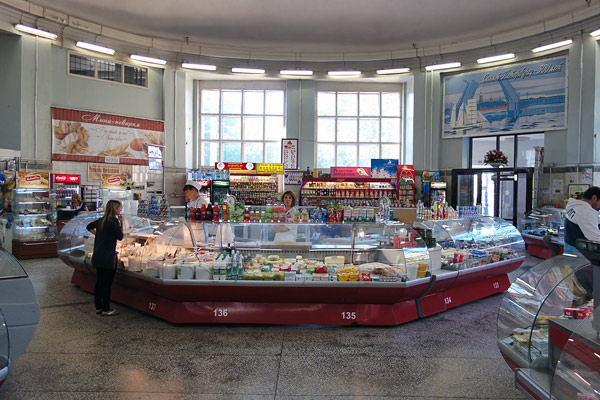
While St. Petersburg has lots of earthshaking turnstile sights, simply visiting a neighborhood market is one of the most entertaining and enjoyable experiences a visitor can have. Part of my mission on this visit was to find some good markets that are accessible to tourists and add them to our guidebook chapter on St. Petersburg. Do you have any market memories from towns in the former Soviet Union to share?
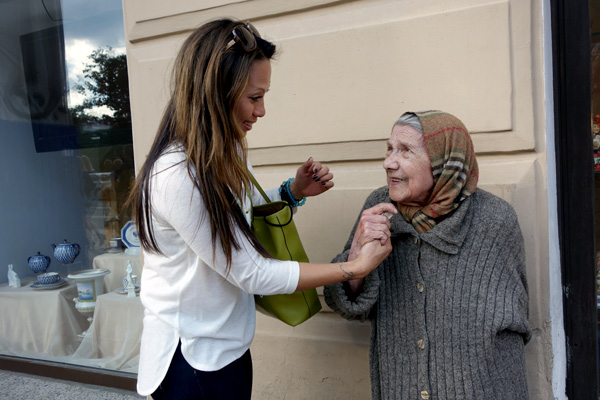
Pickles are a big part of any market scene, partly because when a Russian man thinks of vodka, he also thinks of pickles. Just like we enjoy chips or pretzels with beer, Russians have pickled vegetables with their firewater.No offense to Russian cuisine, but even after the fall of the USSR, it’s the people from Central Asia (“the ’stans”) who bring spiciness and a fun twist to the otherwise predictable local menu. In markets you’ll invariably see Uzbeks selling taste treats like these.As a tourist, it’s helpful to enjoy the little chores and rituals of everyday life. Just stopping by the corner mini-market and buying some handpicked blueberries gives us a chance to exchange smiles with a local who may never see a tourist, resulting in fun memories for all.Chance encounters with sweet people on the street is a delightful contrast to the vast and overwhelming sights of the city.
Trish had a beautiful and emotional encounter with this woman and writes about it in an entry titled “Never Judge a Babushka by Her Head Cover” at The Travelphile.com.
Back in the 1990s when the Soviet Union collapsed, the ownership of Russia passed from the state to the people through a well-intended but chaotic system of vouchers for everyone. Of course, aggressive people ended up owning nearly everything and, to a great extent, Russia is now run by a gang of shadowy oligarchs. When Putin came to power he had a meeting with the oligarchs and essentially said, “I’ll let you continue to make money if you stay out of politics.” With this alliance (and the hard lesson taught when a couple of oligarchs who got political were thrown in jail), the oligarchs generally stay out of Putin’s way and he stays out of theirs. The oligarchs have to do a bit of a balancing act in order to keep the public from rising up against them, and they occasionally do good deeds. Just like the Koch brothers fund some high culture in the US, oligarchs in Russia donate to the opera and provide parks like this one, New Holland. It is an oligarch-owned oasis of calm and grassy elegance in the middle of St. Petersburg that fills a former military shipyard. People love it, and it’s a public relations coup for the oligarch. Here’s a brief tour.
If you can’t see the video below, watch it on YouTube.
I was so impressed by the sightseeing in St. Petersburg that my filming plans were bumped up a notch. Before my visit I had thought “to express my frustration with Russia’s insistence on making visitors get an expensive and pesky visa, I won’t promote their tourism with a TV show.” After this week, I can’t help but dream of coming back with the crew. The city was gray and depressing last time I visited (in the 1990s). It sparkles (and feels much safer) today.
The main drag of the city is Nevsky Prospekt. This provides a spine for your sightseeing leading from the Winter Palace (Hermitage Museum) through the center of town.
Attractive and entertaining as Nevsky Prospekt may be, it’s important to get away from the center and all the touristy stuff. For our guidebook we’ve added a neighborhood walk through the heart of Vasilyevsky Island, a residential zone stretching from the city center all the way to the massive new Marine Facade cruise port. Something that continually amazes me is that in the early 1700s, Peter the Great, inspired by Amsterdam, laid out his great city in a swamp. Many of the original grid-planned neighborhoods survive. This neighborhood was built with a series of canals — Amsterdam-style. Later, the canals were filled in. The center of this street, once a canal, then a trolley line, is today simply a well-groomed park.
A new high-speed train, running several times a day, connects Moscow and St. Petersburg in just four hours. Muscovite tourists come to St. Petersburg and tell their guides, “Show us the charm of St. Petersburg.” St. Petersburg has charms, like this, that are rare in Russia.
St. Petersburg is a city of venerable, low-slung bridges. But each night at about 2:00 a.m., traffic is interrupted as the bridges open up and ships — which were stacked up and waiting patiently all day — motor through to begin their journeys through the Russian heartland. With the help of Soviet-era canals, shipping from Russia’s western port (St. Petersburg on the Baltic Sea) can get to the Volga and other great rivers and voyage to the Black Sea, the Arctic, and beyond.
By the way, one of my guides explained to me that 80 percent of Russians just want stability. Putin is so popular because, while he may not be an icon of democracy, he symbolizes stability. Anyone who wants something else is deviating from the norm — thus a “deviant.”
Speaking of deviance: One night recently, a group of deviant artists arranged (in a matter of minutes) to paint a giant erect penis on the street section of a bridge that would rise to let the cargo ships through at 2:00 a.m. The bridge happened to face what’s called “the big house” — the former KGB headquarters, now the headquarters of the Russian version of our CIA. As planned, when the bridge was raised, a towering penis flipped off that symbol of Russian non-democracy. (You can see this on YouTube.)
Three hundred years ago, Czar Peter I became Peter the Great because of his huge personality — a great traveler, city planner, warrior, scientist, and the Westernizer of Russia. In his travels he brought back lots of scientific wonders that illustrated his curious mind. The Kunstkamera, the oldest museum in town and one of St. Petersburg’s most interesting sights, includes Peter the Great’s personal freak show — typical of the period — of all kinds of human and animal deformities preserved in jars for three centuries.
St. Petersburg suffered like no other big city in World War II — with a 900-day siege that started in 1941 and lasted through three brutally cold winters. Starvation and desperation wracked the city but, with a courageous volunteer army, it stood strong against a determined Nazi army. I was impressed by this memorial to those who defended the city during what Russians call “The Great Patriotic War.” I wrote it up in our guidebook this way:
Monument to the Heroic Defenders of Leningrad — It’s hard to imagine the horror, suffering, and importance of the Siege of Leningrad, also known as “The Battle of 900 Days.” Hitler intended to literally wipe the city off the map…and the people of Leningrad knew it. The city survived, and May 9, 1945, was Victory Day. To mark the 30th anniversary of that victory, on May 9, 1975, this stirring monument was inaugurated. 700,000 Nazi troops got to the edge of the city, and this — with its 48-meter-tall granite obelisk with the dates 1941-1945 — marks the spot where the 300,000-strong ragtag army of mostly volunteer Soviets held the line. In the sculpture at its base (called The Victors), a worker stands by a soldier, symbolizing the unity of the people and the army in the struggle against the enemy. With the music of Shostakovich or Rachmaninoff playing, visitors ponder the million people who died defending the city. Walking by 900 lamplights (symbolizing the 900 days of suffering the battle brought), you enter an underground exhibit with a powerful 10-minute movie showing life and death during the siege.
By the way, while the city dumped the term Leningrad for other uses, when referring to the city during the siege, “Leningrad” is still used out of respect to the people whose valor and suffering saved the city. Each May 9, you see hammers, sickles, and the word Leningrad all over St. Petersburg.
While I try to teach with a gentle touch, some travelers just don’t realize that my tips will make their travels not only more fun and meaningful, but less expensive. In these isolated cases, I need to be more forceful.