Wasting Away on the Algarve

Enlarge photo

To commemorate the Smithsonian Presents Travels with Rick Steves magazine — now on sale online, and at newsstands nationwide — Rick is blogging about the 20 top destinations featured in that issue. One of those destinations is Salema, on Portugal’s Algarve Coast.

I can close my eyes and feel the salty ambience of Salema: The tall, fresh-squeezed orange juice of the loss-leader breakfasts where I put my feet up on the rusty railing, gaze out at the sea, and wonder what I’ll do today.

Actually, since I’m usually in Salema updating my guidebook, my options are all work-related: find a desolate beach farther north, on the windy side of Cape Sagres; venture up into the modern part of town to see how soft prices are for the modern hotel scene; drop by expat Brits in the next town, where those on humble retirement accounts live like kings with everything you could want in Portugal except a sea view.

I do fantasize about just being here on vacation. Nursing a drink in a still-wet bathing suit. Going out with Sebastian to haul in the octopus pots. Hiking to the beach where you expose skin that’s never seen the sun. Getting to the point where you can competently discuss the quality of the fish soup in each beachfront restaurant.

I was going to say there are just a few places in Europe where I could savor a true vacation. But then, when I think about it, there are many. But for a beach break — simply wasting away in a European Margaritaville — it’s fair to call Salema, on Portugal’s Algarve, my favorite.

Mostar, Yugoslav Banks, and War Damage

Enlarge photo

To commemorate the Smithsonian Presents Travels with Rick Steves magazine — now on sale online, and at newsstands nationwide — Rick is blogging about the 20 top destinations featured in that issue. One of those destinations is Mostar, in Bosnia-Herzegovina.

Whether in Mostar or elsewhere, former war zones offer powerful sightseeing. Thankfully, in Europe, they are rare.

I remember that in the 1970s, lots of World War II damage still awaited repair throughout Germany. With the disparity of wealth between Eastern and Western Europe during the Cold War, in the 1980s it was striking to see how the West had bulldozed and rebuilt virtually every bit of damage, while the East was still pockmarked with dreary WWII souvenirs. Of course, the town centers of the East were dolled up for visitors. Back then, the tourists didn’t see the reality of a society without the economic wherewithal to entirely rebuild 40 years after the war unless they ventured out into the suburbs, where strafed plaster and broken concrete were still commonplace.

Traveling in Northern Ireland a few years ago, you’d see little actual destruction, but you would see the poverty resulting from the Troubles, and angry political murals. And even those are much less commonplace these days.

And, of course, the only actual war fought on European soil since World War II was the war precipitated by the break-up of Yugoslavia. Driving through the interior of Croatia, you can still see damage from the war in the early 1990s. Touristy places along the Dalmatian Coast were generally unscathed. The glaring exception, Dubrovnik, has already been thoroughly rebuilt — a prerequisite for it to regain its happy-go-lucky position as the former Yugoslavia’s top tourist attraction.

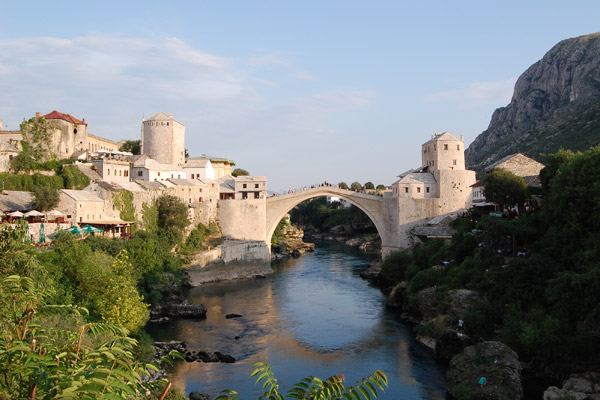
For many travelers, the European destination where they’re most likely to see war damage on a massive scale is Mostar, in Bosnia-Herzegovina. A major reason why the city has been slow to rebuild is that most property owners had big mortgages on their buildings…so the actual “owners” were the banks. With the outbreak of war, people obviously stopped making payments on evacuated and bombed-out buildings. The bank assumed ownership. And, as Yugoslavia fell apart, so did its national bank. It costs a lot of money to rebuild, and — with ownership not being clearly established — there’s little incentive for anyone to spearhead the rebuilding efforts. Consequently, the bullet-speckled facades fester unrepaired.

But on my last visit to Mostar, I noticed that several formerly damaged buildings had been fixed. As these perplexing ownership issues are cleared up, physical reminders of 1993 are being plastered over — just as the literal and psychological scars of war among the people of Mostar are fading. That’s why traveling to Mostar — especially over time — is particularly powerful…at once tragic and uplifting.

Gimmelwald: Getting to that World Apart

Enlarge photo

To commemorate the Smithsonian Presents Travels with Rick Steves magazine — now on sale online, and at newsstands nationwide — Rick is blogging about the 20 top destinations featured in that issue. One of those destinations is Gimmelwald, in the Swiss Alps.

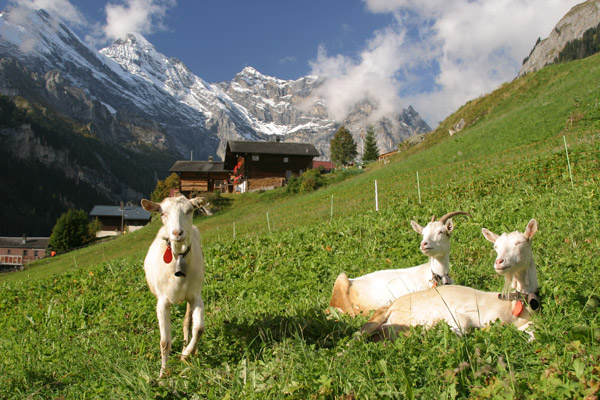
A great challenge in travel research is finding destinations that are a world apart. Gimmelwald, that remote and impossibly idyllic village high in the Swiss Alps, is a classic example. Parking you car in the valley floor and riding the cable car up is like going through a looking glass. You car shrinks, your stomach flip-flops, you look over the valley like a hang-glider, then suddenly you’re deposited — as if from a magical glass bubble — into another world. It’s a place where the air feels different — where the only noises are bees, bugs, and birds perusing alpine flowers, paddling water spilling from a hose into the hollowed-out log that keeps the cows watered, and gnome-like men sucking gnome-like pipes while chopping firewood.

Many of my “Back Doors” give this sensation. That’s probably why they appeal to me in the first place. It takes a little extra effort to reach them: Hallstatt (reached by lake ferry from the tiny train station buried in a forest east of Salzburg), Civita de Bagnoregio (you walk to it up a donkey path, then through a medieval gate, to enter a classic hill town an hour north of Rome), Salema (beyond the Portuguese resort of Lagos, near the far-southwest tip of Europe, at the end of a dirt road), Ærøskøbing (a traffic-free, ship-in-a-bottle dream town a ferry ride away from Svendborg in Denmark), and Inishmore (on the Aran Islands, off the rugged West Coast of Ireland). What place in Europe gives you that “world apart” feeling, and why?

Baden-Baden: Globalization and Leaky Borders

Enlarge photo

To commemorate the Smithsonian Presents Travels with Rick Steves magazine — now on sale online, and at newsstands nationwide — Rick is blogging about the 20 top destinations featured in that issue. One of those destinations is the German spa resort of Baden-Baden.

Germany’s spa town of Baden-Baden is a fun and relaxing place to splash around in a thermal bath. But, as with many resort towns, a more substantial history bubbles just beneath the surface. And, in the case of Baden-Baden, that history still has ripples today.

After the czars banned gambling, many Russians flocked to Baden-Baden, creating their own little Russian enclaves. (Many lost their fortunes, borrowed a pistol, and did themselves in on the so-called “Alley of Sighs.”) While the Russian expat community dwindled for a while, in recent years (after the end of communism), ultra-wealthy Russians have sought out safe property investments all over Europe…and Baden-Baden has re-emerged as a favorite destination. Russians have bought up property here like crazy. You’ll see Russian on multilingual signs around town. On my last visit, the lady who ran the launderette spoke German and Russian…but no English.

This is worrying to locals. The mayor — saying his town must either take action or let itself become essentially Russian-owned — recently declared that Russians were no longer allowed to purchase Baden-Baden real estate.

With immigration a persistent and complex issue in the USA, it’s good to remember that we’re not the only nation struggling with how to handle the realities of race, class distinctions, foreign investment, and use of government services. I see the same challenges all over Europe.

A vast suburb of Tallinn, Estonia, is filled with Russians. They were planted there during Soviet rule, and — although Estonia is now its own independent nation — they still refuse to embrace the local language, Estonian. They live as a separate, Russian-speaking community within Tallinn.

Norwegians — who pride themselves on not being racist — are upset with unemployed Pakistanis living in their country who, they say, don’t share the Norwegian work ethic, but take advantage of the luxurious Norwegian welfare state. I sense that Norwegians don’t know how to discuss this issue comfortably.

I was just in Gibraltar, and the buzz there was about a $20 million mosque built with money from the Middle East for the humble local community of 900 Muslims workers.

Just as people with less money go to work in wealthy lands, people with more money turn their vacation and retirement funds into maximum joy and comfort in cheaper places. I have a friend who’s a retired postman living very comfortably on his meager pension in southern Portugal. A Venetian friend of mine is excited about her new holiday home in Tunisia. No crowds, great beaches, very cheap — she said Tunisia is all the rage among Italians. Belgians have staked out their enclave in Spain’s Costa del Sol — just one more community where the stray Spaniard complains that some eateries don’t offer menus in Spanish. Americans are buying fixer-uppers in droves in rural Italy. And they’re doing it with the encouragement of a government that appreciates the economic boost these romantic Frances Mayes-wannabes bring to regions that need expat newcomers to keep from withering.

There are immigration issues everywhere you travel. Second-generation Turkish Germans can honestly say “Ich bin ein Berliner.” Construction work throughout France would slow to a trickle without Polish builders. While many are now careful to refer to Gypsies as “Roma,” there’s still not enough money to build a Holocaust memorial in Berlin to this group, which suffered a genocide that was comparable, in many ways, to what happened to the Jews.

Like the Swiss are afraid of minarets, the French are afraid of women with covered heads, and America is afraid of a leaky southern border, a lot of anxiety is driving current legislation in all these countries. In Europe, as in the USA, it’s hard to talk about immigration and race issues for fear of offending people. But one thing is clear: Race and immigration concerns are not unique to any one country, and they are here to stay.

While travel may not give us answers, it does give us perspective and a clear sense that we will all ultimately live together…whether we like it or not. The other day, a frightened white woman asked me to sign a petition, saying, “We’ll soon be in the minority.” As a traveler, I know “we” already are in the minority on this planet…and that’s fine with me.

Prague Trumps Rothenburg

Enlarge photo

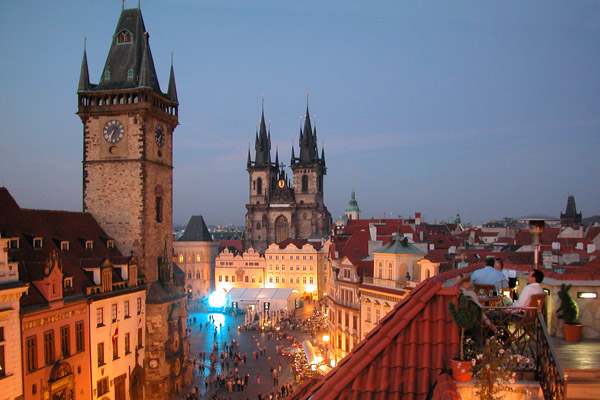
To commemorate the Smithsonian Presents Travels with Rick Steves magazine — now on sale online, and at newsstands nationwide — Rick is blogging about the 20 top destinations featured in that issue. One of those destinations is Prague, Czech Republic.

I’m currently on a Central European swing, updating my guidebooks: Budapest, Prague, Vienna, Munich. Being back in Prague reminds me of how that city first broke down the Iron Curtain in my guidebooks many years ago.

On a research trip back in the 1990s, I was on a train heading to Rothenburg to update the ultimate medieval town in Germany, as I did nearly every year. For a decade, I’d been diligently visiting to check the woodcarvings, walk the old wall, visit the toy museum and the medieval crime-and-punishment museum, and check in with old friends who run the hotels and restaurants that serve the town’s hordes of tourists. The work was almost mechanical. Socially, it was a happy homecoming. The ramparts and cute lanes were filled with my readers, who cheered me on. I loved going to Rothenburg.

This was just a couple of years after the end of the Cold War. The obvious new frontier of European tourism was the mysterious East. The former Warsaw Pact countries were now wide open and eager to welcome Western travelers. I knew that sooner or later, I’d tackle the region and expand my guidebook coverage there. But it was overwhelming, and, psychologically, it was easy to just keep redoing the Rothenburgs of Western Europe. I was daunted by the job — a bit lazy…dreading the unavoidable truth that if I was to cover Europe, I would now need to stretch east.

I was rattling down the tracks in the direction of Rothenburg, when I realized the very train I was on would end its run in Prague. I started comparing the value of spending the next three days in Rothenburg versus doing a groundbreaking research stint in Prague. I stayed on that train and didn’t get off until the Golden City of a Hundred Spires. I jumbled my itinerary a bit to accommodate the new job, and what followed was one of the most exciting and rewarding weeks of research I can remember. I left with Prague now in the realm of what we covered.

That first Prague chapter needed a home, and the only home we had for it was splicing it into our existing Germany, Austria & Switzerland guidebook. What was called “GAS” in my office would now be “GASP.” (Over the years, GASP became GAS, then GA…until finally there were separate guidebooks for each of the four destinations, including Prague.)

With the beautiful co-author partnership of Honza Vihan (our good friend and super guide from Prague), Prague joined the elite league of cities that merited their own Rick Steves guidebook (along with London, Paris, Venice, Florence, and Rome). Cameron Hewitt took this Czech nucleus and expanded into another five countries (which I termed the “Louisiana Purchase” of Europe) — Poland, Slovakia, Hungary, Croatia, and Slovenia — co-authoring my Eastern Europe guidebook, and then two others (on Croatia & Slovenia and Budapest). Today Eastern Europe is fully integrated into our Europe-wide program, with four different guidebooks and six different bus tour itineraries.

And it all started in that year when Rothenburg went unresearched and a seed was planted in Prague.