Happy Palm Sunday. In honor of Holy Week, I’m sharing daily clips from Rick Steves’ European Easter, my one-hour public television special that’s airing now nationwide (check your local listings) and streaming online.
In today’s clip, we’ll experience one of Europe’s most bombastic Holy Week celebrations: the processions of Sevilla’s Semana Santa. Beginning on Palm Sunday, neighborhood congregations around Sevilla adorn their floats with flowers and candles, as “costaleros” prepare to carry those floats through the streets on their backs, amid a parade of cloaked penitents.
— Join our traveling community — connect with me on Facebook and Twitter.
Throughout southern Spain — a region so expert at fiestas and romance — locals greet each spring with a festival for all ages. In Sevilla, much of the city packs into its vast fairgrounds each spring for seven days of dancing, drinking, and socializing. The horses are nearly as dressed up as the people, a springtime flirtatiousness fills the air, and travelers are more than welcome to join in the fun.
In this clip from my new, one-hour Rick Steves’ European Festivals public television special, I explore the fair with my friend Concepción.
Every young child knows that it’s nice to share. But grown-up travelers find it fun, cost-effective, and educational, too.
One of my favorite travel splurges is hiring a local guide to show me their hometown. I find that a private guide helps me make the most of my time while enhancing my appreciation of a place. I recommend the best of these guides in my books. But I realize that not everybody can afford to hire their own guide for the day.
That’s why, a few years ago, I had the brainstorm to work with great guides to assemble “shared tours” for groups of my readers — letting good travelers split the cost of a great tour, and giving a great guide more work.
The first place I tried this was in Sevilla, Spain, where Concepción Delgao and I worked together to come up with the perfect two-hour walking tour. For the last several years, Rick Steves readers have been happy to show up each morning at 10:30 (except Sundays…Concepción’s day off) and chip €15 apiece into the communal hat in exchange for a top-notch tour. Thousands of my readers have taken advantage of this…and Concepción couldn’t be happier.
Later, I teamed up with Annie Adair — an American expat married to an Italian — in the Tuscan hill town of Volterra. We created a similar tour that lets Annie and her colleague Claudia show off the best one-hour walk of Volterra for just €10 a head (meets Tuesday, Wednesday, and Thursday evenings at 6:00 p.m., and Wednesday mornings at 12:30).When I was in Volterra last summer, I just had to check out how the tour was working. I met up with Claudia, as we explain in our book. It was a slow night, so we waited to see if the required-minimum three Rick Steves travelers would show up. Sure enough, at the stroke of 6, a family arrived for the tour…and we all enjoyed a great guided walk together.
Vincenzo, an ambitious entrepreneur based in Naples, runs Mondo Guide. I have long regretted that Naples, Pompeii, and the Amalfi Coast — three of Southern Italy’s best experiences — were so challenging to see on your own, but so expensive to do with a private guide. Vincenzo and I hatched a plan to offer shared tours, tailored for my readers, for these three itineraries. Vincenzo designed a website to make signing up easy, and for the last two years, thousands of my readers have had a better (and more cost-effective) experience in this part of Italy. New for 2016, Mondo has added two more shared tours for my readers: A private boat trip from Sorrento to the Isle of Capri (a romantic and efficient alternative to the crowded public ferries); and thoughtfully designed shore excursions for cruise passengers arriving in Naples and Salerno.
In each of these cases, shared tours are a win-win-win. My readers are happy because they get to split the cost of a talented local guide’s personal attention. The guides are happy because they get more business (and, they tell me, they find my readers great to work with). And I’m happy because everyone else is happy.
Helping travelers maximize their experience in Europe, while minimizing the cost, is our mission. Shared tours like these are just one of many ways we enjoy our work at Rick Steves’ Europe. Happy travels!
Eating in Sevilla is fun and affordable. People from Madrid and Barcelona find it a wonderful value. Make a point to get out and eat well when in Sevilla.
The general system is to eat family-style, sharing everything. Smaller tapas are served at the bar, while larger portions called half-raciones and full raciones are at the tables. While raciones work great for small groups, individuals and couples get more variety with tapas. Fortunately, many places are easing up on the “tapas only at the bar” rule. You can always ask — many places are easing up on this rule, and if things are slow, they’ll let tapas eaters sit at a table.
A clear eating trend in Sevilla is the rise of gourmet tapas bars, with spiffed-up decor and creative menus, at the expense of traditional restaurants. Even in difficult economic times, when other businesses are closing down, tapas bars are popping up all over. (Locals explain that with the collapse of the construction industry here, engineers, architects, and other professionals — eager for a business opportunity — are investing in trendy tapas bars.) Old-school places survive, but they often lack energy, and it seems that their clientele is aging with them. My quandary: I like the classic típico places. But the lively atmosphere and the best food are in the new places. One thing’s for certain: If you want a good “restaurant” experience, your best value these days is to find a trendy tapas bar that offers good table seating, and sit down to enjoy some raciones.
While you can find tapas somewhere just about any time, the best action starts late. Restaurants generally serve lunch from 13:00 to 16:00 and dinner from 20:00 until very late. Spaniards don’t start lunch until about 14:00 and dinner until after 21:00; at these times, the top tapas bars can get extremely crowded with locals, and it can be tough for English-speaking tourists to find a place — or even order. Tourists wanting to avoid the crush have clear windows of opportunity: If you go early — around 13:30 for lunch or 20:30- 21:00 for dinner — you’ll get better service and a place at the bar.
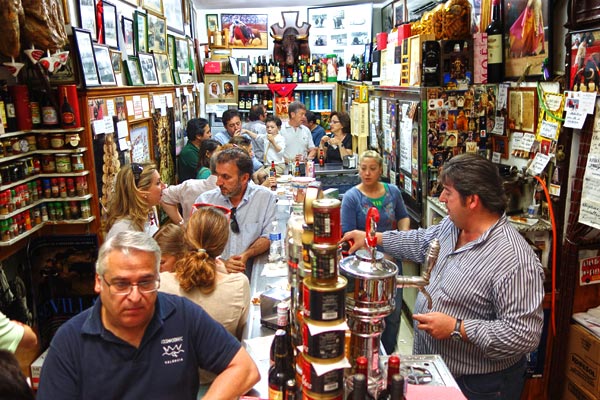
For a different twist on a tapas bar, find an abacería. This is a neighborhood grocery store that doubles as a tapas bar. I found a great one, which will star in the next edition of my Spain guidebook: Abacería Casa Moreno is a rare, classic abacería (an old-time grocery store that also serves tapas). Squeeze into the back room, and you’re squeezing back in time — and that includes a steep language barrier. It’s standing-only. Help yourself to the box of pork scratchings on the bar while choosing from an enticing list of €2.50 tapas. They’re proud of their top-quality jamón serrano and queso manchego, and serve hot tapas only at lunch. Rubbing elbows here with local eaters under a bull’s head surrounded by jars of peaches and cans of sardines, you feel like you’re in on a secret (Mon-Fri 8:00-15:30 & 19:30-22:30, closed Sat-Sun, 3 blocks off Plaza Nueva at Gamazo 7, tel. 954-228-315).
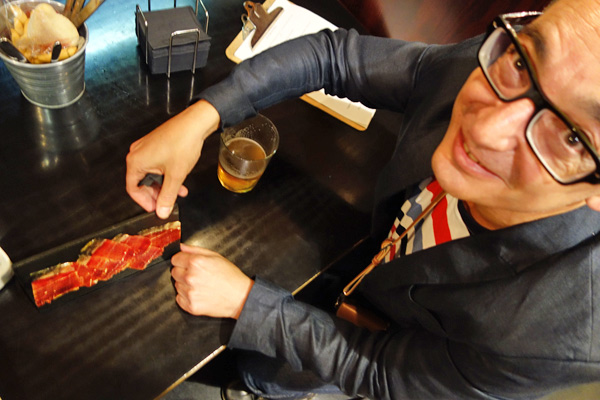
My guide demonstrates how quality ham, sliced thin, will stick to the plate when upturned. I’m not sure what that has to do with quality, but one thing I am sure of: When in Spain, life’s too short to eat mediocre jamón. At least a couple of times, pay extra for the best ham on the list.
Updating the flamenco scene in Sevilla for my Spain guidebook, I had the occasion to pop into concerts in five different venues in town. Sevilla is the best city in which to experience flamenco. While the concerts are designed for tourists, they are real and riveting, and a great value. Here’s my latest report on the much-changed flamenco concert scene in Sevilla:
In Sevilla, you basically have three flamenco options: serious — yet still touristy — flamenco concerts, where the singing and dancing take center stage; even more touristy shows that have a bar and/or food (scurrying waiters can distract from the performers); and — least touristy — casual bars late at night, where you can catch impromptu or semi-impromptu musicians at play.
Serious Flamenco Concerts
While it’s hard to choose among these three nightly, one-hour Flamenco concerts, I’d say enjoying one is a must during your Sevilla visit. To the novice viewer, each company offers equal quality. They cost about the same, and each venue is small, intimate, and air-conditioned. For most, they are preferable to the “shows” listed later; compared to those, these options are half the cost, half the length, half the seats, and earlier in the evening. (While you can hear flamenco for free in various bars around town — also described later — that scene ignites very late.) My recommended concerts are careful to give you a good overview of the art form, covering all the flamenco bases. At each venue, you can reserve by phone and pay upon arrival, or drop by early to pick up a ticket. While La Casa del Flamenco is the nicest and most central venue, the other two have exhibits that can add to the experience. Casa de la Memoria is a strangely wide venue (just two rows deep), where everyone gets a close-up view and room to stretch out (€16, nightly at 19:30 and 21:00, no drinks, no children under 6, 80 seats, Calle Cuna 6, tel. 954-560-670, www.casadelamemoria.es, flamencomemoria@gmail.com, run by Rosanna). Their exhibit is one easy, well-described floor, with lots of photos and a few artifacts (€3, or free with concert ticket — but only open 10:00-18:00). The Flamenco Dance Museum, while the most congested venue (with 115 tightly packed seats), has a bar and allows drinks, and you can visit the museum immediately before the show. It’s festival seating. The doors open at 18:00, allowing you to grab the seat of your choice and spend an hour touring the museum, and enjoy a drink before the show (€20, nightly at 19:00; €24 combo-ticket includes the museum and a show; 10 percent discount off museum, show, or combo-ticket with this book; Manuel Rojas Marcos 3, about 3 blocks east of Plaza Nueva, tel. 954-340-311, www.flamencomuseum.com). La Casa del Flamenco is in a delightful arcaded courtyard right in the Barrio Santa Cruz (€18, nightly at 21:00 April-Sept, 19:30 Oct-March, no drinks, no kids under 6, 60 spacious seats, the reception at the adjacent hotel serves as the box office, tel. 954-500-595, Ximénez de Enciso 33).
Razzle-Dazzle Flamenco Shows
These packaged shows can be a bit sterile — and an audience of tourists doesn’t help — but I find both Los Gallos and El Arenal entertaining and riveting. While El Arenal may have a slight edge on talent and feels slicker, Los Gallos has a cozier setting, with cushy rather than hard chairs — and it’s cheaper. Los Gallos presents nightly two-hour shows at 20:15 and 22:30 (€35 ticket includes a drink, €3/person discount with this book in 2014 — but limited to two admissions, arrive 30 minutes early for best seats, noisy bar but no food served, Plaza de la Santa Cruz 11, tel. 954-216-981, www.tablaolosgallos.com, owners José and Blanca promise goose bumps). Tablao El Arenal has arguably more professional performers and a classier setting for its show — but dinner customers get the preferred seating, and waiters are working throughout the performance (€38 ticket includes a drink, €60 includes tapas, €72 includes dinner, 1.5-hour shows at 20:00 and 22:00, near bullring at Calle Rodó 7, tel. 954-216-492, www.tablaoelarenal.com). El Patio Sevillano is more of a variety show, with flamenco as well as other forms of song and dance. While hotels may recommend this, they’re just working for kickbacks. I like the others much better.
Impromptu Flamenco in Bars
Spirited flamenco singing still erupts spontaneously in bars throughout the old town after midnight — but you need to know where to look. Ask a local for the latest. La Carbonería Bar, the sangria equivalent of a beer garden, is a few blocks north of the Barrio Santa Cruz. It’s a sprawling place with a variety of rooms leading to a big, open, tented area filled with young locals, casual guitar strummers, and nearly nightly flamenco music from about 22:30 to 24:00. Located just a few blocks from most of my recommended hotels, this is worth finding if you’re not quite ready to end the day (no cover, €2.50 sangria, daily 20:00-3:00 in the morning; near Plaza Santa María — find Hotel Fernando III, the side alley Céspedes dead-ends at Levies, head left to Levies 18, unsigned door; tel. 954-214-460).
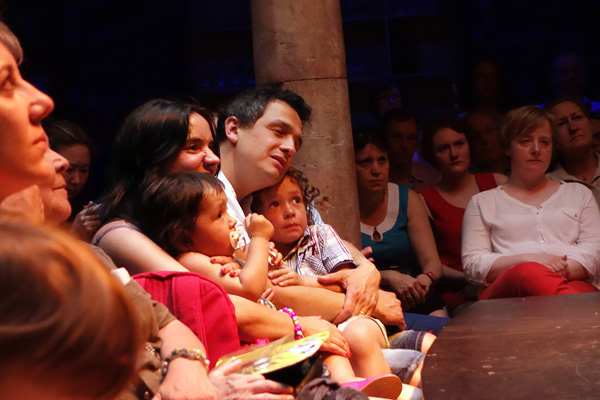
Sitting in the front row of an intimate concert venue with a powerful and intense performance going on, I found myself watching the little children (also in the front row). It helped me experience the dancer — towering, in black, with a demonic expression on her contorted face, long fingernails making her outstretched arms seem even longer and more able to take me into her grasp — from the perspective of the toddlers in the audience. Terrifying.Parents bringing their children to a flamenco concert do more comforting than actually focusing on the music and dance. These children were terrified by the performance.