A Visit to St. George’s Market, Belfast

It was a rainy day on the Emerald Isle, and I was somewhere I had never been before: St. George’s Market. Join me and my guide Jackie there now in this little clip.

Here’s how I wrote this place up for our Rick Steves Ireland guidebook:

St. George’s Market was the largest covered Victorian produce market in Ireland. Today, the farmers are gone and everyone else, it seems, has moved in. Three days a week (Friday, Saturday, and Sunday, about 9:00-15:00), St. George’s Market becomes a thriving artisan, crafts and flea market with a few fish and produce stalls to round things out. With a diverse array of street food and homemade goodies added to the mix, it’s a fun place for lunch (5 blocks east of City Hall, at the corner of Oxford and East Bridge streets, tel. 028/9043-5704).

A Memorial Garden in Belfast

I have always believed that no trip to the Emerald Isle is complete without a visit to Northern Ireland. And I recently spent a few days there, after a stop in Dublin, researching the next edition of our Rick Steves Ireland guidebook.

In Belfast, I spent a fascinating 90 minutes with Tucker, a guide from Cab Tours Belfast — a taxi tour company that is made up of both Catholic and Protestant driver guides who are committed to giving unbiased, dual-narrative tours. On Bombay Street, we stopped at the Clonard Martyrs Memorial Garden. Join us there now.

Video: Understanding and Empathy at a Northern Ireland Wall

We’ve been leading tours through Ireland for more than 20 years, and as a matter of principle, I’ve never had one of our Best of Ireland tours not include a trip through Northern Ireland. Ireland needs to be understood as a whole. And for our group, the last couple of days in Ulster has been an emotional highlight.

It’s a happy and hopeful time right now, as “The Troubles” that wracked the country in recent decades are essentially over. But there is still deep-seated tension ― as this so-called “Peace Wall” (built to separate the two sectarian communities) illustrates. Wherever travelers encounter walls ― whether between Palestine and Israel, San Diego and Tijuana, or Catholic and Protestant neighborhoods in Belfast ― it’s a thought-provoking experience.

Our guide, Declan, made a point to stop at this wall, and he gave us all pens to leave our hopes and prayers for peace in Ireland. Our Rick Steves’ Europe Tours program, with the support of our tour guides, works to help our American travelers hear both narratives and gain empathy for societies where there is tension and strife.

This is Day 74 of my “100 Days in Europe” series. As I travel with Rick Steves’ Europe Tours, research my guidebooks, and make new TV shows, I’m reporting on my experiences across Europe. Still to come: England, Scotland, Germany, Switzerland, and more. Thanks for joining me here on my blog and via Facebook.

Brexit and the Traveler: Europe Just Got Even More Interesting

facebook-brexit

Since 1066, the English Channel has been a very effective moat for Great Britain. But during our generation, Britain has seen a new kind of invasion from the Continent — a peaceful, political one. And with the Brexit vote, the British people have decided to pull up the drawbridge.

I remain a staunch supporter of the European Union. But with the UK’s decision to leave the EU, my idealism has taken a serious blow. I’m flying to Europe this weekend. And from a practical standpoint, for travelers heading to Europe soon, I don’t see much of a difference…other than a cheaper pound sterling, and plenty to talk about with your new European friends. But what about the long-term consequences? Here’s my take.

For years in my lectures, I’ve said this about the European Union:

Imagine Europe amid the ruins of World War II. As people began to dig out, they thought, “Twice in our lifetimes, we’ve gotten into horrific wars. We have to do something drastic, or our children will be digging out again. We need to weave our economies together — especially France and Germany — so that going to war in the future will be inconceivable.” So European citizens got together and created the European Union, a “United States of Europe.” It’s been a stuttering evolution — two steps forward and one step back — for nearly 70 years. Of course, there’s no meaningful union unless you can talk sovereign nations into giving up real sovereignty. That’s a tough sell — especially in Europe. But the EU is here to stay. And even with its cumbersome political correctness and its almost comical excess of regulations, the EU has created a free trade zone big enough to compete with the USA and the emerging economies of China and India. But the real triumph of the EU is that Europe is at peace.

With the Brexit, I realize my statement that “the EU is here to stay” may be wrong after all. Suddenly, the future of the EU is murky. What I do know is that the EU is about to shrink from 28 to 27 member nations and lose 17% of its economic clout. The world’s gateway to the EU is logically London — as English is the language of globalization and London is the world’s financial capital. The EU has lost that. Britain has lost it, too.

I also see the Brexit vote as a symptom of the populism and nativism that is sweeping the Western world. This is a big day for those who believe cooperation is for losers. It’s a good day for Putin, and it’s a good day for Trump. Is it as good day for the white, working-class, less-educated, rural and rust belt voters who cast the deciding ballots? Time will tell. But one thing’s for sure: At home and abroad, those voters feel their voices are not being heard.

The referendum didn’t instantly pull the UK out of the EU. That will require a long negotiation, likely lasting years. So now Britain and Europe have to deal with the reality of an acrimonious divorce. Both parties will try to come out on top, both will be attempting to compromise with an undercurrent of anger, and both will lose the shared efficiencies they’ve enjoyed as a couple. One thing is clear: It will be messy, and there will be no winners.

You can also think of this unlinking biologically: When something has grown together, it’s painful to tear it apart. No matter how slow and careful you are, it’s going to hurt.

Nobody knows exactly what will come of the Brexit. But let’s try looking into our hazy crystal ball:

When the dust settles, will the UK be better off? It depends on your thoughts about free trade and immigration. One way or another, my hunch is that it will become poorer. And I believe British voters will suffer from “exiters’ remorse” when the consequences of their protest vote sink in.

Will Scotland break from the United Kingdom? Hard to say. But I believe that, had they known about the Brexit when they voted to stay in the UK two years ago, the Scots would have voted differently.

Northern Ireland — which voted to stay in the EU — suddenly has more in common with Republic of Ireland. Will this be a nudge toward a (finally) unified Ireland? Or will it destabilize a delicate peace? Stay tuned.

And what about the future of the EU? It’ll always be Europe. But the momentum toward further integration and expansion has hit a wall. Nationalistic, isolationist movements are on the rise across Europe, and the Brexit vote will only embolden them. The potential domino effect — for Europe and beyond — is unknown.

And finally, how will this affect travelers? For now, nothing has changed (except that the pound is on sale). For the time being, travel to the UK and Europe remains as it was. And down the road, I imagine there may be a few more borders to cross and a little less shared affluence. In a few weeks, I’ll be in England, where I’m looking forward to hearing — and sharing — local opinions on the Brexit.

I’m famous for saying “Keep on traveling” during times of upheaval in Europe. And that’s my response now, too. I don’t want to be glib or naive about the challenges that face the UK and the EU in the coming months. It’s going to be a long and difficult process. But as I head for the airport, I’ve chosen to look on the bright side of life: For American travelers, Europe just got even more interesting.

Keep on traveling!
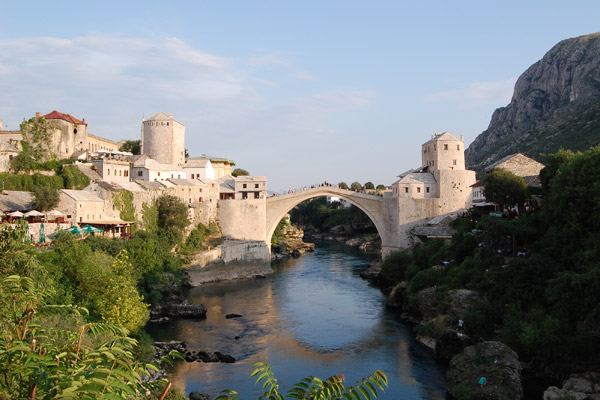
 

Mostar, Yugoslav Banks, and War Damage

Enlarge photo

To commemorate the Smithsonian Presents Travels with Rick Steves magazine — now on sale online, and at newsstands nationwide — Rick is blogging about the 20 top destinations featured in that issue. One of those destinations is Mostar, in Bosnia-Herzegovina.

Whether in Mostar or elsewhere, former war zones offer powerful sightseeing. Thankfully, in Europe, they are rare.

I remember that in the 1970s, lots of World War II damage still awaited repair throughout Germany. With the disparity of wealth between Eastern and Western Europe during the Cold War, in the 1980s it was striking to see how the West had bulldozed and rebuilt virtually every bit of damage, while the East was still pockmarked with dreary WWII souvenirs. Of course, the town centers of the East were dolled up for visitors. Back then, the tourists didn’t see the reality of a society without the economic wherewithal to entirely rebuild 40 years after the war unless they ventured out into the suburbs, where strafed plaster and broken concrete were still commonplace.

Traveling in Northern Ireland a few years ago, you’d see little actual destruction, but you would see the poverty resulting from the Troubles, and angry political murals. And even those are much less commonplace these days.

And, of course, the only actual war fought on European soil since World War II was the war precipitated by the break-up of Yugoslavia. Driving through the interior of Croatia, you can still see damage from the war in the early 1990s. Touristy places along the Dalmatian Coast were generally unscathed. The glaring exception, Dubrovnik, has already been thoroughly rebuilt — a prerequisite for it to regain its happy-go-lucky position as the former Yugoslavia’s top tourist attraction.

For many travelers, the European destination where they’re most likely to see war damage on a massive scale is Mostar, in Bosnia-Herzegovina. A major reason why the city has been slow to rebuild is that most property owners had big mortgages on their buildings…so the actual “owners” were the banks. With the outbreak of war, people obviously stopped making payments on evacuated and bombed-out buildings. The bank assumed ownership. And, as Yugoslavia fell apart, so did its national bank. It costs a lot of money to rebuild, and — with ownership not being clearly established — there’s little incentive for anyone to spearhead the rebuilding efforts. Consequently, the bullet-speckled facades fester unrepaired.

But on my last visit to Mostar, I noticed that several formerly damaged buildings had been fixed. As these perplexing ownership issues are cleared up, physical reminders of 1993 are being plastered over — just as the literal and psychological scars of war among the people of Mostar are fading. That’s why traveling to Mostar — especially over time — is particularly powerful…at once tragic and uplifting.