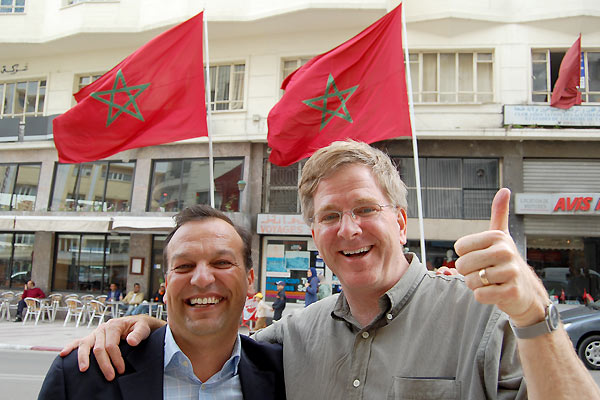
I love Morocco. But I’ve always called Tangier the Tijuana of Africa. That has changed. Tangier was a neglected hell hole for a generation. It was an international city — favored by the West and therefore distained by Morocco’s last king. He made a point to divert all national investment away from his country’s fourth city.
The new king, who took the throne in 1999, believes Tangier should be a great city again. The first city he visited after his coronation was Tangier. The difference — as I just learned — is breathtaking. The place is still exotic…but likeably exotic.
Checking into Hotel Continental, flamboyant Jimmy, who runs the shop, met me. Six or seven years ago, I told him I was from Seattle. He said, “206.” Now I test him again saying I’m from Seattle. He says, “206, 360, 425…new area codes.” He knows every telephone area code in the USA.
Hotel Continental has you looking for the English Patient. Gramophones gather dust on dressers under mangy chandeliers. A serene woman paints a figure eight in the loose tiles with her mop, day after day, surrounded by dilapidation that never goes away. As I updated the information in my guidebook, I found a rare and nonchalant incompetence. My guidebook listed the hotel’s phone and email data more accurately than their own printed material. It’s a 70-room hotel with not a sheet of paper in its office.
 Roosters and the Muslim call to prayer work together to wake me and the rest of that world. When the sun is high enough to send a rainbow plunging into the harbor amid ferries busily coming and going, I stand on my balcony and survey Tangier kicking into gear. Women in colorful, flowing robes walk to sweat shops adjacent the port, happy to earn $8 a day sewing for big-name European clothing lines. Cabbies jostle at the pier for the chance to rip off arriving tourists.
It’s an exciting time in Morocco. The king is modernizing. His queen was a commoner. Moroccans say she’s the first to be seen in public. They have never seen the king’s mother. They actually don’t know what she even looks like. Walking the streets, you see a modest new affluence, lots of vision and energy, and no compromise with being Arabic.
They don’t emulate or even seem to care about the USA. Al Jazeera blares on teahouse TVs — with stirring images of American atrocities inflicted on fellow Muslims. But people seem numb to the propaganda. I felt not a hint of animosity to me as an American, something I was concerned about. There was no political edge to any graffiti or posters.
My guide, Aziz, explained to me the fundamental difference between Islamic and Islamist, and then said Morocco is Islamic.
 Wandering — especially after dark — is entertaining. It’s a rare place where signs are in three languages, and English doesn’t make the cut (it’s Arabic, French and Spanish). Aziz said when he wanted someone’s attention he says, “Hey, Mohammad” (or “Hey, Fatima” for a woman). It’s like our “hey, bub”…but very respectful.
The market scene is a wonderland — of everything but pork. Mountains of brilliant olives, a full palette of spices, children with knives happy to perform for my camera. Each animal is slaughtered in accordance with Halal: in the name of Allah, with a sharp knife, head to Mecca, drained of its blood.
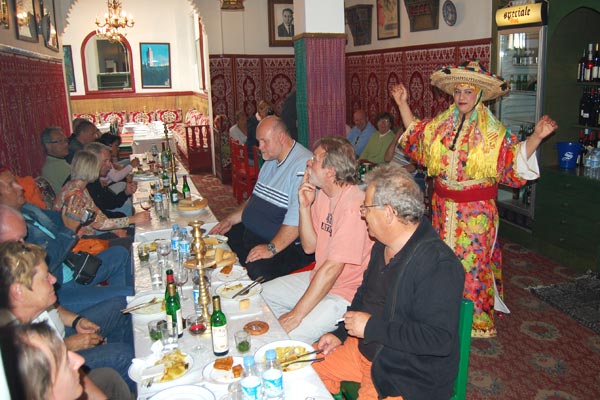
Until now, I’ve recommended that day-trippers from Spain just hold their nose and take the organized tour (with all the groups from Spain’s Costa del Sol). A Tangier guide meets you at the ferry (after the hour-long ride from Spain). They take you on a bus tour of the city, a walk through the old town, lead you to a few staged Kodak moments (camel ride, snake charmer, Atlas mountain tribal musicians) and then you go to a clichéd restaurant where you eat clichéd food with a live band and a belly dancer (which has nothing to do with Moroccan culture, but tourists don’t seem to care). Then you visit a shop.
They must make a healthy commission, because the round-trip ferry ride with the tour cost essentially the same as the round-trip ferry ride without the tour.
During my stay, I met gracious Moroccans eager to talk and share. About the only time I saw other Western tourists was when I crossed paths with one of the many day-tripping tour groups. Those finishing up their tour walk in a tight, single-file formation, clutching their purses and day bags nervously to their bellies like paranoid kangaroos as they bundle past one last spanking line of street merchants, and make it safely back onto the ferry.
I was so comfortable and they were so nervous and embattled. The pathetic scene reminded me of some kind of self-inflicted hostage crisis.