Barricaded Safely in Your Hotel

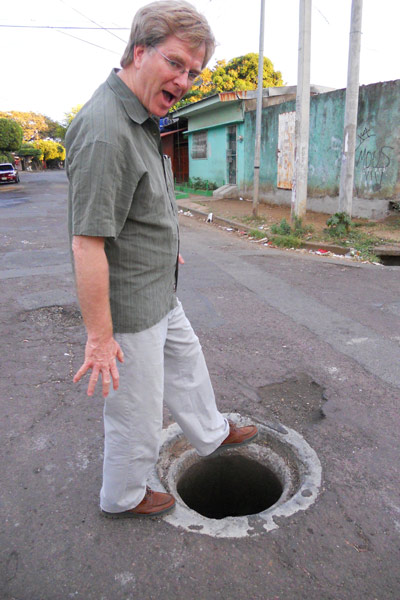
Managua's streets come with surprises. (Photo by Trish Feaster)

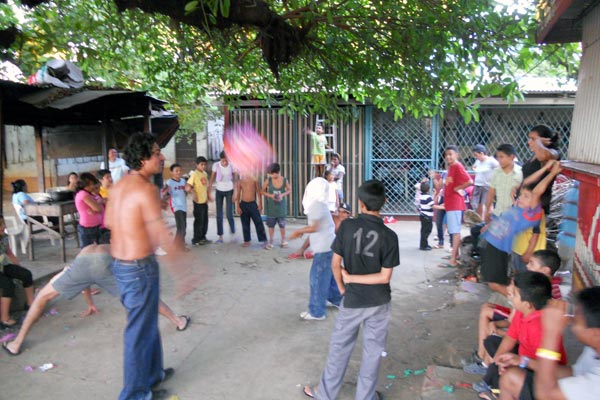
Like ancient Romans got circuses, today's Nicaraguans get a Christmas piñata — both courtesy of governments who care...about their popularity.

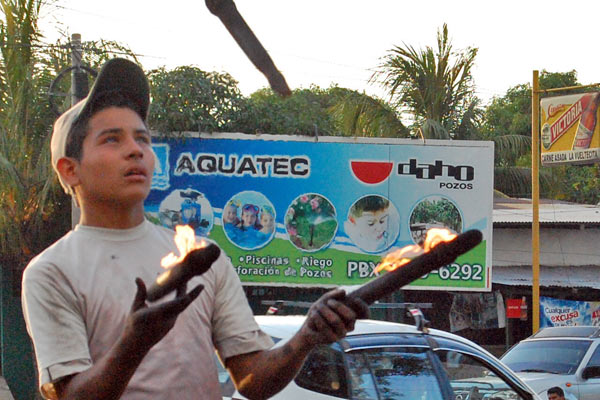
Flame-juggling kids entertain at a Managua intersection for tips.

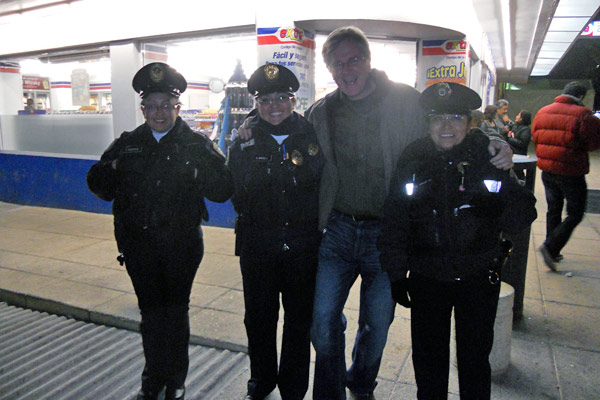
Military police enjoy an easy New Year's Eve in Mexico City.

The saddest thing about visiting Managua and San Salvador is experiencing the fear caused by the violence that comes with extreme poverty in a big city. Every major hotel and nearly every business has an armed guard. It’s unwise to walk around after dark, especially with a big camera. While you’re unlikely to be hurt, the risk is that groups of young thugs might just rob you at knifepoint. I found that, rather than whole safe neighborhoods, there were mostly small islands of safety around malls and fancy hotels. A wealthy tourist (and nearly all tourists here are wealthy, in relative terms) happily pays triple for a taxi that works with the hotels so you know you’re safe. You generally hop from one safe zone to another by cab.

Talking with travelers and residents in these countries, I’ve concluded that the risk for tourists is actually small, but the hype and caution are big. These days, with all the gang action and bloody drug warfare in the news, the image of Mexico and Central America has changed. It’s killing their tourism. Of course, with news media being what it is, if it bleeds, it leads. But a couple we met who spent two months traveling overland throughout Central America experienced nothing like this. When bandits do hit, they corner the victim and demand their valuables, or enter a bus from the front and rear and simply rob everyone on board.

Wandering through one Managua barrio, we kept one eye on the street for Nicaragua’s notorious open manholes. Desperation drives people to steal the lids and sell them as scrap metal. The neighborhood felt pretty desolate. Drivers slow for the omnipresent speed bumps and weave around the open manholes. Apart from a few shops selling odds and ends through barred windows and rustic cantinas serving beers to a rough-looking male crowd, there’s almost no business metabolism.

We came upon a small yard where the neighborhood children were jumping giddily up and down while one swung a stick blindly at a mischievously darting piñata. We enjoyed the scene, but I winced every time the stick viciously cut through the air among all those excited little heads. As I took a photo, a mom came over and suggested I stow the camera for safety. We realized we were in a bad neighborhood, and she ‘ baby in arms and her elderly mother at her side ‘ escorted us to the nearby big street. As we reached a bank with an armed guard out front, she said, “Now you are safe.”

In Nicaragua and El Salvador, there must be more armed guards than military and police forces combined. Nicaraguan security guards make about $1 an hour…and consider it a blessing. We chatted with the guard while watching a grimy kid in the intersection juggling small flaming torches for tips. Whenever a driver stops at an intersection, he is confronted by a battery of children begging, washing your windows, selling little goodies, and entertaining. I marveled at how a society can economize by cutting education. I couldn’t help but think I’ll spend what the guard makes in a day on a taxi back to my hotel, and I spend what that torch juggler hopes to make in a day at poolside for a rum-and-Coke.

Mexico City was the third stop on our visit. I wanted to greet the New Year in one of the world’s biggest cities. While much of Central America has petty crime and gang violence, Mexico is suffering from fear related to its drug war. While border regions in the north are actually seeing lots of bloodshed (Juarez is considered as dangerous as Baghdad), people in Mexico City and the vast majority of Mexico only read about the violence in the news.

Still, violence is the big issue. Out and about for several days in that vast city and celebrating the New Year with throngs in the streets, all I noticed in Mexico City was how the city seems occupied by military police (as opposed to El Salvador and Nicaragua, where private security dominated and there was almost no military presence), and how mellow and in-control things seemed. Subway stations with security cameras and more guards are labeled as “safe stations.” All New Year’s Eve, rather than wish the police gathered on major corners “Feliz Año Nuevo,” I’d say, “Police Año Nuevo”…and they’d return big smiles and answer, “Igualmente” (“Same to you!”).

The lessons I take home? A progressive observer would blame neoliberal (that is, pro-business) policies for contributing to the vast gap between the wealthy and the poor in these countries. A conservative observer would likely blame socialist policies or a lack of law and order. After my experience, it seems that anyone of any political persuasion can agree after traveling in Nicaragua, El Salvador, or Mexico that the fear and violence that wracks a society because of a desperate poor class is bad for the economy and a failure for every strata in that society. While the fear and poverty employ guards and sell razor wire, they also ruin any chance of a healthy tourist industry (potentially a major employer and industry here), and cause beautiful people who want to love and build their country to dream of escaping to the USA.
Managua: Stars Shine Bright over the Big City

You could fly over Managua and almost not notice it.

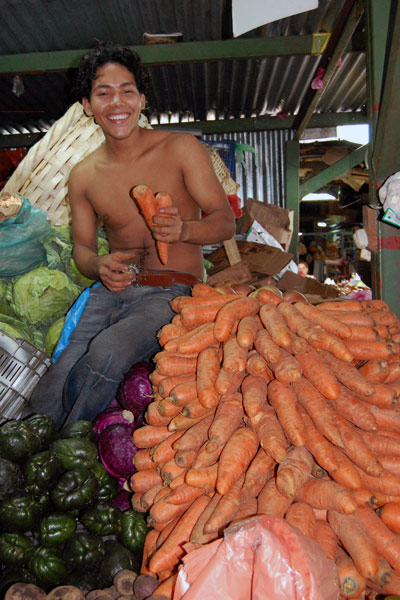
Beast-of-burden men toil in Managua's market. (Photo by Trish Feaster)

Managua's abundant market.

Dining out...a special meal at the mall.

My travels in Central America twenty-some years ago during the revolutions in Nicaragua and El Salvador, and five years ago for the 25th anniversary of the assassination of Archbishop Oscar Romero, were instrumental in forming my worldview. Returning in December of 2010, I was excited to measure the changes and to see if my general sense of the dynamics of the scene was still accurate.

I didn’t anticipate such a striking sense of how things had changed with time. Even at the Managua departure gate at Houston International Airport, unexpected comparisons hit me. Boarding the plane on earlier trips, I had been struck by the mix of elites, roughnecks, and church and NGO (non-government organization) pacifists. In the 1990s, everyone seemed to be carting home cheap electronics. Now, with more prosperity and no more US embargo in Nicaragua, I saw no electronics. Maybe things were getting better down there.

But upon arrival in Managua, it was clear that the gap between rich and poor remains the context in which the story of Nicaragua is being written. The city has no front yards. Everything has been fenced, walled in, and topped with razor wire. The only people living without security are those with nothing worth stealing. As we checked into our Managua hotel, the woman at the reception desk said, with a mix of pride and sadness, “We live in a safe country. But, before going out, leave your valuables in your hotel room.”

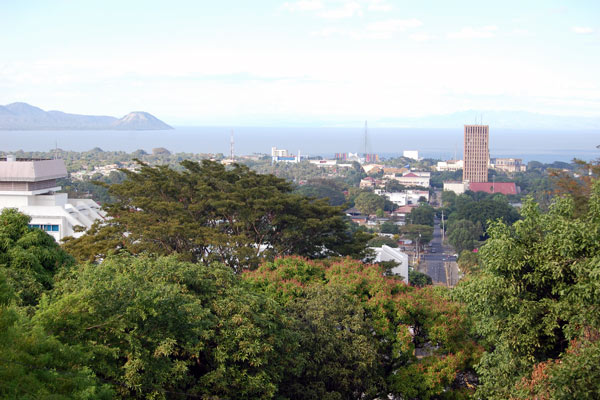
The city of Managua has close to two million people…but I’ll bet there are fewer than 20 elevators. Its devastating 1972 earthquake left only two tall buildings of its once-impressive skyline standing. There has been some rebuilding, but the National Cathedral still stands empty and unusable on the main square, and the city is, in general, a two-story rambler. Standing where the Palace of Samoza once stood, crowning a hill overlooking the city, you see more trees than buildings, and hardly a skyline. You could fly over Managua and almost not notice it. At night, the stars are bright.

The thriving central market is filled with food: small people dwarfed by mountains of carrots, melons, coconuts, and beans. It goes on and on, with a romantic light filtering through holes in the corrugated tin roof. Beast-of-burden men lumber through the commotion of shoppers, with only gunny-sacks-of-rice heads and sweaty, dark-brown, muscular torsos showing. Shoppers here are generally from the low end ‘ guards, farm workers, and house cleaners who make $5 to $15 a day. If they buy their children a soda for a treat, the vendor pours it into a plastic bag with a straw sticking out of it, to avoid paying the bottle deposit.

For a contrast, we hike over to the modern shopping mall below the high-rise hotel. Stepping through a door with a “no-guns-allowed” decal, we find a world of people who’ve brought their kids here to spend half a day’s wages for people shopping in the other market for a photo with Santa Claus ‘ his face painted First World white. The core of the mall is a food court jammed with families enjoying a fine night out. A Happy Meal costs $5 ‘ close to what it does in the USA, but sold to locals lucky to make $15 a day. In the courtyard, kids play with skateboards, teenagers cuddle and kiss in corners, and photo boards with holes for your child’s head let parents take photos of their children posing as their favorite American superhero.

Much as things have changed ‘ former Sandinista revolutionaries now control the government ‘ it’s clear that one thing has remained tragically the same in this hemisphere’s second poorest country: the yawning gap between the haves and the have-nots. I hope to find out why.

Christmas in Managua

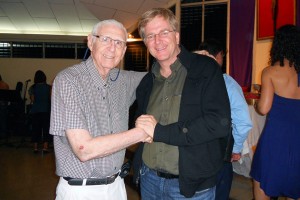
Father Fernando Cardenal with Rick (Photo by Trish Feaster)

For Christmas Eve, I gathered with local worshipers in the humble chapel of Nicaragua’s University of Central America under hard-working fans for Mass. As the band set up and the local congregation gathered, a Downs Syndrome child picked up the mic and entertained all with a hearty Santa-like ho ho ho. That unscripted moment kicked things off with a wonderfully human reminder that people around the world are coming together.

A lanky elderly priest was greeted warmly by the congregation. He was Fernando Cardenal, one of the Sandinista priests John Paul II famously wagged his finger at during a visit to Nicaragua back in 1983 for politicizing the church. Cardenal’s trouble-making message was a Liberation Theology message ‘ that Christians are to be more than charitable. They are to ask why there is poverty and to organize to work for economic justice and dignity in the face of hunger and suffering.

The chapel was filled. It was a bring-your-own-maracas crowd, and with each song the place filled with the happy sound of these shakers. The Lord’s Prayer was sung to the tune of “Sound of Silence.” Before the offering plate was passed, a woman stepped out from her pew to remind everyone that Father Cardenal lives very modestly and to assure all that the offering would go to support the church’s work with the local poor.

My favorite thing about a Central American Mass is the fiesta-like “passing of the peace.” Every time I’m in an American church and that moment in the service comes and people solemnly shake hands, I miss the uproar that breaks out at that moment in Latin America. With mariachi energy the band plays while all attending burst into a rollicking commotion of hugging and exchange of blessings. It just goes on and on. Father Cardenal gave me the warmest of hugs. Knowing of this man’s life work as a Christian revolutionary in Central America ‘ and now holding his frail bag of bones body to mine ‘ touched me in a way that caused me to cry. I don’t know why, but it was an emotional highlight of my trip so far.

While that old Sandinista spirit is a little hard to find these days in Nicaragua, Jesus’ “preferential option for the poor” was woven into the sermon, and the Christmas Mass finished with a rousing Liberation Theology carol. People sang “Merry Christmas, justice and liberty. Merry Christmas, a better world without misery and oppression” (Feliz Navidad, Feliz Navidad, en justicia y libertad. Feliz Navidad, Feliz Navidad, un mundo mejor sin miseria ni opresion). As the song progressed through many verses, the congregation lined up to kiss the baby Jesus in Father Cardenal’s arms. The much-kissed baby Jesus was placed into the, until now, empty manger. And the worshipers dispersed into a city soon to be engulfed in a cacophony of firecrackers.

Flying into Sandino International Airport for Christmas

It’s time to plan holiday travels. I was tempted to go to Italy and enjoy the good life with mittens and a scarf in Rome and Florence, or perhaps do a Barcelona-Madrid-Lisbon loop (as my daughter Jackie did recently ‘ a great itinerary).

But I decided to stay in our hemisphere and head south. My decision: Three days each in Managua, San Salvador, and Mexico City, with Christmas in Managua and New Year’s in Mexico City. I needed some heat…both in the weather, and in connecting with what’s going on with people’s struggles in Latin America.

I just talked with Paul Theroux for my radio show yesterday, and he stressed the importance of not just flying from capital city to capital city. He said that to really connect with a country, you need to cross borders on the ground and travel through the bush.

But I’m doing exactly the opposite ‘ flying to three great capitals. I’d love any suggestions on how I might enjoy and be inspired by my time there. Any ideas? Thanks…and happy Thanksgiving!