Exploring the Unique Museums of Lausanne, Switzerland

Boat on Lake Geneva

Lausanne is an elegant town on Lake Geneva with a fine old town, towering cathedral, and charming lakeside promenade. While I was there this summer, I made a point of visiting its two main museums, the Olympic Museum and the Collection de l’Art Brut. Both are unique and worth a look.

The Art Brut Collection is like nothing else you’ll see in Europe: a museum filled with art produced by untrained artists, many labeled (and even locked up) by society as “criminal” or “insane.” Read thumbnail biographies of these outsiders, and then enjoy their unbridled creativity.

Collection de l'Art Brut

In 1945, the artist Jean Dubuffet began collecting art he called “brut” — created by untrained, highly original individuals who weren’t afraid to ignore rules. In the 1970s, he donated his huge collection to Lausanne, and it has now expanded to 70,000 works by hundreds of artists: loners, mavericks, people on the fringe, prisoners, and mental ward patients. Dubuffet said, “The art does not lie in beds ready-made for it. It runs away when its name is called. It wants to be incognito.”

About 800 works are on display at any given time. As you tour the thought-provoking collection and learn about the artists, ponder the fine line that separates sanity and insanity when it comes to creative output.

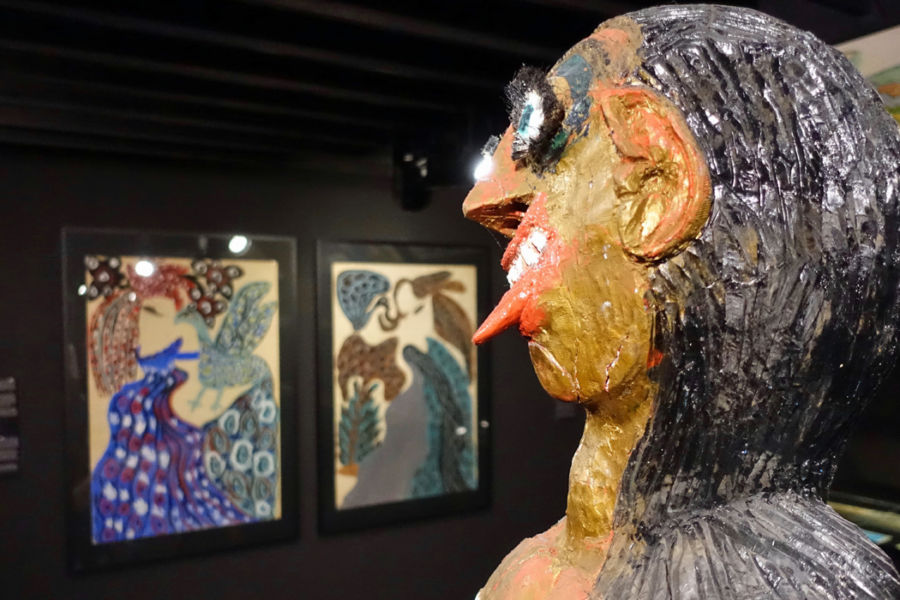
artist bio art

Known as the Olympic Capital, Lausanne has been home to the International Olympic Committee since 1915. The Olympic Museum celebrates the colorful history of the games, with a century’s worth of ceremonial torches and a look at how medals have changed over the years. Surveying gear from each sport (such as Carl Lewis’ track shoes and Sonja Henie’s ice skates), you can follow the evolution of equipment that was clearly state of the art — in its day.

statue with mountains

Back at my Lausanne hotel, my hotelier surprised me by pulling out a little stack of old Steves family Christmas cards. For nearly 20 years, we had a tradition of sending a family Christmas card to all our favorite hotels and restaurants in Europe. For Andy and Jackie, it was an annual chore they dreaded — signing their names to several hundred cards all spread out on the kitchen table.

Hotelier with Christmas cards

Thinking back on this tradition, it’s clear to me that this is a good example of how we have always enjoyed and stressed the people-to-people aspect of our work. To this day, we strive to build our huge gang of hoteliers and restaurateurs into an extended family of friends who understand that we are partners in helping our travelers enjoy the best possible experiences for the best possible price. If there is one aspect of our guidebooks that distinguishes us, perhaps it’s the esprit de corps between us, the legion of small businesses in Europe we recommend in our guidebooks, and our traveling readers.

(Next up on the blog, I’ll be bringing you along on a Mediterranean cruise…stay tuned!)


Video: Enjoying Another Dimension of Switzerland at Lake Geneva

Sure, Switzerland has its mighty alpine peaks and distant valleys. But it also has gentle lakes and hills blanketed by vineyards and dotted with charming farms and villages. From the delightful city of Lausanne (in Switzerland’s French-speaking corner), you can ride a historic paddle steamer across Lac Léman (Lake Geneva), hop out, hike through vineyards to a postcard-perfect village, and catch the train back.


Switzerland may be expensive, but the views are free — and with a Rick Steves Switzerland guidebook, you’ll be able to sort through all the travel options and find ways to enjoy them without going broke…such as this paddle steamer ride.

Video: An Impromptu Musical Moment in Lausanne Cathedral

Every year, I travel to Europe to research and update my guidebooks. For well over a hundred days this year, I’ve enjoyed a parade of sights, tastes, sounds, and experiences. My trip is nearly over, and, while I can hardly wait to get home, I’m feeling like, “Oh, I better soak up all the European fun I can in these last hours.”

Impromptu moments have been a theme of this trip, and today was no different. As I was reviewing my guidebook entry for the towering Lausanne Cathedral, the organist was practicing. This particular organ has a unique arrangement — one set of keyboards up in the gallery and another in the nave, where the audience can have a close-up view of the organist. Surrounded by incredible architecture and the church’s Reformation heritage, I was inspired to record this little clip. Join me now, accompanied by some amazing organ music, in one of Switzerland’s leading churches.

To learn more about the Reformation, watch my 55-minute television special about Luther and the Reformation. It’s streaming now for free and available on DVD.

Video: Deer Sausage, Rösti, and Gruyère — A Perfectly Swiss Dinner in Lausanne

I’m traveling across Switzerland this week, updating my guidebook, and I’ve been thoroughly enjoying the great Swiss cities.

Wherever I travel, my favorite restaurants are always the family-run places that offer caring, hands-on service — and Switzerland is no different. In Lausanne, I had a delightful meal (even though I was dining alone) at Café du Grütli. The owner, Willi Prutsch, was in great form, and I just had to capture his passion for the food he and his family have served here, day in and day out, for over 30 years.

Wilting War Memorials

It’s interesting to think how sightseeing thrills go cold with time. I was just at Luzern’s much-vaunted Swiss Transport Museum. A huge photo-realistic map of Switzerland showing literally every building in the country (which slipper-wearing visitors would walk on as they explored their country) is now (after Google Earth) quaint and underwhelming. We went in with the camera ready to roll…and left having dropped it from the script.

The stamp museum I just saw in Liechtenstein, while as good as a stamp museum can be, was just so 20th century. “Sound and Light Shows” were theafter-dark extravaganza throughout Europe a generation ago. Today, they are essentially extinct.

And as time passes, the immediacy of war memorials wilts, too. As everyone’s “Greatest Generation” passes, the pain of WWII will fade. I know many refuse to accept this…but the pain of WWI faded just like the pain of the Franco-Prussian war and the pain of Napoleon’s Russia campaign faded. Pretty soon those photos of our heroic loved ones will join the others in the three-for-a-dollar box at the flea market.

The city the Nazis burned and murdered in 1944 four days after D-Day — Oradour-sur-Glane — has been intentionally left as it was by the Nazis. With my last visit, it occurred to me that it is intentionally left “as is,” and that is evocative and good…except for the fact that the elements are literally wearing it away. As rust and rot gnaws at France’s Martyr-ville, time does the same to our WWII memories.

Six hundred years has failed to put a stop to the night watchman in Lausanne. Every night since the 1400s, on the hour, a night watchman steps out on the top of the church spire and hollers in four directions, “I am the watchman. I am the watchman. We just had ten o’clock. We just had ten o’clock.” He’s a human cuckoo clock in the land of Rolex and Swatch. He’s so irrelevant — he actually repeated his shout at 10:16 so we could film him a second time from street level…and no one noticed.