Up in the Clouds on Wayna Picchu

Jackie Steves is guest-hosting her Dad’s blog with 17 posts in 17 days. Follow the adventures of Andy and Jackie Steves as they — the first Steves to venture into South America — report on their experience.

Heavenly sunrise seen from Wayna Picchu.

Enlarge photo

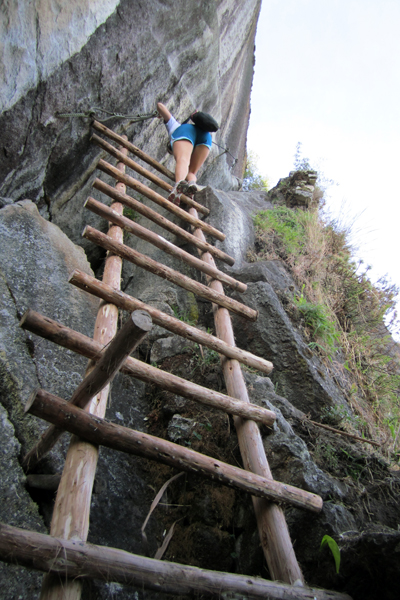
Hikers scaling Wayna Picchu.

Enlarge photo

Enlarge photo
Enlarge photo
Enlarge photo

Aguas Calientes, the town just below Machu Picchu, where we’re staying, doesn’t have much to offer, while having too much to offer for tourists. Restaurant after restaurant boasting Mexican food and “four-for-one” Happy Hours. Stall after stall of the same selection of souvenirs: comical Incan figurines, tacky silver jewelry, knitted hats and gloves, and bright traditional cloth shoulder bags and tablecloths.

Our alarm went off at 3:20 the next morning. Despite having just a few hours of sleep, I was wide-awake, the kind of wide-awake you are when a big day awaits you. We hurriedly packed our bags and left them behind the hostel’s front desk.

As we ran downhill to the bus stop, we heard music still bumping at the club — that’s how early, or late, it was. At 3:40 in the morning there was already a line for the buses that were not set to depart until 5 am. We arrived in the knick of time because in the next several minutes the line sprouted a few blocks longer. We were all desperate to be among the 400 admitted to hike up Machu Picchu’s sister mountain, Wayna Picchu.

The same precarious switchbacks our bus had navigated the day before couldn’t irk us the second time because all we could see out the window was the night’s pitch black.

As our bus (we managed to get on the first one!) rolled to a stop at Machu Picchu’s entrance, a line had already formed of those more ambitious than ourselves who had climbed the stairs up from Aguas Calientes. We won a stamp on our ticket that would admit us into Wayna Picchu at 7 am. That gave us some time to do the mini one-hour hike to the Incan bridge.

Andy remarked a few times how majestic Machu Picchu was at this hour. We were literally up in the clouds, as we could see some clouds below us. The surreal mistiness led me to exclaim, “Oh my gosh, it’s like we’re in heaven!” When Andy said he caught my exclamation on video (on his camera), I laughed, realizing how much I was under the spell of my surroundings.

We entered Wayna Picchu and slithered past a few groups of people. The sun was rising from behind the eastward mountain, casting glimmering illumination on patches of mountains. The clouds floated across the panorama, and we vacillated between making progress to reach the top and needing to stop to take it all in. The glory of it all shed me and Andy of our young-20s cool so that we became babbling brooks of awe and amazement.

The trail turned into StairMaster on steroids. We fell into a rhythm of scaling the never-ending staircase while panting from altitude and exertion. At times the path turned into a climb requiring two hands.

We finally reached the very summit, and a panoramic view made every step worthwhile. When Andy and I sat at a distance from each other, it occurred to us that the awesomeness triggered a need for personal meditation. (Are you sick of me going on about this mountainous beauty? I’m sorry, but you should know it is not exaggeration because all of this comes from a girl who is not a fan of the outdoors and is often at fault for taking natural beauty for granted.)

We didn’t want to descend the way we had come and have to navigate around the ascending hikers, so we chose the long route back, via the Gran Caverna (Great Cave).

At one point we descended a huge wall of stone by stepping down a series of little notches while being suspended above thin air by holding on to a cable for dear life. We also had to climb down a 30-foot slippery wooden ladder. To cope, I shut off my rational thinking process in order to get through it. Afterward I praised God that Andy and I survived. It would have been easy to slip off, for a foot to blunder, or for the ladder to break. It was probably the scariest thing I’ve ever done. Doing that without a carabiner in the States would probably be illegal.

The Great Cave wasn’t much, but I suppose Machu Picchu and Wayna Picchu are hard acts to follow. I have never climbed so many stairs in my life — up, up, up, down, down, down, up, up… Both our knees began to shake with fatigue.

We made it back to Machu Picchu with wobbly exhausted legs, soaked through with sweat, but very satisfied with ourselves. Initially, waking up at 3 am for a four-hour hike was not appealing to me. I was just going along with Andy. But with hindsight I’m totally glad I did it.

We made it back down to Aguas Calientes to watch the World Cup final over lunch at a restaurant. Every building in town was blaring the game. Andy and I don’t get into spectating soccer much, but the excitement of the international crowd around us was contagious.

Peru’s Machu Picchu Comes Alive and Blows My Mind

Jackie Steves is guest-hosting her Dad’s blog with 17 posts in 17 days. Follow the adventures of Andy and Jackie Steves as they — the first Steves to venture into South America — report on their experience.

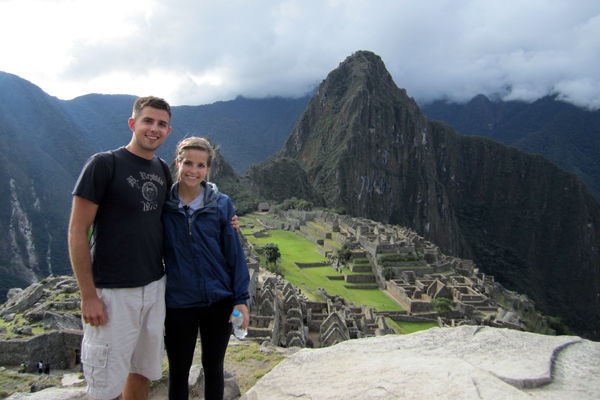
Jackie, Wilfredo, and Andy At Machu Picchu.Enlarge photo

Wilfredo, a guide we found through the Seattle travel company, Wildland Adventure (with whom our family did a Costa Rica tour two years ago) picked us up early from our hostel in Ollantaytambo. He took us to one of the World Wonders, Machu Picchu, via train to Aguas Calientes, and then by bus up precarious switchbacks to the “lost city.”

 We shared a train car with 32 women who appeared to be worshipping crystals. Their leader came around saying in a hokey Zen voice, “We will now seek to reach a higher level of consciousness by focusing the positive energy on our bellies.” I struggled to stifle a laugh. Andy was pretty uncomfortable when the women began taking turns giving each other sensuous head massages. I nearly cringed at the clash of their tones — half spoken in hokey Zen tones, the other half spoken in raucous Southern twang.

We were careful to reassure our guide that not all Americans were this bizarre in spiritual practice, nor this obnoxiously loud. He said with a smile that he knew that, but that these kinds of spiritual groups do have substantial presence in the tourist industry here.

I was sad to hear that the Peruvians were swindled out of a huge portion of the money coming in from the booming Machu Picchu tourist industry because PeruRail (the train everyone must ride to get there) is actually owned half by Britain and half by Chile.

Such money swindling away from the Peruvians is a tragic theme running throughout their history. There was all the exploitation by the Spanish, especially in the taking of gold, silver, and other precious exports. Recently there have been strikes against the selling of Peru’s oil to other countries, where it can be priced higher such that Peruvians cannot afford even their own oil. Protesters are urging the government to nationalize the oil industry so that private companies would have to stop this practice.

I have never had a better guide than Wilfredo (and I’ve taken a lot of tours in my 20 years of travel to Europe and elsewhere.) Not until this trip have ancient ruins intrigued me because for me that history seems so distant. Wilfredo succeeded at bridging that gap of time so that I could actually appreciate the building techniques, spirituality, and lifestyles of these ancient peoples.

The impeccable stonework used to construct Machu Picchu’s temples.Enlarge photo
Andy and I beside condor rock sculpture.Enlarge photo

The site upon which Machu Picchu was built was chosen very specially and intentionally. It lies between four soaring mountains, each perfectly positioned in the four directions — north, east, south, and west. As a people whose God is the sun, one can imagine they were very in tune with the sun’s path from East to West. They built four small temples at the summits of each of these surrounding mountains. They also worshipped water, and it helped that the site’s location made it possible for them to capture water flow from glaciers above them and direct it through their clever viaduct system.

Wilfredo pointed out evidence of the difference between various groups’ handwork. Some walls were made of rectangular stones while others were composed of stones to fit together more like puzzle pieces. The stonework varied from uneven (the houses of the commoners) to absolutely perfect (the temples).

Wilfredo also showed us stone representations of the three worlds: the upper, the middle, and the underworlds. The underworld has to do with the wisdom from which we are born. The middle world is our existence on Earth. And the upper world is when one dies and goes to live with the Gods.

The condor bird is worshipped as well for being the carrier of souls to the upper world when humans die. My favorite single feature of Machu Picchu was this large natural bedrock formation shaped as soaring wings. The Incans built off of this by carving a bedrock beneath it into the bird’s head.

The ruins of Machu Picchu, this incredible man-made construction, evoke in me ambivalent feelings. I am half overwhelmingly impressed with the awesomeness of their creation. Yet, I am half overwhelmingly depressed at all the back-breaking work these small ancient people endured. They must have had faith as strong as a diamond to be compelled to devote such a colossal effort to erecting these perfectly neat stone temples on the peak of this towering mountain. While they had impressive stone masonry techniques, it was still incredibly intensive to cut stones with the straight-line accuracy they did and haul mounds of bedrock. I have scarcely seen a modern-day Peruvian as tall as my own five feet and seven inches. And according to evolution the temple-builders were probably even smaller! All I can say is Machu Picchu is a mind-blowing accomplishment.

Wilfredo provided the most perfect cherry on top as the finale to our Machu Picchu tour. “I would like to play you a tune.” He pulled out a recorder made of amber wood and from it he produced the most beautiful melody I have ever heard come from a wind instrument. Perhaps it was my majestic surroundings that made it all the sweeter. Wilfredo’s traditional tune was like a condor via which I was transcended to a higher serendipity — it was that utterly beautiful.

After reluctantly bidding adios to Wilfredo, we ate our sack lunches in the ultimate picnic setting, on a grassy plain just above and overlooking the ruins. Nearby llamas, kept as natural lawnmowers, trimmed the grass.

Breaking Away from Europe as a Certified Backpacker

Jackie Steves is guest-hosting her Dad’s blog with 17 posts in 17 days. Follow the adventures of Andy and Jackie Steves as they — the first Steves to venture into South America — report on their experience.

Incan Ruins in Ollantaytambo leading up to a sun temple.

Enlarge photo

This is the first time I can legitimately identify as a backpacker. When I was little I wore a backpack, but that doesn’t count since I was with the family. During my past couple of independent Euro trips, I’ve actually used a rolling bag. While I don’t enjoy a sore back, something about bearing the weight of my belongings on my shoulders gives me a sense of independence and strength, as if I could conquer the world (but not like what the Spaniards did to the Incas because that was not nice).

We stopped at a supermarket, one of my favorite windows into any given culture. Time and again, Andy and I have remarked on the freshness of food here. To watch the cutting of fresh whole fruit at a restaurant in Lima’s airport nearly struck us as odd (shows how starved we are in the States for legitimately fresh fruit). This supermarket was another manifestation of fresh. Inside the entrance, you pass a fresh-squeezed orange juice stand, as well as a fresh farm milk stand.

We took a five-passenger car to Ollantaytambo, sharing it with a nice young Argentinean couple. The two-hour ride only cost $3 per person! Can you imagine being able to pay a few dollars for a two-hour taxi ride in the States?

We drove through rolling Peruvian hills resembling Colorado countryside — dry but also green in parts. We passed construction, where men worked with pickaxes and shovels, just like roadwork we saw in the city. Peru’s roads — from its most modern city to its rural back lanes — are handmade.

Our small tires bouncing on a bumpity cobblestone road announced our arrival in Ollantaytambo, a town in the sacred valley below Machu Picchu that boasts ancient Incan ruins as well.

The “hearty Peruvian fare” of chicken, rice, and quinoa soup I ordered for dinner was good, but bland.

We befriended a couple of Minnesotans (who are here volunteering to help local flood victims) and a few local goofballs with whom we went to Gansos (Spanish for geese), one of the only bars in this small town. This bar did not disappoint — drinks cheap as dirt and an upstairs decorated with hammocks, swings, tree houses, funky Bob Marley wall decor, candlelight, and a fire pole to slide drunkenly downstairs at the end of the night (good idea?). Downstairs five drummers provided the beat for our night out.

The First Steves on South American Soil

Jackie Steves is guest-hosting her Dad’s blog with 17 posts in 17 days. Follow the adventures of Andy and Jackie Steves as they — the first Steves to venture into South America — report on their experience.

Enlarge photo

At 7 in the morning, a full 24 hours after our initial departure from The States, my brother Andy and I finally reached our destination: Cusco in Peru, the capital of the magnificent ancient Incan Empire.

Our hostel had sent instructions that a cab ride from the airport should not exceed 10 sol (about 3 US dollars). Our guidebook also told us not to hop into just any cab on the street for risk of kidnapping, even if the cab looks official. A taxi official directed us to a cab driver with whom Andy was careful to pre-negotiate. He insisted on 25 sol. I said to the driver, a bit tongue-in-cheek, but also trying to guilt-trip him, “You know, our hostel warned us that you would try and trick us.” Andy laughed and then mumbled to me in the back seat that it was probably worth the safe ride into the city. I guess we’re grateful for any sense of security after hearing all kinds of stories from friends and relatives about the dangers of travel in South America.

Our drive into the center of the city introduced us to Peruvian architecture: squat buildings, walls of stacked blocks of stone, and glass shards on top of fences for a security system. Messages graffitied on the sides of houses ranged from political endorsements, to advertisements for telephone companies, to written cheers for their favorite football players.

Our hostel had an awesome interior courtyard with a ping-pong table and beanbag chairs for socializing. The place is decorated with quirky furniture and vibrant wall murals.

Once we set out, it took us less than a block before we scored a curious tourist’s treat! On the Plaza San Francisco, we witnessed hundreds of small boys dressed up in military-esque uniforms, all lined up marching in goose-step behind a shabby out-of-tune band. They start training them at a young age for the couple of years of universal conscription. The boys’ out-of-sync step made the scene far more adorable than discerning.

Enlarge photo

The Incans esteemed Cusco so highly that they believed it to be the navel of the world. At the center of this navel, they constructed sacred temples around what is today Plaza de Armas, the main city square.

The Catholic Spanish constructed a cathedral on Plaza de Armas. The artwork of this cathedral is different from European Cathedrals. Crucifixes depict Jesus wearing bright pink, blue, or green skirts, with beads and sequins made of precious metals. The altar decoration is somewhere between tacky tin and extravagant silver. The large Last Supper painting has a roast guinea pig on a platter in the middle of the table who — I have to agree with my guidebook — “steals the show.” It’s curious that in every crucifix Jesus is portrayed, not of Middle Eastern or even Incan race, but as Caucasian.

I used the chilly night temperatures here as an excuse to buy a hat and gloves, made by local nuns, as souvenirs. The proceeds go to five social projects, including abandoned children, sexually abused women, and girls’ education. I would agree with Andy that the hat is dorky with its long tassel, but I still like it a lot!

We found a coca shop where we tried some coca chocolate and coca tea. I’m not a huge fan of the bitter lemony taste. Coca is the leaf used in cocaine and Coca-Cola. Drinking coca tea and chewing it can’t get you high, but it can help prevent altitude sickness. We’re feeling the 11,000-foot altitude here and hope this stuff will help Andy’s dizziness and my headache. The Incans worshipped coca for its plethora of uses.

At the Inca Museum we learned that these ancient peoples (a completely isolated civilization when the Spaniards found them) were tremendously developed, basically only lacking the wheel and the arch.

An Irish pub was next on the agenda — training wheels on the going-out-in-South-America bicycle. We asked to share a table with a couple we discovered were Norwegian. At the table next to us sat four Irish girls. By coincidence, we were sandwiched between groups of our own heritage. We shared travel itineraries with these friendly Europeans over Cusqueña (the popular beer in Cusco). Already on the first night I was feeling good about our upcoming adventure.

South America Isn’t Europe

My kids, Andy (23) and Jackie (20), are heading for South America. And, for the next 17 days, Jackie will guest-host my blog, with daily reports on their adventures in Peru, Argentina, and Brazil.

Why a South America trip on a European travel blog? Four reasons come to mind:

The spirit of our work at Europe Through the Back Door is to inspire people to turn their travel dreams into smooth and affordable reality by equipping themselves with good information and an expectation to travel smartly. As Andy and Jackie venture south of the equator, I hope you’ll join me in following their adventures. They are unescorted, don’t speak Spanish, have virtually no international travel experience outside of Europe, and will use non-Rick Steves guidebooks as they follow their wanderlust. They plan to travel both smart and well. They’re basically doing what any of us could do (though likely with a lot more late-night clubbing tossed in).

A photo from my Asia Through the Back Door days.

Enlarge photo

I’ve long said that Europe is the wading pool of world exploration and that many of my favorite destinations and experiences are beyond Europe. Ages ago I wrote a guidebook called Asia Through the Back Door by simply adapting my Europe tips to my experience traveling in the Far East. For me, Europe was a fun and easy first stop to making the world my friend. As we follow these youthful adventures through Jackie’s candid reports, I hope we can envision ourselves taking the experience and confidence gained in Europe and using it (with a youthful vigor) in more distant corners.

I hope Jackie’s hosting of my blog will also cause parents to consider the value of young people gaining self-confidence and a broader world view by venturing beyond our borders — whether that be Europe or into more challenging places. As any parent knows, it’s both scary and exhilarating to see your children outgrow accompanied trips and fly away on their own. I’m betting this trip will be a rite of passage, and Andy and Jackie will come home with a better understanding of both themselves and the world around them.

Finally, I have a patriotic motive for turning my blog over to Jackie. My theme this season — inspired by all the Quran-burning, foreigner-fearing, anti-intellectual legions in our country — is this:  “Fear is for people who don’t get out much.” Given the mesmerizing power of our media, it’s understandable that elderly Americans might be riddled with paranoia. (Observing my parents and my friends’ parents, I have a theory that people who can’t work or don’t have DVRs are limited to watching TV live, and 24/7 news is always there for them.) But even young people are susceptible to the fear-mongering that’s wracking our great nation. It’s my hope (but I could be wrong) that Andy and Jackie’s experience will help inoculate them to this new and virulent strain of pest in our society. And it’s also my hope that travel adventures can help us all better recognize the good and the joy in our world and then — rather than fear it — celebrate it.

With that, I’m going to step back and give the bully pulpit to my daughter. South America, here we come!