I still get just a little rush when I settle into the right train. I can’t remember taking a train in the USA, but here, with each journey, I celebrate the ease of not having to drive. And after all these years, train travel still comes with a twinge of risk: Do I have enough time for a cup of coffee? Is my wristwatch in synch with the official station time? Would these locals really point me in the right direction? Am I on the right train?
The European Union has pulled Portugal up to its standards now. The country has plenty of freeways, and Brussels is telling it how hygienic its markets must be. Portugal has taken lots of money from Europe and is now a net giver rather than receiver, as the EU is on to spiffing up the infrastructure of poorer new members in the east.
Yet Portugal is still a humble and relatively isolated place where locals proudly point out, “We now have three places where you can buy foreign newspapers.” Apparently George Clooney’s agent doesn’t care too much for his image here, as he’s all over the country on TV and billboards — selling martinis and coffee like a greedy Joe DiMaggio.
Many things just don’t change in Portugal. Women still squat on the curb at the road into Nazaré. Their hope: to waylay tourists from reserved hotel rooms with signs saying, “Quartos!”— rooms for rent…cheap. (By the way, simple hotels all over Portugal rent decent double rooms for $60. And sleepable dives can be had for $40 per double.)
Service is friendly in the hole-in-the-wall restaurants where menus come with two columns: “half dose” and “full dose” (€4 and €6, respectively). “Full dose” is designed to be split by two…giving traveling couples meals for less than $5 each. When I resisted a special dessert drink, the waiter told me, “Don’t be a camel…have a drink!” With a line like that, how could I refuse?
I’ve noticed all over Europe that monks are famous for their ingenious knack for brewing beer and distilling liquors. And in Portugal, nuns round out the menu with fine sweets (see previous blog entry for “nuns’ tummies” and “angel’s breasts”). For a good sampling, I’ve taken to asking for mixta dulce, and waiters are happy to bring a nibble of several of their top sobremesas(desserts).
Young Portuguese people don’t go to church much these days. But the country is remarkably Catholic for the sightseer (for example, my last stop, Nazaré, was named for Nazareth). The main sights of most towns are the musty old churches — those Gothic stone shells slathered in dusty, gold-leaf Baroque altars.
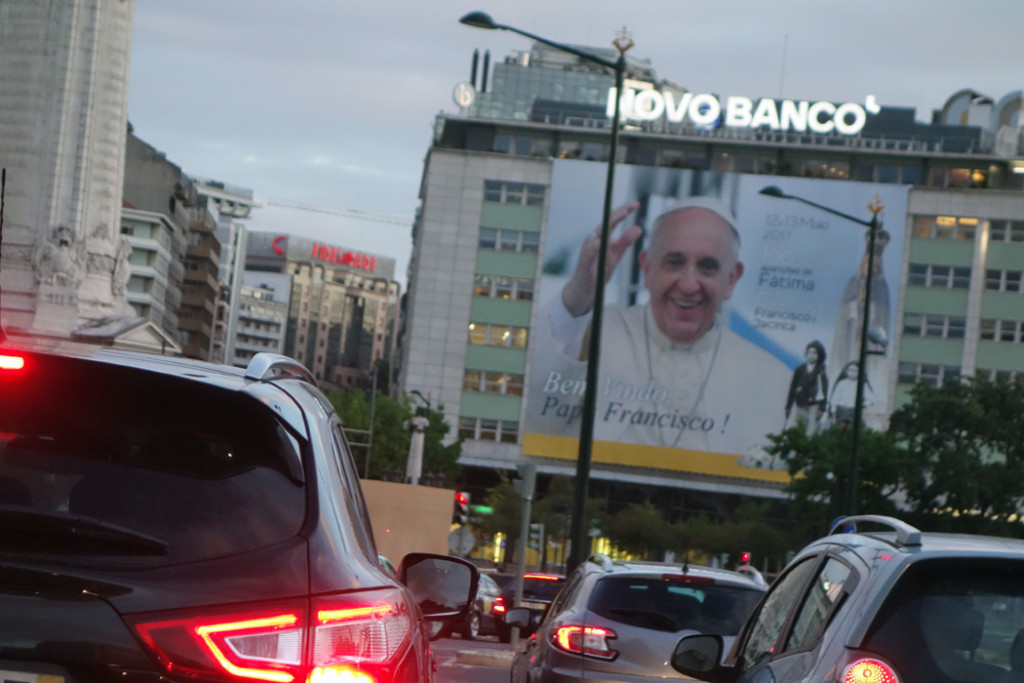
In 1917, three kids encountered the Virgin Mary near the village of Fátima and were asked to return on the 13th of each month for six months. The final apparition was witnessed by thousands of locals. Ever since, Fátima is on the pilgrimage trail — mobbed on the 13th of each month through the spring and summer.
On my visit, the vast esplanade leading to the basilica and site of the mystical appearance was quiet, as a few solitary pilgrims shuffled on their knees slowly down the long, smooth approach. Staring at a forest of candles dripping into a fiery trench that funnels all the melted wax into a bin to be resurrected as new candles was evocative in this spiritual setting.
Huge letters spelling “Queen of the Holy Rosary of Fátima Pray for Us” in Latin ring the ceiling of the basilica. John Paul II loved Fátima and visited it three times. (After the attempted assassination of JPII, the Vatican revealed that this event was predicted by Our Lady of Fátima in 1917.)
Wandering around modern Fátima and its commercial zone, I’m impressed by how it mirrors my image of a medieval pilgrim gathering place: oodles of picnic benches, endless parking, and desolate toilets for the masses. Just beyond the church, thirty uniform stalls lining a horseshoe-shaped mall await the 13th. Even without any business, old ladies still man their booths, surrounded by trinkets for pilgrims — including gaudy wax body parts and rosaries that will be blessed after Mass and taken home to remember Our Lady of Fátima.