Tallinn: I Cut the Forest

Tallinn, the capital of Estonia, is the only part of the former USSR that I include in my guidebooks and TV series. I put it in our Scandinavia guidebook because I love it — it’s so easy to reach from Helsinki (ferries leave hourly, it’s a 2-hour ride, no visas, and they’ll be on the euro in just a few months), and it provides a great contrast to the rest of Nordic Europe.

The Old Town — with the best-preserved medieval center in all of Nordic Europe — is quite comfortable now. In fact, it’s almost too comfortable. It’s Muzak hell: Billy Joel melodies done à  la Kenny G are everywhere. At the same time, there’s an edge I really like. I ate dinner under rusty barbed-wire lampshades in the first pub to open after communism fell.

Its Russian-ness sharpens Tallinn’s edge. Estonia is one-third Russian — a leftover from when the Soviet Union planted Russians here in an attempt to do to Estonia what China is doing to Tibet. While China is succeeding, Russia did not dilute Estonia into oblivion. Today Estonia is strong — but with a tough Russian minority that resists assimilation. Strolling through the Russian market, you feel tension. They are clearly the poor minority. And young Russian men can often make me uncomfortable. Their lives are tough. As I was passing a group of young Russians with heads nearly shaved bald, one of their phones rang. His ringtone was the sound of gunshots.

On my visit last year, I was charmed by the Estonian tradition of burying loved ones in forests. Wandering in a dense pine forest with well-cared-for tombs scattered all around, I thought this would be great for our TV show, and included it in our script.

This year, I returned with a script that read, “You feel the connection to their land and heritage at the forested Estonian cemeteries. Estonia is a thickly forested country and, for many, they see trees as almost spiritual.” Then I planned for my guide to say, as he’d told me last year, “This is our forest cemetery. Since ancient pagan times, we Estonians have buried our loved ones with the trees. We are people of the trees. This is one way we are still connected with our pagan past…still uniquely Estonian.” But it felt a little forced. While he could say it to one tourist, looking into a TV camera, he hedged and squirmed. I decided to leave it out of the show.

Still, we ended up with a great new show called “Tallinn and Helsinki: Baltic Sisters.” As I figured last year, each one is not substantial enough to make a blockbuster script individually, but a show split between these two fascinating cities is very full and strong.

Finishing our work in Estonia, we wrapped the last show of our new series. It’ll air this October.

Baden-Baden: Globalization and Leaky Borders

Enlarge photo

To commemorate the Smithsonian Presents Travels with Rick Steves magazine — now on sale online, and at newsstands nationwide — Rick is blogging about the 20 top destinations featured in that issue. One of those destinations is the German spa resort of Baden-Baden.

Germany’s spa town of Baden-Baden is a fun and relaxing place to splash around in a thermal bath. But, as with many resort towns, a more substantial history bubbles just beneath the surface. And, in the case of Baden-Baden, that history still has ripples today.

After the czars banned gambling, many Russians flocked to Baden-Baden, creating their own little Russian enclaves. (Many lost their fortunes, borrowed a pistol, and did themselves in on the so-called “Alley of Sighs.”) While the Russian expat community dwindled for a while, in recent years (after the end of communism), ultra-wealthy Russians have sought out safe property investments all over Europe…and Baden-Baden has re-emerged as a favorite destination. Russians have bought up property here like crazy. You’ll see Russian on multilingual signs around town. On my last visit, the lady who ran the launderette spoke German and Russian…but no English.

This is worrying to locals. The mayor — saying his town must either take action or let itself become essentially Russian-owned — recently declared that Russians were no longer allowed to purchase Baden-Baden real estate.

With immigration a persistent and complex issue in the USA, it’s good to remember that we’re not the only nation struggling with how to handle the realities of race, class distinctions, foreign investment, and use of government services. I see the same challenges all over Europe.

A vast suburb of Tallinn, Estonia, is filled with Russians. They were planted there during Soviet rule, and — although Estonia is now its own independent nation — they still refuse to embrace the local language, Estonian. They live as a separate, Russian-speaking community within Tallinn.

Norwegians — who pride themselves on not being racist — are upset with unemployed Pakistanis living in their country who, they say, don’t share the Norwegian work ethic, but take advantage of the luxurious Norwegian welfare state. I sense that Norwegians don’t know how to discuss this issue comfortably.

I was just in Gibraltar, and the buzz there was about a $20 million mosque built with money from the Middle East for the humble local community of 900 Muslims workers.

Just as people with less money go to work in wealthy lands, people with more money turn their vacation and retirement funds into maximum joy and comfort in cheaper places. I have a friend who’s a retired postman living very comfortably on his meager pension in southern Portugal. A Venetian friend of mine is excited about her new holiday home in Tunisia. No crowds, great beaches, very cheap — she said Tunisia is all the rage among Italians. Belgians have staked out their enclave in Spain’s Costa del Sol — just one more community where the stray Spaniard complains that some eateries don’t offer menus in Spanish. Americans are buying fixer-uppers in droves in rural Italy. And they’re doing it with the encouragement of a government that appreciates the economic boost these romantic Frances Mayes-wannabes bring to regions that need expat newcomers to keep from withering.

There are immigration issues everywhere you travel. Second-generation Turkish Germans can honestly say “Ich bin ein Berliner.” Construction work throughout France would slow to a trickle without Polish builders. While many are now careful to refer to Gypsies as “Roma,” there’s still not enough money to build a Holocaust memorial in Berlin to this group, which suffered a genocide that was comparable, in many ways, to what happened to the Jews.

Like the Swiss are afraid of minarets, the French are afraid of women with covered heads, and America is afraid of a leaky southern border, a lot of anxiety is driving current legislation in all these countries. In Europe, as in the USA, it’s hard to talk about immigration and race issues for fear of offending people. But one thing is clear: Race and immigration concerns are not unique to any one country, and they are here to stay.

While travel may not give us answers, it does give us perspective and a clear sense that we will all ultimately live together…whether we like it or not. The other day, a frightened white woman asked me to sign a petition, saying, “We’ll soon be in the minority.” As a traveler, I know “we” already are in the minority on this planet…and that’s fine with me.

You Can’t Flush Tallinn

Enlarge photo

To commemorate the Smithsonian Presents Travels with Rick Steves magazine — now on sale online, and at newsstands nationwide — Rick is blogging about the 20 top destinations featured in that issue. One of those destinations is Tallinn, the capital of Estonia.

Visiting a tiny land like Estonia, I’m impressed by the resilience of a small nation. How can just over a million Estonians survive the centuries wedged between Russia and Germany? With the agenda of tyrants to the East and West, I’d think Estonia would fare like a sheet of Kleenex in a flushing toilet.

And not every tiny land survives. There are countless sister cultures that are simply gone or nearly gone today. (For example, Livonia, in this same Baltic region, or the Sorbs of Germany.) But the pride and strength itself of nationalities like Bulgarians, Montenegrins, Kosovars, Icelanders, Estonians, and Basques as they maintain their traditions and language in the brutal (if not flushing) demographic currents of the 21st century is an inspiration.

With our new TV series, I find myself highlighting the Basques, Montenegrins, and Estonians. Come to think of it, even Norway (with about the population of Alabama) is a mighty mite, and we’re doing two shows on that country. Maybe, subconsciously, these days — when the media work to homogenize us all, globalization tries to convince us that selling our souls is the only option, and material values have become “too big to fail” — I’m in the mood to celebrate the cultural underdogs.

So here’s to the 1.25 million people who speak Estonian, the 700,000 people who speak Basque, the 150,000 people who speak Montenegrin, and the 5 million people who speak Norwegian. And here’s to traveling to a place where you can hear Estonians, Basques, Montenegrins, and Norwegians — in their own language — drink to your travels.

Photos: Illustrating Scandinavia

A million people on this planet speak Estonian. When visiting Estonia, I’m inspired by a distinct and proud culture that somehow has survived living between Russia and Germany over the centuries. The language is unrelated to most European languages — and so are many of the deep-seated customs. For instance, Estonians bury their loved ones in forests so that they ultimately “live” with the trees.
Enlarge photo
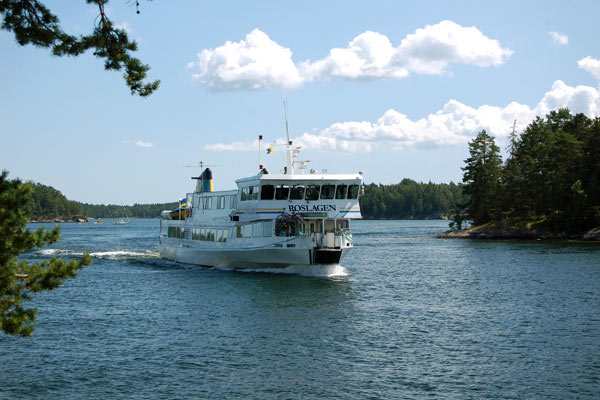
For years I’ve flown over Stockholm’s famed archipelago, or glided by it on a big cruise ship heading for Helsinki. Eighty miles of scenic islands stretch out from downtown Stockholm. (Locals love to brag that there are 34,000 islands — but that must count mossy little rocks, so I ignore that figure.) A hundred of them are served by ferries, providing Stockholmers with the ideal island escape. This year, finally, I did good research on the archipelago. It’s covered in our upcoming Scandinavia guidebook, and we had a gloriously sunny day that allowed us to include it in our upcoming Stockholm TV show.
Enlarge photo
Ice bars must be good moneymakers — $25 entry includes one vodka drink not “on the rocks” but “in a rock” — because they are popping up all over Europe. While they’re environmentally stupid, if it ever felt right to be in an ice bar, it would be in Stockholm. Apart from an actual ice hotel (in north Sweden’s Lapland), this ice bar is the original — with ice actually shipped down from Lapland.
Enlarge photo
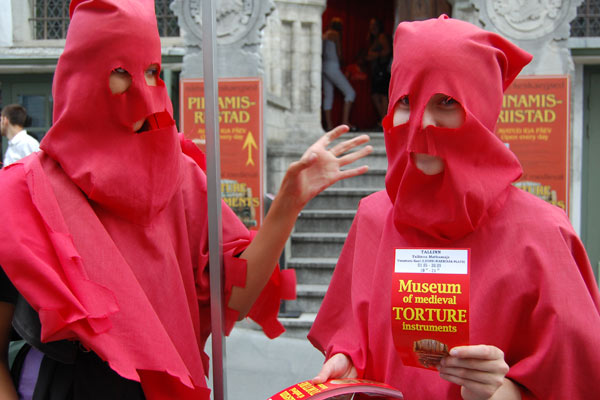
All over Europe, stupid torture exhibits are cleverly marketed. They make lots of money by appealing to the lowest desires of dumbed-down travelers. Nearly every major city has a “torture museum.” None have any real artifacts. I think there must be a catalog somewhere allowing people to equip a building with the scary and gory gear needed to open up a torture museum. The catalogue must promise that there will be an endless stream of bored tourists willing to pay $15 to ponder creative ways people have maimed and mutilated other people through the ages.
Enlarge photo
Even in notoriously expensive Scandinavia there are cheap ways to enjoy the good life. In Stockholm — the least expensive of the Scandinavian capitals — the old town is filled with feisty and competitive restaurants offering lunch specials for $10 (hot plate, salad, bread, and a drink). I can’t get that in my home town of Edmonds.
Enlarge photo
Those darn Scandinavians are so socialistic. Here some pinko dad is enjoying paid paternity leave with his new baby. Can you believe that each Swedish couple gets to split 16 months of parental leave? What ever happened to family values? And who’s paying for that? They probably have to raise their families with some single-payer health care system too. Incredible.
Enlarge photo
Berlin must be one of Europe’s cheapest and liveliest capitals. And when you want to eat cheap and lively, find the neighborhood Currywurst shop and munch with the locals.
Enlarge photo
The remains of your Currywurst plate might stoke the appetite of an abstract artist.
Enlarge photo

Scrap Metal and Estonian Brides

I spent a long day touring the Estonian countryside with my guide, Mati. It seems that the life and money are being sucked into the big city, Tallinn. Country people are moving there for work. The Estonian countryside seemed pretty dead — enjoyed by holiday-makers and offering work to those who can telecommute.

Estonia’s Baltic coast was once the wall of its Soviet-maintained prison. Now the ruins of that cage are a place that free Estonians come for peace, rest, and to celebrate their nature.
Enlarge photo

The forests are thick, but the country is flat. Its highest “mountain” is under 1,000 feet, nicknamed “Big Egg Hill.” The endless pine forests are carpeted by wild berries and mushrooms. It is a part of the lifestyle to pick the berries. Mati said, “We have many berries. If you are very sick, some can make you well. Others can kill you. We pick them now for the joy, but during communist times, we picked them because we needed the food.”

The coastline is littered with souvenirs of Soviet occupation. Each little lip of land had a track for a gun and a searchlight. The metal used to keep the Estonians down is everywhere. Estonia’s first post-independence millionaires made their fortune selling scrap metal to the West. Today, Estonians enjoy their mellow, peaceful Baltic coastline, playing amid the ruins of their former prison.

History was tough even before the Soviet Union. If it wasn’t Russians, it was Germans…making life miserable around here. Until the mid-19th century, a good hunting dog was worth more than an Estonian peasant worker. And it was even tougher east of Estonia. In fact, Mati said that the vast majority of Soviet movies set in past centuries were shot in Tallinn, Odessa, or Riga. He said that was because these three towns were among the few from the former Soviet Union with an old quarter that survived the tumult of the 20th century.

And there was nothing charming about the architectural heritage of the Soviet Union. Ugly buildings, which dominate most cityscapes, are just assumed to be “from communist times.” Hotel Viru, long the only skyscraper in Tallinn, was an infamous Soviet hotel. Mati said it was built of a new Soviet material: “mico-concrete” (60% concrete, 40% microphones).

Doing my research, I asked Mati about a good Italian restaurant. He said these days, Italian restaurants are common in Estonia…but no good. They’re generally based on couples: Italian guy marries Estonian girl. His mom was a good cook, so they think, “Easy. Let’s open an Italian restaurant.” Mati said, “It’s always Italian boys and Estonian girls — not the other way. Italian boys think Mediterranean women (Portuguese, Spanish, Italian) don’t age well. Let’s face it: For this, God created the Catholic religion…so they can’t divorce.”

Mati explained his theory that Italian boys see Estonian women as the best bride material: They are the ideal Russian/Scandinavia/Estonian mix: deep, poetic, and romantic like Russians; free-spirited like Scandinavians, but without the problematic feminism of a Scandinavian; and the hands-on, can-do practicality of Estonians…the perfect woman.