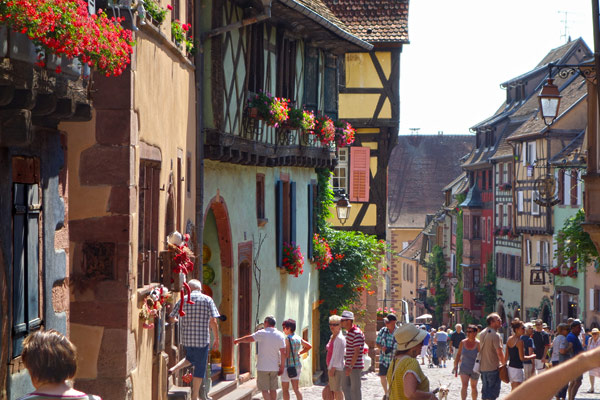
Want to experience classic, small-town, French culture? Head to Alsace, on France’s eastern border with Germany. I just returned from there and I have lots of travel lessons to share with you. In this little series of photos, I share the region’s art treasures, take you on a walk through an untouristy village on the Route du Vin, and point you to my new favorite restaurant in Colmar.

Let’s begin with a mesmerizing medieval masterpiece which I find to be one of the most exquisite pieces of art in Europe. Martin Schongauer’s angelically beautiful Virgin in the Rosebush is housed in Colmar’s Dominican Church. Dated 1473, it still looks as if Schongauer painted it yesterday.

We describe Virgin in the Rosebush this way in our France guidebook:
In Schongauer’s Virgin in the Rosebush, graceful Mary is shown as a loving and welcoming mother. Jesus clings to her, reminding the viewer of the warmth of his relationship with Mary. The Latin on her halo reads, “Pick me also for your child, O very Holy Virgin.” Rather than telling a particular Bible story, this is a general scene, designed to meet the personal devotional needs of any worshipper. Nature is not a backdrop; Mary and Jesus are encircled by it. Schongauer’s robins, sparrows, and goldfinches bring extra life to an already impressively natural rosebush. The white rose (over Mary’s right shoulder) anticipates Jesus’ crucifixion. Angels hold Mary’s heavenly crown high above.
Colmar’s top museum, the Unterlinden Museum, has been spiffed up and is now truly ready for prime time. Its centerpiece is Matthias Grünewald’s gripping Isenheim Altarpiece (c. 1515) — a many-paneled masterpiece. Taken apart and displayed in many sections, it fills a venerable chapel under Gothic vaulting.
The Isenheim Altarpiece is actually a polyptych — a series of two-sided paintings on hinges that pivot like shutters. As the church calendar changed, priests would change the painting by opening or closing its various panels. Designed to help people in a medieval hospital endure horrible skin diseases — long before the age of painkillers — it’s one of the most powerful paintings ever produced. Germans know this painting like Americans know the Mona Lisa.
Stand in front of the altarpiece as if you were a medieval peasant, and feel the agony and suffering of the Crucifixion. It’s an intimate drama. The point — Jesus’ suffering and then death — is drilled home: The weight of his body bends the horizontal bar (unrealistically, creating an almost crossbow effect). His elbows are pulled from their sockets by the weight of his dead body. People who are crucified die of asphyxiation, as Jesus’ chest illustrates. His mangled feet are swollen with blood. The intended viewers — the hospital’s patients — may have felt that Jesus understood their suffering, because he looks like he had a skin disease.

Alsace is known for its Route du Vin (Wine Road) and the many delightful (if touristy) towns along the way. While the most famous of these towns are over-the-top cute and inundated with tourists, I finally found the untouristy alternative…the little walled town of Bergheim, about half an hour north of Colmar.

A visit is quick and easy: Park on the uphill side of town and enjoy a fascinating stroll. The keen sightseeing eye will notice lots of fun bits of history. Here’s an example of what a tiny town like this can reveal:
Bergheim was contained within its medieval walls. Because of the value of the surrounding vineyards (worth more as grapevine plantations than as land that houses people), the town stayed small.
You’ll notice that two town walls were built in the 14th century — an inner and outer wall, between which was a moat (now a handy place for gardens). While these original walls were strong enough against arrows, more protection was needed with the advent of cannon fire. So, at the end of the 15th century, flanking towers were built outside the double walls as an extra defense.
From 1530 to 1667, Bergheim provided sanctuary to criminals who came to the town gates, on the run from the law. Only one of those gates survives today: The High Gate. A carved relief at the gate depicts a guy happily mooning his pursuers. Today, as you step inside the town walls, it seems like he’s mooning the modern world.
Bergheim’s main drag is lined by a small canal. You’ll notice a little iron dam. When lowered, the canal filled with water and the laundry women could do their work.
As you stroll, you’ll notice inns with gates and courtyards ideal for horse-drawn carriages. This town, unlike its more touristy neighbors, still has a real economy — there are enough locals to keep a newsstand in business and cars, rather than tour groups, on its streets.
Look up at Bergheim’s nondescript church — you’ll see a stork nest on the roof. The church is surrounded by gardens and there’s even an “insect hotel” at the far end.
And, once you leave town, a 10-minute walk will bring you to a German war cemetery. Notice that this war memorial is dedicated not to heroes who died for their country, but to the “victims of war.” In World War I, Alsace was part of Germany. After the war, it was returned to France…only to then be occupied by the Third Reich during World War II. As a result, 100,000 young Alsatian men were conscripted into Hitler’s army.
While I was in the region, I stopped at a port for river cruise ships on the Rhine River. It was fun to poke around and get a feel that booming industry. River cruising is quite popular, and we considered adding it to our tour program — we even sent one of our staffers on a river cruise — but we decided that it’s just not our kind of touring. One thing is for certain: Tour groups side-tripping by bus from river cruise ships are contributing to the crowding you find in cities all over Europe these days.

A big goal for me and my guidebook co-authors is finding the best restaurants for our readers — not the most expensive, but those offering the best value and experience. On this trip to Alsace, Steve Smith (my France guidebook co-author) and I found several good new places to recommend in Colmar.

Here’s a sneak peek (from the 2018 edition of the guidebook) at the entry for our new favorite restaurant in Colmar:
Restaurant L’Arpège offers a special experience — like eating in a Monet painting, where each waiter’s mission is to be sure you leave evangelical about chef Jean-Martin’s cooking. He gives classic French dishes a creative modern twist with seasonal and organic ingredients, always respects the vegetarians with a serious dish, and finishes with a delightful dessert. You’ll want to order family style for maximum experience. Inside, you’ll enjoy candlelight and sleek rocking chairs. Outside, you dine in a homey and thoughtfully lit garden. It’s romantic either way (€24 mains, closed Sun-Tue, 24 Rue des Marchands, tel. 03 89 24 29 64, reservations essentially required).
Each year, I look forward to a week or two of guidebook research in France with Steve. He is the ultimate Francophile who, for 30 years, has coached me in all things French. Steve’s labor of love is our Rick Steves France guidebook…and I’m honored to be his co-author.
Steve has also been a key player in the development of our tour program. We just found out that more than 24,000 travelers will join us on a Rick Steves tour by the end of 2017. And this week, we’ll be the busiest we have been all season — it will be all hands on deck, with a total of 100 guides leading great tours all over Europe on the same day.
After more than 20 years of building our amazing team of tour guides, Steve just retired from his role as Manager of Guide Services. But thankfully, he never wants to stop working on our France guidebook. If you’ve ever enjoyed our material on France or our tours anywhere in Europe, a good part of your travel joy is thanks to Steve Smith. Merci, Steve!