From time to time, we share a random video to fuel your travel dreams. Today, we’re sharing this clip from my TV episode about Belgium. Join me as I visit a Bruges museum that displays masterpieces by the great Flemish painter Hans Memling. In the St. John Altarpiece, Memling shows us the full range of his palette, from medieval grace to Renaissance realism to avant-garde surrealism…all in a luxurious setting somewhere between Bruges and heaven.
Inspired to Find Your Niche
As I’ve been traveling through Belgium, I’ve been thinking about how rare and special it is when someone finds his or her niche. Here are three examples.
|
|
|
|
|
Bruges: Callused Pinkies, Wobbly Fries, and a High-Calorie Passion for Good Living
 |
|
Enlarge photo |
To commemorate the Smithsonian Presents Travels with Rick Steves magazine — now on sale online, and at newsstands nationwide — Rick is blogging about the 20 top destinations featured in that issue. One of those destinations is Bruges, Belgium.
Chocolate, beer, canalside bike rides, French fries, carillon concerts…Bruges is an amazing little tourist town. While you might get discouraged as you shuffle through its sights along with hordes of tourists, it’s worth it. The town entertains with a unique knack for excellence and an infectious passion for good living.
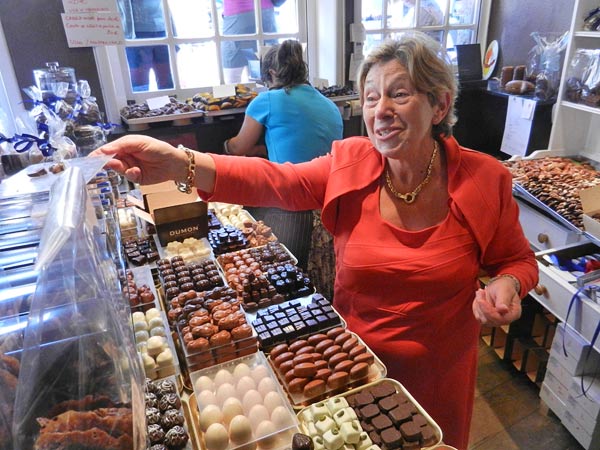
Locals swear by their personal favorite chocolatier. They know that when the weather’s too hot, the chocolate-makers close down. The people of Bruges buy their chocolate with a concern for freshness like a muffin-eater does in the USA. Yesterday’s chocolate just won’t do.
Pubs are not just pubs. They are destinations…as the annual visits of many American beer aficionados attest. Pubs in the ye olde center — places you’d think would be overrun by tourists — are the proud domain of locals, who find the fact that monasteries have historically brewed the finest Belgian beers perfectly in line with their personal theology.
French fries (called Vlaamse frites, or “Flemish fries,” for the region of Flanders, in which Bruges lies) are another guilty local pleasure. One time a Bruges chef took me into the kitchen to witness the double-deep-frying process required to make a fry up to Flemish standards. His nervous, giggly reveal reminded me of the kid who showed me my first dirty magazine at the Y back when I was a grade-schooler. He’d pick up a single fat fry, ready for its second hot-oil bath. Holding it at the bottom, he made it wobble, as if playfully sharing a centerfold.
Bruges offers the best carillon concert I’ve found in Europe (normally June-Sept Mon, Wed, and Sat at 21:00; Oct-May Wed and Sun at 14:15). The city puts out benches in the courtyard below the City Hall bell tower. You can hear the tunes ringing out from the tower’s bells anywhere in the town center. But to sit in that courtyard, looking up at the rustic brick tower and hearing the performance, is a ritual for locals…and it just seems right.
Seated there one evening, I gaze up at the lofty tower. Like a kid checks in with his mom and dad before going down a long slide at the playground, the carillonneur pops his head out a window and waves. Then he disappears and begins hammering — literally hammering, as a carillon keyboard looks like the keyboard foot pedals of a big organ, yet are played by the little-finger sides of clenched fists.
After the concert, we clap, and he appears again — tiny head popping out the little window to happily catch our applause. The crowd dissipates. I wait at the base of the tower to personally thank the carillonneur. A few minutes later, he’s at street level, in his overcoat, looking like any passerby. I shake his hand and find myself gripping a freakishly wide little finger. A lifetime of pounding the carillon has left him with a callus that more then doubled the width of his pinky. Just one more artist in the city of Bruges.
Beer Pilgrims in Belgium
I’m a little drunk after an evening of research in Belgium (so forgive the wordiness of this long-winded entry). A good percentage of the tourists you meet here are beer pilgrims — on a quest. For two nights in a row, I’ve shared a table or bar with American couples here specifically to enjoy the fine local beer.
 |
| The Belgian love of fine beer shows itself in mini-markets dominated by bottles of the finest monk-made brew. Enlarge photo |
Tonight, at my favorite Brugge bar (‘t Brugs Beertje — a favorite here…famous and even beloved for stocking over 300 Belgian beers), I sat with Chris from San Diego. Chris actually brought a bottle of Speedway Stout by Alesmith all the way from San Diego to give to Daisy, who runs this local pub.
I was a bit down on Brugge (a.k.a. Bruges) after a long day of visiting every sight in town. The place is inundated with tourists, especially when a cruise ship is in. It seems nothing is possibly “untouristy.” I’ve been in Belgium, the Netherlands, Britain, Denmark, Turkey, and Iran lately. With the high price of things here (with our dollar down) and the predictability and homogeneity that comes with the new affluence in northern Europe, I was thinking how much more challenging and rewarding travel in places like Iran and Turkey is. It took staying out late and enjoying a couple of beers to jolt me back into a positive mindset.
After making the rounds of 12 or 14 restaurants last night, I wanted to actually eat in one high-end little place in my book — Bistro in den Wittenkop. It’s a cool, candlelit, jazzy place serving $30 plates (the going price for a nice dinner place these days).
I was mad at them last night for insisting that no one in Belgium served tap water in restaurants. Then I asked at all the other restaurants and learned it’s true. Germany, France, and the Netherlands have no problem serving free tap water. But in Belgium, it’s just not done. They claim all their water is “recycled,” and a few years ago a bunch of people got sick drinking tap water here, so — apparently — the government doesn’t allow restaurants to serve tap water.
I tracked down three places from reader feedback, and all were good. Two were characteristic pubs — focus on beer with cheap bar food (€7 spaghetti), allowing the poor American tourist to have a great night out for cheap (two great beers and a basic meal for $17).
The third place was a real winner. I just loved it. The local guide who was tagging along with me pointed to the medallion outside the door and said, “Yes, Hotelschool Koksude — one of the best cooking schools in Belgium…this place has got to be good.” My gut feeling was that this was a good value, but recognizing where the chef had studied…that was way beyond me. I wish I was more sophisticated about these things.
I had a fine meal, affirming my take on the place, and then popped over to the ‘t Brugs Beertje pub to check the intro material I had on Belgian beers. I sat at the bar planning on picking Daisy’s brain. But I was surrounded by beer experts — all happy to clue me in. Soon I had a chemistry lab of four different beers in front of me — each with its distinct beaker (a critical part of the beer culture here is that the glass must fit the beer). I had one called Zot (“the fool” — the last beer actually brewed in Brugge and considered one of Belgium’s best), Kriek (made bitter with cherry), an apple Lambic (what you order for your friend if they “don’t like beer”), and a complex and creamy Chimay brewed by Trappist monks. Licking my lips, I thought that Chimay would almost make celibacy livable.
As a beginner, I was extremely steep on the learning curve (and did my best to stay there as I walked home).
As I busily took notes, the gang on stools around me marveled at what a cool job I have. A couple stools down, a girl recognized me and said, “My mom loves you.” (I don’t know why, but I get a lot of that lately…lots of moms love me.)
Two stools beyond her was Astrid. She’s a guide at the local brewery that makes the Zot beer. (She wasn’t drinking Zot.) For years I’ve recommended that brewery tour in my book, raving about Inge (a guide there who I like and who’s a friend of mine). Today, Astrid rather than Inge was my guide. She had to mention, “There’s more than one guide here.” And I realized how it was wrong for me to favor one of seven guides just because I happened to know her. For six years, the other guides have had to hear American tourists ask, “Are you Inge?” I thanked Astrid for the nudge, apologized for the oversight, and assured her that in the new edition she won’t have to tell people she’s not Inge. Loosened up by a few Zots, my Belgian stool-mates explained to me how money-oriented the Dutch are. They said, “The Dutch have the worst beer, Heineken — but sell it all over the world. Belgians make far better beer, and it is barely exported. The first thing the Dutch ask you is about money (how much people make and how much things cost), which is taboo here in Belgium. Those Dutch could sell a fridge to an Eskimo.”
I’ve been in Belgium for 24 hours now. I’ve learned they “have nice weather 20 times a day.” And it occurs to me that old people speak English now. This is really a switch. I have been conditioned to find only young people able to clue me in on things; consequently, I get a young perspective. Now, enough years have gone by that I need to remember that the era of Europeans speaking English is long enough so that even the semi-retired people helping out in museums will likely speak English. They may be old, but they are from the modern age.
Speaking of the modern age, I just passed a threshold. Yesterday in Antwerp at the train station, I had 15 minutes between trains and wanted to get a SIM card for my cell phone to work in Belgium. I asked where the shop would be, and the information person directed me not to a shop but to a machine. I popped a ten-euro bill into the SIM card dispenser, and got my chip with a Belgian phone number and €7.50 of credit.