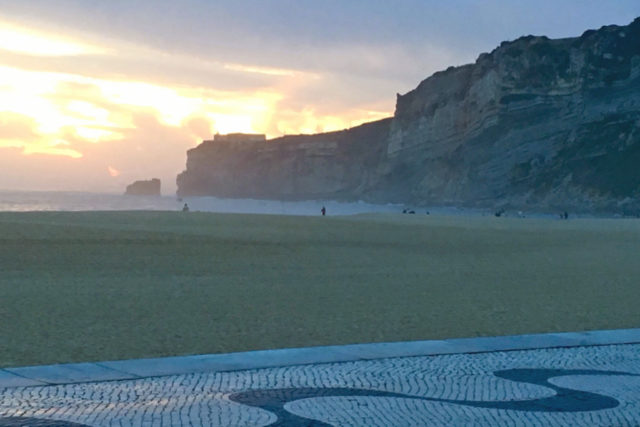
It’s Good to be Back on the Beach in Nazaré

sunset

It’s always enjoyable to go from a big-city airport directly to a small town and settle into a new country that way. After landing at the Lisbon airport, I talked to a few taxi drivers and settled on a €100 fare (about $100) for the 90-minute drive north to Nazaré. A bit pricey, but for a group with limited time, a good investment. In about two hours, I went from touchdown at the Lisbon airport to on the beach for a sunset in little Nazaré.

view of nazare

Nazaré has a romantic appeal, even to birds — here out on a date and clearly enjoying themselves.
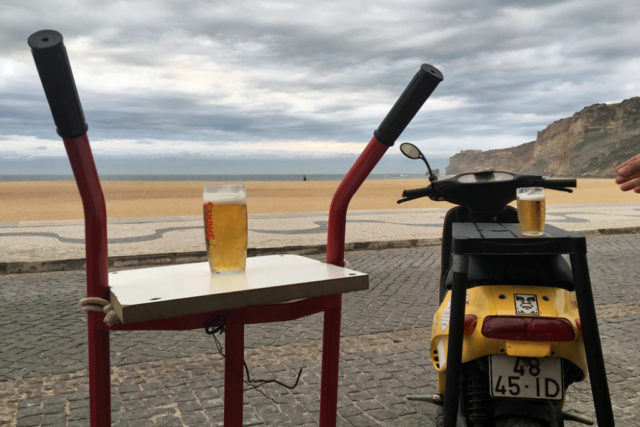
beer and motor scooter

From our beachside bar, we marveled at how cleverly our friends rigged up their motor scooter and hand truck to give their beers a scenic perch.

plate of barnacles

Did I tell you I love barnacles? You eat them like boiled clams and wash them down with beer. They are expensive because they are difficult and dangerous to harvest — from rocks in turbulent places. But rip off the tough outer skin of one of these guys and pop it in your mouth…it’s worth the expense and all that trouble.
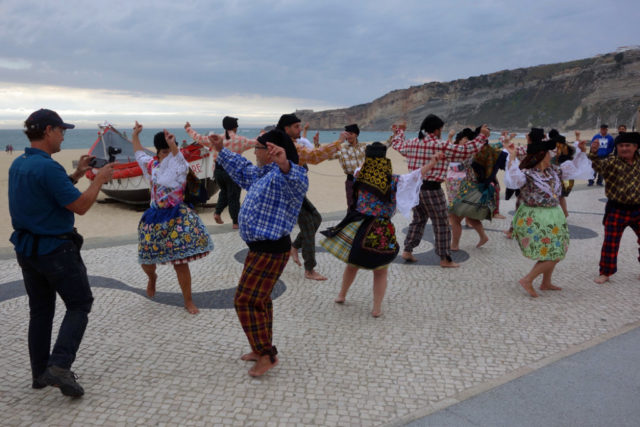
dancers

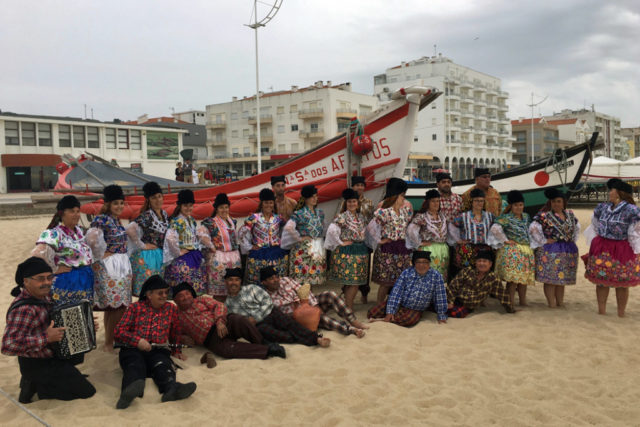
We filmed here 18 years ago, and Nazaré was the first show Simon Griffith (my longtime producer) and I made together. We also worked with the same cameraman we have on this shoot: Karel Bauer. Just for fun, we arranged to have the same folk group dance for us on the beach. While last time they literally danced in the sand, this time they didn’t — saying they can’t dance well in sand. (I tried it, and understand their concern.) They had planned to perform on the dance stage set up on the beach. But dancing on the sidewalk — inlaid with the fine Portuguese stonework — looked much better. Sadly, for the barefoot dancers, it came with painful pebbles. We were the same crew…and even some of the dancers today danced for our camera back in 1999.
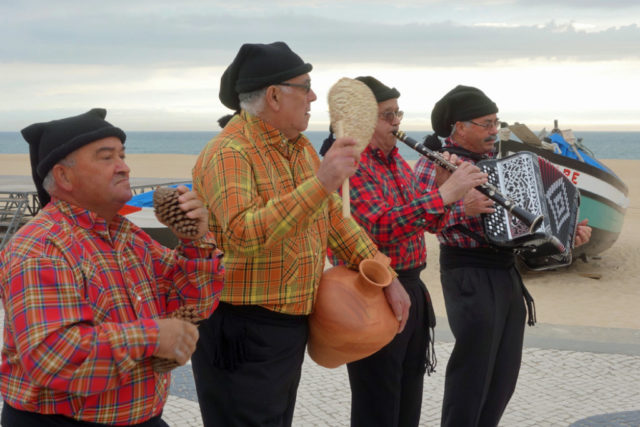
band

When we film a folk group in action we like to have them perform the same song three times: once to get the wide establishing shots and the entire music track; a second time for tight shots on the dancers; and a final time so Karel can focus on the instrumentalists. This combo came with a percussionist who played a mean set of pinecones.  
group of dancers

When these dancers were younger, the vast beach at Nazaré was littered with colorfully painted fishing boats that would be hauled in by oxen or teams of fishermen and, later, by tractors. Today, the new harbor is dug, and the boats are out of sight — except for a few historic examples still ornamenting the beach. Now, this is the domain of sun-seeking holidaygoers who pack the beach through the summer. Being here in May, however, the beach was nearly empty.

__

This is Day 37 of my “100 Days in Europe” series. As I travel with Rick Steves’ Europe Tours, research my guidebooks, and make new TV shows, I’m reporting on my experiences in Italy, Portugal, France, Ireland, England, Scotland, Germany, Switzerland, and more. Thanks for joining me here on my blog and via Facebook.
Video: Barnacles in Nazaré

I view each of my Europe trips in segments. So far, my spring 2017 trip has had three: Sicily tour, Naples/Amalfi Coast, and Rome. Now, for the fourth segment, I’ve flown to Lisbon, zipped up to Nazaré, and joined my TV crew (producer Simon Griffith and cameraman Karel Bauer). For the next 12 days or so, it’s TV production in Portugal.

I recently started a new tradition of sending the crew over a day ahead of me to collect B-roll (lovely video clips without me to make sure the show looks beautiful). That extra day gives us flexibility to deal with possible weather frustrations. Simon and Karel, with the help of our wonderful local guide, Teresa Ferreira, have had a great first day. I’ve just joined them and we’re enjoying our ritual barnacles-and-beer break. There’s nothing quite like ripping open barnacles with the expert help of your local guide, especially when you’re within sight of the rocks where they were harvested on the wild west coast of Portugal. Don’t you agree?

This is Day 36 of my “100 Days in Europe” series. As I travel with Rick Steves’ Europe Tours, research my guidebooks, and make new TV shows, I’m reporting on my experiences in Italy, Portugal, France, Ireland, England, Scotland, Germany, Switzerland, and more. Thanks for joining me here on my blog and via Facebook.
Rome’s New Sound-and-Light Shows

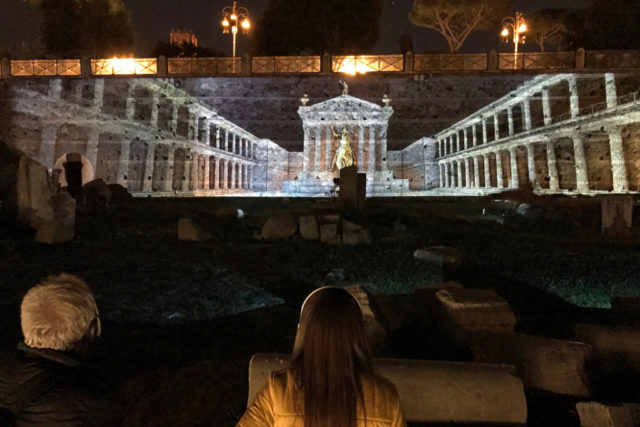
Sound-and-light shows are so 1970s to me. But, with new laser technology, they are coming back and coming back strong. In the old days, travelers would gather on folding chairs in courtyards (at a temple in Luxor, the Invalides in Paris, or a château in Amboise) and listen to thundering voices of great historic figures (a pharaoh, Napoleon, Leonardo) tell stories as colored lights made the stony walls more evocative. Today, the power of laser projections is so strong and the images so vivid that a cathedral facade (in Reims) can be filled with workers treading in mills and carrying stone. And now, in Rome, we can walk through the ruins of a forum under the stars and see shops peopled with merchants, the Curia filled with senators, and fire sweep the Eternal City as Nero just fiddled. What are your old-school sound-and-light show memories? And what new shows have you enjoyed in Europe?

Below is the listing for the new sound-and-light show options in Rome (excerpted from the upcoming 2018 edition of my Rome guidebook). This is truly big news for people visiting Rome:

Sound-and-Light Shows: Forum of Caesar and Forum of Augustus

For an atmospheric and inspirational sound-and-light show giving you a chance to fantasize about the world of the Caesars, two similar and adjacent evening experiences are offered. With each of these “nighttime journeys through ancient Rome,” you spend about an hour with a headphone (dialed to English) listening to an artfully crafted narration synced with projections on ancient walls, columns, and porticos that take you back 2,000 years and bring the rubble to life. Each show is distinct and worth the €15 (or do both for €25, nightly from mid-April through mid-November, bring your warmest coat or sweater, tickets sold online and at the gate, tel. 06-0608, www.viaggioneifori.it). If planning to see both shows, do the Forum of Caesar first and allow 80 minutes between starts. While shows can sell out on busy weekends, generally there are plenty of seats.

Forum of Caesar Stroll: For this show you’ll stroll a few hundred meters on a wooden sidewalk, making about eight stops over the course of an hour, as the narration tells the dramatic story of Julius Caesar. During this nighttime walk, you are actually on ground level in normally closed-to-the-public archeological sites, enjoying views you’d never see otherwise. This show starts at Trajan’s Column, with departures every 20 minutes from dark until nearly midnight.

Forum of Augustus Show: At this show you’ll sit on wooden bleachers for the duration while looking out at the remains of a vast forum. Its surviving rear “fire wall” provides a fine “screen” upon which to project the images telling the story of Augustus. Showings are on the hour from dark until 22:00 or 23:00. There is plenty of seating and shows rarely sell out. Enter on Via dei Fori Imperiali just before Via Cavour (you’ll see the bleachers along the boulevard).

____

This is Day 35 of my “100 Days in Europe” series. As I travel with Rick Steves’ Europe Tours, research my guidebooks, and make new TV shows, I’m reporting on my experiences in Italy, Portugal, France, Ireland, England, Scotland, Germany, Switzerland, and more. Thanks for joining me here on my blog and via Facebook.

Let Tech Enhance Your Travels

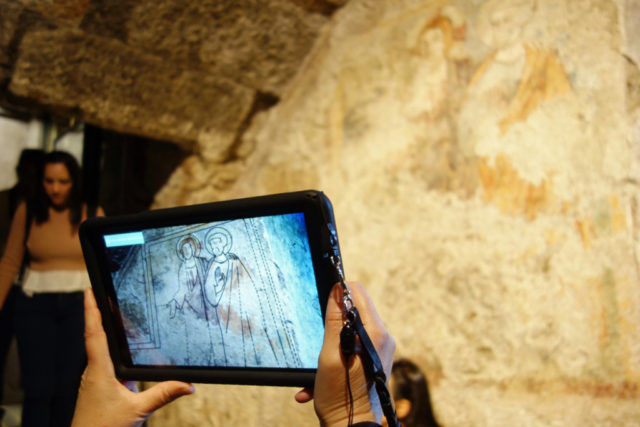
With each trip to Europe, I look forward to the new tech innovations that’ll pump up my experiences. This year I’ve noticed new iPad applications that reconstruct ancient frescoes when you focus the iPad on the scant remains of the original — like here at the Mamertine Prison in Rome, where the faithful believe Saints Peter and Paul were imprisoned. Astounding as this app is, I have to say that such tech developments no longer surprise me — they’re becoming commonplace.

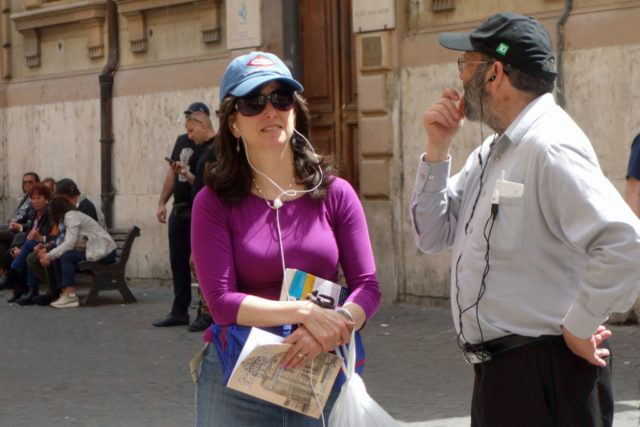
One of the great joys for me these days is checking in with travelers in Europe who’ve enjoyed my new (and much improved) free audio tours. In fact, when I meet someone on the road one of my first questions is, “Have you used the free tours from the Rick Steves Audio Europe app?” I’m so high on these audio tours because people absolutely love them. And we’re making new tours all the time. So, when considering the blessing of new tech for travelers, don’t forget to download Rick Steves Audio Europe and stick me in your ear. I promise, you’ll like me there — just look how happy these travelers are.

___
This is Day 34 of my “100 Days in Europe” series. As I travel with Rick Steves’ Europe Tours, research my guidebooks, and make new TV shows, I’m reporting on my experiences in Italy, Portugal, France, Ireland, England, Scotland, Germany, Switzerland, and more. Thanks for joining me here on my blog and via Facebook.

Video: In Love with Rome

Why am I in such a giddy mood? Because I’m in Rome, updating one of my favorite guidebooks. From spilled artichoke splatter outside the kosher restaurants in the Jewish Ghetto, to saints bullying pagans off their obelisk-capping perches, to the spritzing breeze that fountains give off as they do their Baroque song-and-dance, to the way elegant locals share their world with rumpled tourists, to soldiers hanging out at all the most romantic piazzas, to children honing their spaghetti-slurping skills in the trattoria, I take moments between sightseeing and writing to simply stroll with all my senses wide open. I hope you can, too.

This is Day 33 of my “100 Days in Europe” series. As I travel with Rick Steves’ Europe Tours, research my guidebooks, and make new TV shows, I’m reporting on my experiences in Italy, Portugal, France, Ireland, England, Scotland, Germany, Switzerland, and more. Thanks for joining me here on my blog and via Facebook.