Married in Gibraltar Near Spain

I can’t resist popping into the British colony of Gibraltar when in Southern Spain. Gibraltar is hardly signposted in Spain, as if Spain wishes the British colony didn’t exist. (You follow signs to La Linea, the last Spanish town.)

Quirky Gibraltar is happily English. Just 30,000 people live along a three-mile lip of land under that famous Prudential Rock, but the people of Gib have an impressive national pride. In a 2002 referendum they voted 99 percent to stay with Britain. If you ask locals what they think of their current governor, now in his third term, they say, “He deals effectively with Spain.”

The colony is part British, part not-Spanish, part Gibraltarian. They have the big three-pronged English plugs, their own currency (the pound sterling — but a Gibraltar version, like Scotland) and their own web domain (gi). Their Anglican church is proudly “headquarters of the Anglican Church in Europe” (not very centrally located for the business of administering that vast parish).

The people have that annoying British correctness — I got chewed out by the woman at the tourist board for not giving them advance notice of my visit. They’ve decided to change the name of what for a thousand years has been known as “the Moorish Castle” to the “Medieval Castle.” (I told them, “Not in my guidebook.”)

An American submarine was in port during my visit, so the colony’s pubs were busy with Yankees on a quest for cold beer. Gibraltar’s economy, once dominated by the military, is now based mostly on tourism. (And that includes quickie weddings — only 48 hours notice is required and it’s legally British. Sean Connery got married here. And, of course Beatle fans remember from “The Ballad of John and Yoko” that they too got “married in Gibraltar near Spain.”)

While the British military presence is now dwarfed by the presence of British sun-seekers, the colony is encrusted with military souvenirs — thick, thick ramparts, war memorials, 30 miles of tunnels drilled into its rock and big rusted iron rings every 20 yards along the military roads that switchback to the top of the rock, designed to enable limeys to hoist up the giant cannons that once helped the Brits seal off the Mediterranean when they wanted.

As we drove high above the port, my taxi driver pointed down to a tiny breakwater and said, “That’s where they pickled Admiral Nelson after the Battle of Trafalgar.” (While he won, he died too. His body was preserved in a barrel of spirits for the trip back to London.)

Gibraltar’s dominant tour company is called Blands. I remember 10 years ago all the buses said “Bland Tours.” Mr. Bland — who speaks perfect English, so there’s no excuse — finally realized that his name just wasn’t ideal from a marketing point of view. But sometimes ego trumps greed. He added an “s.” Now his buses read: Blands Tours.

The Gibraltar business sense is quirky. The hotels are twice as expensive as those across the border in Spain (and not as comfortable). For a decade, I’ve said, “English food is no longer as bad as its reputation.” Now I’ll add: “…except in Gibraltar.”

And the businesses pad their bottom line by gouging anyone who comes in and spends euros. I imagine well over 200,000,000 people spend euros. Only 30,000 spend Gibraltar pounds. And Gib business people say, “Sure, we take euros.” They don’t tell you that it comes with about a 20 percent loss in the exchange rate.

Nevertheless, tourism is booming. Midday, the pedestrian-friendly main street (which locals call “Main Street”) is a virtual human traffic jam. And twice as many planes are landing in the colony every day. While it’s still only four planes, it is more important than ever now that when you walk across the military airstrip that marks the border between Spain and what’s left of the British Empire, you look left, right and up.

Time Shares and Rip Tides

One of my least favorite places in Europe is the Costa del Sol. When I’m not calling it “strip malled and parking metered,” I call it “bikini-strangled and Nivea-creamed.”

To me, it’s just endless condos filled with people who are there because they have free rooms in time shares. (It seems every time someone in the USA tells me they’re going to Malaga, I don’t say “yuk,” I ask “why?” They say, “Time share.”)

The Costa del Sol is just right for the tourists who fill it. There are enclaves that cater to various rainy cultures from the north. One town will be filled with Belgians, the next Swedes, and the next Scots — all able to still have their local brews, newspapers….and buy them from people who speak their language. The attraction: a change of weather without a change of culture. In some restaurants, the stray Spaniard complains that they can’t find a Spanish menu. Whenever I’m driving through I tune my car radio to “Sun Coast Radio” — the station for ex-pat Brits.

But west of Gibraltar it’s windy and the water is cooler. That was great…it kept out the sun-seekers and development. Tarifa has long been the South Spain of my dreams. Then the wind actually became a boon. For North European windsurfers, Tarifa — with its strong winds — has become a mecca.

The wind was up, so I drove out west of Tarifa for the spectacle. Munching my dish of paella in the lee side of a hedge, I watched the action. The world felt like an aquarium with way too many fish. Wetsuit-clad windsurfers jetted like skeeter bugs across the choppy water. And — something I haven’t seen before — countless brightly colored kites filled the sky as they powered surfers across the sea. To add to the color, flags flapped all around as if to celebrate the famously steady Tarifa winds.

Locals say this is the only place in the world where you can see two continents and two seas from the same vantage point. The mountains of Morocco stood crisp across the straits. Behind me, a forest of sleek windmills whirled with attitude. And the women in the thatched restaurant called out another hungry surfer’s name as the latest batch of paella was ready. From this vantage point, the world seemed healthy and at peace.

Back in Tarifa, I walked through the fortified gate and climbed the ramparts of the castle named for Guzmán El Bueno. Guzman earned his nickname 800 years ago when he stood where I stood, looking down at Moorish invaders who wanted into the town. They held Guzman’s little son hostage. As if in a movie, the Moors (Muslim invaders from North Africa) said, “open the door or we kill the boy.” Guzman said “hell no” and defiantly tossed them his knife to do the job. They slit his son’s throat, but Guzman held out and the town was saved. Bueno.

Stepping into the church (most churches in this part of Spain are built upon the ruins of a mosque which was built upon the ruins of a church), I see a painting of a favorite local saint. He’s called James the Moor Slayer. He was portrayed doing what he always does — lopping off Muslim heads.

Next to the church is the office of a “Save the Whales” group that takes tourists on whale-watching excursions, raising awareness of the plight caused by shipping through the Straits of Gibraltar. They hope to make the straits an international nature preserve (which would have shipping lanes steer clear of feeding grounds, among other things). These whale-lovers expressed frustration, saying progress was stalled because Muslim culture (Morocco) had no real affinity for creatures other than humans.

Here — where Africa, Europe, the Mediterranean, the Atlantic, Christendom and Islam all come together — a few cultural rip tides should surprise no one. Whales and dolphins know that where there are rip tides, there is food. Wind surfers know there’s excitement. I like to think there’s a positive aspect of intercultural rip tides for Christians and Muslims too. Perhaps it’s just hiding.

España: Happiness Curves and Hitting Jamon

My Spanish assistant Roberto was catnapping on a chair in front of the Avis desk at the Madrid airport. Born in Nashville but because of a love of Spain, Robert lives in Argentina. He prefers Third World chaos and inefficiency. (His blog, at wrighton.com.ar, explains.) While Robert celebrates things that are needlessly complicated and frustrating, I fight them. Traveling with him will probably be good for me.

It’s a big holiday, so the trains south to Cordoba were booked. We rented a car. Robert can’t drive a stick and automatics are still rare in Europe. Thankfully, Avis had a mighty little BMW — that was automatic — held for us. Robert drives…I type on my laptop. Efficiency. Ricky likes it.

Minutes later, we’re southbound on the freeway, immersed in the vastness of La Mancha. It’s a tough terrain. A windmill — weathered into a rough little useless nub — still caps its blustery hill. I swear, bugs here bounce off the windshield and keep on flying.

We pop into a rustic truck stop for lunch. As my teeth break into my ham sandwich, I finally arrive. España! My passport was stamped, but I didn’t realize that I hadn’t really arrived until I broke through the crisp crust, into the fluffy fresh baguette — and hit jamon.

In Spain, you gotta love the ham…from happy pigs…acorn fed. Cured ham hocks — toned legs with pointed toes, like dismembered farmyard ballerinas in vice grips — are found in every bar. That simple truck-stop sandwich spoke to me. “Welcome to España.”

Europe is changing fast. I once thought when I had TV shows covering the entire Continent I could say “mission accomplished.” But no. Spain still has its short men with tobacco voices and “curves of happiness” — round Buddha bellies. (Sure, some would say “reminders of lives cut short.” The men would say souvenirs of lives well lived.) But you no longer fear the thieves who smash your car window and grab your purse. People don’t throw trash on the bar floors as much as before. Restaurants are no longer hazy with smoke. And there’s orthodontia — young people with straight teeth. Affluence is here. It’s a cell phone and iPod culture.

Traveling shows you that history lives. It has a metabolism — driven by a society confronting (or ignoring) its problems. Solving old challenges…dealing with new ones. For instance, driving south to Cordoba, we pass road signs in Arabic, posted just two years ago. Some locals say “to make sure their Moroccan guests find their way home.”

Five hours after my Alitalia pilot said I could release my seat belt, we pull into Cordoba and settle in. Later, wandering the Art Deco streets, we’re drawn to commotion on a square.

It’s almost midnight. Short men with curva de la felicidad bellies jostle and bark as a dozen little school girls rattle a makeshift stage, working on their sultry. Even with iPods and straight teeth, Andalusia’s flamenco culture survives.

Burrowed deep into my bed, rather than count sheep I review the day: breakfast in Milan, the scare at the airport (long lines and too little time), being wowed by smooth and freshly painted asphalt ribbons lacing together Spain, and Cordoba’s every-night festival of life filling the streets. Then a noisy parade rumbles down the cobbled lane I thought promised a good night’s sleep.

Standing in my underwear and wrapped in the drapes, I peer secretively out my window. Below, a band of guitars and castanets with a choir of tobacco voices funnels down my narrow alley. Grandmothers — guardians of a persistent culture — make sure the children pick up their Andalusian traditions. Suddenly, one looks up and catches my eye. I feel like a Peeping Tom…good.

Ciao Venezia, Ciao, Ciao, Ciao

Venetians may be dwindling in number. But those who remain seem to be a happy lot. And when Venetians are happy, they sing. You hear it early in the morning as they wheel their souvenir carts into the tourist zone. You hear it from maids cleaning rooms. You hear it on the back lanes in the wee hours when you’re trying to sleep and voices travel twice as far.

But the gondoliers — who sing for a price — annoy me. They’re one big, wannabe rat pack who flip-flopped suave and schmaltz. Convoys of gondolas — each heavy with tourists — follow the leader who sings “Ciao Venezia, Ciao Venezia, Ciao Venezia, ciao, ciao, ciao.” And the accordionist is an enabler.

Prices in Venice have become outrageous. When I comment to hoteliers, the standard reply is, “People pay it.” As Las Vegas tries to recreate Venice, the reverse is happening as well. Demand for hotels is driving locals onto the mainland, so their vacated apartments can be made into boutique hotels. (I slept in one, under an enchanting barcode of medieval beams.) Looking for something non-touristy here is more and more like looking for a restaurant filled with locals at Disneyland.

That’s my rant. I get down as I realize that, in some cases, my ideal “back door” Europe is — in truth — wishful thinking. But I still love Venice.

A real community survives in Venice. The guy who runs the elevator at the bell tower of San Giorgio Maggiore — that wet Palladian dream floating just beyond the Doges’ Palace — told me he travels 10 kilometers (6 miles) a day up and down.

There are real energy concerns. Here, as all over Italy, restaurants are trading away a little ambience for harsh-yet-energy-efficient fluorescents. As is often the case in Europe, the government shows a kind of tough love — even if it’s bad for business and uncomfortable for citizens. Homes and hotels stop heating before they are allowed to start cooling. In the case of Venice, heat is generally turned off by mid-April and air-conditioning is only activated in mid-May. (Odd weather during that no-heat-no-air-conditioning window causes many American tourists to complain. When it comes to energy conservation, they get no sympathy from me.)

Leaving Venice for Padua the other day, I marveled at how easy it is for experienced travelers to transfer. (And the rewards awaiting the rookie who is a quick study.) Heidi, my Italy-specialist assistant, and I went from hotel to hotel in 70 minutes for €14 ($20).

At our Venice hotel — 100 yards behind the high-rent strip of hotels facing the lagoon, next to the Doges’ Palace — the guy at the desk told us we just had time to catch boat 42; it’s leaving at 6:46. We paid €6 each for tickets and hoped on the fast boat. I munched a dinner sandwich while enjoying the views and scoffing at the horrible location of the vast, new Venice Hilton Hotel.

Twenty-four minutes later, we were at the train station. In the station, we looked at the departure board — a fast train was leaving for Milan (stopping in Padua) in five minutes from track 8. Heidi (who’s better at this than me) zipped over to the now omnipresent ticket machines, typed in Padua, tapped the departure time, two people, second class, put in her credit card to pay €5 each and out popped our tickets. Two minutes later, we joined three Italian kids in a compartment on the express train. The kids packed up and left, making us feel like we had bad breath. I surveyed the photos Heidi took on today’s research swing through the Lagoon (from Igor Stravinsky’s tomb in Venice’s island cemetery to the old lady with the huge ears who still makes lace in Burano) and 25 minutes later we were in Padua. Hoping in a taxi, €6 and five minutes later we checked into our hotel.

After five days in Venice, I was a little shocked by modern buildings and all the rude cars. Recalling the story of the old women who spent her entire life in Venice and finally went to the mainland — and got run over — I reminded myself to cross streets with care.

Doctor, Doctor, You’re Still Just an A-Hole.

I’m in Padua (just half an hour from Venice, but a world away). I didn’t see a soul all day with my guidebook. (Kind of depressing after so many in Florence and Venice.) But if nobody’s here, I can’t let my coverage slide. I really like this town and I want my chapter to be worthy.

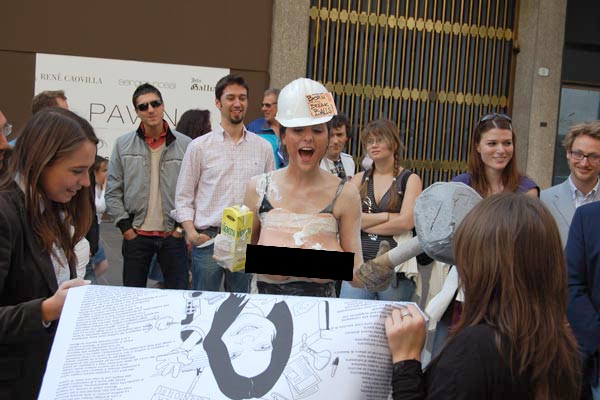
Galileo called his 18 years on the faculty in Padua the best of his life. The university seems to dominate the town and since its 60,000 students can graduate whenever they defend their thesis, I’ve never been here without little graduation parties erupting on the street all day long.

Graduates are given a green laurel wreath. Then formal group and family photos are taken. It’s a sweet, multi-generational scene with family love and pride busting out all over. Then, grandma goes home and the craziness takes over. Sober clothing is replaced by raunchy wear as gangs of friends gather around the new grad in the street in front of the university and the roast begins.

A giant butcher paper poster with a generally obscene caricature of the student and a litany of This Is Your Life photos and stories is presented to the new grad who, with various embarrassing pranks being pulled, reads the funny statement out loud. The poster is then taped to the university wall for all to see (and allowed to stay there for 24 hours).

During the roast, the friends sing the catchy but obscene local university anthem, reminding their newly esteemed friend to keep his or her feet on the ground: “Dottore, dottore, Dottore del buso del cul. Vaffancul, vaffancul.”

Very loosely translated it means: Doctor, doctor. You’re just a Doctor of the a-hole…go f-off, go f-off. (Sorry…G-rated blog.) Once I hear this song (it starts like an Olympic games fanfare and finishes like a German cartoon: oom-pah-pah, oom-pah-pah) and see all the good-natured fun, I just can’t stop singing it.