Wilting War Memorials

It’s interesting to think how sightseeing thrills go cold with time. I was just at Luzern’s much-vaunted Swiss Transport Museum. A huge photo-realistic map of Switzerland showing literally every building in the country (which slipper-wearing visitors would walk on as they explored their country) is now (after Google Earth) quaint and underwhelming. We went in with the camera ready to roll…and left having dropped it from the script.

The stamp museum I just saw in Liechtenstein, while as good as a stamp museum can be, was just so 20th century. “Sound and Light Shows” were theafter-dark extravaganza throughout Europe a generation ago. Today, they are essentially extinct.

And as time passes, the immediacy of war memorials wilts, too. As everyone’s “Greatest Generation” passes, the pain of WWII will fade. I know many refuse to accept this…but the pain of WWI faded just like the pain of the Franco-Prussian war and the pain of Napoleon’s Russia campaign faded. Pretty soon those photos of our heroic loved ones will join the others in the three-for-a-dollar box at the flea market.

The city the Nazis burned and murdered in 1944 four days after D-Day — Oradour-sur-Glane — has been intentionally left as it was by the Nazis. With my last visit, it occurred to me that it is intentionally left “as is,” and that is evocative and good…except for the fact that the elements are literally wearing it away. As rust and rot gnaws at France’s Martyr-ville, time does the same to our WWII memories.

Six hundred years has failed to put a stop to the night watchman in Lausanne. Every night since the 1400s, on the hour, a night watchman steps out on the top of the church spire and hollers in four directions, “I am the watchman. I am the watchman. We just had ten o’clock. We just had ten o’clock.” He’s a human cuckoo clock in the land of Rolex and Swatch. He’s so irrelevant — he actually repeated his shout at 10:16 so we could film him a second time from street level…and no one noticed.

Alphorns, Clean Needles, and Fireworks

It’s August 1st — the Swiss National Holiday — and we’re in the capital city of Bern. The lakeside park is packed with beautiful people. I follow the steady stream of bathers hiking up the river to jump in and float down — the city’s wet, urban paseo.

Even with thousands in bathing suits and under a glorious sunshine, the Swiss are subdued. The most enthusiastic expression is the happy shudder I make as I plunge into the fast-flowing river. It’s a wonderfully free float until you near the post positioned so bathers can rescue themselves from the swift current and get out. I don’t know what would happen if someone missed the post — but you paddle like mad to grab it. This was great fun for TV.

Later, in the town, the sun is low. A Turkish girl and Swiss girl drink wine out of bottle under a flower-filled fountain featuring a medieval maiden pouring water from a jug. Trolley tracks, glinting in the sun, shoot like a bottle rocket up the cobbled lane.

A listless guy sits in a shipping container converted into a bike depot. The city has sponsored a free loaner bike program to both cut car traffic and create work for the hard-to-employ.

Enlarge photo

A threesome lies on the grass in shade of the national parliament building, passing a joint. No one cares. The new big Starbucks has a code for the toilet downstairs: 1122. Opening the door, I step into a very blue space. Blue lights make it impossible for junkies to find their veins. The last public WC I was in had a garbage box with a lid labeled “syringes.”

Down the street, I study the layered ads and labels on the coin-op dispenser. I see it was a cigarette machine, converted to a condom machine, and finally converted again to become a syringe dispenser — offering heroin addicts cheap and clean needles.

Just next to the Museum of Fine Arts, a heroin-maintenance center has a yard filled with people fighting their addictions. A steady stream of people step up to a window to get their needles. Filming that was really tricky…but extremely rewarding to bring home to the USA — a “harm-reduction” approach to drug policy. For more on this and other issues related to the European drug policy — and how it differs from ours — read this article I wrote recently for a talk I gave at an ACLU convention.

We tend to see Switzerland as so efficient and impossibly successful. But they have the same problems other countries do. Just like they opted out of the EU, and just like each of their states or “cantons” is fiercely independent, they deal with their problems their way…openly and creatively.

The city center is traffic-free except for taxis and quiet trams flying flags. The streets are filled with people, mostly young. It’s quiet enough to hear the splash of the fountains. As darkness settles, the town’s artful floodlighting becomes evident. The noise of firecrackers grows. Leaving my hotel without my camera, I knew something fun would appear. Sure enough, I came upon an open-air performance by a jazz band whose lead instrument was a long alphorn. Very cool. It would have been a fine photo bridging tradition with the present. Later I joined what seemed like half the city on the big bridge to watch the fireworks show. It was just like a Fourth of July show back home — with the same oohs and aahs for the best explosions. But the pyrotechnics were underwhelming. They’ve been celebrating the First of August since 1291…being a bit jaded would be understandable.

$60 to Iron My Shirt?

Coming from France into Switzerland, there’s a clear contrast. France has a rough patina. Switzerland has paved over its patina with success. I had to remark as we entered Lausanne, our first big Swiss city, “There’s just too much money here.”

While the French are discreet with sex, the Swiss are discreet with money. There are actually unmarked banks — perfect for unmarked deposits. (People come from around the globe to store their black money in Swiss banks…happy to earn negative interest. They actually pay Switzerland to keep it for them — anonymously and with no questions asked.)

The tourist board put us up in one of the finest hotels in the world — the Lausanne Palace and Spa Hotel. When I notice “thread count” under the sheets, you know it’s really top quality. (Ironically, the place is so nice it actually cuts into our productivity.) There’s even an unmarked bank in the hotel.

At breakfast, I was surrounded by people speaking Russian and Arabic. I sat between an old woman talking Russian on a cell phone and a guy in a bowtie who looked like Paul Wolfowitz with nothing to do. Tearing off a bit of my warm-out-of-the-oven mini-croissant, I wondered if it’s worse to blow obscene amounts of money if you are from a poor country or a rich one. (If I were paying for my room, it would run $350.) Where did these people get their money? Cynically, I thought, “They didn’t earn it.”

Starting a new TV episode, I needed to change wardrobe. (It was good to get that Burgundy shirt off my back after five days.) I called room service. Asked if I could get two shirts and a pair of pants ironed. They said sure. Something deep inside screamed, “Ask the price.” I did. They said, “74 Swiss Francs.” I thought, “At $60, I’ll body iron them.” I then did a little laundry in the sink. Rather than succumb to the temptation to hang it on my balcony — with a view of Lake Geneva — I put my heated towel rack to good use. It dried in a jiffy.

48 Stars over Burgundy

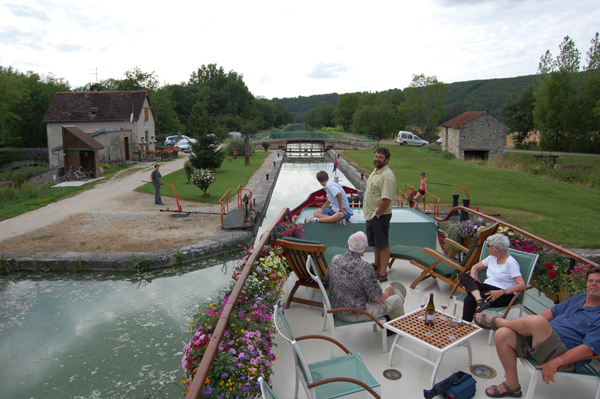
I’m happily sunburned today — after a day barging Burgundy. We filmed the luxury barge experience, and captain Arnaud and first mate/chef Marie made sure the day was smooth and stress-free. I’ll never forget producer Simon and cameraman Peter running along the tow path to get ahead of our barge, then filming Steve’s family and me stretched out on the deck as we floated elegantly by.

It was an idyllic scene: Gliding by fields of sunflowers, playing with my tapenade, being careful not to let the fine red wine mess up my ability to remember my lines, savoring the sight of Steve’s in-laws enjoying their grandchildren so…and doing the arithmetic to try to justify the high cost of a luxury barge (while expensive, the experience includes absolutely everything: sleeping, eating, drinking, excursions, transfers, transportation…and the scenery comes to you).

It’s spendy, but it’s easy to make the case that luxury barging is a reasonable value…especially if you share a barge with three or four couples you really wanted to be decadent with. The glide is punctuated each mile or so by a lock — each a model of 19th-century Industrial Age efficiency, with a tidy lock house providing government-subsidized housing for the bohemian couple who runs the lock. These characters are fixtures in France’s lazy canal culture.

Later we filmed Château de la Rochepot. For years I’ve had a negative feeling for the national chauvinism of this castle. Its owners, the noble Carnot family, refused to offer English descriptions of their fine rooms as a matter of principle (“As part of the patrimony of France, it should be explained only in French”).

Today, I came with my film crew, and after we filmed the wonderful centuries-old kitchen, the staff announced that Madame Carnot had a special treat for us. They opened a fine ancient chest and pulled out a huge 48-star American flag, explaining this was the flag that the Carnot family flew on the day of Liberation in 1945. And, to this day, they love their American guests.

For two decades, I led groups through France and was constantly impressed at how Americans expected the French to speak English. People would go to the post office in some little town and be frustrated and upset because there was no help in English and the people were not friendly. I had to remind them that small-town French postal clerks are every bit as speedy, cheery, and multilingual as those you’d find in the USA. It’s important when we are frustrated by the language barrier that we don’t expect linguistically more than we give.

Escargot and the Great American Buffalo

Filming a TV show in Burgundy this week has caused me to think a lot about the French. The great issues of the day seem to deal with food and drink.

Take the sad story of snails. Good escargot must grow wild. But as effective chemicals have successfully killed off weeds and undesirable insects, they have also decimated the slug and snail populations. These days in France, much of the escargot is farmed. Locals know the grey snails are farmed and mediocre at best.

Enlarge photo

Perhaps the snail is to France what the buffalo is to America. The great French snail — once so common that early-19th-century train companies hired women and children to clean the tracks of them so the trains could get a grip — has gone the way of the great American buffalo. I hate to burst any bubbles…but if you’re slurping top-quality “free-range snails” in a little Paris bistro, they most likely last slithered free in Poland.

The French, in an attempt to cut back on farming chemicals, are resorting to “sexual confusion.” Farmers use an organic spray that covers everything with the scent of a female insect. Male insects smell females, find nothing, get mad, and in their sexual funk…refuse to reproduce.

Wine is another topic that arouses the French. Walking through the finest vineyards in France, the fabled Côte d’Or (or “Golden Hillside”) of Burgundy, an elegant vintner evangelizes:

“A good grape must suffer. Look at this soil — it’s horrible…just rocks. And these grapes have character. The roots of these struggling vines are thin as hairs, searching as much as 30 meters down for moisture. The vines in the flat fields” — she motions to fields just a kilometer away — “have it too easy…a silver spoon in their teeth. It’s like people. Paris Hilton, she is not interesting. The fine wines of humanity, they are the ones who have suffered.” (I found myself comparing Paris Hilton and Tina Turner.)

“The best vintners don’t force their style on the grape. They play to the wine’s strength, respecting the natural character of the sun, soil, and vine…the terroir.They play the wine like a great musician plays classical music. You don’t want to recognize the musician…you want to hear Beethoven.”

After biking through the idyllic vineyards, where road signs read like a list of fine wines, I was determined to film a restaurant set in a vineyard. Steve and I had enjoyed a place called Le Relais de la Diligence. Two years ago, the vines were lapping at its tables. Today, it’s in a wheat field. With the whole world making good wines, the French are cutting back on quantity, using marginal land for other crops, and working to build the quality.

The next restaurant we tried was aghast that we would even think of filming there. It was a matter of discretion…as if most of their clientele were enjoying affairs. (Only in France is this a major issue in restaurants. Even so, wherever we film in restaurants, we politely visit with each table and confirm that they are okay being shown on TV.)

I have long thought there was something affected and pseudo-sophisticated about all this finicky French culture. While buying wine, you ask what would be good with escargot, and the wine merchant needs to know how you plan to cook the snails. I envisioned a good Chardonnay…oh, you’re cooking it that way? Then you need something flinty — a Chablis.

Then I thought of the way I (or someone who pooh-poohs the French passion for fine points in cuisine) might celebrate the nuances of baseball. Take a Frenchman to the ballpark. All the stuff that matters to me — how far the runner is leading off first base, who’s on deck and how he does against left-handed pitchers, how deep is the bullpen, put in a pinch runner! — would be nonsense to him.

The next time I put a little ketchup on my meat and my French friend is mortified, I’ll just remember that with two outs and a full count, he’ll have no idea why I know the runner’s off with the pitch.