Three Dinners on Hydra

Enlarge photo

To commemorate the Smithsonian Presents Travels with Rick Steves magazine — now on sale online, and at newsstands nationwide — Rick is blogging about the 20 top destinations featured in that issue. One of those destinations is the Greek isle of Hydra.

The island of Hydra is made-to-order for relaxing…and that means eating, long and well. Greek food — so simple, but oh so good — tastes even better in the convivial mom-and-pop tavernas that seem to be a Greek island specialty. On Hydra, I have three favorites. They’re so delicious and so different, it almost makes it worth stretching a two-night stay to three nights to be able to dine at one each evening. I’m just wrapping up a visit to Hydra to update my guidebook, and I made a point to stop in at each of these.

Taverna Leonidas, which feels like a cross between a history museum and a friendly local home, has been around so long it doesn’t need (and doesn’t have) a sign out front…everyone just seems to know where it is. The island’s oldest and most traditional taverna was the hangout for sponge-divers a century ago. Today, former New Yorkers Leonidas and Panagiota, who returned to Hydra in 1993 to take over the family business, enjoy feeding guests as if they’re family. Diners call in the morning to discuss what main dish they’d like. Then Leonidas and Panagiota shop and prepare a great meal. When I filmed a TV show about Hydra, I found these two almost too eager-to-please: We’d arranged ahead of time to film dinner here. When we showed up, we found that they’d closed the place down just for us. Unfortunately, empty restaurants make for bad TV; we’d rather be surrounded by other diners. And so we filmed an intimate dinner…just Leonidas, Panagiota, my producer Simon, and me. But the food and company was so wonderful, it was good TV after all.

Taverna Gitoniko — which Hydriots simply call “Manolis and Christina” for its warm and kindly owners — is an Hydra institution. Offering wonderful hospitality, delicious food, and a delightful rooftop garden, this tricky-to-find taverna is worth seeking out for a memorable meal. Visitors climb up a staircase to a vine-covered terrace nestled above the rooftops of Hydra. Christina is a great cook — everything is good. My Greek-island M.O. works perfectly here: Order a variety of starters to sample as many different dishes as possible.

My favorite way to cap any Hydra day is to follow the coastal path to the rustic, picturesque village of Kaminia, which hides behind the headland from Hydra town. Kaminia’s pocket-sized harbor shelters the community’s fishing boats, and on the bluff just above is Kodylenia’s Taverna. Owner Dimitris takes his own boat out early in the morning to buy the day’s best catch directly from the fishermen, before they even come back to port. Here, with a glass of ouzo and some munchies, as the sun slowly sinks into the Saronic Gulf and boats become silhouettes, you can drink to the beauties of a Greek isle escape.

I hope you’ve enjoyed revisiting 20 of my favorite destinations this summer. The Smithsonian magazine covering these 20 places is just finishing its run on the newsstands. Good news: It sold great. It seems that, just like travelers on Hydra have an appetite for that perfect Greek taverna meal, travelers back home hunger for tales of faraway places. Thanks for joining me.

Tallinn: I Cut the Forest

Tallinn, the capital of Estonia, is the only part of the former USSR that I include in my guidebooks and TV series. I put it in our Scandinavia guidebook because I love it — it’s so easy to reach from Helsinki (ferries leave hourly, it’s a 2-hour ride, no visas, and they’ll be on the euro in just a few months), and it provides a great contrast to the rest of Nordic Europe.

The Old Town — with the best-preserved medieval center in all of Nordic Europe — is quite comfortable now. In fact, it’s almost too comfortable. It’s Muzak hell: Billy Joel melodies done à  la Kenny G are everywhere. At the same time, there’s an edge I really like. I ate dinner under rusty barbed-wire lampshades in the first pub to open after communism fell.

Its Russian-ness sharpens Tallinn’s edge. Estonia is one-third Russian — a leftover from when the Soviet Union planted Russians here in an attempt to do to Estonia what China is doing to Tibet. While China is succeeding, Russia did not dilute Estonia into oblivion. Today Estonia is strong — but with a tough Russian minority that resists assimilation. Strolling through the Russian market, you feel tension. They are clearly the poor minority. And young Russian men can often make me uncomfortable. Their lives are tough. As I was passing a group of young Russians with heads nearly shaved bald, one of their phones rang. His ringtone was the sound of gunshots.

On my visit last year, I was charmed by the Estonian tradition of burying loved ones in forests. Wandering in a dense pine forest with well-cared-for tombs scattered all around, I thought this would be great for our TV show, and included it in our script.

This year, I returned with a script that read, “You feel the connection to their land and heritage at the forested Estonian cemeteries. Estonia is a thickly forested country and, for many, they see trees as almost spiritual.” Then I planned for my guide to say, as he’d told me last year, “This is our forest cemetery. Since ancient pagan times, we Estonians have buried our loved ones with the trees. We are people of the trees. This is one way we are still connected with our pagan past…still uniquely Estonian.” But it felt a little forced. While he could say it to one tourist, looking into a TV camera, he hedged and squirmed. I decided to leave it out of the show.

Still, we ended up with a great new show called “Tallinn and Helsinki: Baltic Sisters.” As I figured last year, each one is not substantial enough to make a blockbuster script individually, but a show split between these two fascinating cities is very full and strong.

Finishing our work in Estonia, we wrapped the last show of our new series. It’ll air this October.

Bruges: Callused Pinkies, Wobbly Fries, and a High-Calorie Passion for Good Living

Enlarge photo

To commemorate the Smithsonian Presents Travels with Rick Steves magazine — now on sale online, and at newsstands nationwide — Rick is blogging about the 20 top destinations featured in that issue. One of those destinations is Bruges, Belgium.

Chocolate, beer, canalside bike rides, French fries, carillon concerts…Bruges is an amazing little tourist town. While you might get discouraged as you shuffle through its sights along with hordes of tourists, it’s worth it. The town entertains with a unique knack for excellence and an infectious passion for good living.

Locals swear by their personal favorite chocolatier. They know that when the weather’s too hot, the chocolate-makers close down. The people of Bruges buy their chocolate with a concern for freshness like a muffin-eater does in the USA. Yesterday’s chocolate just won’t do.

Pubs are not just pubs. They are destinations…as the annual visits of many American beer aficionados attest. Pubs in the ye olde center — places you’d think would be overrun by tourists — are the proud domain of locals, who find the fact that monasteries have historically brewed the finest Belgian beers perfectly in line with their personal theology.

French fries (called Vlaamse frites, or “Flemish fries,” for the region of Flanders, in which Bruges lies) are another guilty local pleasure. One time a Bruges chef took me into the kitchen to witness the double-deep-frying process required to make a fry up to Flemish standards. His nervous, giggly reveal reminded me of the kid who showed me my first dirty magazine at the Y back when I was a grade-schooler. He’d pick up a single fat fry, ready for its second hot-oil bath. Holding it at the bottom, he made it wobble, as if playfully sharing a centerfold.

Bruges offers the best carillon concert I’ve found in Europe (normally June-Sept Mon, Wed, and Sat at 21:00; Oct-May Wed and Sun at 14:15). The city puts out benches in the courtyard below the City Hall bell tower. You can hear the tunes ringing out from the tower’s bells anywhere in the town center. But to sit in that courtyard, looking up at the rustic brick tower and hearing the performance, is a ritual for locals…and it just seems right.

Seated there one evening, I gaze up at the lofty tower. Like a kid checks in with his mom and dad before going down a long slide at the playground, the carillonneur pops his head out a window and waves. Then he disappears and begins hammering — literally hammering, as a carillon keyboard looks like the keyboard foot pedals of a big organ, yet are played by the little-finger sides of clenched fists.

After the concert, we clap, and he appears again — tiny head popping out the little window to happily catch our applause. The crowd dissipates. I wait at the base of the tower to personally thank the carillonneur. A few minutes later, he’s at street level, in his overcoat, looking like any passerby. I shake his hand and find myself gripping a freakishly wide little finger. A lifetime of pounding the carillon has left him with a callus that more then doubled the width of his pinky. Just one more artist in the city of Bruges.

Helsinki: Somewhere Between Bland and Mellow

Helsinki blossoms if you take time for a walk. I came upon the flea market — a square filled with folding tables stacked with stuff. The days are long gone when Helsinki flea markets were full of treasures sold by desperate Russians from just over the border. This was just stuff being shuffled from one family to the next.

Wandering under the sun through the square, I closed my eyes and listened to the soundtrack of 300 Finns at a flea market. It was almost silent. I could have been in a mountain meadow. At this moment, Finland seemed somewhere between bland and mellow…very orderly.

Two powerful icebreakers were moored across the harbor. Since they are capable of breaking through 15 feet of ice, you know this place gets cold in the winter. At the shore is a wooden deck with washing tables built out over the water. The city provides this for locals to clean their carpets. A good Saturday chore in the summer is to bring the family carpet down to the harborfront, scrub it with seawater, and then let it air-dry in the Baltic breeze. Whenever I’m in Helsinki, I go to a neighborhood sauna. The sauna on the cruise ship from Stockholm or in the hotel is just not right. I want to be with Finns, not tourists. My guidebook has long described one particular sauna as being in a poor neighborhood where people don’t have saunas of their own. That’s old news. Now, like so many old neighborhoods, with the general affluence of our age, this place is becoming trendy.

People of all walks of life come here for a relaxing break. It’s a personal thing…a time for some peace and quiet. Finns say the sauna is a great equalizer — here, wearing nothing and slapping your back with birch twigs, there are no bosses. Everyone’s equal. The sauna has a particular appeal during the long, cold winters. There’s a big cooler just inside the door where people put their drinks (if you want a beer, you have to bring your own). It’s stacked with BYOB bottles and frozen bundles of birch twigs.

Sitting there, naked and sweating, surrounded by sauna experts, not knowing a word of Finnish and not knowing the routine, I felt a little gawky. Locals can seem stern and off-putting. But as soon as I talked to someone, I realized how deceiving that impression is. It’s a lost opportunity when tourists let their awkward self-consciousness bully them into silence. Break the silence and you’ll likely enjoy a warm avalanche of acceptance — and a great conversation. Almost always, when locals look unfriendly… it’s a misperception. I bet they feel a similar awkwardness — or at least believing that assumption helps me break the ice.

Leaving the sauna, I walked back to my hotel — impressed again at the way five million Finns can maintain a distinct culture here in this far-northern corner of Europe.

Aerø: Everything’s so…Danish

Enlarge photo

To commemorate the Smithsonian Presents Travels with Rick Steves magazine — now on sale online, and at newsstands nationwide — Rick is blogging about the 20 top destinations featured in that issue. One of those destinations is the Danish isle of Aerø.

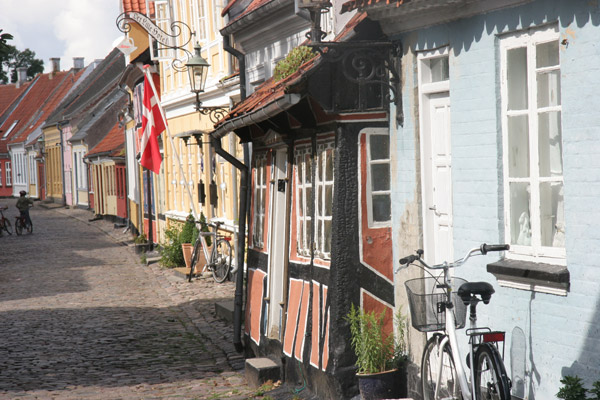
While big cities often mask the distinctive features of a nation, I find the rural corners and small towns give a better insight into what makes a particular culture unique. A strong social ethic permeates Danish society, and you really feel that on the quiet and sleepy little isle of Aerø.

On Aerø, you’re welcome to pick berries and nuts, but historically the limit has been “no more than would fit in your hat.” For years I’ve been recommending Mrs. Hansen’s bike-rental depot next to the gas station at the edge of town. Recently, a big hotel in town (with far more economic clout) decided to rent bikes, too. I saw Danish communalism in the reaction of a local friend of mine: “They don’t need to do that — that’s Mrs. Hansen’s livelihood.” Of course, there’s no law forbidding it, and with our social ethic, we’d just say competition is good. But in Denmark, to look out for Mrs. Hansen’s little bike-rental business was a matter of neighborly decency.

I love to rent a bike from Mrs. Hansen and pedal into the idyllic Danish countryside, where I find myself saying “cute” more than I should. When in the Netherlands, I have a running joke with my guide friends. We say, “Everything’s so…Dutch.” Now, in Denmark, I say, “Everything’s so…Danish.”

Denmark is, simply, cute. Travelers here find the human scale and orderliness of Danish society itself the focus of their “sightseeing.” The place feels like a pitch ‘n putt course sparsely inhabited by blonde Vulcans. And survey after survey finds the Danes the most content and happy people on the planet.