I’m flying on Veterans Day, and this day ‘ when we remember and honor our veterans for their profound sacrifice for our nation ‘ has my mind spinning. I always find working my way through airport security lines thought-provoking, and doing so on November 11 is even more so.
I take a guzzle, toss my half-empty water bottle at the garbage can the next lane over, and miss. It rolls over to a guard, who picks it up and sinks it for this lousy basketball player. The can is filled with plastic bottles. That pile of petroleum products, along with the plastic slippers and Ziploc bags provided to help people get through security, remind me of oil ‘ and have me pondering why we have to stand in these lines.
Going through security at airports, with all the uniformed security agents, I recall that many travelers joke that TSA stands for “thousands standing around.” In small airports, there are often more security agents than travelers. In this airport, they have “Team SFO” printed across their shoulders. I wonder what’s in the minds of the legions of Americans who get up before sunrise and put on those TSA uniforms. What’s their relationship with their senior officers? Do the pep talks really pep them up?
With each pass, I wonder if all my little packing transgressions will trigger a more extensive search. I’m impressed as the system evolves over time…we rhythmically take off and put on our shoes, and the plastic bins are cycled around more efficiently all the time.
Veterans Day was originally Armistice Day, established in 1919 to celebrate the end of the war that was promoted as “the war to end all wars.” Our government declared that Armistice Day would celebrate “the resumption by the people of the United States of peaceful relations with other nations, which we hope may never again be severed.” Then, in 1954, Armistice Day (which celebrated peace) was changed to Veterans Day (which celebrates our soldiers for their sacrifice and patriotic valor). Even though our veterans are statistically far more homeless, suicidal, and prone to depression and psychological disorders than our society as a whole, at least this is a day when we remember their contributions. Thankfully, whether they support our current wars or not, Americans take this day to appreciate and honor those who have served in our military.
It’s so easy to clap for veterans once a year. But what if it’s actually a day to soothe the conscience of the society that sends these people into war? As a society, it’s healthy to look honestly at our situation. Exactly who’s fighting? And who are they fighting for? I believe that the relatively small number of deaths in our latest wars masks the huge number of suicides and broken people our military adventures leave us with. On any given night in our country, at least 100,000 veterans are homeless. Over 600,000 Iraq and Afghanistan veterans have been patients in the VA system. About half of those have been mental-health patients, and a more than quarter have been treated for PTSD (nervous-system and stress disorders related to their service).
The big topic among travelers seems to be whether or not you’ll submit to the full-body scanners that are being purchased en masse to be sure we have nothing dangerous in our body cavities. Or will we refuse and go through the punitive, intensive, old-fashioned body search? While nearly all walks of life in America will be subjected to austerity budget cuts in the coming years, we’ll continue ramping up the money we spend for things like multi-million dollar banks of scanners.
Waiting my turn, I observe “Team SFO.” Some TSA ID-checkers make cheery small talk. Others plod through their work. I can’t imagine an eight-hour shift of this. What do they really think about their work? How do they keep it interesting? Or do they even try? What kind of people end up in this TSA program? What’s the camaraderie like? Imagine wearing rubber gloves for eight hours straight. I wish someone would write a TSA tell-all.
For some reason I never get frisked, while much safer-looking people before and after me do. Sitting on the bench and putting my shoes back on, I observe two small boys watching while their dad puts his feet on the footprints on the rubber mat and the man in the uniform pats him down as if painting every inch of his body. What is everybody really thinking? Nice job. Get me outta here. I’m helping my country. This is a sham. Thank God for our first defenders. I’m tired of being polite to the public. I want to scream. God bless America. This is a drag, but if we save one life from a terrorist, it’s a small price to pay.
It’s poignant to mix thoughts of security and veterans on November 11.
Every few days, it seems, the editor of our Web newsletters gives me a general theme and asks me to write a vivid travel nugget. It’s one of my favorite tasks: just sitting quietly in front of my computer and meditating on a particular place. In fact, it occurs to me that having a memory bank of rich travel experiences is a wonderful blessing. Just the other day, I revisited London:
If I flew to London tomorrow, I’d eat dinner with a man in a fisherman’s apron who knows as many words for white fish as Eskimos have for ice. I’d learn of the wonders of scotch with local experts at a fancy mahogany bar under the chandeliers of a luxurious former bank lobby. I’d join the crush of commuters on the ramshackle Tube as they read their trashy daily newspapers. I’d walk the Jubilee Promenade along the Thames under the towering icons of a new skyline and past quirky bits of Dickens’ London ‘ half-timbered stagecoach inns, operating theaters where they sopped up the blood with hay, and a hospital for psychiatric inmates in a neighborhood called Bedlam. And I’d while away my afternoons in Europe’s greatest museums ‘ free and always tickling my sightseeing fancy with new exhibits. Between each stroll and museum visit, I’d join chatty locals again to feel the pulse of today’s London behind the etched windows of venerable watering holes where candles have spilled and beers have sloshed on the same tables for literally centuries. Just writing this makes me want to fling around my winter scarf and head for London town.
If you haven’t tried this, you might enjoy it. Spend a few meditative moments bundling travel memories.
Perhaps the most beautiful spot in all of Europe is inside the Sistine Chapel, surrounded by the artistic riches of the Renaissance. Above you is a celebration of Humanism, with God giving an impressive Adam the “spark of life.” And behind the altar, filling the front wall, is the Last Judgment.
The only downside of a visit here is that it’s jam-packed with people, and there’s an annoying loudspeaker requesting everyone to be quiet. Now, the Vatican Museum has released a cool Web tool that lets you be all alone (virtually) in the Sistine Chapel…just you and the brilliance of Michelangelo and the theological points he was hired to make ‘ as only he could.
This website is probably your only opportunity to get so dizzy you fall, if not onto the ornate inlaid-marble floor, at least off your computer chair. Motor with a left click on your mouse to the ceiling, with God giving Adam life in the center. Then, holding down that left click, slide to the left and twirl, riding the Creation merry-go-round. Then, pick yourself up off the virtual floor and head over to the Last Judgment on the front wall. Click the zoom (+) button in the lower corner to push into Christ.
While the ceiling is the celebration of Creation from a positive, Humanist perspective, the Last Judgment was done later. It’s Counter-Reformation art ‘ a powerful and, I imagine, very effective response to the Protestant Reformation ‘ in which a vindictive Jesus is coming down on Judgment Day, arm raised, with Mary cowering at his side, as if no longer able to intervene for people who were led astray.
Put yourself in a 500-years-ago frame of mind as you venture to the left (where people are going to heaven) and then to the right ‘ where sorry souls are plummeting down, down, down.
While floating through this incredible chapel is a fun virtual experience, it also makes me thankful to be able to experience the great artistic accomplishments of our civilization both in silico (via Web simulation) and in person.
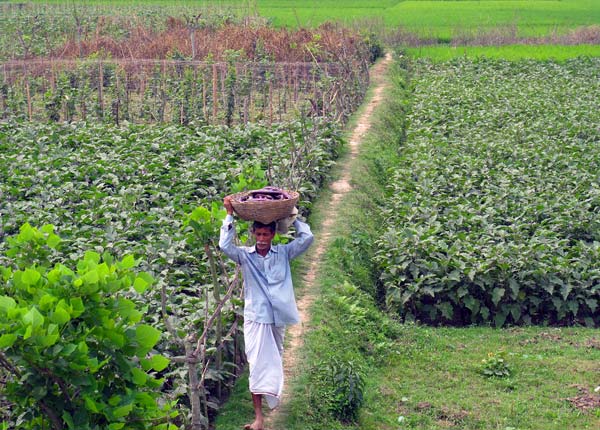
Farmers in Asia, including this farmer in Bangladesh, have benefitted from the Green Revolution, but there is still more work to be done. (photo credit: Bread for the World)
I just enjoyed a fascinating little vacation in a place I’d never been: Des Moines, Iowa. I shared my time off with a thousand people from 65 nations. It was part of my new ethic: When invited to experience something out of the ordinary, like the World Food Prize Award Ceremony, just say “yes.”
I was there to help honor one of the prizewinners: David Beckmann, president of Bread for the World, whose goal is to encourage our government to consider the needs of the world’s poor and hungry. Simply put, it lobbies for hungry people. As a friend of David’s and a longtime supporter of Bread for the World, I was invited to the festivities, which included a daylong international symposium on hunger.
The dinner conversation was curious. People shared tips on getting African villagers to embrace their new drought-resistant corn seeds, even though the kernels were yellower than normal. Someone else was excited about a new strain of rice with a “snorkel gene” so that it can grow tall enough to survive floods. And all marveled at how the chocolate cake was soy-based and still tasted fine.
Thanks to the efforts of many non-profit groups, millions of Africans, such as this mother in Zambia, have schools, clinics, and seeds with money that would have otherwise gone to interest payments on debt. (photo credit: Margaret W. Nea)
Each meal came with a speaker. There was an impressive esprit de corps, where all of us were just knuckling down to the business at hand. No one was debating whether or not our climate was warming up. One speaker summed up the sentiment: “We need to get a higher yield on the same land in harsher weather and that requires scientific progress. Drought, flooding, and pests will rise with the world’s temperatures, and the science of smart agriculture must rise with it.”
Speaker after speaker shared their experiences. Jeff Raikes, CEO of the Bill and Melinda Gates Foundation, showed a slide of himself at the side of a feeble Norman Borlaug, the late hero of this movement. The reason why we were all in Des Moines is because Iowa is where Borlaug was born ‘ and where the World Food Prize Foundation has its headquarters. Borlaug, who bred new strains of wheat to get disease-resistant varieties with higher yields, is credited as being the father of the Green Revolution (which dramatically reduced hunger in South Asia). Seeing the photo of Raikes with Borlaug reminded me of a priest who treasured a photo of himself with the pope. With the spirit of Borlaug ‘ whose last words, “Take it to the farmer” ‘ were ever-present, Raikes’ talk was an inspiration.
The hotel ballroom was filled with giants of compassion from across the globe. Hearing former UN Secretary General Kofi Annan speak, I was touched by his charisma and passion. US Secretary of Agriculture Tom Vilsack shared a panel with Mohammad Asif Rahimi, Afghanistan’s minister of agriculture. The topic was keeping young people interested in farming ‘ a challenge in the developed world. We, for example, have 4-H Clubs to stoke interest as fewer young people choose to work on the land. When asked about Afghanistan’s stance on this challenge, Minister Rahimi said, “Remember, in your society one percent of the people are farmers. In Afghanistan, 80 percent of our people are farmers. Encouraging young people to farm is not an issue for us.”
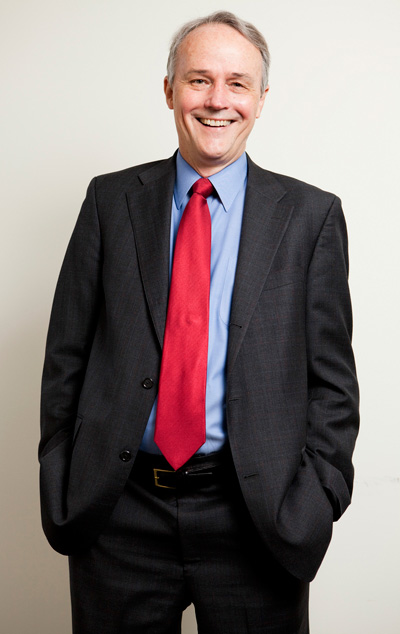
David Beckmann, president of Bread for the World, is a winner of the 2010 World Food Prize. (photo credit: Bread for the World)
Speakers like Raikes, Annan, Gregory Page (CEO of Cargill), and David Beckmann (president of Bread for the World) filled the forum with challenging ideas. This was a gathering not of idealistic, bleeding-heart liberals, but of civil servants, scientists, and business leaders. While we appreciated Gandhi’s reminder that “Nature provides for everyone’s need but not everyone’s greed,” no one questioned the fundamentals of capitalism. Market wisdom like “Predictable pricing gives small farmers courage to invest,” “Agriculture and affluence must grow together,” “You can’t eat potential,” and “Real opportunity to feed the world lies in supporting work of small and family farms” was embraced. Jo Luck (president of Heifer International) took Borlaug’s last words one step further, encouraging all of us to “Listen to the farmer.”
Along with powerful leaders, I also met heroic and inspirational pew-sitters and soccer moms like Elaine VanCleave ‘ an avid supporter of Bread for the World from Alabama. Elaine was moved to help hungry people in Africa. She personally met with her US representative, Spencer Bachus, a Republican who prides himself on his conservatism. He admittedly had never given Third World debt and its consequences on hungry people much thought. Bread for the World simply can’t motor legislation to help hungry people without bipartisan support. For debt relief to even get to first base, it needed the support of Bachus, who chairs a key committee. Elaine mobilized her neighbors, and together they educated Bachus.
Congressman Bachus eventually did more than just say OK. He enthusiastically embraced the cause, helping spearhead a multi-billion-dollar debt relief bill that gave the world’s most heavily indebted nations a chance to rise out of poverty. The human benefits of this are mind-blowing; literally millions of poor Africans now have schools, clinics, and seeds with money that would have otherwise gone to the First World for interest payments on debt. Elaine demonstrated how legislators care, how they sometimes just need to be educated on this issue, and how fighting hunger is neither liberal nor conservative. It’s simply the right thing to do in a world where there’s plenty of food ‘ and issues of buying-power and distribution are all that stand between a billion people and freedom from hunger.
When I hear people talk endlessly about “tough economic times in America,” I try to keep things in perspective. By any measure but our own, we are a wealthy nation. Our challenge is a smart distribution of our national wealth. The reality is that in the developing world, a billion people have no food security ‘ families are struggling to live on $1 a day. If your family is living on $1 a day, 70 percent of your family budget is spent on grain. There’s little concern for meat or fruit or vegetables or dessert. You need enough grain to stay alive. And when the cost of grain suddenly goes up 50 percent…that’s a crisis.
The climax of the World Food Prize festivities was under the dome of the grand Iowa State Capitol. As we arrived, a high school band snapped to attention and then played fortissimo on the capitol steps. A red carpet led through security into the legislative chamber, where the governor of Iowa welcomed senators, representatives, World Food Prize laureates, and this year’s prizewinners. Sitting between Lutheran bishops and “excellencies” such as the agriculture ministers of Burkina Faso and Pakistan, I felt like I was at a coronation.
In addition to David Beckmann, the other laureate this year is Jo Luck, president of Heifer International. Under her creative leadership, the group provides livestock, seeds, and training to extremely poor families so that they have better nutrition and can start a small business. (To learn more about David Beckmann and Jo Luck, watch this video.)
While Heifer International provides direct aid, Bread for the World is a new type of honoree. This is the first time the leader of an advocacy group has been given this prize. Advocacy, as explained in David’s new book Exodus from Hunger (www.exodusfromhunger.org), is channeling energy to change government policy for a cause ‘ rather than dealing directly with the cause. In his book, he explains how all private US aid for the world’s hungry amounts to just six percent of our governmental aid. So a drop in governmental aid of just six percent negates all the good generated by those hard-earned and well-meaning charitable contributions. Conversely, an increase in governmental aid of just six percent doubles our nation’s philanthropic will. (A common misperception among the American electorate is that we are more generous with foreign aid than we actually are. Less than one percent of our national budget goes to developmental aid.)
I appreciate Bread for the World because it has taught me the economics of hunger and structural poverty. With all my travel experience, I’ve gained empathy for the struggles of people in developing nations, but my concern used to be confused and directionless. Understanding the basics of structural poverty put my compassion into clear focus. I believe the vast majority of Americans (whether regular citizens or politicians) are good and caring people, but we often need help when it comes to putting hunger in perspective. And when it comes to the needs of the desperately poor, we can’t let overblown threats to our own security and well-being hijack our compassion.
David’s acceptance speech was inspiring. He concluded, in a soft voice that filled that grand hall, with powerful challenge: We need to change the politics of hunger. In the privacy of the voting booth, we should vote not for our economic self-interest, but for candidates who will help the hungry.
This was a great travel experience, and anyone is welcome to attend. Going to Des Moines to celebrate World Food Day, and be inspired by people who have committed their lives to feeding the world’s poor, is something that’s affordable. If you can afford a trip to Disneyland, you can afford this experience ‘ you just need to be interested. Next year on or near World Food Day (Oct. 16), Des Moines will host the 25th annual World Food Prize Award Ceremony and the Borlaug International Symposium.
While sorghum and wheat rust are not things I tend to think about, being with a thousand people dedicating their lives to fighting hunger gave me inspiration. Flying home, I was plunged back into a world of video games, People magazine, football fans, and regular Americans with fears and real personal struggles. And, as hoped for three days ago when I landed at Des Moines’ tidy little airport, I flew home a different person.
I was recently asked about my top-ten things to see or do in Europe. I thought I’d share them with my blog and Facebook friends:
1. Hang out on the cliffs (literally) on the West Coast of Ireland where they say, “Ahh, the next parish over is Boston.”
2. Be all alone in the Pantheon early or late in the day in the building that ‘ more than any other ‘ gives us a feeling for the magnificence of splendor of Rome at its zenith.
3. Play backgammon in a rough-and-tumble Istanbul suburb with handmade dice on a board with softer wood worn below the harder wood, while I’m surrounded by whiskered tea drinkers as curious about me as I am about them.
4. Sit outside the stout walls of Dubrovnik in a rustic bar sipping a local beer while cruise ships sail into the sunset.
5. Be on St. Mark’s Square late in the evening when the orchestra seems to be playing just for fun, and only the locals and hard-core romantics remain.
6. Stand atop the new glass dome of Berlin’s Reichstag and get teary-eyed with Berliners so excited that their city is one again and that Germany is looking, together, into a promising future.
7. Canoe down the Dordogne River in France under imposing castles working up an appetite for foie gras, fine cheese, and full-bodied red wine.
8. Stand atop the Rock of Gibraltar looking out at Morocco and consider the strategic importance of a fort here effectively bottling up the Mediterranean in the old days.
9. Sit on the bench with Daniel Roth, Europe’s greatest living pipe organist, as he plays Europe’s greatest pipe organ in St. Sulpice Cathedral in Paris.
10. Hike on a ridge high in Switzerland’s Alps ‘ literally tight-roping on it for three hours ‘ with lakes on one side stretching all the way to Germany and the ultimate mountain view on the other with the Eiger, Monch, and Jungfrau cutting like glass into the blue sky as the long legato tones of an alphorn in the distance announce that the helicopter-stocked mountain hut is open, it’s just around the corner…and the coffee schnapps is on.
These little things remind me why I continue to enjoy Europe so much. How about you?