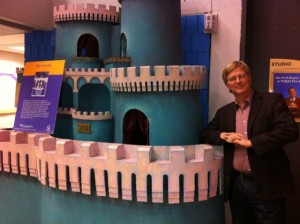
At the Pittsburg TV station, where Mr. Rogers was produced, a castle was in the hall — a dusty painted cardboard bit of public television history.
I’m on a six-cities-in-six-days public television pledge tour (LA, Chicago, Pittsburgh, Washington DC, Tampa, Seattle), and having a great trip. It’s that season when public television has to beg people to help pay for it (since there is no advertising). While this pledge business annoys viewers and is lot of work for stations and me, it’s the only way to keep a non-commercial alternative to all the other stations on the air. (In Europe, they just levy a small tax on anyone with a TV in order to have a media source that’s not advertiser-driven.) No station likes to interrupt programming with this, but it’s the only way anyone’s found to coax viewers into helping support it.
While traveling the USA during March and December pledge seasons is a major chore and investment of time for me, it gives my work very good exposure and over the last 15 years, I’ve come to enjoy it. Here are a few behind-the-scenes insights into the great American pledge drive:
Just like local stations reflect their demographics with their choice of programming, a station’s pledge style mirrors its neighborhood. New York is the only place to put make-up on my hands as well as my face ‘ just so everything matches. LA is hyper-produced, complete with movie-announcer voices for the “roll-ins.” Texas stations are proud of their BBQ dinners for volunteers. Only Chicago raffles off a free Europe tour. Florida is the only place where I’m met at the airport by a big, white gangster limo. In some cities, you make sure to heed the local ethnicities. In others, you pay homage to the beloved local sports team. (Show a lack of respect for college basketball in North Carolina…and you’re pledge toast.)
While some stations have beautiful talent and painstakingly produced breaks, others just let it rip with a well-worn station manager on camera with me, no make-up artist fussing with hair and powder for “shine” between breaks, and no teleprompter. After all these years, I see no correlation between money-raising success and carefully planned production. And I see a near-perfect correlation (with some notable exceptions) between good-looking talent and airiness. While I’m generally working with great talent, I’m often impressed by how mindless many of the best-looking on-camera co-hosts can be. It seems embarrassing…but then I wonder if the audience even notices.
I love working with people who can speak from the heart with eloquence (most commonly the frumpy-looking co-hosts). No matter how carefully written the teleprompter copy is, if a good talker who understands the mission and value of public television is set loose without reading the message, that’s the best.
Traditionally, stations periodically run a nice clip of related images without a voice track, to give viewers time to call in (dubbed “music to pledge by”). But luckily, I have my own film-production crew, so we can produce little one-minute “roll-ins” showcasing the most important gifts we offer people supporting public television. These give the hosts a break while constructively filling up otherwise wasted air, and allow us to highlight enticing give-aways.
Watching at home, most viewers don’t realize that the hosts peering into the camera are actually looking at words or images (projected onto a transparent sheet of glass). Rather than a teleprompter scrolling by on the camera, I always want what’s called a “line feed” into the camera ‘ so I can look straight at the camera and see exactly what people are seeing at home. That way I can hold up gifts and see if the lights are causing a glare or if the 800 number is blocking the view. Anything shrink-wrapped (like a DVD set) will glare, so I’m careful to take that off for better show-‘n-tell. With a line feed, when the director cuts away momentarily to a still shot showing the gifts, I can mess with my hair or glance at my notes. I learned my pledge pitch tricks by watching televangelist Benny Hinn, who’s notoriously effective in getting people to give money to his ministry. I’d swear he’s looking into his own eyes (via a line feed into his camera) as he asks for your soul and a little money.
When I drop by, my reputation precedes me. Somehow the word got out that I like bananas and orange juice, which are often waiting for me in the green room. Public television stations’ budgets are so tight that green rooms generally have a very old, clunky TV. Green rooms are really important for on-camera talent to rest and gather their thoughts. While I’ve never said this before, I hate mindless chat in green rooms. I want to watch the show that’s airing and get something intelligent loaded up to say during the upcoming intermission. One of my pet peeves is make-up artists who seem to just inhabit the green room as if it’s their place to hang out and chat on the phone. (Some stations employ a make-up artist. Others just let a multi-tasking pledge producer slap on some powder. Others don’t even bother.)
By the way, “PBS” is generally a misnomer. It’s “public television,” and PBS is just the biggest provider of content. My series is not a PBS show, but an APT (American Public Television) show.
Each season, there’s generally a blockbuster pledge special ‘ often some lifestyle guru, or a new version of an old music extravaganza (Three Tenors, Riverdance, and so on). While attention-grabbing, these aren’t particularly representative of what public television is about. The stations wish their core programming would resonate with viewers during pledge time, but it rarely does. Many stations have no choice but to “hold their nose” as they take the money generated by a blockbuster show that’s not core public television programming.
My show is a happy exception ‘ a regular line-up program that also works well during pledge time. This season, with a fresh and hard hit on “mission” (explaining why public television is worth supporting), and with the debut of a dozen new shows, my programs are among the top moneymakers for the system. Part of our pledge success is because when I pitch, I really believe in the value of an alternative to commercial TV, and that sincerity comes across.
(I was just watching a commercial news station sharing a segment with an “industry expert” on dropping the “junk food tax.” He was claiming orange juice is no healthier than Coca-Cola, and that schools might as well sell junk food in vending machines because the kids will get it across the street anyway. The cute anchorwoman kept lobbing him softball lines and nodding in agreement. This was clearly programming in tune with advertiser needs that very few viewers would find problematic. And this just stoked my passion for having a non-commercial alternative on the dial.)
Our show also works well because it comes with logical gifts that relate to the program and have a high perceived value. Stations try to keep a multiplier of ten to one. That means the gifts they offer at any level should cost them around a tenth of the money they are raising (for example, a DVD gift for a $60 contribution should cost the station $6). That’s a challenge. I need to make some money providing the gifts, the station needs a huge mark-up, and viewers need a good value, too. Some stations are more aggressive at “merchandizing” to motor giving than others. But others are concerned that they are creating a public that is addicted to ever-more-generous gift packages, and will forget that they are supporting community broadcasting with a donation…not buying books or DVDs.
It’s fun to evolve in my fundraising partnership with public television. They needed a half-hour event to fill the gaps left by the many 90-minute specials, so the next show can start on the top of the hour. So last year, I produced a half-hour European Insights special. It was the most widely aired and repeated show of 2010.
I used to visit 30 stations annually, which meant I spent a month each year on the road. Now I’ve cut that in half, spend only two weeks traveling for pledge, and produce two “virtual” pledge specials a year that are generic (with spaces left open for local call letters and phone numbers) and available to the entire system. This way, literally hundreds of stations can run our special. This month I’m producing two specials ‘ a two-hour Spain program called Viva España and a new half-hour show called Europe with Abandon ‘ which will feed in late February.
Small stations really appreciate an in-person visit, and when I come by, they are careful to produce a travel special that is “evergreen” ‘ with no reference to the date, season, weather, and so on. This way it can be rerun several times.
On this trip, I’ve enjoyed reminding people that because times are tough, we need to have strong public media. Since the complicated challenges confronting our nation are unprecedented, we need media that peddles understanding rather than fear, and that smartens us up rather than dumbs us down. And I’ve enjoyed the pledge-host exhilaration of making a strong pitch, turning around, and seeing the phone banks light up, becoming inundated with calls. Then I look at the excited producer pulling his hands apart, indicating “stretch,” and the break lasts a few extra minutes more than planned as membership grows. I’ve visited public television stations in well over half our states in the last decade, and I am inspired by the idealism, talent, and commitment of their hardscrabble staffs. And I’m thankful that we have a place on the dial where shows like mine ‘ that respect your intelligence, assume an attention span, and are not shaped by advertiser needs ‘ can thrive.
If you understand that and are a supporting member of your local public television station, congratulations ‘ and thanks a lot.