The Return to El Salvador: Updating Travel as a Political Act

When I wrote my Travel as a Political Act book a couple of years ago, I included a chapter on El Salvador. Realizing that things here have changed substantially in just that short time, I needed to be sure my impressions were still valid. So I sat down with our guide, Cesar Acevedo, and Professor Knut Walter from the University of Central America. Cesar is a soft-spoken Salvadoran who fled the war with his family, grew up in Alberta, Canada, and came home 15 years ago when peace arrived. Professor Walter is a stony and sage Norwegian who’s spent most of his long adulthood here, and feels like a font of unemotional wisdom as he observes the scene. Below are a few updates I gleaned from the conversation (which will be of particular interest if you’ve read that chapter of my book).

El Salvador’s recent history is even more tumultuous than Nicaragua’s: It begins with a long tradition of right-wing military governments who brutally repressed campesinos. Through the 1980s, the leftist FMLN guerilla insurgency threatened to take power (opposed by the US government, which spent $1 million a day to keep the pro-business ARENA party in power). These two forces met in a bloody civil war. With the peace accords to end that war, the FMLN traded in their weapons for a place at the governmental table, and today they are the ruling party. Only by offering up a less political candidate for president ‘ Mauricio Funes, who is known more as a journalist and a writer than as a politician ‘ could the former guerillas win a slim majority to take the presidency in 2009. Today the FMLN seems to respect the democratic process and the country, exhausted by extremism, feels determined to be peacefully pluralistic.

Mind the Gap
When a society fails to mind the gap, you have armed guards welcoming you at shops, hotels, and finer residential neighborhoods. (Photo by Trish Feaster)

In the last decade, extreme poverty in El Salvador has declined significantly. And yet, the FMLN seems to accept democracy, capitalism, and a globalized world. Professor Walter said, “Consider my breakfast: I eat oatmeal from Nicaragua, powdered milk from Australia, my fruit is from Guatemala…and the coffee is from El Salvador. Importing coffee to El Salvador would be like carrying coals to Newcastle.”

On the global scene, El Salvador has been dealt some miserable cards. There’s just no way it can compete. El Salvador is one of the few countries that consumes more than it produces ‘ possible only because of remittances: Twenty percent of its economy is money wired home from loved ones doing mostly menial labor in the USA. Salvadoran cell phone contracts allow calls to the USA cheaper than local calls. Soil, rain, and air ‘ plus people ‘ are the only natural resources this country has. Half of El Salvador’s university students aspire to leave the country. They see higher education as their ticket out.

I always thought land reform was a driving issue of economic justice in Central America. Walter explained that, until this generation, land struggles were, indeed, a critical issue. But no longer. The post-civil war government gave land to soldiers in trade for disarming. Landowning soldiers simply sold their land. These days, people don’t want to work the land. They want an education and to get big-city jobs ‘ or to emigrate to a land with more opportunity. Labor is decapitated. There are no real strikes today. You couldn’t rally labor to support another war.
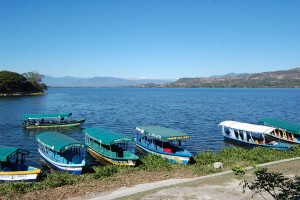
Tourist Lake
El Salvador…never a tourist crowd.

The export of young men to the USA to fill low-end jobs there and to send home money is promoted by El Salvador’s government. In Central America, the two countries with the closest economic ties to the USA are Costa Rica and El Salvador. Both get their money from the USA ‘ Costa Rica welcomes tourists, while El Salvador exports its labor…and its problems. Passports are issued fast and easy. The government basically is saying, if you’re not happy here and want to leave, fine. Here’s a passport. Now go. And, while immigrants send home lots of money, the resulting broken families ‘ poor single mothers trying to raise children alone ‘ leaves a society ripe for the growth of street gangs.

Walter lamented how, because the government has allowed the rape of its land, there will never be a real tourist industry in El Salvador. The government here has long been business-friendly ‘ allowing corporations to operate with almost no regulations. Because of this unbridled capitalism, El Salvador has little real outdoors to enjoy or use as a basis for growing tourism. Its rivers are polluted. Just to the south, Costa Rica has a marketable environment because its government shielded it from corporate abuse. Because of its natural charms, tourism thrives in Costa Rica today.

Politically, it’s easy to be the guerilla opposition and just complain. But now that the FMLN is actually in power, they must actually grapple with big challenges. Its priorities ‘ which seem to be accepted by all but the wealthy ‘ are: improve education and health care; deal with violence; and reform the tax codes so favorable to the rich.

Taxation is a hot-button issue among El Salvador’s wealthy, just as it is among American conservatives. El Salvador’s current tax code is a remnant of its past right-wing governments. Its main tax is a sales tax. (Sales taxes are the most regressive, and therefore favor the wealthy.) The maximum income tax is 25 percent, with loopholes for the business class. There is no property tax and no inheritance tax. Revamping this regressive tax code ‘ part of the country’s ARENA party heritage ‘ is one of the primary challenges of the current FMLN government.

I love how travel to developing ‘ or unraveling ‘ countries lets me see the problems confronting my own country in high contrast. I travel to places like El Salvador not just to try to better understand our world, but also to see where my own country is heading if we don’t smartly tackle problems confronting us. For example, in this petri dish of unbridled capitalism, I see the power of corporate ads, environmental damage as the downside of fewer regulations, and the consequences of paying down debt by squeezing health and education.

Walter considered El Salvador’s bloody civil war the growing pains of democracy. After lots of tumult and bloodshed, there is now a basis for democracy like never before. There are new political institutions. This fits my belief that different societies (whether Iran, China, El Salvador, or the USA) are on parallel evolutionary tracks. Absent naive and impatient external forces, if left to their own, societies develop in a way that is good for their people. (As we capitalists believe in the invisible hand of the marketplace, I see this as the invisible hand of the political arena.) El Salvador, along with the rest of Central America, is evolving. Their fragile democracies are maturing. The successful revolutions in El Salvador and Nicaragua have morphed into pragmatic and moderately corrupt political parties. The brutality of earlier strongman governments is a thing of the past. There is a respect for the political process and hope for progress without more armed resistance.
San Salvador Lip-Sync

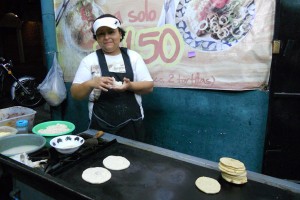
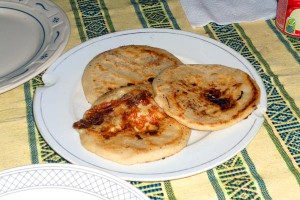
You can’t really know how good the savory filled pancakes called pupusas are until you eat them in their homeland, El Salvador. Tired but not wanting to eat in our big, fancy hotel, we walked just down the street to a humble pupuseria. We enjoyed watching the thick, handmade corn-masa tortillas on the griddle. We chose from various ingredients ‘ including cheese, beans, pork, and squash ‘ and had a delightful dinner with a fun local crowd. We closed the place down, and when the bill came, it was about $5 for both of us. This simple and very local meal made me happy, and with a great day of Central American experiences under my belt (along with those pupusas) ‘ and Carole King on the soundtrack ‘ I just couldn’t contain myself.

Woman grilling up our pupusas. (Photo by Patricia Feaster)

Pupusas are thick, hand-made corn masa tortillas filled with various ingredients like cheese, beans, pork, or squash. (Photo by Patricia Feaster)

Can’t see the video below? Watch it on YouTube.

El Salvador: Really, Why Are You Here?

As I land in El Salvador, the difference between this country and Nicaragua is immediately clear. El Salvador, while pretty poor, is a relative powerhouse. The airport is like a mall, and posters work to make visitors feel welcome. But at customs, when the man asks us why we’re here, we say, “Tourism.” He has a hard time believing us. He keeps asking, “No, really ‘ why are you here?”

Not a pretty city.

In the security of a fancy hotel, hammock and fans seem to make a smiley face that says, "everything's just fine."

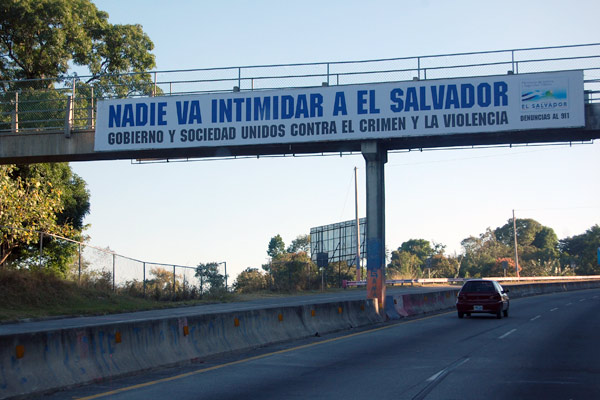
Billboards throughout San Salvador proclaim, "Nothing will intimidate El Salvador. Government and society united against crime and violence."

While petty thieves were the concern in Managua, El Salvador has become notorious for its gangs, inspired by their bloody brothers in Los Angeles. People at home expressed concern when I told them I was El Salvador-bound. I laughed off their concerns. But now that I’m here, I’m no longer so confident about my safety.

At the airport, we choose a car from the taxi company our hotel said was safe. We’re already on edge. Then, when the car won’t start, suddenly four men begin shifting us and our luggage to another car. We feel swept up in a commotion out of our control. Our hearts are pumping as we find ourselves being driven into the darkness by a man whose face we haven’t seen.

Fortunately, it turns out that our driver is a philosopher cabbie, who fills the 40-minute ride into San Salvador with a wonderful discussion. As we sense is the general sentiment in Nicaragua, our cabbie says that Salvadorans came out of their civil war understanding that everyone needs to get along and accept that political ideas will differ. He says that he doesn’t want to complicate an already-complicated world. He just strives to accept his class in life and enjoy what he has. He’s simply happy to see the sun go down each day, thankful to have a place to sleep, and thankful to see the blessing of each day’s sun rise. I ask if he’s satisfied with the new government (led by the FMLN, the former leftist guerilla group). He says, “Well, everyone has their point of view, but this one is more transparent, and people are benefitting.” About the fear: He knows there are gangs and lots of killings in San Salvador, but in eleven years of driving his taxi, he’s never witnessed a violent crime.

Our hotel is the Sheraton ‘ a tower of comfort and an island of security in this troubled city. After checking in, we wander over to the pool, where a hammock slung under two fans seems to make a smiley face, and a sign assures us this is a safe area. Guidebooks, signs, armed guards, hotel concierges, and memories of loved ones at home worried for our safety ‘ all the warnings conspire to keep us on edge. And we are on edge. Are we overreacting? I’ll never know.

As we drive out of our hotel and into the harsh urban scene, we see a big banner proclaiming, “Nothing will intimidate El Salvador: government and society united against crime and violence.” A few blocks later, a big billboard features a Superman-type character pulling open his shirt to reveal the same determined message.

Apart from that government message, there are ads on banners and billboards everywhere. Driving down main roads, you feel as if you’re in a tunnel of advertising ‘ not just billboards, but banners that stretch over the highway. If a billboard is unrented, its giant phone number fills the space. Even in the countryside, town centers are dominated by big Christmas trees put up by the dominant cell phone provider ‘ making one big tree-shaped ad.

Noting how the country seems covered by advertisements, we are told that this society spends nearly as much on advertising ($500 million) as it does on education ($700 million). Some believe that when a poor society is inundated with ads, the populace becomes frustrated ‘ unable to buy things they never knew they needed. Communism famously tried to control minds with its propaganda, but history has proven that communism was ultimately lousy at marketing. Capitalism, on the other hand, knows how to market. But a material appetite that can’t be satisfied, combined with broken families caused by immigration by the most able-bodied to the USA, leaves a country ripe for gangs. And that’s the biggest news in El Salvador: gangs and the violence that comes with them.

The Indigenous Potter

Driving an hour outside of Managua, we visit the town of San Juan de Oriente, where 90 percent of the people are indigenous (of native rather than European descent), and the economy is based on pottery. We meet Valentín López, who is passionate about keeping the pre-Colombian local art alive in his craft. As we sit in his workshop, he dances while his son plays the marimba (a xylophone-like wooden instrument favored among indigenous Nicaraguans). And as he dances, he explains the connection of their craft to their indigenous past.

Potter
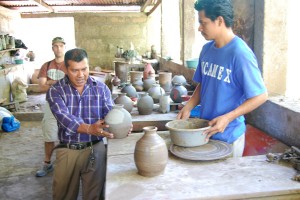
Valentín López and his son help keep an ancient indigenous craft alive.

Then we gather around the wheel and he demonstrates the traditional way pottery is made, painted, and burnished. It’s all organic: clay pounded by bare feet, brushes made of a woman’s hair, and giant seeds as burnishers. As his son kick-starts the potter’s wheel, Valentín notes there is no electricity involved ‘ “The gas is rice and beans.” When the boy quickly gets the wheel really ramped up with his muscular leg, he adds, “This town produces very good soccer players.” A recurring theme of his demonstration is how the indigenous potters are in tune with nature. In the US, a potter orders clay on the phone. Here, they hike to the clay pit and gather it themselves.

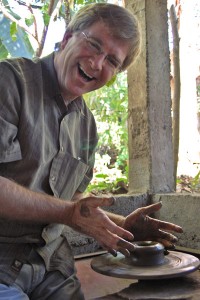
The chance for the tourist to be humiliated follows, and I jump at the opportunity. Climbing into the potter’s chair is like saddling a strange animal. I push the heavy stone wheel with my feet. It’s awkward. With images of Fred Flintstone trying to start his car, I struggle to get it going. My foot nearly gets pinched and dragged by the rough wheel under the brace of the table ‘ which would make me probably the first person to lose a leg to a potter’s wheel.

The potter’s son helps me get the wheel turning with a full head of steam, and then slams a blob of clay onto my spinning work table. I cup it, and it wobbles. He shows me how to be gentle with the clay. As he trickles on some water and guides my fingers and thumbs, the clay comes to life. But my creation is still a clumsy little baby…eventually made elegant, effortlessly, by my teenage teacher.

Giving pottery a spin.

Glancing down the row of eight stations like the one I’m sitting at, all under the shade of a corrugated tin roof, I imagine this cottage industry in full swing. And I appreciate the timelessness of the technology. While the advent of plastic must have done to pottery what the advent of cars did to blacksmithing, indigenous people want vessels that are of the earth, made by hand, and ornamented with the iconography of their ancestors. And, as long as there are indigenous people ‘ even if there are no tourists seeking souvenirs ‘ there will be potters in Latin America.

There’s an indigenous pride throughout Latin America. And, although decimated by European colonialism, the indigenous people of Latin America play a bigger role in contemporary society than Native Americans do in the USA.

The struggles of the indigenous people are an important theme in the political discussion in Latin America today. They are the ones discriminated against in schools, the work force, in the judicial system, and so on. If a Mestizo (mixed-race Latin American) loses his temper or does something violent, rather than say, “The devil made me do it,” he’ll say, “Se me salió el indio” (The Indian just came out of me.) Throughout much of Latin America, to call someone indigenous is an insult. For any indigenous person, a visit to Bolivia or Guatemala ‘ the only two predominantly indigenous countries left ‘ is how they can go back in time.

While indigenous people have distinct languages and cultures, their spiritual outlook is basically the same ‘ from the wilderness of Canada to the southern tip of the hemisphere. While it seems they have embraced Catholicism vigorously, I’ve heard the word “synchronism” repeatedly. The traditional spirituality survives to this day as many indigenous Christians routinely weave pre-Christian customs into their modern religion.

Unfortunately, in most of Latin America, it is the brown people who end up living with discrimination and are destined to live in poverty. I grew up fascinated by Pancho Villa, but always considered him a Mexican bandit. Indigenous Latin Americans refer to him as a hero who stood up against white dominance. As long as indigenous Latin Americans are kept down, my hunch is that the headlines will be filled with the Pancho Villas of the 21st century as they stand up for their rights in an aggressive and often uncompromising modern world.

As I watch Valentín and his son turn, polish, and bake their pottery with a spiritual connection to their ancestors much healthier than the connection I enjoy to my ancestors, I gain a new respect for the strength of indigenous culture in our hemisphere.

Coffee with Maria

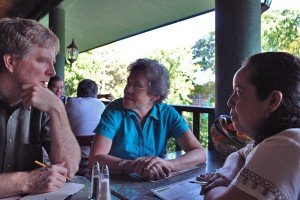
To balance our conversation, we went from poor, maternal head-of-household (Señora Nicaragua) to longtime activist/publisher. We had coffee with María López Vigil, a former nun and now editor of Envío (the monthly magazine of political and economic analysis on Nicaragua, published by the University of Central America). Here are a few insights from our conversation:

Getting up-to-date on Nicaragua with María López Vigil. (Photo by Trish Feaster)

The birth of Liberation Theology as a political power came out of the 1968 gathering of Latin American Catholic Church leaders in Medellín, Colombia. It established a radical doctrine with three key points: 1. Structural poverty is sinful; 2. Violent response to that is just, for the sake of dignity which God intended for all people; 3. God is not neutral ‘ God is on the side of the poor. Medellín (meh-deh-YEEN) empowered peasants throughout Latin America. In El Salvador, where this brand of Christianity was particularly strong, campesinos kept saying, “We follow Medellín” ‘ which caused the befuddled National Guard to look for a person named Medellín.

The revolution used Liberation Theology to stand up against John Paul II, who opposed using religious fervor to win economic justice. Liberation Theology came naturally for Latin America because it’s poor and the only continent with a majority of Catholics. When the Sandinistas won power, the wind went out of the Liberation Theology sails. But its basic message remains embraced by the people: The Church should be about justice, not rituals.

María affirmed the feeling I picked up from others in Nicaragua that today it seems, in general, the Church has lost the revolutionary fervor. Once-activist Christians are spent. They have accepted peace without as much justice as they once demanded. The Mother Teresa approach to things ‘ that a Christian is charitable and helps the poor ‘ has surpassed the Archbishop Oscar Romero approach, which fights for economic justice, asks why there is hunger and desperation in a world of plenty, and organizes the poor. During the revolutionary days, the big question was not, “What’s his political party?” It was, “Is he organized?”

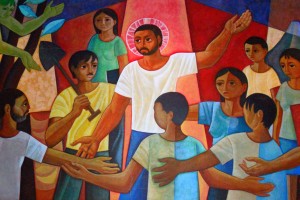
Jesus with an empathy for the working class.

I asked María about globalization, and she said locals seem to accept it like they do the weather. Not liking it is futile and makes no sense. You just have to live with it. In globalization, there are no frontiers or borders for the flow of money ‘ but there are borders for flow of people. This is the crux of why globalization is tough on the poor. María pointed out that there is plenty good about globalization. Ideas have no borders now. That means, for example, women can see examples where women in other cultures have rights. She said globalization ‘ which inspires, motivates, and generates hard questions ‘ has been good for women.

I am particularly interested in the cost of debt relief for the world’s poorest countries. Banks in the rich world don’t just forgive debt to poor countries. They exact a price. According to María, neoliberal structural adjustment exacted on Nicaragua in return for some debt relief has been disastrous on her society. In return for debt relief, health and education were cut back and privatized. (It seems interesting that health care and education will take a hit as the USA attempts to tackle its own debt problems.) María said it was believed that the private sector would better manage health and education ‘ but in reality, in the transition from government to corporation, it just went from one monopoly to another.

When asked what one thing might be fundamental to Nicaragua’s economic success, María said, “Education.” Education is like planting seeds. When done right, the fruit will just keep on coming.