Greece in Economic Crisis and Your Travel Dreams


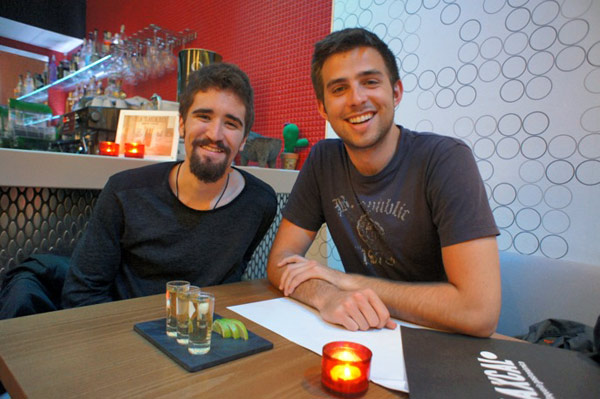
Rick Steves checking out the impact of the economic crisis in Greece

With all the news about Greece’s economic problems, people are wondering whether it’s a good time to go there or not. I’ve surveyed my Tour Department and our Greek guides who live and work in Greece, and here’s my report.

We’re running our Athens and the Heart of Greece tours this year as normal (the next tour, going out in a couple of weeks, is full with 23 on board). While Greece tour sales are slow (9 tours in 2012 compared with 14 tours in 2011) and we’re not adding extra departures, we expect each of our tours to go full this year. My guides report that our Greece tours so far this spring have been as smooth and fun as ever — virtually unaffected by the local political and economic events

The big concern among the hotels and restaurants we use in Greece is whether they’ll be able to survive the downturn in tourism as many postpone their travels there, fearing “instability.” And many sights are running on their shorter winter schedules for lack of money to staff the longer summer hours.

People wonder about Greece and the euro. At a recent foreign currency seminar, we were told that if Greece pulls out of the Eurozone and reverts to the drachma, it wouldn’t happen overnight but take place over about a six-month transition. Greece’s parliamentary elections — the results of which will determine the currency direction — are on June 17. If Greeks opt to abandon the euro and go back to the drachma, foreign travelers to Greece should encounter no difficulty using euros at least through the end of 2012. Whenever and wherever I travel, I pack along a few hundred dollars of hard cash in case of a temporary closure of banks or ATMs. I’d advise that when travelling in Greece (or anywhere else).

I’ve reviewed surveys from tour members who completed our Athens and the Heart of Greece tours in the last month. Here are some comments directly from these travelers about the reception they received in Greece and the impact of the economic problems there on their travels:

“We had some reservations about taking our tour to Greece because of the economy and recent rioting there. But while there, we found the people to be so gracious and thankful that we were visiting there and helping them with our dollars in their time of need. Please don’t hesitate to go there! Americans are all about helping others, and the citizens there have all taken a huge financial hit. What better way to make an impact than by contributing to their economy while visiting a beautiful country, enjoying wonderful food, and seeing ancient history.”

“The news media is, perhaps, causing people to remove Greece as a possible destination. After taking our Greece tour, I believe this is a mistake. I hope ETBD helps to encourage a visit to this lovely country. The people are friendly and generous. Sites are accessible, English is spoken well and readily. We had a great time.”

“I felt safe and welcomed among the Greek people. A couple of tour days were very vigorous, but they needed to be in order to see the sites and associated museums. It would have been nice to have more time at some of the ruins, but the Greek government was only keeping them open until 3 p.m. due to budget cutbacks so there was nothing our tour guides could do to alter that situation.”

“After taking our tour, we think this was a great time to visit Greece. The hospitality of the people we met was great, we felt very well taken care of, and our business was certainly appreciated.”

“Greece needs visitors. Sure, we were a little uncertain about going given what the international media has reported on the economic situation. But we found that, other than that one little Metro slowdown in Athens, our tour was perfect. Everyone was gracious and the country is spectacular.”

One of our guides sent me this note from Athens:

Hi Rick. I was asked to send you a few thoughts about Greece. First and foremost, Greece is a safe place to visit. In fact, it’s a good time to visit because you will be made especially welcome. Tourism is Greece’s heavy industry and its leading employer.

It seems to me that US media coverage of Greece has been nothing less than hysterical — just plain silly at times, and woefully lacking in analysis. Greeks are emotional people, and they are given to outbursts of anger — as well as outbursts of joy. Their bad governments in recent times have given them plenty of reasons to be angry. The scenes in Syntagma, the big square immediately in front of the Greek parliament building, are a symptom of this — and act as a release valve. These scenes occur only when the parliament is voting on the hated austerity measures. When you see riots on TV, they are generally the work of a group of anarchists who are limited to Syntagma and know how to get on the news.

The big debate politically is austerity (from the right) versus no austerity (from the left). Until this all sorts itself out, I would recommend that travelers do not wear “Angela Merkel” masks. Regardless of how the debate turns out, and who emerges as the new government, Greeks of all political stripes will take care of tourism, so vital to its struggling economy. The Greeks, a welcoming people at any time, will be doubly appreciative of any visitors in these difficult circumstances.

The main impact on travelers as Greece struggles through this period will be: shorter hours of sights; intermittent strikes; and friends and loved ones back home wondering if Americans traveling in Greece are okay. From my experience, they are more than okay…they are enjoying a wonderful vacation in a wonderful and more-welcoming-then-ever corner of Europe.
Keeping Young People Traveling, Writing, and Engaging with Our Wider World

I was just at the NAFSA: Association of International Educators convention in Houston — a gathering of 8,000 university administrators, teachers, and advisors who coordinate the foreign study industry in the USA (both for inbound foreigners, and for Americans going out to the rest of the world). I enjoyed the honor of giving a 90-minute plenary talk to a huge and packed auditorium, sharing my take on the importance and value of foreign study — now more than ever.

That experience — combined with my recent 20-cities-in-20-days road trip, and my upcoming commencement address at the Evergreen State College in Olympia, Washington — has connected me with the excitement of exposing the next generation to the wonders, complexities, and challenges of our world firsthand.

One thing I always encourage young travelers to do is to keep a journal. Along with writing countless postcards (which were ultimately gathered together to make running accounts of my early travels), I diligently filled “empty books” with 200 pages of tiny handwriting from  each of my first ten adventures in Europe and Asia. Of course, these days, kids blog. My kids, Andy and Jackie, have each enjoyed blogging, as has my niece, Nicolina, on her recent street art mission in Brazil.

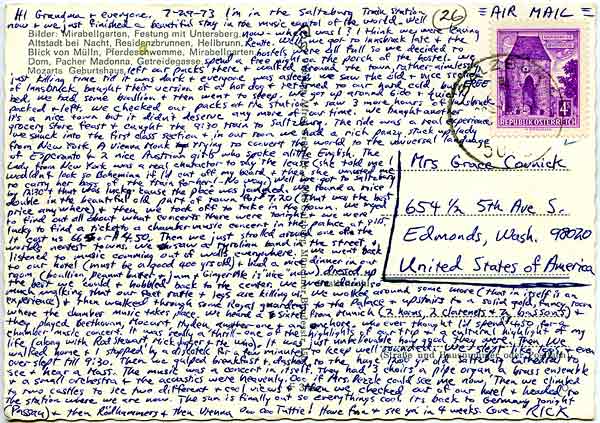
At age 18, I wrote this postcard to my grandmother from Salzburg. Austrian beer halls were filled with one-legged reminders of WWII, Franco ruled in Spain, it took about nine hours to travel from London to Paris, bars were filled with smoke, pizzerias were considered ethnic restaurants in northern Italy, a two-month Eurail pass cost about $200, travelers would gather at AmExCo offices to share information and collect mail from loved ones back home, and cell phones, euros, and ATMs were unknown. But the magic of European travel was the same then as it is today.

During my March lecture tour, I met John Paul Gairhan, a 15-year-old in Conway, Arkansas, who was excited to be planning his first European adventure. John just began his trip, and following his blog reminds me of the thrilling mix of fun, fear, and fantasy of my first trip at his age. I promised John if he shared an insider’s look at the thrill of a 15-year-old kid from Arkansas enjoying Europe for his first time, I’d send him lots of readers. So travel along with John on his blog.

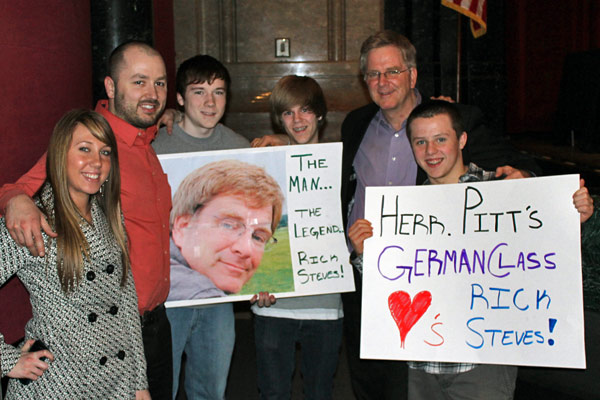
Another highlight of my lecture tour was in Omaha, where I was ambushed by an enthusiastic band of high-school German students. I just received this email from their teacher:

Hi Rick,

I’m the German teacher at Millard North High School you met here in Omaha.  I wanted to thank you again for all that you do.  When I was in college, your travel books and videos were an extremely positive influence on me and how I organized my trips to Europe.  More importantly, I was inspired by and followed your advice that wise travelers remove as many barriers as possible between themselves and the culture they came to visit.

Outside of the classroom, I don’t think there’s any better way to educate oneself but through travel.  I became a German teacher just in the past year and I do my best to teach my students not only an appreciation for other cultures but also a strong wanderlust.  I want them to see life as an adventure for which they must boldly write their own personal script.

Throughout the year, we’ve used your videos on Germany, Austria & Switzerland as a teaching tool.  In fact, you’ve achieved a quasi-cult status amongst my students. I invited my students to attend your lecture here last March and thirty showed up.  Although they were a bit raucous at times, you were kind enough to invite us all on stage for this photograph. Thanks again for coming to Omaha and speaking to our community.

Best Regards,

Jason Pitt and the German language students of Millard North High School

Backstage in Omaha in March, I met this gang of high-school German students, who have a lifetime of travel adventures ahead of them.

Andy Steves Gets His Dad Up-to-Date on Travel Skills

Andy and Diego
“This is my friend, Diego who I met through airbnb.com. I had a great time staying with him in his very comfortable apartment while in Barcelona. And at only 25 euros a night, a great value and great travel.”

I just spent a weekend at the NAFSA: National Association of Foreign Study Advisors convention in Houston with my son, Andy. I was actually working for Andy at his booth, and enjoyed seeing how, in two years, he has really established himself in the minds of university foreign study program advisors across the USA.

As Andy (with his Weekend Student Adventures business) is more hands-on with student and budget travel than I am these days (he lives out of hostels running his business from his laptop in Europe for half the year), I ran the script for my upcoming three-part series on travel skills by him. (I’ll be updating my ten-year-old travel skills shows this summer, for debut on public television this fall.)

I gave Andy my rough script, and he shared some great comments on how I can be more up-to-date and tuned in to the way younger people travel. Here are Andy’s suggestions:

Bikes: While there are many public bike rental systems across Europe that work very well for locals, often times they require “chip and PIN” debit cards, and even national social security numbers to set up an account. For this reason, it’s unlikely your American viewers will be able to get in on the great deal if only in town for two or three days. For instance, in Barcelona, you need to have a national ID card to subscribe to the service (€45/year), and then your rides are free for the first 30 minutes. Locals take longer jaunts by checking in and out at multiple stations along the way before the time goes over the limit.

Credit Cards vs. Debit Cards: Using a credit card almost always comes with a higher percentage transaction fee compared to a debit card — 5 percent compared to 2.5 percent or so. Keep in mind that your daily withdrawal limit is in US dollars, but you have to convert that to euros — they’re different!

Recreational Reading: When discussing how to prepare for your trip, make a point to include listening to podcasts, too. There are great podcasts about all sorts of topics related to your upcoming trip.

Car Rental: For a backpacker, renting a car is hardly ever the cheapest option for getting around. The daily fee may be enticing, but the inevitable extras make it far more expensive then you were led to believe. You’re paying for your independence through tolls, gas, and parking. Remember, Europe is dotted with automatic speed guns and cameras that will issue a ticket and track you down even across the pond. I got photographed speeding and got a $100 ticket with a $100 service charge added on by my rental company.

Estimating Metric: For rough conversion from kilometers to miles, two-thirds does it: 30 kph is 20 mph, 100 kph is 60 mph. For Celsius, room temp (71 degrees F) is 20 degrees C.

Internet and Phoning: Cybercafés are getting more and more dated. Most travelers use Wi-Fi devices — in either cafés or hostels. Smartphone users beware the huge fees when you roam. Before my plane takes off from the States, on my iPhone I switch “on” Airplane Mode, switch “off” Cellular Data, and switch “on” Wi-Fi. This prevents me from racking up hundreds in phone bills for data usage. “International data plan” options offered by your provider are hardly ever a good deal.

Communicating with Loved Ones Back Home:  Skype and FaceTime are key and cheap (or free). If you are both online and have iPhones, you can enjoy a FaceTime connection across the street or across the ocean for the same price — free. Otherwise, Skype is a good standby. In either case, the key is having a good Internet connection, as you have to be online.

Events: Take your trip to the next level by paying attention to and researching event schedules on the route you want to travel: sporting events, concerts, festivals, special exhibits, and other celebrations are invaluable experiences that will really make your trip unforgettable. Chasing down events that interest you help you connect with locals who share the same passion, whether it’s catching the Tour de France, or experiencing a special photography exhibit by your favorite photographer.

Beggars: Along with thieves, a common distraction technique is for young women to beg for you to sign a seemingly reasonable petition (like “against drugs”). These are just ways to distract you while their partners pick your pocket. Never stop for them.

Dress Code:  European adults generally don’t wear shorts, no matter how hot it gets. If blending in is a priority, bring your swimsuit, but leave the shorts at home.

Hosteling: References to IYHF (the International Youth Hostel Federation) are dated. People book hostels through Hostelworld.com. Hostel rooms are generally either mixed or female-only — no exclusively male dorms. CouchSurfing.com and Airbnb.com are both popular these days. I don’t think I’d ever follow a local who picks me up at a train station home. Airbnb.com is safer — you can agree on the price, cash never trades hands (it’s done automatically), and you can read reviews to make sure it’s what you’re looking for.

Free Walking Tours: While you don’t get a licensed guide, and your “guide” is generally an expat student who has memorized a script, these “free” tours can be a great value. They are advertised all over the place, provide little personal attention, and are often entertaining, but emphasize stories over the strictly academic. They’re known to take some liberties with historical events and characters. And they are based on tips. You will be hit up really hard for a tip. Still, I use them all the time and enjoy them.

Cheap Flights vs. Sleeping on the Train: People don’t sleep on the train like they did in the old days. In your TV show, you should do a bit on discount flights: how to find a budget flight, search engines, booking flights online, encountering a difficult experience at the airport, how to play their games (baggage fees, fees for checking in at the airport, printing boarding passes before to save on more fees), etc. Also, be sure to factor in additional costs for the transfer between the airport and downtown. Some flights may cost €20, but the bus to and from the airports costs €35.

For more on Andy Steves’ travels, see http://www.wsaeurope.com/.

Ghost Writers?

I have become strangely attached to writing this blog. It bullies more time from me than I ever imagined it would. I simply enjoy sharing the fun of my work with so many traveling friends. In a fun way, we are all travel partners.

Some people have emailed us assuming that I don’t actually write these blog entries or read the responses. As my staff can assure you, I jealously guard my responsibility to personally write everything that we put on this page. Except for the rare guest blogger, I write every word you see. (I do have an editor proof my writing. The thinking among my staff: If you saw how poorly I spelled, you might think less of my guidebooks.) And I eagerly look forward to reading your responses. I rarely respond back, because that would suck me into an entire new arena — and I need to draw a few boundaries. (While my staff does make announcements for me on Twitter, I have little interest in tweeting.) One reason I enjoy this blog is that I can be unguarded, candid, and even reckless from a marketing point of view…and just call it fun. I feel like my traveling blog friends are a kind of special inner circle, and it’s refreshing to be able to call it like I see it. I hope you enjoy being part of it all.

On a related note, I’m looking for someone to help me manage all of this content we’re producing. In order to amplify everything we’re doing to as many travelers as possible, we have to have a cutting-edge tech staff. And we need some help.

We’re looking for a full-time Web Producer to fill a new position on our Marketing Team. The Web Producer will oversee and coordinate activities related to our website content, design, and usability, which will include planning, production, testing, maintenance, and analysis. The Web Producer will report to the Marketing Manager and will also supervise our Web staff. This person needs to be really talented, hardworking, and experienced. For details and instructions on how to apply, please visit my Job Openings page.

Porn Stars on Venetian Gondolas

Wrapping up my spring trip, I found a few stay observations and lessons gleaned from my time in Spain and Italy. When I’m researching my guidebooks, I pick up lots of fun bits, but they don’t all make it into the books. As I never know what will find a niche in a book until I work over the chapter, I tuck every thought that flutters by into my satchel. Here are a few fun fragments from the cutting-room floor:

Chatting with the owner of a thriving new eatery in Madrid, I commented on the speed at which the restaurant scene can change here. He noted, “Before the Internet, it took five years for a restaurant to get off the ground. Now, you can kick-start it with an Internet promotion, and it’ll be full in a month.”

Discussing the difficult aftermath of the Spanish dictator Franco and marveling at how everyone wasn’t against his fascist policies when it came to personal liberties, I asked my friend, “Who wouldn’t want freedom when Spain was evolving from fascism to democracy in the late 1970s?” The answer was brilliantly simple: “Only those who didn’t want others to have freedom.”

Flying from Madrid to Barcelona on Iberia Air, for the first time in my life, I was really mad at an airline. They had configured the seats so tight that I literally couldn’t fit my knees into my space. The experience reminded me of an evening I once spent alone with a wrench on a tour bus. I was meeting a tour group the next morning, and the bus I hired came with too many seats jammed into it. The seats slide on runners tightened into place by bolts. I spent several hours loosening each seat, taking out two sets, and rearranging the positions of the remaining seats. We did that tour with half our storage area under the bus filled with bus seats — but plenty of legroom for all on board.

Stepping off that too-tight Iberia plane in Barcelona, I realized I hadn’t even considered taking the Madrid-Barcelona train, which is now a nonstop bullet connection of less than three hours. In this case, the train would have saved me time, if not money, and given me plenty of stretch-out room…not to mention a delightful look at the countryside.

Even if I'm "full as an egg," there's always room for peppers in a Spanish tapas bar.

A good indication that a bar is a colorful local hangout is that it has the local football (soccer) team poster on the wall — a way for the staff to let customers know who they root for.

In towns with lots of foreign-study programs, you can see American teenagers poaching Internet signals on the sidewalk in front of American chains like Starbucks, KFC, and McDonalds. (These are more likely than European chains to offer free Wi-Fi for customers.) Students, who collect and share passwords and tips, are expert Wi-Fi poachers.

Riding out to the airport in Barcelona, my cabbie was pulled over and fined €50 on the spot for being slow to stop for an ambulance siren. He explained that, with the economic crisis, cops are coming down hard and fast on drivers in Spain.

I enjoy picking up little bits of folk wisdom in my travels. A local guide in Barcelona marveled at the low caliber of leadership in his country, saying, “En el país de los ciegos, el tuerto es el rey.” (In the land of the blind, the one-eyed man is king.) Talking about pain-pleasure ratios between cultures, another friend said, “He who gets up early is helped by God.” His wife countered, “No, getting up early doesn’t speed up the sun.” Later, in Italy, when a restaurateur wanted to give me more and more food, I said I was stuffed. He told me that in Italy, you say, “Sono pieno come un uovo” (I’m full like an egg).

After one of my researchers commented on how people were not that friendly in the Cinque Terre, I asked some locals about it. They talked about their experience in restaurants, saying, “Friendly is not the currency here. Waiters don’t want to know your name. They’re working hard. They’re grumpy to all. I just want them to get my food right.” The humor here is flavored with sarcasm, which can come off mean-spirited.

One year later, the cover of my Venice guidebook is still accurate — but there are plenty of changes inside.

I enjoyed more time than ever in Venice. And it occurred to me that you could pause anywhere in Venice, observe, and, from that single viewpoint, write an article. Leaning against a church’s leaning bell tower as a flock of birds flew just in front of my face, I jotted down a few notes: A group of Russians wandered by — rich men with their platinum-blonde trophies. They were silent but hooked up to their guide with ear buds and a “whisper system.” The crowd in the restaurant looked intentionally disinterested in the music as a roving Romanian accordionist pumped away while sussing out the potential of getting any tips. A solitary local waved his hands while pacing back and forth across a bridge and talking on his cell phone. Next to me, litter was growing out the top of a garbage can like a bum with a bushy head of hair.

As far as I can tell, there are no porn stars on Venetian gondolas. In fact, there are not even lovers on gondolas. Everyone is too busy reading their iPhones or looking into their cameras. Desperate to get someone kissing on a gondola for our TV show, I walked briskly along a canal to get ahead of what I thought was a potentially romantic couple. I got their attention, and motioned to our cameraman and did a charade of kissing as if to clearly ask them to give each other a little kiss as they approached. The man, pointing to the woman next to him, mouthed with silent yet exaggerated motions, “She’s my daughter.”