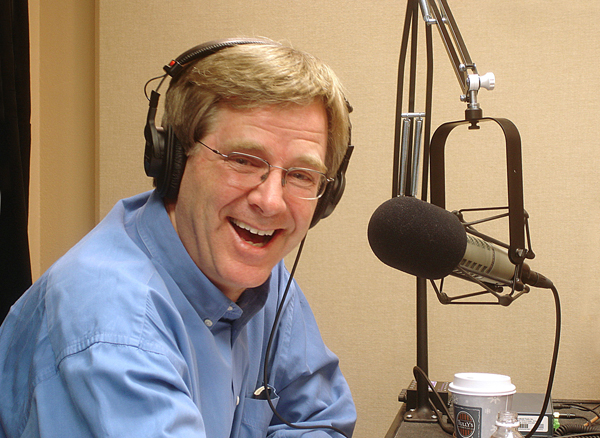
Our weekly public radio show, Travel with Rick Steves, is now seven years old. We started airing on only one station: Seattle’s KUOW. After a year, we were thrilled to air on 16 different stations, from Seattle to Fresno to Sioux Falls. And this week, we passed a much bigger milestone: 200 stations.
The latest additions include stations in Rochester, New York; Gainesville, Florida; Quad Cities, Illinois/Iowa; Valdez, Alaska; a network of stations based at Eastern Kentucky University; and a new station in Gray’s Harbor, Washington. And the newest member of our radio family: WUWF in Pensacola, Florida, will begin airing our show in September.
The full list of local airtimes for Travel with Rick Steves on our website includes “listen live” links to affiliates with Web streaming, as an alternative to subscribing to the podcast. You can also listen to any of our past shows in the radio archive at ricksteves.com/radio.
Thanks and congratulations to my producer, Tim Tattan, who mixes a passion for all things cultural, great editing skills (and the patience to digitally clean up my not-so-smooth interviews), musical brilliance (I love the way Tim uses music to enliven the hour), and a love of public radio. Thanks to our promotions wizard, Sheila Gerzoff, for helping us with station relations. And thanks to the stations and their listeners for keeping us on the air.
By the way, our show is completely free, better than ever, and it’s here to stay. If your public radio station is not airing us, you’re welcome to give them a call and ask them why. Travel with us all over the world — or an hour each week on the radio for Travel with Rick Steves. Thanks.
I’m a week into my trip and, while it’s been wonderful in so many ways, a special highlight has been enjoying my newest audio tours created for our Rick Steves Audio Europe™ app. In Vienna, I did the Ringstrasse Tram Tour, the Vienna City Walk, and the St. Stephen’s Cathedral Tour. And yesterday I did the Salzburg Town Walk with a friend from Salzburg. Doing the Vienna walks in the quiet of the evening was particularly enjoyable and relaxing after a hard day of aggressive sightseeing. And the Salzburg walk nailed the city while giving my local friend an insight to how beautiful her city is for tourists. I say “nailed it” with a bit of personal relief, because I never know exactly how the audio tours will work until they are recorded and I can actually give them a whirl. The Salzburg tour is a pure and easy joy.
Okay, now the news: We originally released our free Rick Steves Audio Europe™ app a year ago. In April, I announced the release of Version 2.0 for Apple devices (still free, and better than ever). More than 100,000 travelers have since downloaded and enjoyed the expanded content and improved design (we’re thankful for the rave reviews on iTunes). And now, our much-improved Version 2.0 is also available for Android devices.
This app is entirely free. It’s loaded with user-friendly, trip-enhancing content — both audio tours and interviews with experts and locals. And if you’re a student of Europe traveling on a budget, forgive me for being immodest, but it’s a godsend. People love it, and my hardworking staff and I are really excited about it. I literally lie in bed at night thinking of new tours I can produce for this. (Strange, I know.) Munich is on deck. Download the app (or update your current version) today at Google Play or Amazon Appstore, and incorporate all of this free audio content into your next trip.
Here are some details on the new version of the app:
What’s new in Version 2.0: We’ve added eight audio walking tours (covering Vienna, Salzburg, Germany’s Rhine River Valley, Assisi, and Ephesus), as well as 26 new radio features on Ireland, the Netherlands, Eastern Europe, Scandinavia, Germany, Italy, and Portugal.
What’s improved with Version 2.0: Audio tour maps and scripts can now be viewed from the player. We’ve expanded track descriptions, including photos. Tracks can be shared via Facebook, Twitter and email. Rick Steves e-books can be ordered and downloaded directly to your device (not free).
If you want to know more about this app, here’s our product description: The Rick Steves Audio Europe™ app organizes Rick’s vast and varied library of audio content into country- and city-specific playlists so you can enjoy ready access to the information that relates specifically to your travel plans. You’ll get Rick’s self-guided tours for dozens of Europe’s top museums, sights and historic walks — plus 200 tracks of travel tips and cultural insights from his radio show — all for free. This app downloads and stores audio files on your iPhone, iPad, or iPod Touch running iOS 4 or later. The Android version runs on Android 1.6 or higher. Download the audio files before you go, or use a Wi-Fi hotspot to download them in Europe. You can then listen for free anytime off line (no Wi-Fi or cellphone connection is required). Handy PDF maps that complement the app’s walking tours can be viewed on your device. Audio content originates from Rick Steves’ guidebooks and the Travel with Rick Steves public radio program. Self-guided walking tours are excerpted from Rick Steves’ guidebooks.
The bad news: After releasing our new Basilica of St. Francis of Assisi audio tour, I hear the friars at the basilica are not allowing tourists to listen to mobile devices. Apparently the friars would rather that tourists pay to rent their own audio guides. That strikes me as not very Franciscan.
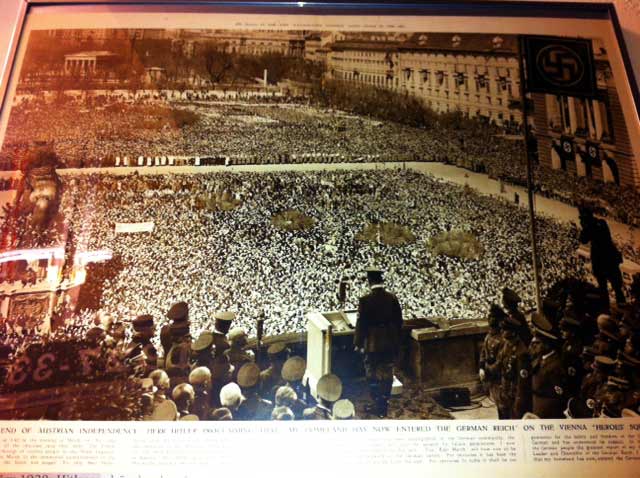
Today I stood on Vienna’s Heroes Square where, in 1938, more than 200,000 tearfully happy Austrians gathered before Adolf Hitler. The Nazi dictator stood on the palace balcony and stated, “In front of German history, I declare my former homeland now a part of the Third Reich. One of the pearls of the Third Reich will be Vienna.” From that day on, Austrians were forbidden to say the word “Austria.”
In 1938, Vienna gave Hitler a rousing welcome.
Americans often wonder how Austria could so eagerly embrace Hitler and the Anschluss (the notion that Austria was meant to be unified with Germany anyway). Let me hazard an explanation: Imagine post-WWI Austria. One of the mightiest empires on earth started — and lost — a great war. In a few bloody years, it went from being a grand empire of 55 million people to a relatively insignificant landlocked state of six million that was required to be nonaligned. The capital, Vienna, was left with little to rule, and now its population comprised a third of the country’s. With the economic crisis we know as the Great Depression (which swept the Nazis to power in Germany in 1933), Austria also got a fascist government complete with a dictator named Engelbert Dollfuss. He was as right-wing and anti-Semitic as the tyrant ruling Germany, but he was pro-Roman Catholic Church, pro-Habsburg, and anti-Nazi. When an Austrian Nazi assassinated Dollfuss in 1934, it was easy for the German Nazis to take over four years later. By that point, the Austrian fascists had already put down the leftists. The German Nazis just took over their Austrian counterparts’ file cabinets. And, Hitler promised greatness again…and jobs — something that has driven voters to support crazy political notions to this day.
This final wing of the Habsburgs' palace, the Hofburg, was built — with imperial grandeur in mind — just a few years before World War I and the end of the Habsburg dynasty. Twenty years after the last Habsburg stood here, Hitler spoke from its balcony. Today, after so much megalomania crashed and burned, the theme of the Habsburg military museum is "war is something for museums." This architectural last hurrah of the Habsburgs — which hosts three museums — is now filled with armor, Greek statues, and musical instruments.
I’ve been in Vienna for 36 hours and, with all I’ve learned, I feel as excited as a kid sorting through his candy on the living room floor on Halloween.
I met a new guide named Gerhard Strassgschwandtner. I didn’t know you could have seven consonants in a row — that’s some kind of record. He runs Vienna’s “The Third Man” Museum, dedicated to a classic movie with a cult-like following that’s set in bombed-out, spy-ridden Vienna in 1945 (museum open Saturdays only, see www.3mpc.net).
Gerhard is passionate about history in all its marvelous complexity. Chatting with him, we imagined Vienna’s city wall back when the Austrian capital was the fifth largest city in the world. The core of the city was contained in a hulking, three-mile-long ring peppered with 2,200 cannons. The artillery was aimed across the 500-yard-wide “shooting fields,” as the stretch of land beyond the city wall was called in the 18th century. Napoleon destroyed much of the wall in 1809. It was replaced with only an iron fence — easy to shoot through but hard to shoot at. It seemed strong enough in the mid-19th century, as the greatest foe of “modern” governments was considered to be mobs of people in the streets.
It’s summertime, and the city’s museums are busy with students enjoying summer-camp-type activities. Austria provides a special kids’ summer pass — unlimited train travel anywhere in the country all summer long for young students for about €40 ($50).
As I update my Vienna guidebook, I’m discovering lots of sightseeing news. The Kunsthistorisches Museum, the city’s answer to the Prado and Louvre, is reopening its ground floor “Habsburg Kunstkammer” (or Chamber of Wonders) in 2013 to show off the lavish curiosities the emperors gathered to impress their friends. Also in 2013, Vienna will have a new Biedermeier exhibit in the City Palace of the Liechtenstein family.
For a rare bit of Prague-like ambience in Vienna, stroll through the charming Spittelberg district. Vienna’s population exploded from 1880 to 1910. Most of grand architecture and apartment flats that shape a visitor’s impression of the city date from this period. The Spittelberg district, just a 15-minute walk from the Hofburg in the city center, offers a rare enclave of pre-1880 Vienna.
Music lovers come to Vienna on a kind of pilgrimage to see the houses of composers who lived and worked here. The homes of Schubert, Brahms, Haydn, Beethoven, and Mozart all host museums — but they are small, forgettable, and pretty spread out. For the best music history experience, I like the Haus der Musik (www.hausdermusik.at) which honors the great Viennese composers with lots of actual historic artifacts on one fine floor. Vienna is still a thriving capital of classical music, with three local opera companies (including the world-famous Vienna State Opera putting on 300 performances a year). Its glorious music venues offer a total of 10,000 seats which are generally sold-out every night. (Even so, they run at a deficit — so they’re subsidized by a caring government, the general populace, and lineup of corporate sponsors.)
Stepping into St. Stephen’s Cathedral, I was invited into a new elevator to visit an attraction that just opened — the Cathedral Treasury (€4, daily 10:00-18:00, includes a fine audioguide). The substantial treasures of the cathedral were ignored in the nearby (and outmoded) cathedral museum. So they were moved into the church, filling an — until now — inaccessible space high above the nave on the west portal wall. The visit includes the “Portrait of Rudolf IV” (the earliest realistic portrait in German art), precious relics, and commanding views of the nave.
Next, I popped into the Augustinian Church, where each Sunday the 11:00 Mass is performed with a wonderful orchestra. There’s a Neoclassical memorial by Canova to Empress Maria Theresa’s favorite daughter, Maria Christina; next to it is a chapel dedicated to Charles I, the last Habsburg emperor, who ruled from 1916 to 1918. He’s on a dubious road to sainthood pushed by Habsburg royalists who worship here. His required miracle: The varicose veins of a Brazilian nun were healed after she prayed to the emperor.
Vienna is great for both art nouveau and early modern buildings by architect Otto Wagner, who played a big part in shaping the urban landscape. Wagner’s Postal Savings Bank (built 1904-1907) overlooks the Ringstrasse (a.k.a. the Ring) with a facade that looks as secure as a safety deposit box. Its slinky angels atop the roof proclaim a new age made with a new metal — aluminum. The plain, marble-sided panels with their aluminum bolts remind us of Wagner’s belief that, “What is impractical can never be beautiful.”
Stepping inside, you understand the value this bank had for the new working class. It offered workers an unintimidating way to save their earnings in a combination post office/bank, rather than in some palace for elites. Its form follows function everywhere, as “necessity is the master of art.” With white and gray efficiency, the aluminum fixtures are simple yet elegant. A glass roof lets in light, and the glass floor allows light into the basement. The strong, geometric elements dignify the technological — and celebrate it as cultural. Wagner — like his angels on the roof — was heralding a new age. Facing this masterpiece across the street is the Kriegsministerium (the former ministry of war building). Its style is Neo-Baroque Historicism; it’s actually a few years younger than Wagner’s building, but it’s way behind the times — fighting against modernity.
Many things in Vienna are named after Karl Lueger, the mayor of the city before World War I. A century later, his legacy is being reconsidered. While he did much to modernize Vienna, he’s now seen as an anti-Semite — a demagogue who was admired by a young student in Vienna named Adolf Hitler. Lueger, while being a strong leader, was also a right-wing fearmonger. The city has just decided that a stretch of Vienna’s elegant Ringstrasse named for Lueger will be renamed for the university instead.
The USA is hot this week. But as Americans swelter, we should remember we don’t swelter alone. The entire world is feeling what is delicately called “global climate change” in order not to offend the people who refuse to accept the reality of global warming. While the Dutch raise their dikes, the Viennese are also preparing for a warmer reality. As older people suffer most from the stifling heat, the city is providing more shady places with benches and public mist machines. And there are big, shiny, new water dispensers popping up with reminders to be sure to hydrate. It’s good advice for locals and tourists — young and old alike — as scorching summers become our new norm.
Vienna is gearing up for more sweltering summers as fancy new water dispensers are placed at key points around the city.
They say Seattle has nice summers. I think the last time I was home for one was in 1972. And tomorrow, I head back to Europe.
This trip will be rather short, as far as research trips go: just 45 days. I’ll fly to Vienna, research Vienna, Salzburg, Munich, new cities for me in northern Germany, and then lots of Belgium and the Netherlands. Then I meet our TV crew for a three-week shoot (making our Best of Europe tour route) to update our three European Travel Skills TV shows.
I just reviewed the three original episodes we filmed with my producer Simon, and I was struck by how surprisingly similar European travel is from a decade ago. In 2000, we did our best to produce a show that would “have legs,” and it has lasted very well. Even so, there have been plenty of changes: the demise of traveler’s checks is no longer news, smoke-free zones are now commonplace, phone cards are no longer used, and it’s just assumed you’ll travel with a cell phone. Railpasses are less of a player, while discount one-way flights are more popular. The opening of Eastern Europe is old news and Couchsurfing and AirB&B are the new way to slum around Europe. Filming in 2000, we had to pretend the euro (which was about to be released) was in circulation. Filming in 2012, we have to be a little careful in assuming the euro will remain Europe’s single currency. My kids are now adults, many of my best European friends have passed away, and, somehow — except for a slightly earlier bedtime and getting rid of my dorky aviator glasses — I’m more or less the same.
By the way, while I have great guides lined up throughout, I’m a little short in Amsterdam, Bruges, and Brussels. If you have a private guide you’ve worked with (or know about) in any of those cities that you’d like to recommend, please let me know in the comments here. Thanks!
I’ve got an exciting trip set up and look forward to reporting regularly via this blog. Thanks for traveling with me.
 Our weekly public radio show, Travel with Rick Steves, is now seven years old. We started airing on only one station: Seattle’s KUOW. After a year, we were thrilled to air on 16 different stations, from Seattle to Fresno to Sioux Falls. And this week, we passed a much bigger milestone: 200 stations.