Because my parents imported pianos from Germany, our family traveled there when I was a kid. They took me — the eldest son — to Europe first. The next year, it was my younger sister Jan’s turn. But she opted to go to music camp instead. So I got to go to Europe for the second time in a row. I ended up going overseas every year since, and Jan, who had other passions, never did much international travel.
I never realized just how adventurous Jan is until a couple of years ago, when we discovered that she was, on the sly (thinking no one would take her seriously), setting her sights on actually competing in one of the world’s ultimate races: the Iditarod. Over the last several winters, she’s spent countless long Arctic nights mushing through the Alaskan wilds in subzero weather, running her beloved dog team down trails lit only by the moon and her headlamp. Last year Jan completed the Iditarod getting the prestigious “Red Lantern” for finishing… but finishing last. And in about a week, Jan sets out again for what promises to be the race of her life.
Starting today at ricksteves.com (look for the “Jan Steves’ Iditarod” link on the right side of the page), we’ll be running her blog, sharing an intimate, insider’s account of her personal quest. (For the fascinating back story, you can also browse through several months’ worth of Jan’s blog entries.)
The Iditarod is a thousand-mile race from Anchorage to Nome, which begins the first Saturday in March. Teams of 12 to 16 dogs take 10 to 14 days to complete the race (the fastest time is 9 days). The Iditarod was inspired by the original “serum run” in 1925. In that year, a diphtheria epidemic was sweeping Alaska, and Eskimo children, who had no immunity to this “white man’s disease,” were at great risk. A heroic relay of dog teams rushed a vial of life-saving serum to Nome, rescuing the children.
Each year since 1973, dog teams and mushers have set out from Anchorage to re-enact that first run — braving brutal temperatures, white-outs, wild-animal attacks, and gale-force winds. Mushers sleep with their teams under the Arctic stars, while the moose, the dogs, and the wind all howl. Competing with well-funded, beautifully equipped professional teams, Jan and her team are, you could say, the ultimate underdogs.
Jan will be calling in reports nearly daily (mobile phone access permitting). These communiqués will be transcribed and posted on her blog. For Jan, just finishing this epic and grueling — not to mention dangerous — race will be a huge personal accomplishment. And to not get that Red Lantern…that will be even better.
If you’d like to follow along and root for Jan and her team, be sure to check in, as her blog will be featured at ricksteves.com for the next two weeks.
We recently had our annual, all-day, all-staff meeting. Each department made a report. Our Travel Center noted that they had replied to 20,532 traveler emails this year. They found a few of those questions, complaints, or comments entertaining and worth sharing. Here are our favorites:
Can you help me out? Can you get to Capri from Sorrento by land (bus or car) or must you take a boat?
About Rick’s language: The trouble is that something or someone doesn’t evoke, they evoke something. No one, hopefully, goes about evoking (null). It gives the impression that there’s not actually anything to be said but that, by God, it’s going to be said anyway. It does provide a transparent sheen of smarm as well as an air of feigned erudition, both of which may, I suspect, be more easily disregarded when drunk.
We loved the Christmas in Europe special that aired on PBS last night. Thank you!!!!! Also loved the torches Rick and family carried down the hill in the dark after cutting their tree and sledding home to their friends in Austria. Are these torches available in the USA?
Please shave! I’m not used to seeing Rick with a beard…and it’s gray!
I was looking for a new waist wallet and found the silk you use for your money belts very appealing. My waist is 23 inches, but saw that yours were starting at an unbelievable 36 inches and then expanded to 72 inches. Is this a joke???? My husband is a big guy, 6’4″ and his waist is only 35 inches. I know Americans have gotten bigger, but those that are this big can’t even fit in an airline seat. Please don’t forget those of us that are in good shape as this seems to be marketed to the obese whales that give our country such a bad name. Really, who has a 72 inch waist???? This includes nothing for us women and men that are not fat porkers. No woman should have a waist that big unless she is in late pregnancy. We are thinking of taking one of your Greece tour next year, but this gave me reason to be concerned. Please tell us that people are not going to be that fat so we can even consider it.
Usually, I get baked and watch your shows on TV. I enjoy every place you go too. But I have one question. Have you gone to Amsterdam and gotten stoned? Thanks for traveling everywhere and showing how awesome this world really is.
Sincerely, A satisfied viewer.
PS. I’m jealous of all the delicious food you eat.
I am a stylist, wondering if Rick has a personal stylist, who maintains his hair color? Looks very natural, well done…
Season I & II there was this guy drinking on a wooden bar with Rick (also in a train scene and he spoke very good English) explaining that there was 3 types of drunks… I was very taken with this guy (blushing!) and I was just wondering who he was or if at all possible if you could contact him and let him know that a viewer saw him and would really like to get to know him (via email of course) and if he were interested in doing so. I am aware that the program might be 10 years old but I have a feeling he is still as dashing now, or even more so : ). I have never done this before! But I just couldn’t take my eyes off of him…
I’ve watched your show for many years; but, I think it’s time to lose the over-the-shoulder bag. I don’t understand it and carrying a bag like that kills your arm and it is NOT COOL. It seems like nowadays you seem to just eat and look at churches. Kinda boring. And unhealthy.
What is the “dingle part” of Ireland as you described in your book of Europe?
Are there WWII sites in Germany? Or has Germany outlawed all of them?
As we are two gentlemen of the world I will make haste. You and I have no time for the banter of petty words. I desire to watch more episodes of your television special, Rick Steves Europe. It is my favorite program and I enjoy it immensely while reclining in my chamber with my womenfolk, snacking on grapes and drinking glistening wines from crystal goblets of the finest make detailed with ornate glass pictures of ancient kings of yore who only certain people remember even in their respective towns of birth. I support your work with Cannabis legalization and am a part of the fight myself :).
I traveled Europe in 1996. I seem to remember purchasing a rubber ear but can’t remember where I got it. The Van Gogh museum is the only thing I can come up with but that seems too tasteless. Any ideas?
On our last night in Venice we, myself age 70, daughter, son-in-law, & grandson 11 decided on a gondola ride. Our gondolier was Massimo. It was an early evening in June. The water was like a mirror in the small canal. We proceeded into the Grand Canal where Massimo had words with another gondolier who, apparently, had parked his gondola in correctly. Later, we were back in the peaceful smaller canal and the other gondolier, now with a motor boat came after us. I saw everything unfold and couldn’t believe that a motorboat was aiming right for us. He rammed our gondola, reversed, rammed us a second time. Massimo fell into the canal and was beaten with an oar as we were left drifting. The police decided to respond after 30 minutes. They had the audacity to call it an accident and didn’t even ask if anyone was hurt. Beware Rick…the gondola ride in Venice…
I put in my two weeks’ notice, sold my house and broke up with my girlfriend of 5 years to take the trip I’ve been waiting to take for 20 years. I’ve read your books over the years and I greatly appreciate your advice.
A nice older lady came into the Travel Center and asked, “Do you have any information on South Africa?”
The Travel Center said: “Oh we just cover Europe here.”
Lady: “Where is South Africa?” (in a very serious and sort of surprised voice)
Travel Center: “Africa.”
Lady: “Oh,” and then turned and walked back out the door.
A man walked into the Travel Center and asked, “Hello, I saw your “no pets” sign, but does that also mean hamsters? I have one running around in my car and wondered if I could bring it in?”
As we’re about the only travel guidebook publisher that endeavors to visit every place in person every year when we update our annual editions, we catch lots of important little changes from year to year. We collect these in a series of articles for our travelers. This past week, we’ve been sharing the latest in Italy, France and Great Britain. I hope these country-specific travel news flashes are of help in turning your travel dreams into smooth, efficient and affordable reality. For our last “What’s New” review, here’s Germany, Hungary, and Austria:
Three countries with a rich heritage–Germany, Hungary, and Austria–each have a constantly evolving sightseeing scene. Here’s the latest:
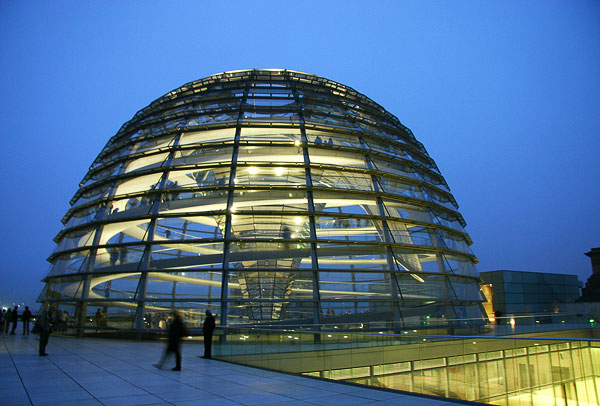
Getting into the Reichstag, Berlin’s parliament building (with its striking 155-foot-tall glass cupola), has been difficult over the last few years due to changing security and entrance procedures. Things have finally settled down and the process is clear: To visit the dome, it’s best to make a free reservation online several days in advance at www.bundestag.de. Once you have a reservation, simply report to the visitors center at the appointed time.
In Berlin, a convenient online ticketing system is making it easier to visit the Reichstag’s roof terrace and dome. (photo credit: Laura VanDeventer)
In Munich, sights are closing and opening. In the Residenz, the downtown palace of the Bavarian kings, the mythological scenes decorating the Halls of the Nibelungen are not on view, undergoing restoration at least through 2014. Reopening in Munich is the Lenbachhaus, home to the world’s largest collection of early Modernist Blaue Reiter paintings. The refurbished galleries now also host a first-rate collection of international contemporary art.
In Bavaria, the new Museum of the Bavarian Kings occupies a grand former hotel on the shore of the Alpsee, adjacent to the fairy-tale Hohenschwangau and Neuschwanstein castles. If you have free time between your castle tours and a higher-than-average curiosity about arcane Teutonic dynasties, this might be worth a stop. For most visitors, though, the highlight is the view of the lovely lake from the museum’s top floor.
St. Kilian’s Cathedral–the main church in Wurzburg, and the fourth-largest Romanesque cathedral in Germany–has reopened following a 3.2 million-euro renovation. The ornate stucco decoration inside has been spiffed up and the cathedral’s two organs restored.
Hamburg’s city center is taking on a new look, thanks to the urban renewal project called HafenCity. Built on 400 acres reclaimed from disused docklands right along the Elbe River, this roughly 15-block area in the city center is filling up with “starchitect”-designed buildings and waterside cafés. The anchor is the gigantic, architecturally striking Elbphilharmonie complex, home to a concert hall, hotel, apartments, and shopping center (due for completion in 2015).
Towns in Germany are already preparing for 2017 and the 500th anniversary of the Reformation, the movement started by Martin Luther that led to the establishment of the Protestant Church. In Wittenberg, where Luther began his challenge to papal authority, the Luther Garden is a leafy statement of cooperation between Protestant, Catholic, and Orthodox faiths. Hundreds of trees from as many Christian communities from around the world have been planted here, and each has a sister tree growing in its community of origin. Erfurt, Luther’s spiritual home, is welcoming visitors with Wednesday evening organ concerts at the Preachers’ Church and open-air opera performances on the steps of the cathedral in summer.
Little Hungary can’t compete in size with Germany, but its capital, Budapest, has its fair share of changes. Riverboats operated by the transit authority now connect strategic locations throughout the city. Although not as quick or convenient as Budapest’s subway or trams, the boats are a romantic, cheap alternative to pricey riverboat cruises on the Danube. Up on Castle Hill, the Royal Wine House has closed (at least temporarily), but the nearby House of Hungarian Wines has reopened, offering a survey of Hungary’s wine-growing regions. But the best place to sample local wines is in the company of locals–try any of the trendy wine bars opening up around town (such as DiVino, in front of St. Istvan’s Basilica, on the Pest side of the Danube).
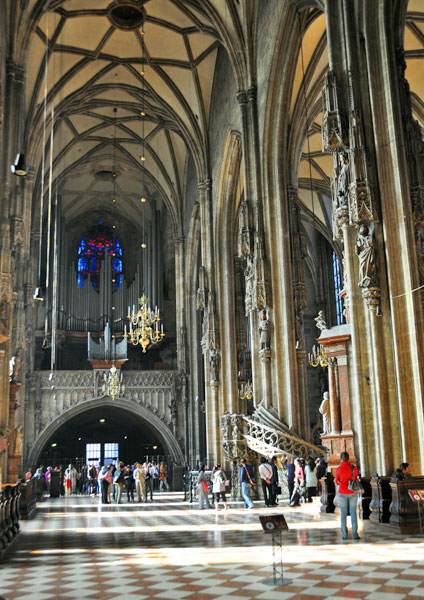
The news from Austria is all about Vienna. At St. Stephen’s Cathedral, visitors can ride an elevator up to the newly opened Cathedral Treasury. The substantial treasures of the cathedral had been ignored in the nearby (and outmoded) cathedral museum, so they’ve been moved into the church, filling a space high above the nave on the west portal wall.
A new display tucked into a loft in the oldest part of Vienna’s St. Stephen’s Cathedral showcases church treasures. (photo credit: Cameron Hewitt)
The Kunsthistorisches Museum in Vienna is reopening its Kunstkammer (Cabinet of Wonders) exhibit to show off the lavish curiosities the Habsburg emperors gathered to impress their friends and enemies. Meanwhile, in the upstairs gallery known as the Gemaldegalerie, curators have been busily rearranging the paintings.
Vienna’s most impressive and crowded palace, Schonbrunn, now has an online ticketing system. It’s possible to avoid the admission lines there by reserving a timed-entry ticket at the palace’s website in advance (www.schoenbrunn.at).
Vienna’s train stations will be in disarray for the next few years, as the city rebuilds its central station and remodels several others. The wonderful Westbahnhof (West Station) has already been beautifully renovated–with the 1950s shell now filled with a modern mall of services, shops, and eateries. It’s all part of Europe’s steady investment in its infrastructure, a commitment that will benefit all travelers to Germany, Hungary, and Austria in 2013.
As we’re about the only travel guidebook publisher that endeavors to visit every place in person every year when we update our annual editions, we catch lots of important little changes from year to year. We collect these in a series of articles for our travelers. This week, we’re sharing all the latest in Italy, France, Britain and Germany. I hope these country-specific travel news flashes are of help in turning your travel dreams into smooth, efficient and affordable reality. Up today: Great Britain.
Great Britain will likely be taking a deep breath (and perhaps a sigh of relief) this year as it recovers from a busy summer, when it hosted both the Olympics and Queen Elizabeth’s Diamond Jubilee.
Despite the flurry of investment that swept Britain in the lead-up to the Olympics, austerity measures have taken their toll on Britain’s tourist information services. I’ve long been disappointed in Britain’s inability to see that tourist information is an investment in an important industry that brings in business. Rather, Britain views tourist-info offices as businesses in their own right, having to scramble to stay afloat like the countless attractions they’re supposedly designed to serve. As a result, tourist offices across the country are either closing or morphing into shops peddling tourist activities, information, and knickknacks for a profit. The biggest hit is in London, where the Britain and London Visitors Centre near Piccadilly Circus has closed. Now the only publicly funded (and therefore impartial) tourist office is the City of London Information Centre, across from St. Paul’s Cathedral.
Even with these issues, London remains a dynamic destination. One of the biggest changes is to its skyline, which now boasts Europe’s tallest building, designed by Renzo Piano, the co-architect of Paris’ Pompidou Center. Rocketing 1,020 feet above the south end of London Bridge, the Shard (www.the-shard.com) shimmers in the sun and glows like the city’s nightlight after dark. The tip houses a 15-story stack of observation platforms enclosed in glass which opened to the public in February.
London’s newest skyscraper, the Shard--shown here nearly completed--is visible from virtually anywhere along the Thames. (photo credit: Cameron Hewitt)
Visitors hoping to capture some of the Olympic afterglow can soon visit the new Queen Elizabeth Olympic Park. The northern part, opening this summer, will feature footpaths, playgrounds, and picnic-friendly greens. The southern half, highlighted by the twisty red Orbit, is slated to open in spring of 2014. Visitors will also be able to swim in the pool where Michael Phelps won his 18th gold medal, as construction is underway to open up the Aquatics Centre for public leisure (pronounced LEH-zhoor in Britain).
Travelers interested in royalty will delight in the newly refurbished Kensington Palace, (www.hrp.org.uk/KensingtonPalace) which now hosts a worthwhile series of exhibits on its most notable past residents, including William and Mary, and the Hanovers (the “Georges”). The highlight is the exhibit on Queen Victoria, who was born and raised in this palace.
The new Kensington Palace has been immaculately restored, with engaging and creatively presented exhibits. (photo credit: Cameron Hewitt)
The wizarding world is abuzz over the opening of the “Making of Harry Potter” studio tour in Leavesden, a 20-minute train ride from London. The attraction lets Potter-philes see the actual sets and props used in the films, along with exhibits about how the special effects were created. Visitors must book a time slot in advance–and in 2013, it’s smart to do so as far ahead as possible (www.wbstudiotour.co.uk).
In Bath, a 90-minute train ride west of London, visitors to the Roman and Medieval Bath can now avoid lines–worst on Saturdays and any day in summer–by buying advance tickets online (www.romanbaths.co.uk).
Near Bath, visitors can explore Avebury Manor and Garden, the subject of The Manor Reborn, a four-hour BBC documentary on the refurbishment of the 500-year-old estate by a team of historians and craftspeople. Nine rooms decorated in five different styles show the progression of design trends from Tudor to Queen Anne to early 20th-century. A limited number of timed tickets are sold each day.
Along England’s southern coast, the Portsmouth Historic Dockyard complex will soon welcome a new museum displaying the 16th-century warship Mary Rose (Henry VIII’s favorite ship) and numerous Tudor-era items found inside the wreck.
In the charming city of York, in northeast England, the noble Kit Kat, Aero bars, and Chocolate Oranges are now featured in a fun attraction dubbed “Chocolate: York’s Sweet Story” (all three confections were famously born in York). Visits start with a film and guided tour before flowing into a virtual chocolate factory.
Renovations continue at the stately York Minster. While the Great East Window remains behind scaffolding, several examples of the window’s stained glass can be viewed up close in the Orb, a space-age-looking vessel located inside the Minster.
Two relatively new museums in Liverpool and Glasgow celebrate the heritage of these proud and scrappy port cities. The Museum of Liverpool is packed with interactive displays covering everything from the city’s music and sports background to housing and health issues. Glasgow’s Riverside Museum of Transport and Travel sports high-tech displays, a re-creation of a 20th-century street, and plenty of recollecting Glaswegian seniors. Its vast collection includes stagecoaches, locomotives, the world’s oldest bicycle, and the Glenlee, one of Glasgow’s five remaining tall ships (docked outside the museum).
After a momentous year, 2013 should mark a return to normalcy in Great Britain. For many residents and travelers, that’s a welcome change.
As we’re about the only travel guidebook publisher that endeavors to visit every place in person every year when we update our annual editions, we catch lots of important little changes from year to year. We collect these in a series of articles for our travelers. This week, we’re sharing all the latest in Italy, France, Britain, and Germany. I hope these country-specific travel news flashes are of help in turning your travel dreams into smooth, efficient and affordable reality. Next up: France.
Travelers to France find a rich and constantly changing palette of cultural and historic sights. Here’s a review of what’s new or different in la belle France for 2013:
Increasingly, attractions in Paris and beyond are adding online ticketing, which lets visitors print a receipt that serves as an entry pass. Smart sightseers can now book ahead and avoid lines at destinations such as the Eiffel Tower, the Musée d’Orsay, and Monet’s gardens at Giverny, as well as for activities such as Seine river cruises and church concerts.
As always, there’s news at the Louvre. Videoguides on portable consoles (€5 rental) provide commentary on about 700 masterpieces. The new Islamic art section–with its eye-catching glass roof–is installed in the Cour de Visconti courtyard of the Denon wing.
Other Paris museum openings and closings include the recently refurbished Impressionist galleries of the Musée d’Orsay. After a bit of a shakeout, paintings have settled into permanent locations, offering a fresh view of this rich trove of masterworks. The long-closed Picasso Museum should finally reopen in summer 2013. Meanwhile, the Rodin Museum is undergoing a major renovation until 2014. While statues will be moved around and some rooms will close altogether, the museum’s lovely gardens will remain open.
There are several intriguing new tour options in Paris. Classic Walks offers new Easy Pass tours that allow you to skip the lines at major sights such as the Louvre and the Eiffel Tower (www.easypasstours.com). TripUp’s pedicab tours, helmed by hard-pedaling drivers, are a charming way to experience Paris at a snail’s pace (www.tripup.fr). If rumbling around Paris in a funky old Citroën 2CV convertible à la Inspector Clouseau sounds like your kind of fun, check out Paris Authentic (www.parisauthentic.com) or 4 Roues Sous 1 Parapluie (www.4roues-sous-1parapluie.com).
The city’s Velib bike program is now more accessible to visitors, who can buy a one- or seven-day subscription online (http://en.velib.paris.fr). This is a fun way to tootle between sights–the first 30 minutes of any trip are included with your subscription; after that there’s a small fee for each additional 30 minutes.
Paris’s bike-sharing program has more than 20,000 bikes stationed around the city. (photo credit: Dominic Bonuccelli)
Along the Seine, the French are following a kitschy and annoying “tradition” that’s popping up in other parts of Europe: latching padlocks on the handrails of bridges. Locals and tourists alike honor loved ones by writing a brief message on a padlock and attaching it to a railing. The locks (called un cadenas, €5) are sold at bookseller’s stalls along the river.
At Versailles–the number one side-trip from Paris, just a half-hour away–some rooms of the Queen’s Wing of the main palace may be closed for renovation in 2013. A new shuttle bus is whisking visitors from the Versailles train station to the Trianon Palaces and the Domaine de Marie-Antoinette, on the far side of the palace’s vast grounds (www.phebus.tm.fr).
At Mont St-Michel, the causeway that’s long brought tourists to the dramatic island abbey was closed to car traffic in 2012 (and will eventually be replaced by a new bridge). Instead of parking along the causeway, drivers now leave their cars on the mainland and either walk, ride a free shuttle, or hop a horse-drawn wagon to the island.
Down south, in Provence, the Ancient History Museum in Arles is showing off a recently discovered Roman barge and much of its cargo (exhibit opening in late 2013). This almost 100-foot-long vessel and more than 3,000 ceramic jugs and artifacts were pulled from the Rhône River in 2010. Along the Riviera, the big news in Nice is the reopening of its 100-year-old onion-domed Russian Cathedral, claimed by many to be the finest Orthodox church outside Russia.
The historic Russian Cathedral in Nice, built during the reign of Tsar Nicolas II, is celebrating its 100th anniversary. (photo credit: Michaelanne Jerome)
Through 2014, you won’t be able to cross the Alps from France to Italy by cable car, as the lift from Helbronner Point (near Mont Blanc) down to the Italian valley station of La Palud is closing for renovation. (You can still side-trip to Italy by bus from Chamonix to Aosta.) Gondolas will continue operating on the Mont Blanc lift up from Chamonix to the Aiguille du Midi and over to Helbronner–but only in summer and, even then, only in good weather.
The Alsace’s top art sight, Colmar’s famed Unterlinden Museum, is scheduled for renovation sometime in 2013. When that happens, the jewel of the museum, Grunewald’s gripping Isenheim Altarpiece, will likely move to the nearby Dominican Church, where it should remain on display while the museum is under construction.
With all this renovating and reorganizing, there’s one thing that won’t change in France: The owners of family-run hotels will still run from bakeries through the streets at the crack of dawn, lovingly bringing fresh-baked croissants back to their breakfast rooms so their guests can get a proper start to their sightseeing days.