Anfoushi, Alex, and the Market

While Alexandria, or “Alex” for short, has its ancient sites and its striking modern library, the highlight of the city for me was exploring its crusty old town: the Anfoushi district. I don’t know why, but I’m a hopeless romantic when it comes to broken concrete, faded-elegant facades, kids with big bright eyes and dirt-caked bare feet, and colorful oxcarts of produce under bare light bulbs. Alex’s thriving Souk el-Medan market street, which cuts right through Anfoushi, offers exactly that.

 Enjoy a friendly welcome when you explore Alexandria’s colorful Anfoushi district after dark.
Enjoy a friendly welcome when you explore Alexandria’s colorful Anfoushi district after dark.

Photo by Trish Feaster (for her Egypt blog, see http://thetravelphile.com/).

Strolling the length of this street one evening was the most entertaining experience I can remember anywhere on the Mediterranean coast. Dangling bulbs create puddles of light, spotlighting a surreal montage of slice-of-life vignettes. A toothless man sends shoots of sugar cane five at a time into a wood chipper. Pulp poops out the back while sweet, fresh juice dribbles out the front, filling my glass. A wedding party takes over five picnic tables with a tiny band, working the multigenerational family gathering into a frenzy. We’re invited into the mosh pit to clap, bob, and dance. Teenage boys sit triple on motorbikes, rented just for an hour-long joyride of people-dodging. The cackle of dice on backgammon boards mixes with the satisfying gurgle of old men sucking on giant, bong-like shishas. For a break, we plop into an open-air restaurant for piles of grilled sea bream, bass, and prawns, with baba ghanoush, tahini, and fried eggplant, all washed down with tall glasses of mint lemon juice.

Choosing my juice with help of guide, language barrier. Caption: Just order some juice and pay the price listed. OK, there is a language barrier in Egypt. There’s a number barrier, too.

Photo by Trish Feaster (for her Egypt blog, see http://thetravelphile.com/).

After dinner, we walk on. With the street theater of Egyptian life, you can drop in and out as you like and not miss a beat. Dodging shoeshine boys and old men carrying trays of tea adds to the mix. I marvel out loud about the shared poverty (which is what I call a society with lots of ad-lib jobs that aren’t quite jobs). Tarek explains that as Egypt has no real social security, hiring these struggling people is considered kind of a societal duty for those who have the money. “We don’t shine our own shoes because it’s better to employ the man on the street. I hire a domestic servant because it helps employ that person. When I no longer need the help, it’s very hard to let a good domestic go.”

In the market, you need to know the local numbers. This kind man will sell you a kilo of this for 4 Egyptian pounds, a kilo of that for 2 pounds, and a kilo of the other for just 65 piasters. (There are about 6 pounds to the US dollar.)

Popping out of the chaos and back onto the harborfront, we come upon a tiny children’s park. Two women entirely shrouded in black were enjoying a viewpoint with their children from the castle overlooking the Corniche. One was taking a photo of the other with both their children. I offered to take the photo so she could be in the shot, too. She said, “No, thank you. We’re both wearing a burka, so it’s not necessary — I can just pretend it’s me.”
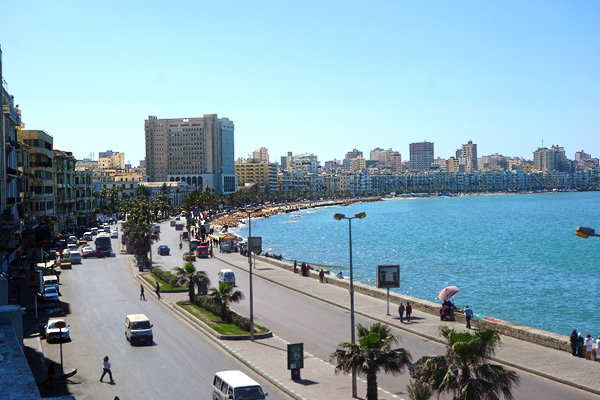
Alexandria, Egypt’s “Pearl of the Mediterranean”

Most tourists in Egypt visit only Cairo and Luxor. Few visit Alexandria, just a three-hour drive away — the country’s second city, and one of the great cities of the Mediterranean. Egypt’s historical capital for almost a millennium, today the “Pearl of the Mediterranean” is a favorite summer getaway for locals who appreciate its cosmopolitan flavor and cooler climate. It’s like Cairo in its mega-millions intensity, but cleaner and quieter, and facing the Mediterranean instead of the Nile.

Alexandria, with a panache unique in Egypt, jams 5 million people up against the Mediterranean.

Alexandria, founded in 331 B.C. by Alexander the Great, is a fabled place. Queen Cleopatra ruled from here, back when the city was, along with Rome, one of two in the ancient world with a million people. Back then, it rivaled Rome as a cultural and intellectual capital. Alexandria’s awe-inspiring lighthouse (or Pharos) — one of the seven wonders of the ancient world — marked its harbor, and its legendary library was the world’s largest. No ship could dock here without giving up its books to be copied for this, the ultimate repository of knowledge. Tragically for all of civilization, the library burned (likely around 48 B.C.), and today only its legend — and a fragment of a single scroll (now kept in Vienna) — survives.

History has been harsh: No trace of Alexander’s day survives, Cleopatra’s city is now under the sea, the library is long gone, and the lighthouse has tumbled (the only surviving image of it is engraved on a coin). Of its ancient wonders, only a hint of Alexandria’s street plan, a few archaeological digs, and the towering Pompey’s Pillar survive today.

The nearly 90-foot-tall Pompey’s Pillar, carved out of a single mighty piece of granite, was shipped 500 miles from Aswan down the Nile to this spot 1,700 years ago. It stands like an exclamation mark, reminding all who visit that today’s city sits upon what was a mighty urban center of a million ancient Egyptians.

The Alexandria National Museum (with wonderful treasures from the time of the pharaohs, a small bust of Alexander, and fine early Christian art) tells the city’s story in an old mansion that once housed the US consulate. Alexandria gave Rome a toehold on Egypt. This is where St. Mark arrived to introduce Christianity to the land. The invading Muslims bypassed it for Cairo. In the Middle Ages, famine, civil wars, earthquakes, and disease left the once-mighty Alexandria just a village of 10,000. Then, in the 19th century, the city enjoyed a resurgence — becoming one of the liveliest ports on the Mediterranean, with a cosmopolitan mix of Greek, French, English, and Italian influence. By World War II, 40 percent of the population had come from other countries. But then, with the anti-colonialism of the 1950s, foreign interests were nationalized, and most of the foreigners who brought such vitality to the city fled.

Today, Alexandria’s early-20th-century grandness is musty and caked in this generation’s dirt. The city is a teeming and thoroughly Egyptian metropolis of about 5 million. It feels spirited, young, and progressive. In fact, Alexandria helped spearhead the revolution of 2011.

Alexandria is a long and skinny port town, just two miles wide but stretching 12 miles along the seaside Corniche — which feels like Nice’s Promenade des Anglais hurled into a Blade Runner furnace. The wistful Cecil Hotel, built in 1930 and overlooking the harbor, gives the visitor a comforting home base with a nostalgic touch of belle époque elegance.

p36-DSC00948

Alexandria’s top attraction is its futuristic modern library. Norwegian-designed and built in 2002 with a dazzling reading room accommodating 2,500 readers, it stands near where the fabled ancient library stood (bibalex.org shows off all its wonders). While the library is a delight of modern architecture, the highlight of the city for me was exploring the Anfoushi old town. More on that tomorrow.

Open Letter to Egyptian President Muhammad Morsi

Dear Mr. President,

I am a Protestant Christian, and a burden I bear all my life is what’s called the “Protestant work ethic.” I was just in your wonderful capital city, and my work ethic drives me to make a suggestion.

Because I care about Egypt very much, I feel I must say that Cairo is in such a shambles that it’s in danger of demoralizing caring people, killing any civic pride that still exists, and even driving your best citizens to emigrate to a country where abandoned cars don’t block streets and sidewalks for months on end. While arguably just a cosmetic problem, this is also very bad for your tourism industry — which could use a little help.

You command a big military. I understand that all men serve (the uneducated for three years and the educated for one year). Consider this move, which could well inspire Cairo to be proud of itself: Shut down the city for three days. Declare war on the junk clogging your city’s veins. Mobilize everyone. Send in the army. Tell everyone that anything left on the street will be taken away. And then flush out your great but crumbling city. Clear out collapsed buildings, remove abandoned and stripped old cars, tear down broken and vandalized phone booths, truck away the broken chunks of concrete, and pick up all the trash. While you’re at it, replace the crumpled and rusty dumpsters with nice new ones with city slogans on them (as in London). Challenge your citizenry to use the dumpsters, and pay to have them emptied every week.

In my travels, I’ve seen firsthand how a similar approach has succeeded in both Istanbul and Tangier, Morocco, in recent years. You’ll quickly recover your investment in increased tourism revenue, and your people will think of you as someone who can get something done that impacts their lives in a positive way.

Good luck!

Rick Steves

Some great cities are people-friendly. Rather than people-friendly, it seems Cairo is garbage- and abandoned car-friendly. But that can change.