Pre-Raphaelites and The Lady of Shalott

As Europe starts opening up to travelers again, it’s more exciting than ever to think about the cultural treasures that await. For me, one of the great joys of travel is having in-person encounters with great art — which I’ve collected in a book called Europe’s Top 100 Masterpieces. Here’s one of my favorites:   

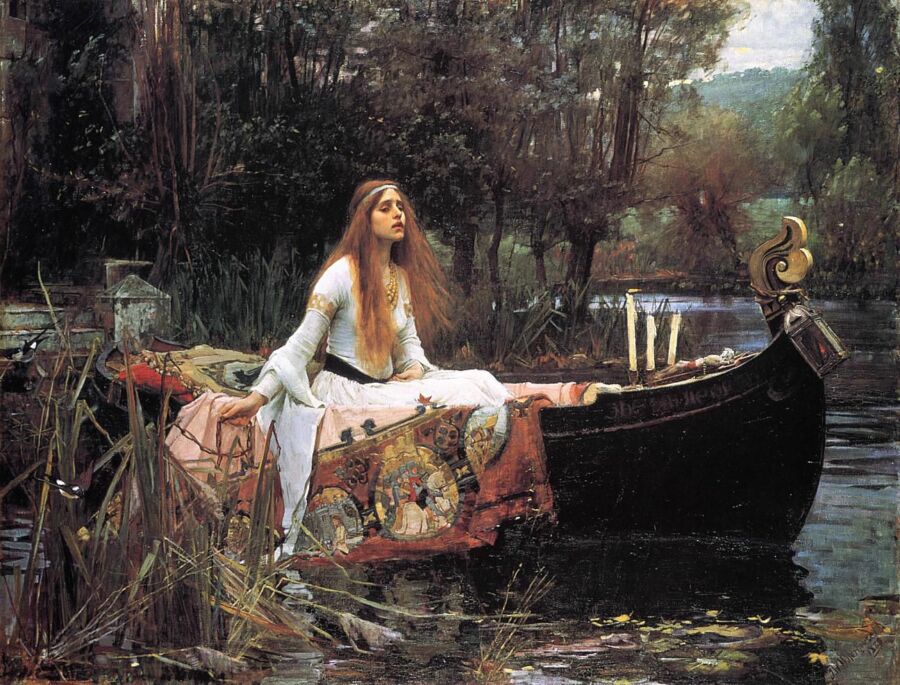
This woman’s haunting face makes it clear right away that — despite the sumptuous beauty of this painting — it doesn’t tell a happy tale. The Lady of Shalott knows she’s floating down a river to her doom. 

The English artist John William Waterhouse depicts the dramatic climax of a legendary tale. The Lady of Shalott had spent her whole life shut up in a castle near King Arthur’s Camelot, forbidden to even look outside, upon pain of death. She could only observe the world indirectly through the reflection in her mirror. But one day, the handsome knight Lancelot rode by. She was so smitten that she broke the rules and looked directly at him. Now she’s followed his tracks and boarded a boat, releasing the mooring chain, as she sets off into the unknown to find her beloved, whatever the cost. 

The riverside landscape — the reeds, the inky water, the darkening atmosphere, even birds in flight — evokes the melancholy beauty of the moment. Ms. Shalott burns brightly, her white gown and red hair radiating from the dark background. Waterhouse focused on evocative details, like the Lady’s wispy hair, pearl necklace, lightly rumpled dress, and cupped hand. For the Lady’s face, he painted his own wife. The colors — reds, greens, and blues — are bright, clear, and luminous, glowing like stained-glass windows. 

The whole scene looks medieval, yet it was painted during an Industrial Age when Britain was leading the world in new technologies like electricity and trains. While Victorian Britain sped forward, its artists looked to the past. Waterhouse was inspired by a group of British artists called the “Pre-Raphaelite Brotherhood,” who reveled in painting medieval damsels and legendary lovers with heartbreaking beauty. 

The Pre-Raphaelites hated overacting. So — even in the face of great tragedy, high passions, and moral dilemmas — this Lady barely raises an eyebrow. But her surroundings speak volumes. Night is falling, foreshadowing her dark destiny. The first leaf of autumn has fallen, landing near her thigh. She brings the bright tapestry she wove in captivity, with scenes of the comforting world of illusion she once knew. Now she’s guided only by a dim lantern on the prow, a small crucifix to fortify her faith, and three fragile candles — only one of which still burns.  

Victorians of all ages knew this Romantic legend (which was also a best-selling poem by Tennyson). Everyone could read their own meaning into the painting: The Lady has chosen to leave her safe-but-deluded existence to pursue truth. She’s following her heart, despite the dangers. She’s taking the risk to find intimacy, love, and sex even at the expense of losing herself in the process. The expression on her face shows a mix of fear, hope, vulnerability, and a realization that — whatever comes — this is her destiny. 

She lets the chain go. Then, “like some bold seer in a trance,” wrote Tennyson, she goes “down the river’s dim expanse.” In the legend, the Lady of Shalott’s boat headed downstream and washed ashore at Camelot, where Lancelot saw it and mourned for her. She had succumbed to the curse of seeing the world as it is. 

Elgin Marbles — The Parthenon Sculptures

As Europe starts opening up to travelers again, it’s more exciting than ever to think about the cultural treasures that await. For me, one of the great joys of travel is having in-person encounters with great art — which I’ve collected in a book called Europe’s Top 100 Masterpieces. Here’s one of my favorites:   

For 2,000 years, the Parthenon temple in Athens remained almost perfectly intact. But in 1687, with Athens under siege, the Parthenon was used to store a huge cache of gunpowder. (See where this is going?) Pow! A massive explosion sent huge chunks of the Parthenon everywhere. Then in 1801, the British ambassador, Lord Elgin, carted the most precious surviving bits of carved stone off to London, where they wow visitors to this day — the “Elgin Marbles.” 

London’s British Museum shows off the statues and relief panels that once decorated the top of the Parthenon’s now-bare exterior. The reliefs, carved in about 430 BC, are part of the 500-foot-long frieze that once ringed the temple. They show 56 snapshots from ancient Athens’ most festive occasion: a grand parade up the Acropolis hill to celebrate the city’s birthday. 

The parade begins with men on horseback, struggling to rein in their spirited steeds. Next come musicians playing flutes, while ladies dance. Distinguished citizens ride in chariots, kids scamper alongside, and priests lead ceremonial oxen for sacrifice. At the heart of the procession is a group of teenage girls. Dressed in elegant pleated robes, they shuffle along carrying gifts for the gods, like incense burners and jugs of wine. 

The girls were entrusted with the parade’s most important gift: a folded-up robe. As the parade culminated inside the Parthenon, the girls symbolically presented the robe to the temple’s 40-foot-tall gold-and-ivory statue of Athena.  

The realism is incredible: the men’s well-defined muscles, the horses’ bulging veins. The girls’ intricately pleated robes make them look as stable as fluted columns, but they step out naturally — the human form emerging from the stone. These panels were originally painted in bold colors. Amid the bustle of details, the frieze has one unifying element — all the heads are at the same level, headed the same direction, creating a single ribbon of humanity around the Parthenon. 

The Parthenon’s main entrance was decorated with a grandiose scene depicting the moment when the city of Athens was born. These statues nestled inside the triangular-shaped pediment over the door. It shows the Greek gods lounging around at an Olympian banquet. Suddenly, there’s a stir of activity. The gods turn toward a miraculous event: Zeus has just had his head split open to reveal Athena, the symbol of the city. (Unfortunately, that key scene is missing — it’s the empty space at the peak of the triangle.)  

These pediment statues are realistic and three-dimensional, reclining in completely natural and relaxed poses. The women’s robes cling and rumple naturally, revealing their perfect anatomy underneath.  

A final set of relief panels (the so-called metopes) depict a Greek legend that sums up the entire Parthenon. They show the primeval Greek people brawling with brutish centaurs. It’s a free-for-all of hair-pulling, throat-grabbing, kicks to the shin, and knees to the groin. Finally, the humans get the upper hand — symbolizing how the civilized Athenians triumphed over their barbarian neighbors. 

In real life, the Greeks rallied from a brutal war, and capped their recovery by building the Parthenon. The treasured Elgin Marbles represent the cream of the crop of that greatest of Greek temples. And they capture that moment in human history when civilization triumphed over barbarism, rational thought over animal urges, and order over chaos. 

Venuses Through History

As Europe starts opening up to travelers again, it’s more exciting than ever to think about the cultural treasures that await. For me, one of the great joys of travel is having in-person encounters with great art and architecture — which I’ve collected in a book called Europe’s Top 100 Masterpieces. Here’s one of my favorites:   

Beauty can take many forms. But since the very beginnings of the human species, the most popular subject for artists has always been the female body. Long before the end of the Ice Age, Europeans were fashioning small statues of women. 

The chubby Venus of Willendorf (c. 25,000 BC), found in modern-day Austria, is shown resting her spindly arms on her ample breasts. At just 4.4 inches high, this statue is like many such statues of the day. Most are no bigger than a smartphone. They’re carved out of stone or bone, or molded from clay. They’re generic females, with no face or feet. The hips are wide, and the breasts and butt are exaggerated, with a prominent vaginal slit. This focus on women’s life-giving attributes has led scholars to suggest they’re symbols of fertility. Living at the mercy of the elements, the early Europeans who created these may have worshipped Mother Nature. Scholars have dubbed them “Venus figurines.” 

During the long journey from Paleo- to Neo-lithic times, statuettes of Stone Age women shed some 20,000 years of fat to become so-called “Cycladic figures” (c. 3,000 BC). These ladies from the Greek Isles are skinny. They’re always naked, with stylized breasts and folded arms. Because they lack distinct features, it’s suggested that they may represent the Everywoman. But no one knows the exact purpose: Was she a fertility goddess, funereal figure, good-luck charm, spirit guide, prehistoric Barbie doll, caveman Playboy Bunny . . . or just art?  

These “Venuses” were only the start of a 25,000-year tradition of using the beauty of women — yes, you could say objectifying women — to express society’s deepest-held values. 

The word “beauty” can apply to harmonious concepts as well as physical beauty. During the days of classical Greece and Rome, a statue of a perfectly-proportioned person — like the Venus de Milo — epitomized the harmony and geometrical order they found in the divine cosmos. 

In Christian times, “Venus” became “Mary.” Just as Venus represented earthly love to pagans, the Madonna was venerated by Christians as a symbol of divine love. Images of Mary welcomed worshippers into the church, promising love and forgiveness. Because medieval art was rather rudimentary, artists used symbolism to communicate this. A vase of lilies might represent Mary’s chastity, and Baby Jesus might hold a symbol of his prophesied death. By Renaissance times, artists could portray Mary with such human realism that she radiated her spirituality through her physical beauty.  

And so it went, as each era created images of beautiful women to express abstract concepts. Mona Lisa is not merely a portrait of a businessman’s wife; it’s a visual treatise on a geometrically perfect universe. Botticelli’s Birth of Venus embodied the Platonic ideal of the quest for enlightenment. In more modern times, a secular Venus nicknamed “Marianne” (in Delacroix’s Liberty Leading the People) carried the torch of France’s revolutionary spirit.  

Throughout art history, artists have used beautiful women as a way to convey deeper meanings. The women of art, which you’ll see featured throughout “Europe’s Top 100 Masterpieces” — whether in their role as life-givers, warriors, sensuous vixens, perfect models, symbols of an era, or forthright workers — have always represented the “beauty” of humanity’s greatest ideals. 

Artisan Europe: Worth Seeking Out

Even though I’m holding off on visiting Europe for now, I believe a regular dose of travel dreaming can be good for the soul. I hope you’ll enjoy this travel tale from my book For the Love of Europe, a collection of 100 of my favorite stories from a lifetime of European travels. 


When you’ve traveled in Europe as long as I have, you experience changes big and small. And more and more, I notice traditional, local businesses making way for cookie-cutter chains and synthetic conformity. In historic city centers, as rents go up, longtime residents, families, and craftspeople are pushed out. Small hotels, one-of-a-kind shops, and individual craftspeople simply don’t have the scale to compete with the big guys. And that, coupled with the impact of COVID sending mom-and-pop shops out of business, makes me want to celebrate my memories of these venerable craftspeople. 

In Florence, the end of rent control made costs spike immediately, driving artisans and shops catering to locals out of business — to be replaced by upscale boutiques and trendy eateries. The same thing happened in Barcelona’s Gothic Quarter. As landlords evicted long-term renters to make more money off short-term Airbnb rentals, mom-and-pop shops lost their traditional clientele and went out of business. In Istanbul, the city wants to move the iconic gold-and-silver workshops from the Grand Bazaar to a place outside the city center, while “Made in Taiwan” gift shops are able to pay higher rents and take their place, changing the character of the market. 

Craftsmen lament that the next generation, drawn to the energy of big cities and lured by the opportunities of big corporations, won’t be there to carry on the traditions. The artists who craft handmade guitars in Madrid, the family winemakers of Burgundy, the fishermen who sell shrimp on the Oslo harborfront…these have all been fixtures in my lifetime of European travel. What will become of these rich facets of local culture if the younger generation opts out? Of course, I can’t blame the children of artisans for jumping into the modern rat race; I’m not an old-school piano technician like my father. But it’s worth considering how the future will look when economic scale and efficiency trump artisan values.  

It’s a real joy when I stumble upon true artisans who are committed to doing things the traditional way, by hand — and communities that understand the importance of keeping them in business. I urge travelers to seek out and support artisan experiences while traveling — before it’s too late. 

In Rothenburg, Germany, I visited with Peter Leyrer, a printmaker who proudly showed me his etchings. He makes his prints using the copper-plate technique, just as Albrecht Dürer did 500 years ago. Peter prints the black-and-white etchings, paints them with watercolors, and sells them in his shop. Peter is getting older and will soon retire. He told me that with no one to take over for him, his 3,000 copper plates will likely end up in a museum. One of his etchings hangs in my office. 

In the Tuscan hill town of Montepulciano, my friend Cesare is a proud coppersmith with a spirit as strong as the oak-tree root upon which his grandfather’s anvil sits. For Cesare, every day is show-and-tell, as steady streams of travelers drop by to see him at work, fashioning special ornaments for the town cathedral and pounding out fine cookware. 

In nearby Orvieto, Federico Badia is a young cobbler who’s passionate about preserving the art of traditional shoemaking. After apprenticing at a leather shop in Rome, he set up his own studio, where he patiently crafts fine leather shoes for an appreciative clientele. Federico says that “Made in Italy” doesn’t apply to mass-produced factory shoes — it’s a label that rightly belongs only to the fine products hand-crafted by artisans like him. 

Back in Istanbul’s Grand Bazaar, Dikran is a silversmith who uses hand tools to create finely designed, one-of-a-kind pieces. For a decade, he worked as an unpaid apprentice, studying under a master until he himself became one. In the past, a volunteer apprentice had to work hard to persuade a master to accept him. Today, it’s a struggle to get young people to enter a field in which training takes years and incomes are limited.  

Guiding a tour group through eastern Turkey, I once dropped in on a craftsman who was famous for his wood carving. We gathered around his table to watch him work, appreciating the pride he took in his art. Suddenly, he stopped, held his chisel high into the sky, and declared, “A man and his chisel — the greatest factory on Earth!” 

As we emerge from this COVID crisis, the big mystery for me is how many artisans, mom-and-pop shops and eateries, and creative little business ventures will still be standing. After all, these are what make our travels (and our hometowns) so easy to love. 

I don’t have the answers on how to sustain Europe’s age-old traditions, but I’m inspired whenever I meet the artisans who lovingly carry treasured and endangered crafts into the future. And it always feels right to buy a piece of their work. 

The Perfectly Posed Artemision Bronze

Even though I’m holding off on visiting Europe for now, I believe a regular dose of travel dreaming can be good for the soul. And for me, one of the great joys of travel is having in-person encounters with great art and architecture — which I’ve collected in a book called Europe’s Top 100 Masterpieces. Here’s one of my favorites:

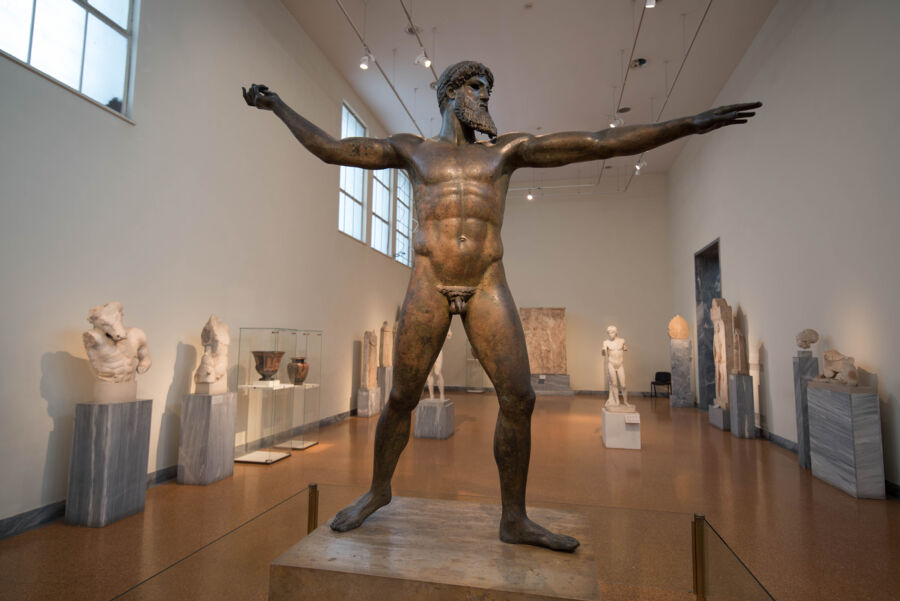
One of the jewels of the ancient world is the Artemision Bronze, a perfectly posed statue of a god at war.

The god steps forward, raises his arm, sights along his other arm at the distant target, and prepares to hurl his weapon. (Or is he about to serve a tennis ball? Or pound a nail? Or maybe he’s riding a surfboard?)

If the statue is meant to be Zeus (as some think), he’d be throwing a thunderbolt — if Poseidon, a trident. When the statue was discovered — in a sunken ship off the coast of Greece (Cape Artemision) in 1928 — no weapon was found, so no one knows for sure who it represents. (For simplicity, I’ll call him Poseidon, and hope jealous Zeus doesn’t strike me down with a thunderbolt.)

Poseidon stands 6 feet 10 inches tall, and has a physique like — well, like a Greek god. He’s trim, graceful, and muscular.

His hair is curly and tied at the back. His now-hollow eyes were once white, made with inset bone. He plants his left foot and pushes off with the right. Even though every limb moves in a different direction, the overall effect is one of balance.

The statue’s dimensions are a study in Greek geometry. His head is exactly one Greek foot in length. He stands 6 Greek feet tall, or exactly one Greek fathom. The entire figure has an “X” shape that would fit into a perfect circle — his navel at the center, and his fingertips touching the rim.

The unknown artist has frozen Poseidon’s movements in time, so we can examine the wonder of the physical body. He’s natural yet ideal, twisting yet balanced, moving while at rest. With his geometrical perfection and godlike air, this figure sums up all that is best about the art of the ancient world.

Sculpted around 460 BC, this statue is an example of the so-called Severe style, describing the style of Greek art between 500 and 450 BC. Historically, this is when Greece battled the Persians. During this time of horrific war, the Greeks made art that was serious and unadorned, and expressed naked, muscular strength. Severe-style statues celebrate the nobility of the human form and the heroism of the individuals who carried them through these tough times.

Shortly after this statue was created, the Greeks emerged victorious from their wars, shook off tyrants at home, and took control of their own destiny through democracy. This Poseidon shows Greece poised at the dawn of that new era of prosperity and enlightenment, his gaze fixed on the coming future. That future would be known as the Golden Age…an age that would inspire Western civilizations to come.