One Final Duty-Free Gauntlet Before Leaving Scotland

This video clip may show what seems like any old airport, but after two weeks in unpolished Scotland, it came as a jolt to me. At Glasgow’s airport, there’s only one way from security to the gates, and it routes you through the duty-free mall gauntlet.

Having survived this, I boarded my plane and settled in for my flight to London Heathrow, where I was connecting to Berlin. But then they announced that there was a fire at Heathrow, and Europe’s busiest airport was completely shut down. I fly a lot, and I’m amazed how rarely I’ve hit a bump in the tarmac like this. Back in the airport, you can imagine the chaotic scene as everyone scrambled to sort out their plans. This is when I’m really happy I use a living travel agent. I simply called her back home and asked her to get me to Berlin any way but through London. I spent the night at the airport hotel ($100), was booked on a flight early the next morning via Amsterdam, and got to Berlin before noon.

If you can’t see the video below, watch it on YouTube.

Two Types of People in Glasgow

Glasgow is a city where it seems there are two kinds of people: those who live to drink beer and cheer their soccer team, and those who confuse you by having that hard Glaswegian accent yet are cosmopolitan, sophisticated, cultured, and hardworking.

The first Glaswegian I met was from the first group. He was a cabbie who spent the entire ride insulting me for being an American because Yankees don’t go to pubs and drink lots of beer until late at night. If you venture into a rough neighborhood after dark — as I did one night — it seems the entire world is populated by angry people with dead-end lives, like that cabbie. Crammed into bars, they leer at passersby who don’t want to join the mosh pit.

But the next morning, with the sunshine came a world of that second type of Glaswegian: people with vision for making Glasgow an on-the-rise city with a purpose.

p3-buchanan-streetBuchanan Street is part of a Glasgow pedestrian shopping zone called the “Golden Zed” for the way it zigzags through town. Just strolling up this street — listening to buskers, enjoying the people-watching, and remembering to look up at the architecture above the modern storefronts — was a delight.

p2-glasgow-street-artGlasgow’s city center has a stretch nicknamed the “Golden Mile.” Rather than letting graffiti artists mess up the vibe with random or angry tagging, the top street artists are given entire walls to paint. These paintings are almost sightseeing destinations in themselves.

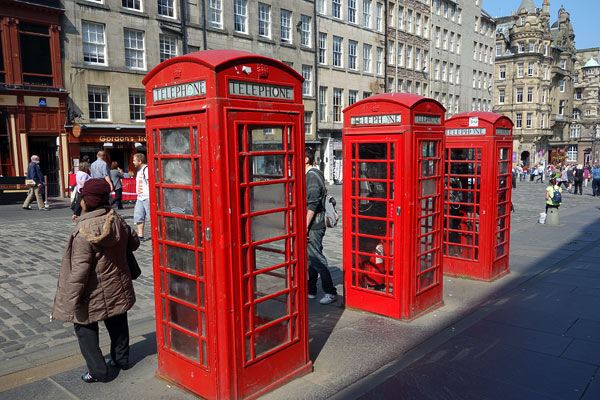
p1-phoneboxThroughout Great Britain, you can see red boxes on the streets that people back in the 20th century would enter in order to make “telephonic” calls to each other. They would put coins in a slot, turn a rotary dial with a sequence of numbers, and then speak through a device connected to the machine by a flexible pipe. These red boxes (which smelled like urine and doubled as handy places for the neighborhood prostitutes to stick their advertisements) were produced for the entire British Isles by a factory in Scotland. Now they are commonly seen no longer on the streets, but decorating nostalgic pensioners’ gardens.

Glasgow Surprises

In recent years, I’ve really been enjoying what I consider the “second cities” of Europe. The Chicagos of Europe don’t get a free ride, and they lack the blockbuster attractions and charming sights that bring everyone to the big-league cultural capitals. These “second cities” often have a rough, Industrial Age heritage that dug them deep into a rust-belt hole with the coming of the Information Age, but enabled them to be honest,  unvarnished, and nonconformist. My list of European “second cities” includes Porto in Portugal, Naples in Italy, Marseilles in France, Hamburg in Germany, Antwerp in Belgium, and Glasgow in Scotland. I find all of these much-improved lately — underrated and great to visit. (Yes, Glasgow’s population is bigger than Edinburgh’s. But given that Edinburgh is the capital and dwarfs its rival from a tourism perspective, this travel writer considers Glasgow an honorary “second city.”)

In part because of my love of Edinburgh and in part because I don’t get to Scotland much, I’ve never seriously considered Glasgow. I thought I’d like it because I liked the Andy Capp cartoon, which I thought was set here. But when I got to Glasgow, I found out that Andy actually “lived” in Newcastle (south of the border, in gritty North England).

But with or without Andy Capp, Glasgow has a wonderful energy. And, being less an hour from Edinburgh by train (with four trains per hour), it’s an easy day trip. I’d say your best “day three” in Edinburgh is to side-trip here for “day one” in Glasgow.

Midway through a very full morning with my guide, Colin, I stopped for a coffee. The busker across the street had charisma, and the people-watching was endearing. Just as I was thinking, “This is so great…where are the Americans?”, two women burst into my video to tell me they’re taking one of our tours.

Enjoy two minutes with an extra-hot latte on what I think of as “the Ramblas of Glasgow”: Buchanan Street.

If you can’t see the video below, watch it on YouTube.

Haggling Over Pyramid Ratings in Our Guidebooks

Our guidebooks have been evolving with annual updates since the first edition of Europe Through the Back Door in 1980. I’m in the midst of month three of my annual four months of guidebook research. But even with four focused months of travel annually, I can’t begin to cover all our chapters. Now I have the joy of a trusted team of writers and researchers that help us meet our goal of covering all of Europe with the best and most lovingly updated guidebooks in print.

Lots of my favorite places have been favorites for literally decades, and we need to constantly reconsider old loves. Last week, I received this thoughtful email from my valued co-author and lead researcher, Cameron Hewitt, who recently returned from a trip to Germany and Britain. He suggested that I reconsider the number of stars (or “pyramids” in our jargon) I awarded to various sights. If you’ve seen our guidebooks, you know how this works:
Each sight gets a rating, from zero pyramids to three pyramids (Δ Δ Δ). As we explain in our books, these ratings mean the following:

Δ Δ Δ  Don’t miss

Δ Δ   Try hard to see

Δ   Worthwhile if you can make it

zero Δ Worth knowing about

These pyramids (like Michelin stars) are carefully and sparingly awarded. They have a real impact on travelers’ itinerary priorities, and we take them very seriously. I agreed with all of Cameron’s suggestions. And, for the upcoming 2014 editions, we have added or subtracted stars for these sights for the reasons explained.

Pyramid-changes

Scotland Tour: All Tours Must Pass

It is always a bit emotional at the end of a tour, when we say goodbye to our bus driver and guide. We have a tour culture where bus drivers eat meals with our groups and are part of the family. Farewells (even with Roddie’s fake over-the-top emotions in this clip) are heartfelt. Our groups pack light, carry their own bags, and take care of the bus as if it’s ours. Drivers appreciate that. And drivers add a wonderful bit of spice to the social and cultural mix.

Our tour guide, Liz Lister (now with three Rick Steves tours — two assisting and one leading — under her belt), has picked up and embraced our quirky style well and clearly enjoys the group.

The party Liz invited the group to is our annual tour reunion party in Seattle. We’ll be flying Liz to Seattle in January (along with our other European guides) for our annual reunion festivities and tour guide summit. Our guides look forward as much as anyone to being reunited with their tour members.

As our tour disperses, I’ll be heading for Glasgow, Berlin, and Prague before meeting Steve Smith in Alsace and then joining up with the crew for TV production in France. Stay tuned.

If you can’t see the video below, watch it on YouTube.