What’s Your Occupation?

While the Holy Land’s troubles are no joking matter, sometimes a little humor can help defuse the tension. I couldn’t help but chuckle at this joke: An Israeli diplomat, when filling out the customs form upon entry in the USA, misunderstood one of the questions, Where it said “Occupation?”, he wrote, “No, just visiting.”

Israel needs to protect itself. That’s obvious and understandable. And there’s a terrible history of terrorists, desperate extremists who will die to kill, and countries that swear they will not rest until Israel is pushed into the sea.

At the same time, one thing that virtually all visitors to Israel and Palestine eventually grapple with is the irony of Jewish people who were so cruelly treated through history — and especially during the horror of the Holocaust — now playing the strongman.

As observers from a distance, we can’t really get an honest picture of the reality here. I might see a news clip of Palestinians destroying a synagogue. It looks so hateful. And then I learn that during a land swap, Israel agreed to give back land upon which they had built a luxurious modern settlement. And, before retreating, they destroyed every building in the settlement except the synagogue. When hardscrabble Palestinians, so poor and needy, walked into their land, they saw only rubble except for one building — and they got mad and destroyed it. It’s ugly both ways.

Today, I sense a commitment among Palestinians to grow beyond violence. (They really have no choice.) In fact, the main job of Palestinian security forces is to support the Israeli forces in keeping angry, pent-up teenagers calm and out of Israeli prisons.

On the other side, among Israelis I met in Palestine (mostly security forces), I noticed a kind of occupier’s vengeance. It’s something most Israelis would not condone, but it’s done in their name nevertheless.

Israelis believe Palestinian children are taught in school to hate Jews. And Palestinians believe Jewish children are taught to hate them. I asked a Palestinian if schoolbooks teach children to hate Jews. He said, “As a parent raising my family under Jewish occupation, it’s my challenge to teach our children not to hate Jews.” I hadn’t considered that angle. But just being a tourist here for a week, I can understand the toll it must take on any “love thy neighbor” person to live in a land where they say, “Mere existence is resistance.”

While edgy political art is commonplace here, I was particularly struck by this mural (in Bethlehem) of a little Palestinian girl shaking down an Israeli soldier. It was only later that I learned it was by the famous British street artist Banksy.

I’ll continue this Holy Land series until November 21st. Then, to celebrate my homecoming, I’ll give a live, free slideshow lecture on Thursday, November 21st at 7 p.m. P.S.T. in Edmonds, Washington. You can attend in person (registration required)…or watch the live webcast from anywhere in the world (no registration required). Learn more at Rick Steves – Holy Land: Israel and Palestine Today.

The Hijab — The Meaning of a Scarf

To show modern Palestine both in its people and its institutions, we popped into Birzeit University. Its campus, at the edge of Ramallah, has an enrollment of about 10,000. With beautiful landscaping connecting modern buildings and a student body that seemed like the future leaders of this young country, the campus was a huge contrast with the intense and chaotic cities.

Strolling through the campus, I sensed a younger generation working hard for a stable and prosperous future. My agenda was to connect with young women and learn a bit about the status of women in Palestine. Along with many other things, I’m curious about the beautiful hijab, or head covering. I’ve noticed that some women throughout the country wear it, while others don’t.
We’ve filmed a series of interviews with people from many walks of life in Israel and Palestine to be used as DVD extras for our Holy Land special (and, I hope, for radio interviews). Our guide set us up with these three women. They were majoring in architecture and civil engineering and spoke English well. We had a delightful conversation about the role of women in a Muslim-dominated society. They all agreed that there were more women than men here in higher education, and that they can do anything if they work hard. Still, the consensus was that a woman’s role is generally to raise children and run the family, while the man’s role is to be out making the money.
The women I talked with agreed that women are free to be individuals in Palestine, and that choosing to wear the hijab was entirely up to them. The woman who covers up is just as socially active and in on all of the jokes and fun. But when she walks in public, she feels she gets more respect.
While a woman on the street wearing a scarf is treated differently, that doesn’t mean she isn’t fashion-conscious. One woman I met told me that she has over a hundred scarves, and each morning, she enjoys choosing one that fits her mood. It’s an ensemble. You never wear pattern-on-pattern or solid-on-solid. If the dress is solid, the hijab will be patterned. And color coordination is important, too. Many women are sure to have toenail polish, handbag, lipstick, and scarf all in sync.

I’ll continue this Holy Land series until November 21st. Then, to celebrate my homecoming, I’ll give a live, free slideshow lecture on Thursday, November 21st at 7 p.m. P.S.T. in Edmonds, Washington. You can attend in person (registration required)…or watch the live webcast from anywhere in the world (no registration required). Learn more at Rick Steves – Holy Land: Israel and Palestine Today.

A Holy Land Miracle

Our work was made much easier by the car and driver provided to us by the Palestinian Ministry of Tourism. It was a long, hot hike down to the Monastery of St. George. Coming up, we were pleasantly surprised by our driver, who managed to drive his car down to a crevice in the mountain, cutting our hike by half.

If you can’t see the video below, watch it on YouTube.

The Desolation of a Monk’s Dreams — The Monastery of St. George

Hiding in folds of the Judean Desert are ancient monasteries which, since ancient times, have given hermits the desolation of their dreams. Orthodox Christians — whether from Palestine, Greece, Russia, or Ethiopia — enliven these monasteries today, as they have since the sixth century. Orthodox Christians maintain a rich and ancient worship style that has not reformed as Catholic and Protestant Christians have. And, logically, their art feels timeless, too. The icons here are a reminder of how, for these monks, the meditation, isolation, and hermetic way of life can all help them to better understand the message and will of Jesus.

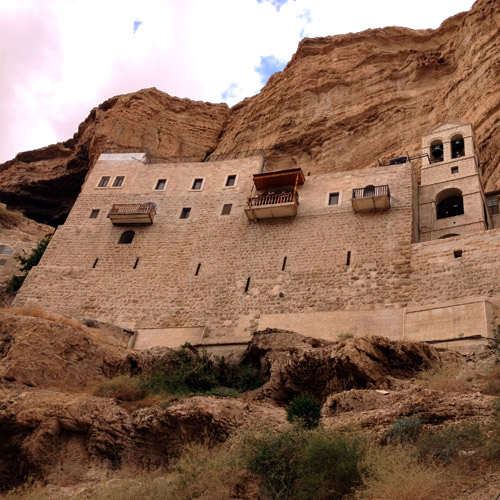
The dramatically set Monastery of St. George welcomes pilgrims and tourists alike. For 15 centuries, the faithful have ventured to this spot, hiked into the ravine, quenched their thirst, and nourished their soul.
Looking up at this imposing monastery — burrowed into its cliff — it almost seems like a mirage in a parched desert. If you want holy solitude, this is clearly the place.
The monks at St. George were very camera-shy. They didn’t want to be “actors.” While they sang to us beautifully off-camera, they told us that filming rooms with just candles was enough.

I’ll continue this Holy Land series until November 21st. Then, to celebrate my homecoming, I’ll give a live, free slideshow lecture on Thursday, November 21st at 7 p.m. P.S.T. in Edmonds, Washington. You can attend in person (registration required)…or watch the live webcast from anywhere in the world (no registration required). Learn more at Rick Steves – Holy Land: Israel and Palestine Today.