Santa Claus: The Many Faces Behind the Beard

christmas-book-santa-tree-bwIn our Rick Steves’ European Christmas book (a companion book to the public television show), we outlined the history and many European variations on Santa Claus. Here’s an excerpt:

Our American Santa Claus — a plump, jolly old fellow dressed in red — is just one of many gift-giving characters who preside over the Christmas season. Depending on where you are in Europe, it’s possible to bump into St. Nicholas, Father Christmas, Père Noël, Samichlaus, Sinterklaas, and others. All are brothers of sorts, tracing their lineage back either to an early Christian saint or a pagan deity. The origin of these multicultural gift-givers is a tangle of folklore, crossed with some early Christian public relations and a dash of modern commercial branding.

Let’s start with the branch of the family that hails from the frozen north. Long before the birth of Christ, there was Odin, father of the Viking gods. Like Santa, Odin was a stout old man dressed in furs with white hair and a long beard. During the winter solstice, Odin rode through the sky on his eight-legged magical horse, Sleipnir, and descended to earth. Disguised in a hooded cloak, he would eavesdrop on Vikings sitting around the campfire, trying to figure out who had been naughty and who had been nice. Occasionally, he would leave a gift of bread for a poor family.

Around the same time in the British Isles, chilly Celts were crowning a Frost King and appealing for leniency during the harsh midwinter months. In the Middle Ages, the legends of King Frost and Odin became associated with the Christian practice of helping the poor at Christmas. Parishes would hire actors in disguise to go undercover through the village, finding needy families, and reporting back to the village priest. In the 16th century, during the party-hearty reign of the Tudors, the character morphed into Captain Christmas, a sort of master of ceremonies presiding over the unruly fun at Christmastide. Banned by Puritan prudes in the 17th century, he re-emerged in the 18th century in plays put on by itinerant players as Father Christmas.

In the 19th-century Victorian era, Father Christmas was portrayed as a bearded pagan wearing robes and a crown of holly, ivy, or icicles, while hoisting a bowl of wassail. Gone were any saintly attributes, but he was a jolly enough fellow who made people happy during the dark days of winter.

Toward the end of the 19th century, Father Christmas was reinvented as the bringer of gifts to children. This probably came about because of the Victorians’ emerging interest in their children, coupled with influences from Europe and America, where St. Nicholas and Santa were popular.

Today, Father Christmas is a kind old gentleman who dresses, depending on his whim, in a long red robe trimmed with fur or a belted red jacket and cap (in which case he is easily confused with Santa, whose nocturnal habits he has also acquired).

Meanwhile, another branch of the Santa Family tree was sprouting from an early Christian monk named St. Nicholas. It’s believed that the historical Nicholas was born in the Eastern Roman Empire (now Turkey) sometime around A.D. 280. Some folklore experts have suggested his life story was probably recycled from tales of various pagan gods and then Christianized. Legends abound about St. Nicholas, who became the bishop of Myra (modern-day Damre, Turkey) and was much admired for his piety and kindness. He was rumored to have given away all of his inherited wealth to travel the countryside helping the poor and sick. He kept an especially watchful eye on orphans, occasionally giving them gifts; over the years, his reputation grew as a compassionate protector of children.

According to one story, he prevented three poor sisters from being sold into prostitution by their destitute father. Nicholas provided them with a dowry, so they could be married. The legend grew that he gave the money anonymously by tossing bags of gold through a window, or perhaps down the chimney. The gold landed in the girls’ stockings (some versions swap stockings for shoes), which had been left by the fire to dry.

By the Middle Ages, St. Nicholas was the most popular saint in Europe. On the eve of his Feast Day, December 6th (the anniversary of his death), a bearded, robed man appeared in every village, passing out gifts to children and the poor.

In many lands, there were now two Christmas figures — the Christian St. Nicholas (commemorated on December 5th and 6th) and the pagan party animal who became Father Christmas (December 24th, 25th, and beyond). Over the centuries, different cultures merged these two figures, some emphasizing one legend over the other, some celebrating on the 6th, some on the 25th, some both. Today, a European Christmas brings the whole extended Santa Family together as you can see in our chart of Santa’s Family Tree.

Early American settlers had strong ties with the Christmas traditions of England. In the 17th century, Dutch immigrants brought the story of St. Nicholas to America. Americans loved the custom, but had trouble pronouncing the name. The Dutch “Sinterklaas” became “Santa Claus,” and the name stuck. Our modern Santa Claus is an amalgam of European traditions, combining the kindly, gift-giving St. Nicholas and the mischievous, fun-loving Father Christmas.

Today’s image of the American Santa Claus — the jolly fellow with the apple cheeks and twinkling eyes — came by way of a German immigrant who published his illustrations in Harper’s Weekly in the late 1800s. This magnanimous Santa Claus was a boon to shopkeepers during a period of unprecedented growth in retailing — department stores, chain stores, and new-fangled billboards. They joyfully exploited the commercial potential of an entire season dedicated to gift giving, brought to you by Santa. In the 1930s, the Coca Cola Company, in need of a sales boost, borrowed Santa’s image and branded their product with the merry ol’ gent… thus completing his epic journey from saint to salesman.

Today, in many parts of Europe, there’s a movement to preserve the tradition of St. Nicholas, who’s at risk of being crowded out by the American Santa. Some villages are even creating Santa-free zones. They see Santa as a super-size symbol of consumption. St. Nicholas, they argue, embodies the real Christmas spirit, a monk whose example taught that giving doesn’t make us poorer — it makes us richer.

Christmas: Not a Day, but a Season

christmas-nativityIn the seven countries we visited to film Rick Steves’ European Christmas, Christmas is more than just December 25th — it’s a season that lasts for more than a month. This isn’t to give people more time to shop, but to fit in all of the holy days and festivals.

First comes Advent, the time to anticipate the “arrival” (advent) of the baby Jesus. Advent begins four Sundays before Christmas Eve. In Europe, this truly is the start of Christmas, since advertisers are reluctant to commercialize the season any earlier.

Next up is the Feast of St. Nicholas, celebrated mostly in Catholic countries with lots of gift giving on the eve or day of December 6th. In some countries, St. Nicholas’ Feast is even bigger than Christmas Day.

December 13th brings Santa Lucia Day — a highlight in Scandinavia, when young girls decked out in candles lead processions promising the return of the light.

For many Europeans, Christmas Eve is the main event, celebrated with Midnight Mass and a grand meal. Others concentrate on the family time and gift giving of Christmas Day.

But for those who really get into the holiday spirit, December 25th is just the start. The Twelve Days of Christmas — featuring more parties, gift giving, and the ringing in of the New Year — stretch from December 25th until January 5th. This period is followed by Epiphany (January 6th), the day the Three Kings delivered their gifts. The Christmas season finally goes into hibernation after this…until next year.

The Roots of Christmas: From Sun Worship to Son Worship


christmas-wheat-wreathAs I’m reflecting on the making of my Rick Steves’ European Christmas television special, CD, and companion book, I wanted to share this book excerpt, which outlines how much of our contemporary notion of celebrating Christmas actually has prehistoric and pagan roots:

For as long as people have shivered in the winter, they’ve celebrated the beginning of its end. For ancient people of Europe, midwinter was known as the Yuletide, meaning the “turning of the sun.”

Imagine you’re living in the cold of northern Europe before the birth of Christ. Your gods are the mysterious forces of nature:  the sun, rain, and wind. In summer, it’s warm, plants grow, and food is plentiful. Then it gets cold and dark, and the earth becomes frozen and bleak.

Just when everything looks darkest — around December 21st, the winter solstice, the longest night of the year — what do you do? You throw a party! And, slowly but surely, the cycle turns. Your sun god, who’d been weak and sick, is now on the mend, spring is coming, and once again life is returning to your world.

For the prehistoric people of Europe, late December — though dreary and dark — was the perfect time to celebrate. Why? Because they had fresh meat and good grog to celebrate with: In December, villagers often slaughtered the cattle they couldn’t afford to feed through the winter, so this was the only time of year when many of them had fresh meat. Also, wine and beer made earlier in the year had finally fermented and were ready to drink. Time to party!

The pagan Romans conquered the pagan Celtic people around 50 B.C. The Romans called their solstice festival Saturnalia, and it was marked by feasting and good-natured goofiness. Then, as Christianity slowly spread through Rome — becoming the empire’s chief religion by the fourth century A.D . — the midwinter celebration got a new twist.

In the first few centuries of Christianity, Easter was the primary holiday — Jesus’ birthday wasn’t even celebrated. The Bible doesn’t say exactly when Jesus was born, and what it does say — that “shepherds were herding their flocks” — suggests spring rather than winter. But in the year 350, Pope Julius I decided to make the birth of Jesus a holiday, choosing December 25th. Politically, it was a clever choice, because the young religion (legal for less than a century) could then adopt and absorb the traditions of the immensely popular Saturnalia. The fun-loving spirit of the pagan festival dovetailed nicely with the joyous welcome given to the Christ child. By the mid-fifth century, the Feast of the Nativity — as Christmas was first called — was celebrated from Egypt to England.

By the Middle Ages, Christianity had largely replaced pagan religions. But the hedonistic partying of pre-Christian religions was inextricably woven into Christian celebrations. On Christmas, believers attended church, and then got wild and crazy.

Though church leaders would have preferred to celebrate with more reverence than revelry, pagan customs survived: People still sang in roving bands, shared bowls of wassail (spiced wine), performed farcical plays, and exchanged gifts at New Year. Most medieval lords provided a Christmas feast for their tenants and made the 12 days of Christmas a holiday from work, so for many people, Christmas was as much about feeding the body as feeding the soul. From these festive rituals — long celebrated around the winter Christian holy days — many sacred observances emerged that are still beloved by the faithful as integral parts of their Christmas celebrations.

Top Ten Things to Do in Paris at Christmas

You probably won’t be able to jet over to Paris for Christmas. But if you could, here are ten fun things to do (excerpted from the Rick Steves’ European Christmas book). Read these and imagine a Joyeux Noël in the City of Light:

Manèges de Noël: Christmas Carousels  These seasonal merry-go-rounds pop up in every neighborhood in Paris. The biggies are at Hôtel de Ville and the Eiffel Tower, but more fun are the charming manèges in less touristy neighborhoods.
Manèges de Noël: Christmas Carousels
These seasonal merry-go-rounds pop up in every neighborhood in Paris. The biggies are at Hôtel de Ville and the Eiffel Tower, but more fun are the charming manèges in less touristy neighborhoods.
Lick a Window The French phrase for "window shopping" is lèche-vitrine — literally, “window licking.” Big department stores compete with one another for the most fabulous window displays of animation and whimsy. French parents dress up their kids and come from all over the country to compare the windows of the three great Parisian department stores: Galeries Lafayette, Printemps, and Bon Marché. Thoughtfully, the stores provide wooden steps at the windows so that even the tiniest tot can get a good view.
Lick a Window
The French phrase for “window shopping” is lèche-vitrine — literally, “window licking.” Big department stores compete with one another for the most fabulous window displays of animation and whimsy. French parents dress up their kids and come from all over the country to compare the windows of the three great Parisian department stores: Galeries Lafayette, Printemps, and Bon Marché. Thoughtfully, the stores provide wooden steps at the windows so that even the tiniest tot can get a good view.
Slurp an Oyster in the Marais To eat an oyster in public: Make sure to cut under the oyster so that it is completely separated from the shell. Then tip the shell toward your mouth, causing the oyster to slide forward and down into your mouth — but whatever you do, don’t let any stray oyster juice run down your chin. Slurp!
Slurp an Oyster in the Marais
To eat an oyster in public: Make sure to cut under the oyster so that it is completely separated from the shell. Then tip the shell toward your mouth, causing the oyster to slide forward and down into your mouth — but whatever you do, don’t let any stray oyster juice run down your chin. Slurp!
Pony Rides Take the little people to Luxembourg Garden to ride the ponies or (sometimes at Christmas) donkeys. If you’re lucky enough to be there when the donkeys are, tell the kids about pregnant Mary and Joseph riding the donkey to Bethlehem.
Pony Rides
Take the little people to Luxembourg Garden to ride the ponies or (sometimes at Christmas) donkeys. If you’re lucky enough to be there when the donkeys are, tell the kids about pregnant Mary and Joseph riding the donkey to Bethlehem.
Chocolate Shopping Buy your best friend a box of chocolates from one of  La Maison du Chocolat boutiques, run by Robert Linxe, the high priest of Paris chocolate. Specialties include jewel-like bonbons with lemon, mint, and ginger-infused fillings. The lines go out the door at Christmastime, so allow plenty of time for your visit. La Maison du Chocolat has seven boutiques in Paris.
Chocolate Shopping
Buy your best friend a box of chocolates from one of La Maison du Chocolat boutiques, run by Robert Linxe, the high priest of Paris chocolate. Specialties include jewel-like bonbons with lemon, mint, and ginger-infused fillings. The lines go out the door at Christmastime, so allow plenty of time for your visit. La Maison du Chocolat has seven boutiques in Paris.
Avante-Garde Trees Visit the annual exhibition of Christmas trees created by top couturiers and designers at the Centre Pompidou. The “trees” don’t look much like your standard evergreen; they’re Christmas concoctions with something vaguely tree-like about them. Creations are by turns wickedly funny, seductive, political, lovely, and just plain weird. It’s a fun exhibit, and your entrance fee goes to a French charity that assists orphaned children.
Avante-Garde Trees
Visit the annual exhibition of Christmas trees created by top couturiers and designers at the Centre Pompidou. The “trees” don’t look much like your standard evergreen; they’re Christmas concoctions with something vaguely tree-like about them. Creations are by turns wickedly funny, seductive, political, lovely, and just plain weird. It’s a fun exhibit, and your entrance fee goes to a French charity that assists orphaned children.
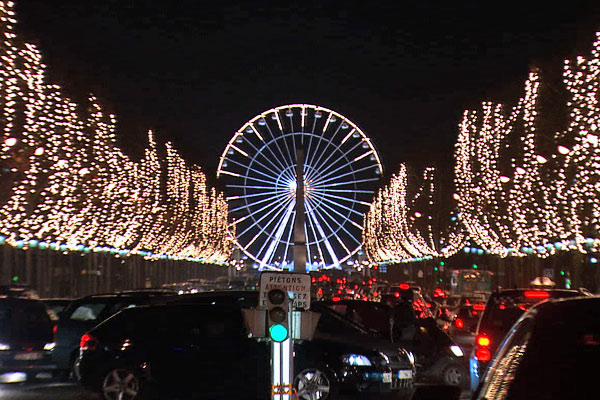
The Champs-Elysées and the Eiffel Tower Bundle up, wander over to the Champs-Elysées, and walk the length of the boulevard, with its fairy forest of twinkling trees. Time it so that you can walk (or take the Métro) over to Trocadéro square in time to see the lights on the Eiffel Tower shimmer — on the hour for five minutes every night until midnight.
The Champs-Elysées and the Eiffel Tower
Bundle up, wander over to the Champs-Elysées, and walk the length of the boulevard, with its fairy forest of twinkling trees. Time it so that you can walk (or take the Métro) over to Trocadéro square in time to see the lights on the Eiffel Tower shimmer — on the hour for five minutes every night until midnight.
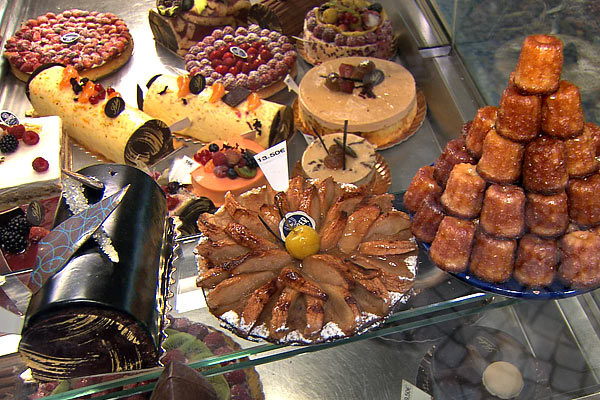
Pastries, Pastries, Pastries Indulge yourself with a bûche de Noël (yule log) from the oldest pâtisserie in Paris. One day in 1730, Queen Marie Leszczyńska, daughter of the king of Poland, stopped in Strasbourg on her way to Versailles to marry Louis XV and met a pastry chef named Störher. She fell in love — not with the chef, but with his famous puits d’amour (“wells of love,” chocolate cups filled with a rich, creamy custard). The Queen offered him a job, and Störher packed up, opened up a pâtisserie in Paris, and became famous. Even the Queen of England couldn’t resist a stop at Ströher’s on her last trip to Paris. (It’s at 51 rue Montorgueil.)
Pastries, Pastries, Pastries
Indulge yourself with a bûche de Noël (yule log) from the oldest pâtisserie in Paris. One day in 1730, Queen Marie Leszczyńska, daughter of the king of Poland, stopped in Strasbourg on her way to Versailles to marry Louis XV and met a pastry chef named Störher. She fell in love — not with the chef, but with his famous puits d’amour (“wells of love,” chocolate cups filled with a rich, creamy custard). The Queen offered him a job, and Störher packed up, opened up a pâtisserie in Paris, and became famous. Even the Queen of England couldn’t resist a stop at Ströher’s on her last trip to Paris. (It’s at 51 rue Montorgueil.)
The City of Light’s Lights  Walk up and down the Boulevard Haussmann admiring the fabulous lights at Printemps and Galeries Lafayette. Try to guess how many bulbs it took to create Galeries Lafayette’s illuminated canvas. (Hint: Last year, it was 150,000.)
The City of Light’s Lights
Walk up and down the Boulevard Haussmann admiring the fabulous lights at Printemps and Galeries Lafayette. Try to guess how many bulbs it took to create Galeries Lafayette’s illuminated canvas. (Hint: Last year, it was 150,000.)
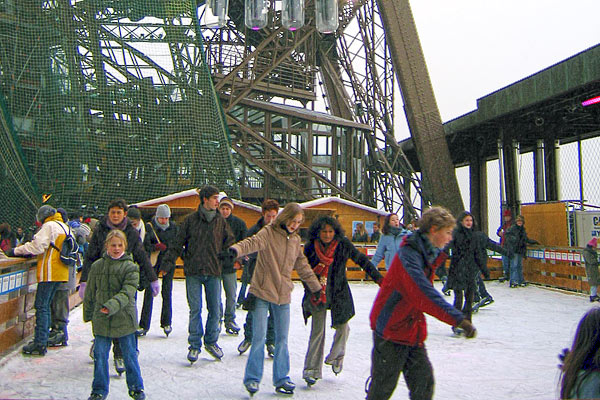
Ice Skating at 200 Feet Put on something chic and cozy. Then ride the elevator to the first level of the Eiffel Tower to glide on Paris’ highest ice-skating rink and gaze at the city’s domes, towers, and rooftops — the City of Light illuminated for the holiday season.
Ice Skating at 200 Feet
Put on something chic and cozy. Then ride the elevator to the first level of the Eiffel Tower to glide on Paris’ highest ice-skating rink and gaze at the city’s domes, towers, and rooftops — the City of Light illuminated for the holiday season.

The 12 Days of European Christmas: Filming (and Celebrating) Christmas All Across Europe

ROnce upon a time, for the 12 days of Christmas, we had two busy television crews a-filming: 12 carol concerts, 11 mugs of Glühwein, 10 living mangers, 9 happy families, 8 Christmas feasts, 7 Euro-cultures, 6 mistletoe kisses, 5 alternative Santas, 4 pounds of weight gain, 3 midnight Masses, 2 exhausted cameramen, and a festive hour of great new public television. (Go ahead, sing it.)

During the 2005 holiday season, my crew and I enjoyed producing a one-hour public television special we hoped would be around for many Christmases to come. As it turns out, stations all over the country air this to audiences who have come to think of watching the show as part of their holiday tradition. For a little holiday cheer here on Facebook, I’m kicking off a “12 Days of Christmas” series of video clips from our experience there.

From England to Norway, Burgundy to Bavaria, and Rome to the top of the Swiss Alps, our mission was to get you a seat at the family feast, save you a pew up in the lofts with the finest choirs, and hand you a rolling pin in Grandma’s kitchen as she labored over her best-kept holiday secrets. We joined Romans cooking up female eels, Parisians slurping oysters, Tuscans tossing fruit cakes, and Norwegian kids winning marzipan pigs. Exploring the rich and fascinating mix of traditions — Christian, pagan, commercial, and edible — we learned lots about the holiday festivities we know and love today and packed it into this special program.

Rather than feature a bunch of shopping malls and Christmas markets, our goal was to get an inside look at sacred, traditional, intimate family Christmas celebrations. We wanted to feature diverse cultures whose colorful yuletide traditions would be appreciated by American families whose ancestors emigrated from those places. Our goal: to give our viewers a look at European Christmas through the eyes of a child, a parent, and a pilgrim. This was not a “happy holidays” sales gimmick, but a true celebration of Christmas. As the increasing commercialization of the holiday season has driven me abroad for several recent Christmases, I was happy to take our crew to a continent where people aren’t counting the shopping days left until Christmas.

So, get ready. Starting tomorrow, for the next couple of weeks, we’ll enjoy a daily dose of European Christmas right here.