Launching winter 2015 dates for 10 great European tour itineraries

winter-tours-image


For 30 years we’ve led our tours of Europe through “the season”–roughly April through October. And now, by popular demand from the many people who want cheaper airfares and the peace of off-season travel, we are ready to give “winterize” a whole new and happy meaning.

We’ve just launched our winter 2015 dates for 10 great itineraries. Why just 10? Not every destination is a good fit for February-March travel, but the ones we’ve chosen really transcend the seasons: Barcelona-Madrid, London, Paris, Rome, Venice-Florence-Rome, Heart of Italy, Sicily, Greece, Istanbul, and Turkey. For a smart traveler, when it comes to these exciting destinations, “winter” is a great idea.

Some of my warmest European memories have been in the off-season. We’d like to help you enjoy the same experiences this next February or March!

Food Police, My Evil Twin, and a Culinary Faux Pas

Thanks for all your thoughtful replies to the video clip about the cobbler in Orvieto and the plight of artisans in our modern world. The video was produced by Steven Brenner, and receiving it from him reminded me of a different, yet equally creative, effort from Steve.

This little clip shows how my evil twin tried to get away with putting Parmesan cheese on spaghetti with clams. Fortunately, he was scuttled by three little members of Rome’s heroic food police.

Watch more of the Food Police’s adventures at foodpolice.it and learn more about the producers at cross-pollinate.com and orvietoorbust.com.

Can We Save Artisan Europe?

Recently I was visiting with the last man in Rothenburg, Germany, to make etchings in the style of Albrecht Dürer. He’s in failing health and in about a year, his 3,000 lovingly etched copper plates will be retired and parked in some obscure museum’s basement. Friends in little towns on the Rhine are lamenting how the younger generation is not following in the footsteps of their family businesses and, as they flee to the energy of the big cities, their parents’ businesses just fade away. The artists who craft handmade guitars in Madrid, the family winemakers of Burgundy, the fisherman who sells his shrimp on the Oslo harborfront–these have all been fixtures of Europe for me in a lifetime of travels. What will become of all these rich facets of local culture when the younger generation opts out? Of course, I can’t blame the children of the artisans for jumping into the modern rat race any more than I’m guilty for not being an old-school piano technician like my dad. But it is worth considering how the future will look when economic scale and efficiency trumps artisan values.

My friend, Steven Brenner (who runs Cross-Pollinate, with some of my favorite budget beds in Rome and beyond) produced a little video that eloquently says what I’ve been thinking lately about artisans in Europe. Check out this short video featuring a young cobbler in Orvieto, Italy, who, in the simple words of a traditional, small-town artisan, captures perfectly an art form we are all losing.

What are your favorite experiences that celebrate the artisan way of life in Europe?

Amsterdam’s Tram Corridor is a Boon to Sightseers

R

When covering Europe, I enjoy raising awareness of public transportation routes that fit the needs of travelers. In Amsterdam there’s a sightseeing spine right through the city center that goes past the Rijksmuseum and this “I amsterdam” sign. Conveniently, this spine is a tram corridor: Trams #1, #2, and #5 come by every two minutes. Taking advantage of this route empowers any visitor. Here’s a new sidebar I wrote for the next edition of our Rick Steves Amsterdam guidebook about this transit spine:


Amsterdam’s Spine by Tram

Tram #1, #2, or #5 from Central Station to Leidseplein (and Museums)

Amsterdam becomes much easier to get your brain around when you master the tram #1, #2, and #5 corridor. As if made for the sightseer, this main tram thoroughfare makes connecting the main train station, the Jordaan neighborhood, my recommended hotels, and the museum zone amazingly easy. The entire ride takes about 20 minutes, with trams zipping by about every two minutes. Use this route for an overview and to lace together major sightseeing spots in the city. At any point you can simply hop off, cross the street, and catch a tram heading back exactly where you came from. A single €2.80 ticket is good for an hour–or you can get the all day or multi-day passes (all sold on the tram). Starting at Amsterdam’s Central Station, here are the stops (and what you need to know about each):


Centraal Station

This is the first and last stop. All #1, #2, and #5 trams starting here are heading in the correct direction. Nearby: The free ferry across the IJ, the starting point for the Rick Steves Audio Europe Amsterdam City Walking Tour, a transportation hub (airport shuttle, bus station, trains, many other trams, subway), bike rentals, the Red Light District, and the start of Damrak (the city’s main drag).


Martelaarsgracht

Notice how the street is wide: Wide streets are generally former canals filled in. (Hint: “gracht” means canal.) Nearby: The Haarlemmerstraat shopping district.


Nieuwezijds Kolk

(nothing of interest nearby)


Dam

You’ll roll by the back side of the towering New Church and Royal Palace on the left. Nearby: Dam Square, Anne Frank House, and the starting point for two Rick Steves Audio Europe tours: Jordaan and Red Light District.


Spui

Pronounced “shpou” (rhymes with cow)–which meant “spew”–this square is where water was once pushed away over a dike. Nearby: Amsterdam History Museum, Begijnhof, University District, bookstores, and the Nine Streets (elegant shopping zone).


Koningsplein

From Spui, the tram turns right. Over the next few stops it crosses four canals: Singel, Heren, Keizers, and Prinsen. Remember the memory aid: “A Single Hairy Kaiser’s Prince really knows his canals.” Nearby: Mint Tower and the flower market.


Keizersgracht

Here the street fills with people and gets so narrow that trams share one set of rails, and bikers are required to walk their bikes. Nearby: The vibrant shopping district of modern Amsterdam.


Prinsengracht

You’ll roll past more shops and more pedestrians.


Leidseplein

This is the tourists’ nightlife center with the famous Bulldog Café and Coffeeshop (a former police station that now sells pot). You’ll find venerable, edgy nightclubs and concert venues like the Melkweg and Paradiso, plus the city theater (Stadsschouwburg). From here, trams #2 and #5 leave the old town, cross the outermost canal, pass an entry to Vondelpark, and head for the Rijksmuseum. (If you’re on tram #1, hop out at Leidseplein.)


Rijksmuseum (tram #2 and #5 only)

This is the start of the museum zone with a popular park (with a pond and much photographed “I amsterdam” sign) and several great museums. Nearby: Rijksmuseum, House of Bols Cocktail & Genever Experience, and Costers Diamonds (diamond cutting and polishing).


Van Baerlestraat (tram #2 and #5 only)

Jump out here for the Van Gogh Museum or the Stedelijk Museum.


Jacob Obrechtstraat (tram #2 only)

Here you leave the commotion of the city–and its tourists–and are in a district of high-end apartments. The inviting Café Gruter faces the tram stop. Nearby: The entry to Vondelpark (with the recommended Blue Tea House).

Traveling in the Netherlands Beyond Amsterdam


Traveling around the Netherlands, I found a number of delightful towns with historic centers that evoke the days of Henry Hudson. Delft, Haarlem, Leiden, and Hoorn were my favorites. The vast majority of visitors to the Netherlands see only Amsterdam. While these other towns are all variations on the same theme, the small historic Dutch cities outside of Amsterdam are important to consider–and all are well within an hour by train.

R

Hoorn has a salty allure, even though the salt is gone now that the Zuiderzee has been dammed and turned into a big freshwater lake. Still, Hoorn’s harbor evokes a time when Dutch vessels dominated much of the seagoing economy.


dutch-golden-age-fashion-ruff

The Dutch Golden Age, the 16th and 17th centuries, was a time when people went to apparently ridiculous lengths to show off their wealth. What was a simple collar became not just a ruff, but a super-duper ruff. This woman’s husband must have been a very successful merchant.


dutch-masters-painting

Seeing these Dutch masters plotting with their globe and their greedy aspirations, I found myself singing, “We are the world…”


police-taking-jet-skis

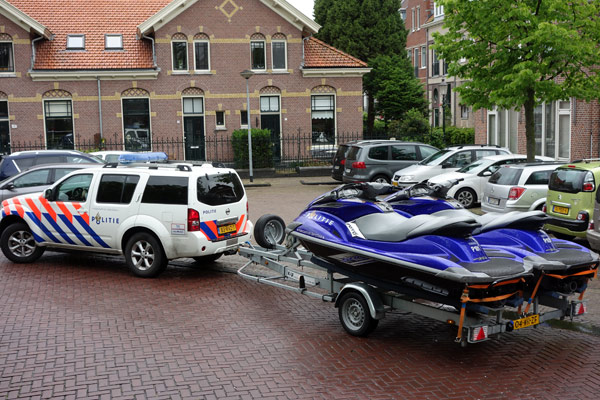
The Dutch enjoy getting drunk on their vacation boats. And just as you can’t drink and drive a car, in the Netherlands you can’t drink and sail a boat. The Dutch police enjoy zooming in on their police jet skis to crash the party. I’m sure just the presence of this trailer with a pair of these zippy machines served as a sobering reminder to yachters enjoying a break in the Hoorn harbor.