The Scream, by Edvard Munch, seems to be everyone’s favorite Norwegian painting. The spot (in Oslo’s Ekeberg Sculpture Park) where Munch actually painted it now has a framed replica, so anyone can do their own scream. If you ever just feel like screaming, this is a great spot.
The buzz in Oslo is its new modern sculpture park, just opened in 2013, with stimulating art sprinkled through a forest with grand city views.
The 63-acre park is a 10-minute tram ride southeast of the center. The project was a gift to the city from the Ringnes family (the Norwegian brewery tycoon, who — like Coors in Denver and Carlsberg in Copenhagen — has lots of money for grand city projects).
The park has a long history, from evidence of the Stone Age people who chose to live here 7,000 years ago, to the memory of this being a Nazi military cemetery in WWII.
Today, its unique feature is the many modern art installations you’ll come upon as you hike — like this work, by Tony Oursler.
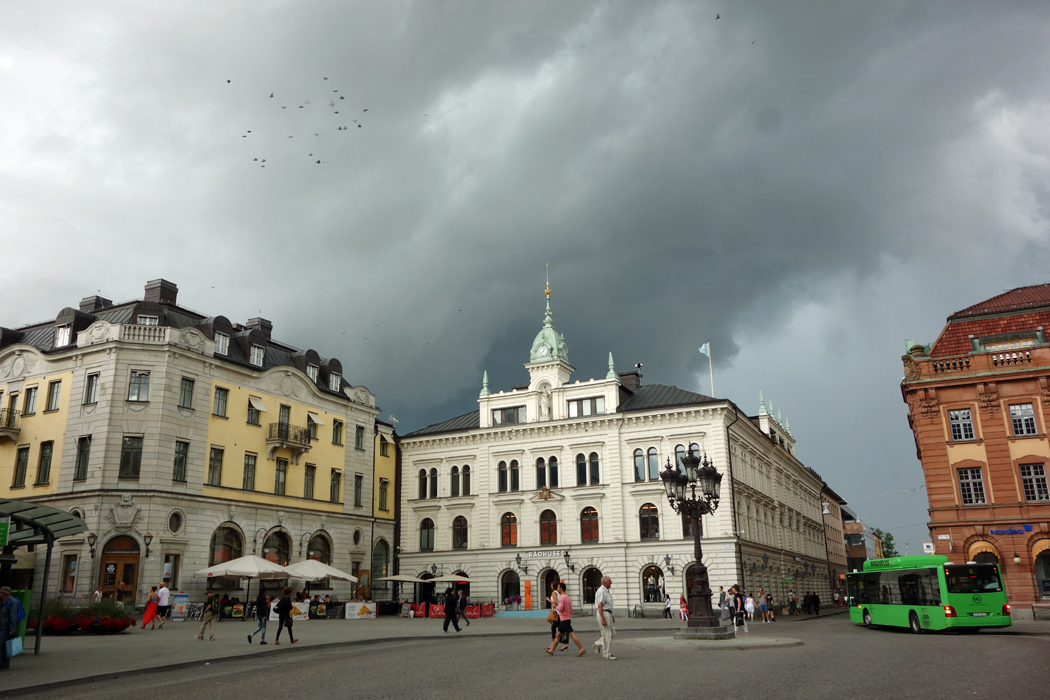
This shot (in Sweden’s Uppsala) shows weather I’ve experienced almost every afternoon for the last month. Throughout northern Europe, it’s been extremely hot and muggy. With all that moisture sucked up into the atmosphere, around 4 p.m. every afternoon, dark clouds descend, birds rush for cover, you smell that metallic dusty fragrance sidewalks give off just before a deluge, and the sky unloads — sending everyone scrambling.
By the way, do you know what I mean about that delightful scent a dry sidewalk gives off before a big rain? What is that, anyway?
Norwegians try to be open to immigration. But like any small, homogeneous society that does not have a melting pot heritage, assimilating lots of immigrants is a challenge here. I was almost shocked by signs on the trams reading “Going Home with a Future: For information about voluntary return, contact…”
When I asked my Norwegian friends about this delicate issue, they explained that they see two kinds of immigrants: those who want to become Norwegians, and those who just want to work hard for a while, earn some serious money, and go home and be set up. But many immigrants from that second category kind of get stuck here, never intending to really settle in, unhappy, and a drag on Norwegian society. This program is hoping to nudge those who wish to return to their homeland…with a little help from the Norwegian government.
One of the most enjoyable activities in Oslo is to ride the subway to the top of its Akers River Valley and stroll downhill through a long riverside park — once the city’s churning industrial zone, with factories belching and waterwheels spinning.
The Akers River, though only about five miles long, powered Oslo’s early industry: flour mills in the 1300s, sawmills in the 1500s, and Norway’s Industrial Revolution in the 1800s.
Along the way, I was chatting with my Norwegian guide, Aksel (who’d never heard of a “pledge drive”), about how different countries pay for their public broadcasting. I was astounded by how much Norwegians are taxed just to own a TV, but those I talked to all seemed to understand the value of quality news (that doesn’t need to be dressed up as entertainment in order to sell ads and be viable), high culture accessible to the masses, children’s programming that isn’t a tool of corporations marketing things to kids, and World Cup coverage with no commercial breaks.
I spend a lot of time traveling around the USA during pledge drive season to explain to Americans why they should kick in $100 or so a year for public broadcasting. This Norwegian and his countrymen value public broadcasting at the rate of $500 a year per family, and willingly pay that tax just to own a TV. I should bring this Norwegian with me to my next pledge drive.