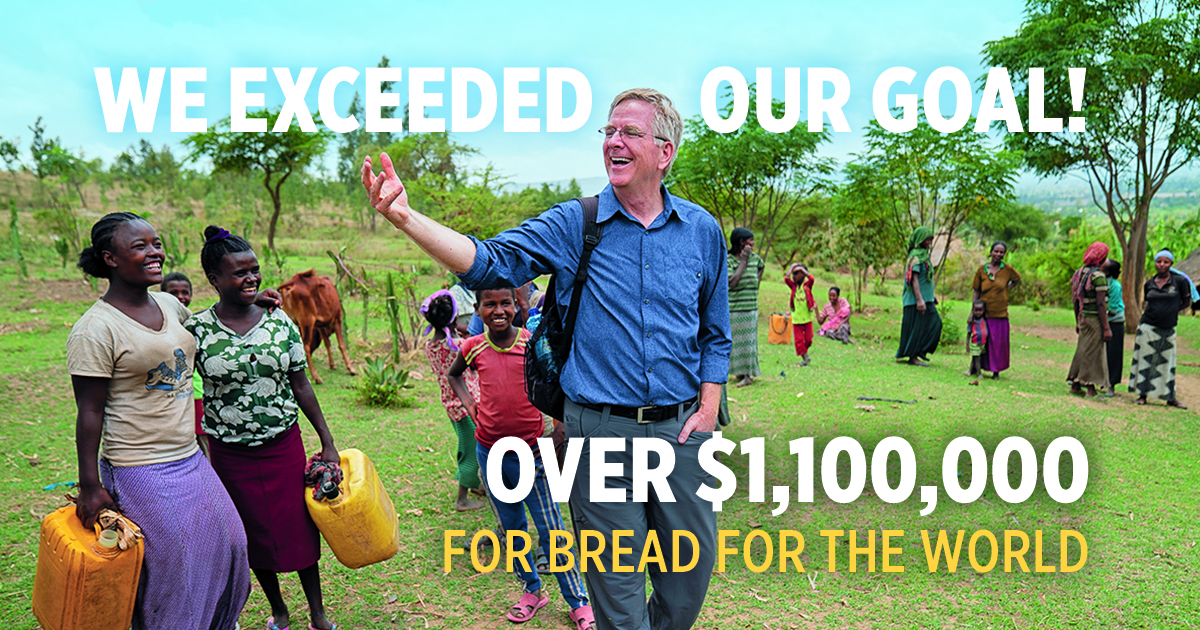
Together, we hit our goal: raising $1,000,000 to empower Bread for the World

$1,000,000 for Bread for the World!

Congrats! Together, we hit our goal: raising $1,000,000 to empower Bread for the World.

I just got great news: the final update from Bread for the World about our holiday fundraiser. (Gifts just kept coming in, well into January.) At total of 3,435 of you participated — and together, you donated $425,810. With my $700,000 “double match” (of the first $350,000), we raised just over $1.1 million — far exceeding our million-dollar goal — to help build the political will to end hunger. Just thinking about what this money will accomplish fills me with joy and gratitude…and pride in the big hearts of my fellow travelers.

When I rave about the work of Bread for the World (as I have for 30 years), people often ask, “Just what does it do?” And when I say that it’s a lobbying organization, some people react with, “Why would you pay for lobbying when you’re fighting hunger?” I explain that “lobbying” is actually advocacy — and it’s more important and impactful than ever, with the Trump Administration pushing harsh policies that threaten great harm to hungry and vulnerable people.

Let me be specific. In 2019, Bread for the World — with our support — played a key role in three important advocacy achievements:

  • Bread for the World mobilized its nationwide network of grassroots activists to build broad, bipartisan support in Washington for US leadership against child malnutrition overseas. Smart, new-style nutrition programs have reduced the number of stunted children around the world by 15 million in the last 7 years. Congress and the Trump Administration committed themselves to continue US support for these programs.
  • Bread also plays a leadership role on funding for programs that help hungry and poor people in our own country. Bread and its partners have successfully resisted cuts to poverty-focused programs throughout the budget controversies of the last decade. And at the end of 2019 — rather than cutting these programs — Congress actually approved a long-overdue increase in funding for low-income programs (Head Start, low-income schools, child nutrition, and housing).
  • Bread for the World is also leading the faith community in urging the presidential candidates to focus on help and opportunity for hungry and poor people. So far, eight Democratic candidates have posted short video statements.

2020 is a critical year in the fight against hunger. It will set long-term directions for our nation and the world, for better or worse. Bread for the World is a key player in Washington, giving a voice to the hungry. Fighting hunger is both ethical and practical — it’s the right thing to do, and it makes our world safer and more stable. In short, it’s a great investment.

I know we all have a lot on our plates these days. But many people, at home and abroad, have the opposite problem. And — thanks to the collective effort of more than 3,400 of you — we’re making a huge difference. Our friends at Bread for the World report that our initiative has injected palpable energy into the organization at the beginning of a crucial election year. If you care about ending hunger…Bread gets it done. Thanks, and congratulations to all involved!

Iran: If You’re Going to Bomb a Place, You Should Know Its People First

Iran: Yesterday and Today

A decade ago, I traveled to Iran to better understand a country with whom we seemed perennially on the verge of war. I came home with a one-hour public television special (“Rick Steves Iran: Yesterday and Today”) that attempted to understand the Iranian psyche and humanize the Iranian people. I believe if you’re going to bomb a place, you should know its people first. Even if military force is justified, it should hurt when you kill someone.

Some things just don’t change. America is, once again, on the verge of war with Iran. And, just like a decade ago, we are not prepared for that reality. As a nation, we don’t adequately understand Iran. From my travels there, it’s clear to me that Americans underestimate both Iran’s baggage and its spine.

“Baggage” shapes a country’s response to future challenges. In the USA, our baggage includes the fight against socialism during the Cold War and the tragedy of 9/11. Iran’s baggage has to do with incursions from the West. Examples include 1953, when the US and Britain deposed a popular Iranian prime minister (after he nationalized their oil) and replaced him with the Shah; and the 1980s, when — with US funding — Saddam Hussein and Iraq invaded Iran, leaving hundreds of thousands of dead soldiers on Iran’s Western Front.

Iran is a proud and powerful nation of 80 million people — long a leader in its corner of the world. When I was in Tehran filming my TV special, I went to the National Museum of Iran expecting to film art from the great Persian Empire (the “Empires of Empires” ruled centuries before Christ by great leaders like Cyrus, Darius, and Xerxes). I found almost nothing. Apologetically, the curator explained, “You’ll need to go to London or Paris. Iran’s patrimony is in the great museums of Europe.” This is baggage.

The Iranian Revolution of 1979, which deposed the US-friendly Shah, is seen in the USA as a terrible thing. It led to the rise of the ayatollahs and the taking of 52 American hostages (which — speaking of baggage — is why our president recently threatened to bomb 52 targets in Iran). But traveling in Iran, I heard a different narrative: The revolution was a people’s uprising in the context of the Cold War, as Iran’s young generation wanted to be neither East nor West (independent from the USA or USSR realms).

If you don’t know Iran (as, I fear, is the case with our country’s decision-makers), it would be easy to underestimate their spine. Filming there, I was impressed by the caliber and the goodness of the people on the street — and haunted by a feeling that we could easily radicalize them with a reckless foreign policy.

I’m no diplomat, and I realize that Iran is a challenging puzzle to solve. It seems we will always be in conflict with Iran, and the answers will never come easy. But surely whatever we do should be built upon a foundation of understanding: We must get to know Iran on its own terms. We would be foolish not to recognize its baggage — and not to appreciate its spine.

My public television special, “Rick Steves Iran: Yesterday and Today,” is as timely and important today as it was when we first released it in 2009. Back then, when people asked me why on earth I was making a TV show about Iran, I told them, “I believe if you’re going to bomb a place, you should know its people first.” And I believe that now more than ever.


Temple of Queen Hatshepsut

For ancient Egyptians, the Nile — which flows from south to north — divided their world into two logical halves. They lived on the east bank where the sun rose each morning and they buried their dead on the west bank, where the sun also died each evening. And, as nearly all the ancient art tourists travel to see is funerary, nearly all the sights (for example, the 60 or so pyramids) are, logically, on the West Bank.

For five centuries in the second millennium BC, Luxor was the capital of Egypt. And its West Bank is famous for its hidden tombs (buried deep in the mountains to be sure they weren’t looted) and for high-profile temples (scattered prominently to be sure dead pharaohs weren’t forgotten). Here are some thoughts from the mortuary temple of a rare female ruler, Queen Hatshepsut (and why she had to wear a beard).

Preparing to Film Dinner in Alexandria, Egypt

When we film a dinner in a restaurant, I like to eat there the night before to make friends with the wait staff, learn the rhythm and quirks of the place, reserve the best table for the cameraman’s needs, and learn which dishes we’d like to feature in the show — while actually enjoying a meal there. Then, the next night, we return with our gear, create the lighting we need, be sure those dining around us are ok with us filming them, and make it happen. There are so many complicated little dimensions of filming a great meal, but we do our best to include one in each show.

While filming a meal is never relaxing, it almost always looks that way. Here’s a candid little moment as we set up to film dinner at a fish joint in Alexandria. Although we were eating before many other diners arrived, we peopled the place with the entourage that accompanies us everywhere we go: driver, security, and local officials excited to get a photo with us.

Market Street in West Alexandria

As we set out to produce our hour-long public television special on Egypt, I was determined to balance the ancient treasures of the pharaohs with vivid slices of modern Egyptian life. While our security escort didn’t allow us to film a poor village outside of Luxor, we did capture the festival of daily life in the colorful market streets of old Cairo and the characteristic west end of Alexandria. This action in the streets of Alexandria exceeded my wildest dreams for our show. Here’s a quick peek.