Video: Kentucky Bourbon Aids Scotch Whisky at a Sweaty Cooperage

It seems everyone visiting Scotland tours a whisky distillery. But try to visit a cooperage as well. Last year, while working on my Scotland guidebook, I enjoyed the Speyside Cooperage (about an hour southeast of Inverness) and knew I had to come back with our Rick Steves’ Europe crew. We just did, and filmed what I’m sure will be one of the best sequences of the three Scotland episodes we’ll be releasing this fall.

Join me with this little clip, from the floor of this amazing workshop.


Here’s how we described the Speyside Cooperage in our script:

Of the hundred or so whisky distilleries in Scotland, about half lie near the valley of the River Spey. Its prized waters, along with a favorable climate and soil for barley, have attracted distillers here for centuries.

Along with natural resources (water and barley), a critical part of the Scotch-making process is quality barrels. The Speyside Cooperage welcomes visitors with guided tours. From an observation deck, you’ll watch master coopers making casks for distilleries throughout Scotland. Perhaps the single biggest factor in defining whisky’s unique flavor is the barrel it’s aged in.

The process is essentially the same today as it was centuries ago. In order to be water-tight, the oak staves are lassoed tightly by metal hoops, and tight-fitting lids are banged into place and sealed with a calking of freshwater reeds. Finally, the inside is artfully charred, creating a carbonized coating that helps give whisky its golden hue and flavor.

The United States actually contributes to the character of Scotch whisky because most of the casks used in Scotland are made from the staves of hand-me-down bourbon casks from Kentucky. It’s impressive to see the intensity and focus of the coopers — who are paid by the piece.

Join our traveling community — connect with me on Facebook and Twitter.

Video: Scottish Fiddles Inspire Whoops of Joy

It’s day 86 of my 100-day trip to Europe, and I’m in Inverness. While not much for sightseeing, the unofficial capital of the Highlands is a great springboard for nearby sights. It’s also entertaining in the evening for live music in the pubs — there’s always something on.

We dropped into MacGregor’s pub for their Sunday traditional jam. While my crew worked hard to capture the musical magic for our show, I got to just relax and have fun. I love how they say in Scotland’s pubs, “There are no strangers…just friends you’ve yet to meet.” Especially when you leave the touristy center of town, locals give you a warm welcome.

When my friend and fellow tour guide, Colin Mairs (he’s our local guide as we shoot these three episodes), shared his Highlander yhoop, it occurred to me that most cultures have a similar kind of whoop that shows joy or excitement: “Opa!” in Greece, the tongue-warble in Eastern Turkey, “Olé!” in Spain.

What’s your favorite foreign “whoop”? I’d love to see you demonstrate — please share a video clip with me on Facebook or Twitter.

Video: Writing Scripts in Scotland, on the Isle of Skye

I love TV production — it’s travel, writing, and creativity on the run in beautiful and unpredictable corners of Europe. This clip shares a moment with my wonderful Scottish guide, Colin Mairs, sitting out a squall in the car and deciding what we’ll say about cutting peat in a bog on the Isle of Skye. I like to get local voices into our shows, but it’s not always easy. We work with lots of guides. All of them are smart — but not all of them can deliver while the camera rolls. Colin is great that way. We’re making three exciting episodes on Scotland, which will air as part of our new Season 10 of Rick Steves’ Europe, starting in September. Stay tuned!

Join our traveling community — connect with me on Facebook and Twitter.

Dropping in on the Queen

In 1848, Queen Victoria and Prince Albert visited the Scottish Highlands and fell in love with this remote part of Britain. In that same year — as the rest of Europe was ensnared in anti-royalist, pro-democracy revolutions — England’s Queen purchased Balmoral Castle on a vast 50,000-acre estate. The Queen proceeded to embrace the Highland culture, which led to something of a renaissance in the local way of life in this northern part of Scotland.

Today, Queen Elizabeth II and her family still spend a good part of their summers here at Balmoral. And, for much of the season, the palace welcomes the public. However, access is limited: You can roam the gardens, see some exhibits in the stables, and visit a single big room in the palace. The admission fee includes a self-guided audio tour, which I enjoyed.


Visiting Scotland, you’ll inevitably visit a few royal palaces — but consider expanding your sightseeing to the castles of clan nobility. It seems each clan has a “spiritual heart” where ancient artifacts, documents, and lots of battle-dinged weaponry are archived, and much of it accessible to the public. I toured every palace-like castle we came upon, and I enjoyed them all. And if you’re a Mac-this, a Mac-that, or a Campbell, these ancestral homes can be particularly interesting. For example, Inveraray Castle (popular for its Downton Abbey connections — their Christmas special was filmed here) bristles with the weaponry of Clan Campbell.

This is Day 96 of my “100 Days in Europe” series. As I travel with Rick Steves’ Europe Tours, research my guidebooks, and make new TV shows, I’m reporting on my experiences across Europe. Still to come: Germany, Switzerland, and more. Thanks for joining me here on my blog and via Facebook.

Travel Memories Old and New in Scotland

Scotland is really hot in the travel business lately. It’s one of our bestselling tours and one of our bestselling guidebooks. And, after traveling a route pretty close to what we do on our tours (with the luxury of having one of our Scotland guides, Colin Mairs, all to myself), I’m seeing just what the kilt-and-whisky-powered buzz is all about.

Colin knows our Scotland tour itinerary down to the minute, allowing us to ambush a big Rick Steves tour bus of travel joy as it pulled in to Clava Cairns (just outside of Inverness). I got to pop into the bus and say to the happy gang, “Thanks for traveling with us.”

Traveling through Scotland, I’ve been impressed by the variety of sights, and how close together things are. In 12 days, I can’t remember a long, boring drive. There are the big iconic blockbuster sights, and there are the silly Loch Ness monster sights. (Actually, I enjoyed the Loch Ness Exhibition Centre — which analyzes how such a crazy legend could capture the imagination of so many generations of visitors.)

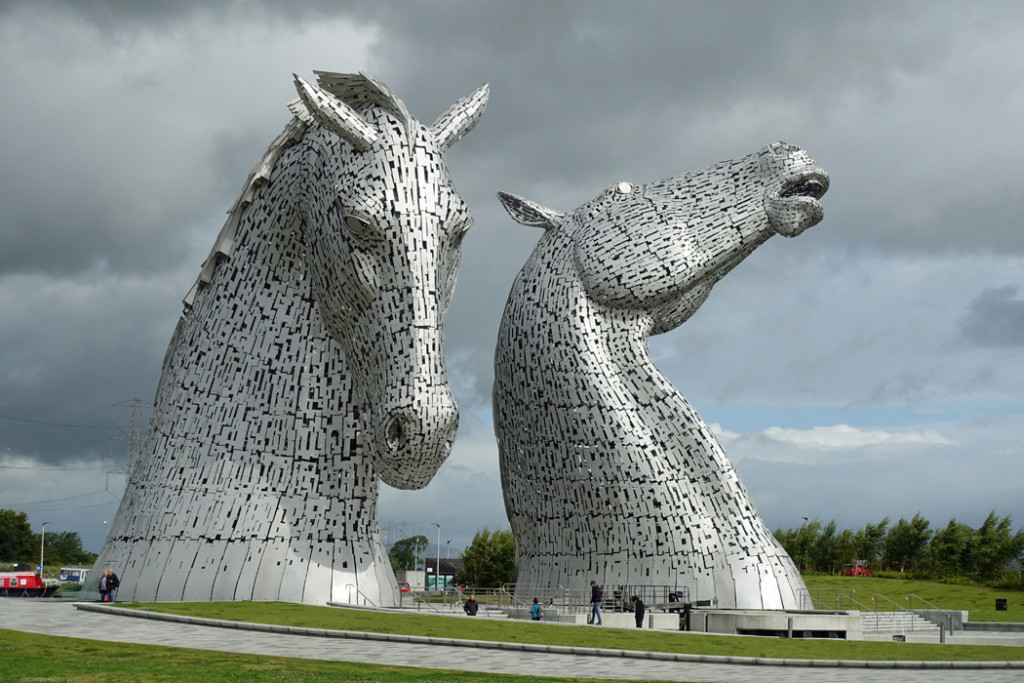
In the last decade or so, two new sights (both near Stirling Castle) have joined the parade of Scottish travel memories: The Falkirk Wheel opened in 2002. Rather than a series of locks, it gracefully raises boats 80 feet from the Forth Canal to the Clyde Canal with an innovative wheel. And a couple of giant steel horse heads, based on the mythic Kelpies, were built in 2014 and have become a symbol of the region around Stirling.

This is Day 95 of my “100 Days in Europe” series. As I travel with Rick Steves’ Europe Tours, research my guidebooks, and make new TV shows, I’m reporting on my experiences across Europe. Still to come: Germany, Switzerland, and more. Thanks for joining me here on my blog and via Facebook.