Open Mic at the Fado Joint

When traveling in Europe, we seek out the living traditions. And many of them survive only as clichés for tourists watching tacky stage shows. But Portugal’s fado (traditional, mournful folk tunes) can still be enjoyed in rustic, authentic settings like this characteristic little eatery (Restaurante A Baiuca, recommended in my guidebook), deep in Lisbon’s Alfama. I filmed in this joint years ago, capturing a magic moment for our TV show–and it’s been in my guidebook ever since. I was anxious to return, afraid that the magic would be gone. Thankfully, it survives. This is “fado vadio”–open mic where any amateur (like the man here) is welcome to share a song. Eating dinner here, with a line of neighbors hanging outside the restaurant door waiting their turn to sing, makes a delightful memory. The cost? Just buy dinner–about $20 with lots of wine.

If you can’t see the video below, watch it on YouTube.

Uncovering Hidden Meanings with a Local Guide

I’ll be researching, filming new TV shows, and enjoying our Best of Europe in 21 Days tour in the next two months. Each day of my research time I’ll be paling around with a local guide. This is my luxury as every minute spent with an expert and translator and friend at my side is filled with learning and insights I wouldn’t enjoy otherwise. Anyone can hire local guides to brighten their travels. In Portugal it costs about €100 ($130) to have your own private guide for four hours. Here, my guide Alex is taking me on a little scavenger hunt through Lisbon’s castle town (built back when nobles needed a safe place within the castle walls). She’s showing me new things I never noticed even after 20 years of visits to Lisbon.

If you can’t see the video below, watch it on YouTube.

Checking In with Lisbon

Lisbon feels to me like Europe’s San Francisco with rattling trolleys, a famous suspension bridge, a heritage dominated by a horrific earthquake (1755), and lots of fog. I’m kicking off my two months of spring research here–and I’ve hit the ground running to be sure everything in my Rick Steves Portugal guidebook is up-to-date for the 2015 edition.

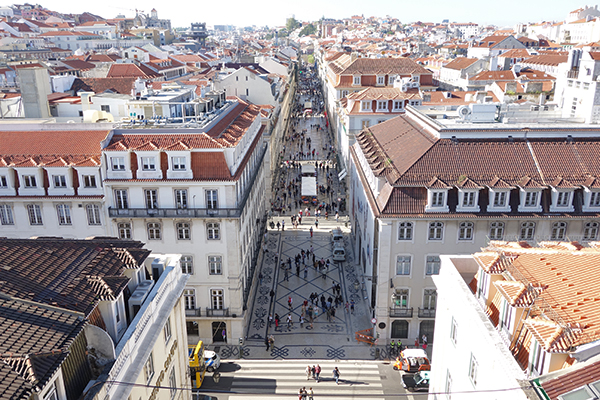
Rua Augusta: The triumphal arch that serves as a gateway to the city is now open for visitors, affording a grand view down the main drag, Rua Augusta.  As can be seen from the top of the arch, the center of town was rebuilt in a strict grid plan after the earthquake/tsunami/fire of 1755 left Lisbon a smoldering pile of rubble.
Rua Augusta: The triumphal arch that serves as a gateway to the city is now open for visitors, affording a grand view down the main drag, Rua Augusta. As can be seen from the top of the arch, the center of town was rebuilt in a strict grid plan after the earthquake/tsunami/fire of 1755 left Lisbon a smoldering pile of rubble.
Lisboners Like Their Sidewalks Slippery and Artistic: Lisbon’s characteristic limestone and basalt mosaics (calçada) decorating its sidewalks are an icon of the city. But they are slippery and expensive to maintain. With the tough economy, the city government is talking about replacing them with modern pavement. Lisboners are saying no way.
Quiosque Cafés Bring Life to Lisbon Miradors: Kiosks ("quiosques" in Portuguese) are the rage in Lisbon, giving squares and miradors (viewpoints) an outdoor café ambience. Judging by the crowds enjoying the spring sunshine, the economy is showing signs of happiness.
Quiosque Cafés Bring Life to Lisbon Miradors: Kiosks (“quiosques” in Portuguese) are the rage in Lisbon, giving squares and miradors (viewpoints) an outdoor café ambience. Judging by the crowds enjoying the spring sunshine, the economy is showing signs of happiness.
Fish Dinner...Cheap, Fresh, Tasty, and Memorable: Characteristic hole-in-the-wall diners hustle for business and offer both fresh fish and great prices. I always look for a small, handwritten menu in the local language only posted on a low-rent street filled with locals; that's my key to a good value. My longtime favorite in this crusty corner of town went out of business, so this eatery will take its place in the new edition. Prices in Portugal are amazing--hearty meals for €9 and they’re big enough to split...and that’s in the capital city. It gets cheaper in the smaller towns.
Fish Dinner…Cheap, Fresh, Tasty, and Memorable: Characteristic hole-in-the-wall diners hustle for business and offer both fresh fish and great prices. I always look for a small, handwritten menu in the local language only posted on a low-rent street filled with locals; that’s my key to a good value. My longtime favorite in this crusty corner of town went out of business, so this eatery will take its place in the new edition. Prices in Portugal are amazing–hearty meals for €9 and they’re big enough to split…and that’s in the capital city. It gets cheaper in the smaller towns.
Basta to Bankers Around the World: Locals are saying "basta" (enough) to financial austerity. The discussion these days in Portugal is how the finances of this society are rigged to keep the 99 percent down. Locals sing a sad song I’ve heard before: The banks, politicians, and economic elites are working together; the working blokes get the shaft; and the rich just get richer.
Basta to Bankers Around the World: Locals are saying “basta” (enough) to financial austerity. The discussion these days in Portugal is how the finances of this society are rigged to keep the 99 percent down. Locals sing a sad song I’ve heard before: The banks, politicians, and economic elites are working together; the working blokes get the shaft; and the rich just get richer.
Demonstrating with Smiles: In post-crisis Portugal (like Spain, Greece, and other countries with struggling economies) you’ll find workers and retirees complain by marching. In Portugal, the people are so sweet that demonstrations feel like festivals. I don’t know exactly was getting the brunt of their dissatisfaction, but it gave me warm and fuzzy feelings all over.
The Dictator’s School Books: Portugal has come a long way in the last generation. They overthrew their authoritarian government in the early 1970s--four years after the death of long-term dictator António Salazar. It’s amazing to think that within living memory Hitler, Mussolini, Franco, and Salazar were all buddies in Europe’s club of Fascist dictators. Today, you can buy textbooks reprinted from a time when schools were propaganda tools of the government.
The Dictator’s School Books: Portugal has come a long way in the last generation. They overthrew their authoritarian government in the early 1970s–four years after the death of long-term dictator António Salazar. It’s amazing to think that within living memory Hitler, Mussolini, Franco, and Salazar were all buddies in Europe’s club of Fascist dictators. Today, you can buy textbooks reprinted from a time when schools were propaganda tools of the government.

Economic Crisis in Portugal: In Cod We Trust


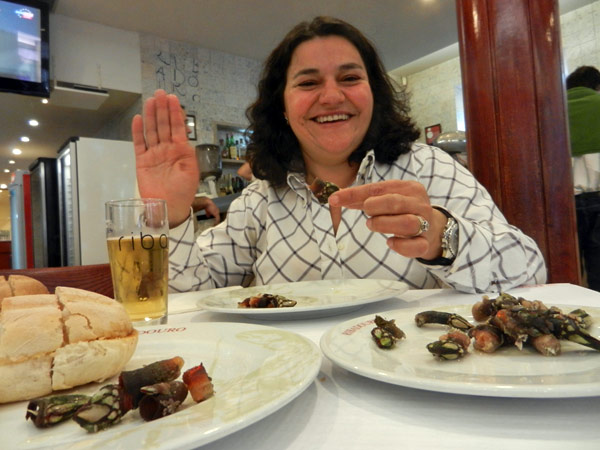
Back in Lisbon, the first thing I eat (with my wonderful guide, Cristina Duarte): barnacles. I love barnacles.

On my last visit to Lisbon, people were scampering to finish projects funded by the European Union. There was scaffolding everywhere as the buzz was, “This is the end of the easy money — use it or lose it, quickly!”

I should have known then, but there’s no free lunch — even in the European Union. Today, Portugal has come to its day of reckoning. The money has dried up, and the interest due on the debt is crushing the local workforce. Portugal’s 11 million people produce about $240 billion annually — nearly the same as Louisiana. But Portugal has about 14 percent unemployment. It once exported dried cod; now its top export is people.

Major projects in Portugal are not just stalled. They are stopped. The TGV-style bullet train from Madrid to Lisbon, Lisbon’s new airport, planned freeway expansion…all nice ideas…all stopped.

Last night, as we walked the newly pedestrianized streets of the Barrio Alto district, things were relatively quiet, even though 50,000 locals were packing the Lisbon stadium for the big, crosstown-rivals soccer match. During our stroll, my friend told me, “In pre-euro days, with the escudo as our currency rather than that deutsche mark in disguise, when there was no money for chocolate milk, we just made due with white milk. Until 1974, when we won our freedom from Salazar (Portugal’s Fascist dictator was overthrown in the “Revolution of the Carnations”), we were on the donkey system. Then we got the fever. With the EU, dazzled by German standards, we were encouraged to have faith in debt. Portugal was made drunk economically by those cheap European loans.”

Today Brussels sends the Portuguese not money but the “Troika,” a trio of managers from the EU, IMF, and European Central Bank who enforce austerity measures to get things on a sustainable track. That means higher tolls on more highways, a new 23 percent tax put on all restaurants, higher deductibles for hospital visits, and cutbacks in health care. Utilities such as electricity are being privatized. Retirement was just raised from 65 to 67 years. And the Troika made the government rescind a worker-friendly scheme of the revolution which took a year’s wages and broke it into 14 “months” rather than 12 to give workers a “bonus” each summer and Christmas. Now workers making over €650 (about $800 a month) get only 12 months’ pay. As this was never really a bonus but just a forced savings account, this amounts to about an 18 percent cut in pay.

Local politicians are fighting despair. To the Troika, the Portuguese, compared to the Greeks, are considered very quiet workers with a nice reputation and good behavior; they’re willing to take their medicine responsibly.

As for the traveler, despite the economic downturn, it’s wonderful to be prowling the streets of Lisbon after dark. Trendy and stylish little bars and restaurants are working hard for their customers. On my first evening in Europe, I’m already back in my research groove.

Portugal: In Cod We Trust

My 12 days in Portugal are over. Except for the Douro Valley and the Algarve, I visited virtually everything in my Portugal guidebook and leave with my enthusiasm for this country rekindled.

I met few Americans (in one day in Athens, where I am today, I saw more of us than in 12 days in Portugal) and found great prices ($5 meals, $60 doubles, $6 tickets to major sights — even with the euro at $1.60).

Side-tripping 45 minutes from Lisbon, I went to plush and lush Sintra. Its Pena Palace, built by a romantic blue-blooded cousin of Mad King Ludwig, sits like a mountain-top Neuschwanstein with an Atlantic view. The elegantly cluttered rooms at the Pena Palace are still set up as they were in 1910 when the king fled — a great example of that Victorian “horror of empty spaces.”

My last day of research was complicated by a walking tour. I intended to check it out by just tagging along for half an hour. It was so good, I stayed the entire 3.5 hours. They called it an intro tour, but after 20 years of visits, I just couldn’t leave. Titled “Lisbon Revelation” and run by a company called Lisbon Walker, there were five in our group. We paid €13 each ($20) and the guide had us enthralled for every minute as we walked and took the trolley through the old town. (That evening I emailed my tour operations director and said, “Let’s get this experience for our Portugal groups!”)

George Bush got some ridicule when he looked into Vladimir Putin’s eyes and, “saw his soul.” This is one rare case where I can relate to our president. I need to look into the eyes of the business people I meet and determine whether I can say, “I trust this person” to my traveling readers.

Perhaps I’m easily impressed (or conned), but I looked into many eyes on this trip and saw the souls of many good people: Sergio who rents ocean view “quartos” above his little bakery/café (simple doubles for $50) in Nazare; Carlos whose cataplana is famous in Porto and whom I’d like my readers to simply trust to feed well and charge honestly; and Gabriel who lovingly serves up traditional dishes in his restaurant while employing fado — Portuguese folk — guitarists who look like tired old turtles, and singers who are ringers for how Morticia (of the Addams family) must look today. (Gabriel’s business takes a big hit from cabbies who tell diners he’s out of business because he doesn’t pay commissions.)

In my hotel rounds, I noticed one of the personalized schedules our tour guides post on the wall for tour members. It laid out the plan for the last day of one of our two-week Spain and Portugal tours. The guide (Federico) had written, “Meet at 7:30 in the lobby to go out for dinner and a big surprise.”

I dropped back at 7:30 and doubled the surprise. I love seeing groups full of smiles after two weeks together. And for some reason Federico always leaves me with a huge smile. Their other surprise — heading out for Gabriel’s restaurant to enjoy the Turtles and Morticia.

I wonder if Lisbon and San Francisco are sister cities — they have twin bridges, famously foggy weather, have survived horrific earthquakes, keep trolleys shivering up and down their steep hills past characteristic buildings, and are situated in about the best natural harbors on the west coast of their respective continents.

Portugal has a poignant souvenir of its colonial days (which ended its nearly 50-year dictatorship — the longest in 20th century Europe — in 1974 with its Carnation Revolution). Over a million Portuguese “returnees” fled the colonies they no longer ruled. Life for them was “shrimp, day and night” and suddenly they were without a homeland — it was too dangerous to stay in the newly independent lands they once dominated…but they were too sour and conservative to feel comfortable back in Portugal. Most ended up emigrating to Brazil, England, the US, or France.

(I wonder if many became builders. A French man I befriended said it is the exception when a small construction or remodel job done in France is not done by a Portuguese contractor.)

I leave Portugal with a taste for Bacalhau — cod. My favorite bar munchie is a fried potato/cod croquet called a pastel de bacalhau. Imagine, the national dish of Portugal is cod and it’s never fresh — only salty and imported from Norway. This — a national dish that is imported from far away — must be unique in the world. Like Portugal itself.