Aalsmeer Flower Auction

One of the joys of our TV production is that I get to actually visit the places and do the things that I recommend in my guidebooks. For instance, on the second morning of filming our Netherlands TV show, we got up at 6 a.m. to catch the Aalsmeer Flower Auction at its busiest.

A hundred buyers click their computers as trainloads of flowers roll through the auction hall. Just outside, a keystone-cops commotion of delivery cars makes sure all the flowers get to their locations that same day — anywhere in Europe. Our cameraman, Peter, got to take a ride on one of these carts to film the point-of-view of a load of flowers.

Filming Rick Steves’ Europe in the Netherlands

I’m excited that we are embarking on a 12-day shoot to produce two shows in the Netherlands.

Ten years ago, we made one episode combining Amsterdam with side trips into the Dutch countryside. In this shoot, we’ll retire the old show and replace it with two episodes: one just for Amsterdam and the other just for the Dutch countryside. This will let us share double fun in Holland.

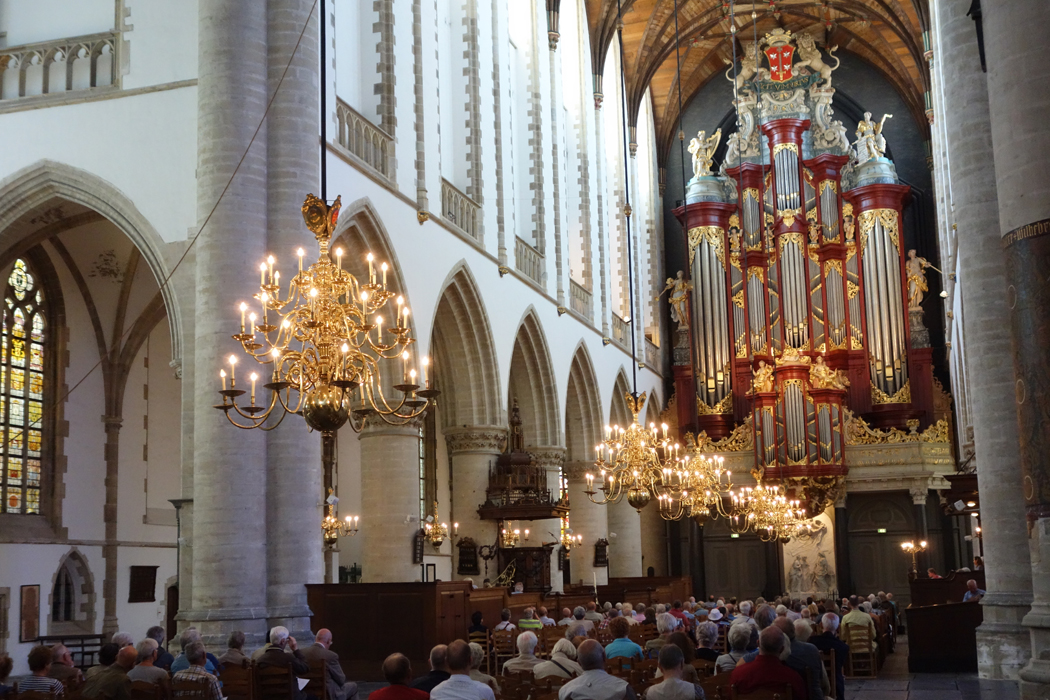
For example, doing two shows instead of one makes room for Haarlem, a charming small town a quick train ride from Amsterdam. We enjoyed filming an organ concert in Haarlem’s church.  I only get 3,200 words per script, so each word needs to earn its place. Here’s that part of the script—5 sequences out of 70 in this half-hour episode (OC means “on camera” — a part I say to the camera):

[38] Haarlem’s Grote Kerk, or Great Church, towers over the market square as if to bless all the business that takes place below.

[39] Inside, you find a towering Gothic nave, which was whitewashed and purged of its Catholic ornamentation when the Reformation arrived in 1566. Small frescoed sections, revealed when the whitewash was cleaned off, show how the entire church was originally decorated. Ships hanging in the nave remind parishioners to pray for all the men at sea. If you know where to look, carvings can be whimsical: crazy little characters supporting the roof…and what were called “pillar biters” mocking people who were overly devout.

[40 OC] And as was the case in many Protestant countries, rather than huge preachy works of visual art — like frescos and statues promoting the message of the Church — the artistic emphasis was put on music.

[41] Protestant churches invested in mighty pipe organs. Haarlem’s towering organ has been giving worship an inspirational soundtrack since 1738.

[42 beauty sequence of Jos van der Kooy playing Cornelis J. Bute Gavotte I & II] And visitors can enjoy free concerts weekly. [Fade to black]


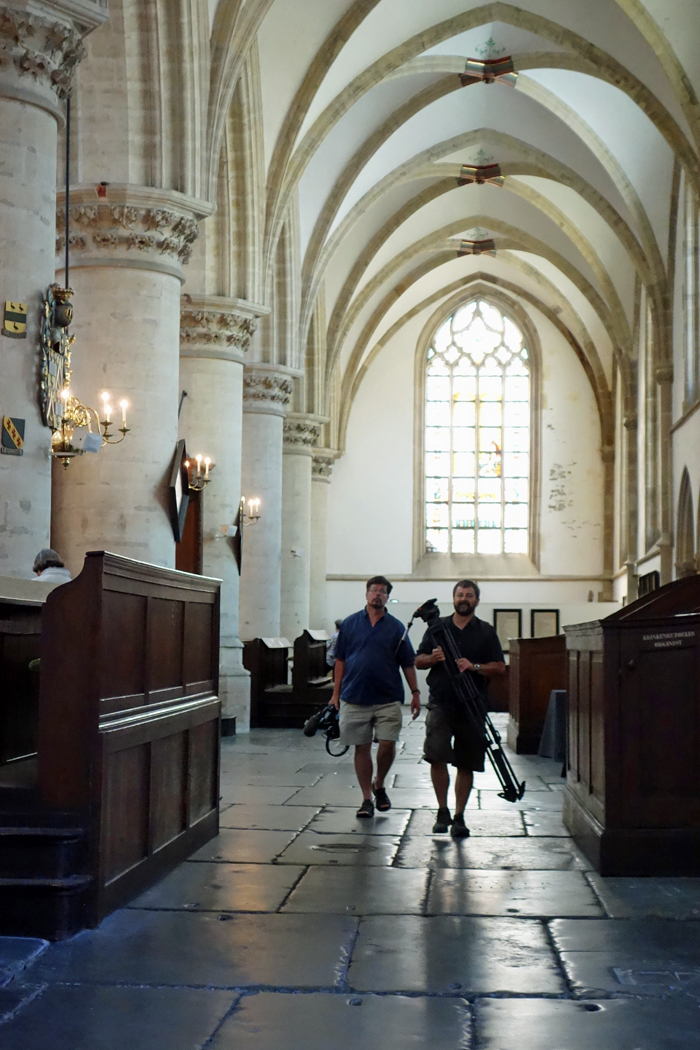
Rick-Steves-TV-crewOur core filming crew, as always, is three of us: me, the producer (Simon), and our cameraman (either Peter — pictured here — or Karel). Lately, I’ve enjoyed adding a local expert to be sure we’re communicating clearly and to smooth the way behind the scenes. My friend Rolinka Bloeming, who has led tours for us for nearly 20 years, had to be rescheduled from one of her Rick Steves tours so she could be our “fixer.” Rolinka speaks Dutch, knows her country expertly, has a way of opening doors, and is a delight to work with. She’ll be on her iPad and on her phone making sure we know where the windmills are turning and where herring’s in the smoker.


Haarlem-great-church-pipe-organIn Haarlem’s Great Church, we climbed up into the organ loft and filmed the organist playing the most spectacular pipe organ I’ve ever seen. I got to simply sit with the audience and enjoy the concert while my crew filmed a beautiful segment.


Filming-in-Haarlem-Grote-KerkWhen filming, we have to be super-organized to get what we need in the time we have. When the crew was in the loft with the organist, I was surveying the church like a little mouse, making a list of things to shoot to “cover the script.” Then I took Simon on a quick walk to show him my shot list. With the crew organized and at work, I got to sit down and enjoy the rest of the concert.


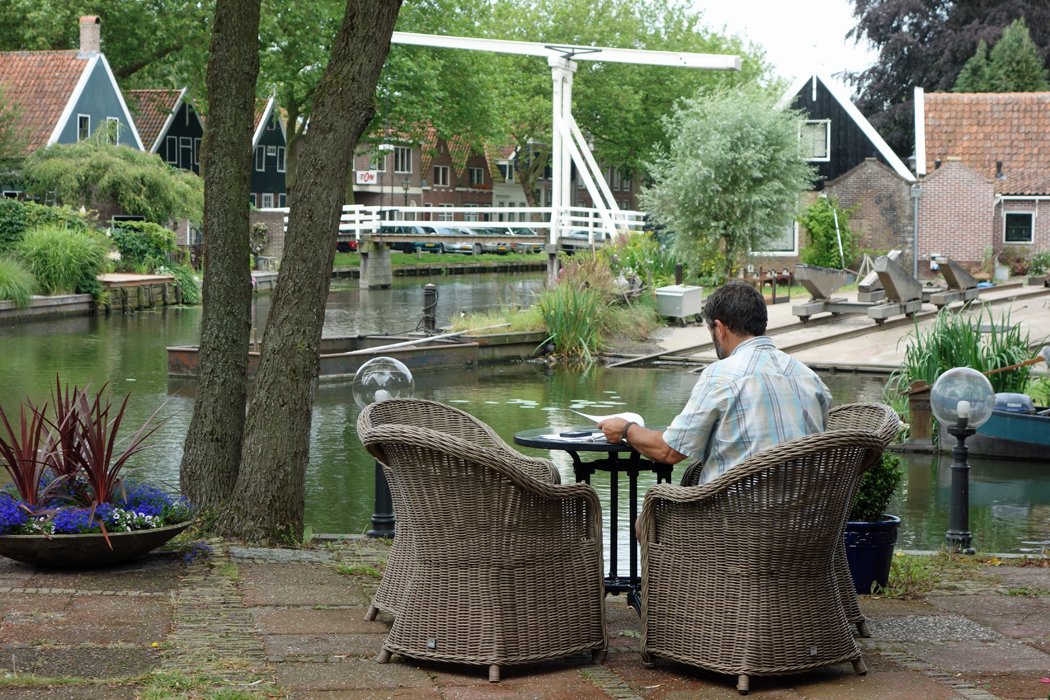
Edam-canalWe settled down for four nights in the cute-as-a-bunny town of Edam. Our home base, Hotel Fortuna, is nestled on a canal in a garden kind of world. (It made me nostalgic for a family visit here 25 years ago, when toddler Andy was enthralled by the box turtles in the hotel garden.) My room opened up onto a quiet perch over the canal, where I would go out after filming in the 11 p.m. twilight and just be still with the water and the birds. Across the way was in industrial dry dock…yet even that was cute. Here, I snuck a photo of producer Simon reviewing our latest script immersed in Dutch beauty.

My Freshest Tips for Smooth Rail Travel

So far on this trip, I’ve really enjoyed using trains to get around Germany and the Netherlands — they make travel fast, smooth, and efficient. Here are a few photos to illustrate strategies for smart rail travel anywhere in Europe.

Fast-bullet-train

The new generation of bullet trains in Europe are sleek. In fact, they’re so sleek that when a city has an old-fashioned, dead-end train station, the new trains often don’t even bother to stop in the city itself, but at a pass-through suburban station instead. New stations are designed — at the insistence of the train companies — to be pass-through stations. Everything’s going very fast these days, and there’s just no time to pull in, then back out.

train-car-signs

No smoking, no talking, no cellphones. You have your choice of train cars — all clearly marked (although none allows smoking anymore). Among Europeans, American tourists are notorious for talking like they’re the only people on the planet, making everyone else on the car listen to their conversation. And you know how annoying it is to listen to someone else’s drawn-out cellphone conversation. Enjoy making a point to take advantage of signs as you travel: If you want peace and quiet, you’ll get it in this car.

train-chart

Trains are long, it’s hot over here, and luggage can be exhausting to schlepp around needlessly — especially if the train platform is mobbed with travelers. Notice and understand signs to save time and stress. Few Americans realize that on big-city train platforms, there’s a chart listing major trains, with a diagram of how each train is arranged: first class (yellow), second class (green), and dining car (red). It even shows specific car numbers — handy if you have a seat reservation. Overheard on the platform are big A, B, C, and other lettered signs to help you find just which zone to stand in to have your train car stop right in front of you. Very often, a long train has ten second-class cars, but just one first-class car. If you have a first-class Eurail pass (as nearly any railpass holder over 26 does) and you don’t notice signs like these, you could wander all the way to the far end of the platform, then realize that you could have just waited at the opposite end. The conductor just blew the whistle, and you need to jump on the train or be left behind. So you spend the next 15 minutes struggling through the crowds to get to your first-class compartment…not very first-class.

Amsterdam’s Tram Corridor is a Boon to Sightseers

R

When covering Europe, I enjoy raising awareness of public transportation routes that fit the needs of travelers. In Amsterdam there’s a sightseeing spine right through the city center that goes past the Rijksmuseum and this “I amsterdam” sign. Conveniently, this spine is a tram corridor: Trams #1, #2, and #5 come by every two minutes. Taking advantage of this route empowers any visitor. Here’s a new sidebar I wrote for the next edition of our Rick Steves Amsterdam guidebook about this transit spine:


Amsterdam’s Spine by Tram

Tram #1, #2, or #5 from Central Station to Leidseplein (and Museums)

Amsterdam becomes much easier to get your brain around when you master the tram #1, #2, and #5 corridor. As if made for the sightseer, this main tram thoroughfare makes connecting the main train station, the Jordaan neighborhood, my recommended hotels, and the museum zone amazingly easy. The entire ride takes about 20 minutes, with trams zipping by about every two minutes. Use this route for an overview and to lace together major sightseeing spots in the city. At any point you can simply hop off, cross the street, and catch a tram heading back exactly where you came from. A single €2.80 ticket is good for an hour–or you can get the all day or multi-day passes (all sold on the tram). Starting at Amsterdam’s Central Station, here are the stops (and what you need to know about each):


Centraal Station

This is the first and last stop. All #1, #2, and #5 trams starting here are heading in the correct direction. Nearby: The free ferry across the IJ, the starting point for the Rick Steves Audio Europe Amsterdam City Walking Tour, a transportation hub (airport shuttle, bus station, trains, many other trams, subway), bike rentals, the Red Light District, and the start of Damrak (the city’s main drag).


Martelaarsgracht

Notice how the street is wide: Wide streets are generally former canals filled in. (Hint: “gracht” means canal.) Nearby: The Haarlemmerstraat shopping district.


Nieuwezijds Kolk

(nothing of interest nearby)


Dam

You’ll roll by the back side of the towering New Church and Royal Palace on the left. Nearby: Dam Square, Anne Frank House, and the starting point for two Rick Steves Audio Europe tours: Jordaan and Red Light District.


Spui

Pronounced “shpou” (rhymes with cow)–which meant “spew”–this square is where water was once pushed away over a dike. Nearby: Amsterdam History Museum, Begijnhof, University District, bookstores, and the Nine Streets (elegant shopping zone).


Koningsplein

From Spui, the tram turns right. Over the next few stops it crosses four canals: Singel, Heren, Keizers, and Prinsen. Remember the memory aid: “A Single Hairy Kaiser’s Prince really knows his canals.” Nearby: Mint Tower and the flower market.


Keizersgracht

Here the street fills with people and gets so narrow that trams share one set of rails, and bikers are required to walk their bikes. Nearby: The vibrant shopping district of modern Amsterdam.


Prinsengracht

You’ll roll past more shops and more pedestrians.


Leidseplein

This is the tourists’ nightlife center with the famous Bulldog Café and Coffeeshop (a former police station that now sells pot). You’ll find venerable, edgy nightclubs and concert venues like the Melkweg and Paradiso, plus the city theater (Stadsschouwburg). From here, trams #2 and #5 leave the old town, cross the outermost canal, pass an entry to Vondelpark, and head for the Rijksmuseum. (If you’re on tram #1, hop out at Leidseplein.)


Rijksmuseum (tram #2 and #5 only)

This is the start of the museum zone with a popular park (with a pond and much photographed “I amsterdam” sign) and several great museums. Nearby: Rijksmuseum, House of Bols Cocktail & Genever Experience, and Costers Diamonds (diamond cutting and polishing).


Van Baerlestraat (tram #2 and #5 only)

Jump out here for the Van Gogh Museum or the Stedelijk Museum.


Jacob Obrechtstraat (tram #2 only)

Here you leave the commotion of the city–and its tourists–and are in a district of high-end apartments. The inviting Café Gruter faces the tram stop. Nearby: The entry to Vondelpark (with the recommended Blue Tea House).
Traveling in the Netherlands Beyond Amsterdam


Traveling around the Netherlands, I found a number of delightful towns with historic centers that evoke the days of Henry Hudson. Delft, Haarlem, Leiden, and Hoorn were my favorites. The vast majority of visitors to the Netherlands see only Amsterdam. While these other towns are all variations on the same theme, the small historic Dutch cities outside of Amsterdam are important to consider–and all are well within an hour by train.

R

Hoorn has a salty allure, even though the salt is gone now that the Zuiderzee has been dammed and turned into a big freshwater lake. Still, Hoorn’s harbor evokes a time when Dutch vessels dominated much of the seagoing economy.


dutch-golden-age-fashion-ruff

The Dutch Golden Age, the 16th and 17th centuries, was a time when people went to apparently ridiculous lengths to show off their wealth. What was a simple collar became not just a ruff, but a super-duper ruff. This woman’s husband must have been a very successful merchant.


dutch-masters-painting

Seeing these Dutch masters plotting with their globe and their greedy aspirations, I found myself singing, “We are the world…”


police-taking-jet-skis

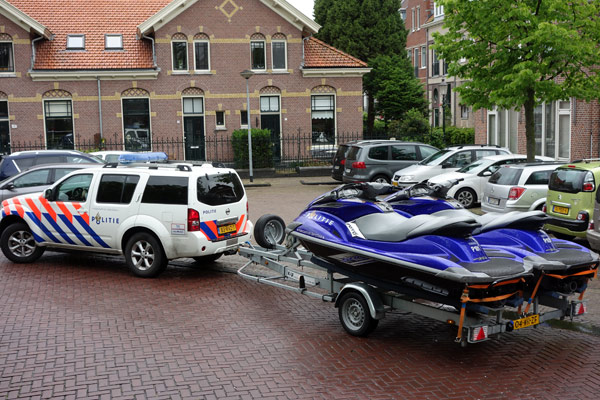
The Dutch enjoy getting drunk on their vacation boats. And just as you can’t drink and drive a car, in the Netherlands you can’t drink and sail a boat. The Dutch police enjoy zooming in on their police jet skis to crash the party. I’m sure just the presence of this trailer with a pair of these zippy machines served as a sobering reminder to yachters enjoying a break in the Hoorn harbor.