Santa Claus: The Many Faces Behind the Beard

christmas-book-santa-tree-bwIn our Rick Steves’ European Christmas book (a companion book to the public television show), we outlined the history and many European variations on Santa Claus. Here’s an excerpt:

Our American Santa Claus — a plump, jolly old fellow dressed in red — is just one of many gift-giving characters who preside over the Christmas season. Depending on where you are in Europe, it’s possible to bump into St. Nicholas, Father Christmas, Père Noël, Samichlaus, Sinterklaas, and others. All are brothers of sorts, tracing their lineage back either to an early Christian saint or a pagan deity. The origin of these multicultural gift-givers is a tangle of folklore, crossed with some early Christian public relations and a dash of modern commercial branding.

Let’s start with the branch of the family that hails from the frozen north. Long before the birth of Christ, there was Odin, father of the Viking gods. Like Santa, Odin was a stout old man dressed in furs with white hair and a long beard. During the winter solstice, Odin rode through the sky on his eight-legged magical horse, Sleipnir, and descended to earth. Disguised in a hooded cloak, he would eavesdrop on Vikings sitting around the campfire, trying to figure out who had been naughty and who had been nice. Occasionally, he would leave a gift of bread for a poor family.

Around the same time in the British Isles, chilly Celts were crowning a Frost King and appealing for leniency during the harsh midwinter months. In the Middle Ages, the legends of King Frost and Odin became associated with the Christian practice of helping the poor at Christmas. Parishes would hire actors in disguise to go undercover through the village, finding needy families, and reporting back to the village priest. In the 16th century, during the party-hearty reign of the Tudors, the character morphed into Captain Christmas, a sort of master of ceremonies presiding over the unruly fun at Christmastide. Banned by Puritan prudes in the 17th century, he re-emerged in the 18th century in plays put on by itinerant players as Father Christmas.

In the 19th-century Victorian era, Father Christmas was portrayed as a bearded pagan wearing robes and a crown of holly, ivy, or icicles, while hoisting a bowl of wassail. Gone were any saintly attributes, but he was a jolly enough fellow who made people happy during the dark days of winter.

Toward the end of the 19th century, Father Christmas was reinvented as the bringer of gifts to children. This probably came about because of the Victorians’ emerging interest in their children, coupled with influences from Europe and America, where St. Nicholas and Santa were popular.

Today, Father Christmas is a kind old gentleman who dresses, depending on his whim, in a long red robe trimmed with fur or a belted red jacket and cap (in which case he is easily confused with Santa, whose nocturnal habits he has also acquired).

Meanwhile, another branch of the Santa Family tree was sprouting from an early Christian monk named St. Nicholas. It’s believed that the historical Nicholas was born in the Eastern Roman Empire (now Turkey) sometime around A.D. 280. Some folklore experts have suggested his life story was probably recycled from tales of various pagan gods and then Christianized. Legends abound about St. Nicholas, who became the bishop of Myra (modern-day Damre, Turkey) and was much admired for his piety and kindness. He was rumored to have given away all of his inherited wealth to travel the countryside helping the poor and sick. He kept an especially watchful eye on orphans, occasionally giving them gifts; over the years, his reputation grew as a compassionate protector of children.

According to one story, he prevented three poor sisters from being sold into prostitution by their destitute father. Nicholas provided them with a dowry, so they could be married. The legend grew that he gave the money anonymously by tossing bags of gold through a window, or perhaps down the chimney. The gold landed in the girls’ stockings (some versions swap stockings for shoes), which had been left by the fire to dry.

By the Middle Ages, St. Nicholas was the most popular saint in Europe. On the eve of his Feast Day, December 6th (the anniversary of his death), a bearded, robed man appeared in every village, passing out gifts to children and the poor.

In many lands, there were now two Christmas figures — the Christian St. Nicholas (commemorated on December 5th and 6th) and the pagan party animal who became Father Christmas (December 24th, 25th, and beyond). Over the centuries, different cultures merged these two figures, some emphasizing one legend over the other, some celebrating on the 6th, some on the 25th, some both. Today, a European Christmas brings the whole extended Santa Family together as you can see in our chart of Santa’s Family Tree.

Early American settlers had strong ties with the Christmas traditions of England. In the 17th century, Dutch immigrants brought the story of St. Nicholas to America. Americans loved the custom, but had trouble pronouncing the name. The Dutch “Sinterklaas” became “Santa Claus,” and the name stuck. Our modern Santa Claus is an amalgam of European traditions, combining the kindly, gift-giving St. Nicholas and the mischievous, fun-loving Father Christmas.

Today’s image of the American Santa Claus — the jolly fellow with the apple cheeks and twinkling eyes — came by way of a German immigrant who published his illustrations in Harper’s Weekly in the late 1800s. This magnanimous Santa Claus was a boon to shopkeepers during a period of unprecedented growth in retailing — department stores, chain stores, and new-fangled billboards. They joyfully exploited the commercial potential of an entire season dedicated to gift giving, brought to you by Santa. In the 1930s, the Coca Cola Company, in need of a sales boost, borrowed Santa’s image and branded their product with the merry ol’ gent… thus completing his epic journey from saint to salesman.

Today, in many parts of Europe, there’s a movement to preserve the tradition of St. Nicholas, who’s at risk of being crowded out by the American Santa. Some villages are even creating Santa-free zones. They see Santa as a super-size symbol of consumption. St. Nicholas, they argue, embodies the real Christmas spirit, a monk whose example taught that giving doesn’t make us poorer — it makes us richer.

Amsterdam’s Eye on the IJ

All over Europe, great cities are adding great new buildings to their skylines. And great cities are taking old industrial zones — left derelict when shipping moved out to more modern quarters — and gentrifying them. I’ve noticed that what we call “the wrong side of the tracks” is, in Europe, often the wrong side of the river (think London, Rome, Florence, and Sevilla). Amsterdam is digging up its center to build a new north-south subway line which will move much of the transportation clutter across the IJ River to its (until now) undeveloped North Bank. And this side of the river — which will get a huge new boost when the new transit hub opens — is on its way to becoming a smart, new people zone. Free ferries shuttle mostly bikers back and forth from immediately behind Amsterdam’s big central train station. Now when you look over the river you see a striking new building — the Film Museum on the IJ. Here’s my new guidebook listing:

This striking new building on Amsterdam’s skyline is a complex of theaters in an edgy structure overlooking the IJ River. (IJ is pronounced “eye.”) That makes this the Eye on the IJ.

The Film Museum on the IJ
The big news for the skyline of Amsterdam is the arrival of the new Film Museum on the IJ, nicknamed “The Eye.” This striking, sleek modern building heralds the coming gentrification of the north side of the IJ River, immediately across from Amsterdam’s Central Station. The building is a complex of four theaters playing mostly art films with a particular theme that changes throughout the year. There’s also a monthly program of silent films with live musical accompaniment and exhibitions on film-related subjects, a free permanent exhibit in the basement, a gift shop, and a trendy café with great riverside seating on its terrace. Helpful attendants at the reception desk can get you oriented (Free entry, movies-€10, exhibit-€10, credit/debit cards only; daily 10:00-24:00, exhibits open daily 11:00-18:00; from behind the Central Train Station catch the free ferry labeled “Buiksloterweg” across the river and walk 200 yards, www.eyefilm.nl).

More Sex and Drugs in the Low Countries

On my research trip through the Low Countries, I discovered several examples of the bold Dutch and Belgian approach to challenging social issues.


Dutch Pot Smokers Are Pro-Choice
“Coffeeshops” throughout the Netherlands sell a variety of perfectly rolled marijuana joints. With their Dutch green thumbs and state-of-the-art greenhouse technology, the pot sellers no longer need to import their exotic strains. It may be called “Thai” and it may smoke like Thai… but it’s Dutch-grown, Dutch-taxed, and Dutch-smoked.

Needle Bridge Has Lost Its Edge
Amsterdam once had the grittiest, most disgusting, and most dangerous sailors’ quarter you could imagine: Zeedijk street, right where the city hits the harbor. I remember venturing in here in the 1970s, when shady characters seemed to support every streetlamp and where the police just kept their distance. It was sex and hard drugs and wandering lonely souls. The Dutch decided to do something about this problem to take back this potentially wonderful corner of their city. Forty years ago, they decided to decriminalize the sale of marijuana (in “coffeeshops”), and then clean out the hard drug trade. Reviewing the policy recently, the Dutch have found that pot smoking has not gone up, the population of hard drug users is smaller and aging, and street crime has diminished. Whenever reactionary forces push lawmakers to change this pragmatic approach to drug abuse and tighten up on pot laws, gangs and criminals reappear in the streets, violence and turf wars ensue, and recreational soft drug users need to do business with criminal hard drug pushers. Today, throughout the Zeedijk zone, restaurants flourish — and what was nicknamed “Needle Bridge” is a delightful place to stop for a photo.

Red Light Antwerp — Just a Trip to the Mall
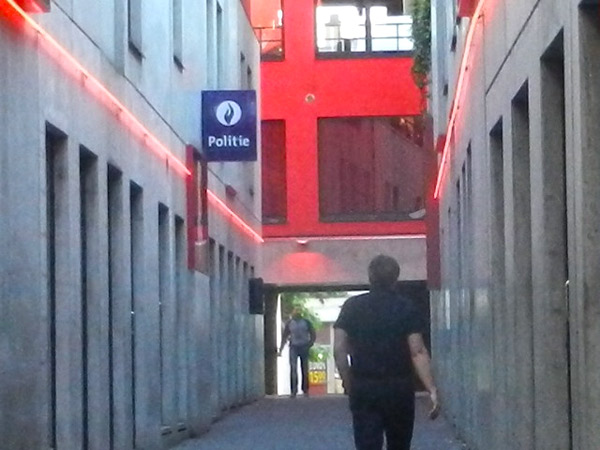
Many American tourists find Europe’s red light districts titillating. There was a time when ladies of the night were loitering around train stations and on the wrong side of the tracks in every sizable city. With stricter law enforcement, modern affluence, and the advent of easy access to porn on the Internet, the tourist rarely sees prostitutes on the street in Europe anymore. In many countries, brothels are allowed and limited to a certain zone. Amsterdam’s Red Light District is shrinking, as city officials are not renewing leases to red light landlords — or are giving them to other, more preferred businesses. Ports (like Hamburg and Amsterdam) are known for their red lights. The most impressive I’ve seen is in Antwerp. About four city blocks are pedestrianized and feel almost like a shopping mall. Here you can see the police station parked right in the middle of all that glowing red. I did notice that, while Antwerp has the biggest and slickest red light district, unlike other big cities, it has almost no sleaze elsewhere in town. In a sense, they cleaned the city up by sweeping it all into a small pile.

Cute Towns and Mighty Delta Works in Holland

When I research my guidebooks, almost by definition, I am always visiting and revisiting the same places. But I also like to take a few days here and there to scout out new places — both for future editions of the guidebooks and for future TV scripts. In the last month, I’ve visited lots of great places for the first time (or, at least, my first time to do research): Leipzig, Wittenberg, Erfurt, Hamburg, Antwerp, Ghent, and the lush lowlands of Holland.

Taking a couple of days to get away from Amsterdam, I enjoyed touring the Dutch countryside. I spent one day visiting the famous Dutch tourist trap towns. My take: Alkmaar — famous for its cheese market and cute…but not cute enough. Edam — full of history, charm, great hotels, and ambience. I love it. Volendam — grotesquely touristic…mix Killarney and Coney Island and then drizzle with herring juice. Marken — on every tourist map, but much less visited because of its relatively remote location (at the end of a five-mile-long manmade jetty). Rounding out my Dutch countryside experience were visits to the city of Delft and the Delta Works. Here are a few photos of places that left me with powerful impressions.


Reflecting on Canal Lilies

I found canals with reflections that would get Monet to set up his easel. Here in Delft, the entire town was twinkling and rippling like water lilies.

Marken Is Good Cute
Marken is a former island, left partially high and dry by the draining of the inland sea but still accessible by ferry. It’s quiet, perfectly quaint, and well-preserved, but not annoyingly crowded like Volendam. Here’s a great day out from Amsterdam: Catch a train with your bike to Edam and enjoy that town for the morning. Roll through the countryside to Volendam, where you’ll catch the ferry to Marken. Enjoy a break there before pedaling along the jetty and through the polder land back to Amsterdam.

Delta Works Needs More
I was excited to see the mighty Delta Works, where the delta of the great rivers that dump into the sea after cutting through the Netherlands are controlled for floods. I assumed there would be an equally mighty visitors’ center…but there was nothing exceptional for the independent traveler to see.


Just like the rubble of Roman ruins, modern engineering marvels can fall flat — unless an enlightening tour by a passionate expert brings them to life. For just that reason, the Delta Works is a huge hit on Day 6 of our “Heart of Belgium & Holland in 11 Days” guided tour. If you’d like to experience this corner of Europe with the advantages of a small group and an expert guide, follow this link: http://tours.ricksteves.com/tours/france-holland-belgium/belgium-holland.

Fish ‘n Chips ‘n Holland

Rene Konings has been a much-appreciated bus driver for our tours for about 15 years. And for three days, I enjoyed the luxury of having Rene as my personal driver through the Netherlands. Taking time to visit places not in my guidebooks, it was a vacation in the middle of my trip. Here, we’re in the historic yet virtually unknown-among-American-travelers little town of Zierikzee. And I’m getting a tasty lesson in the best fish ‘n chips I think I’ve ever enjoyed.

If you can’t see the video below, watch it on YouTube.