Inside the Very Buoyant Mind of a Cruise Line Marketer

Cruise ShipOur Rick Steves’ Mediterranean Cruise Ports guidebook has been the surprise sales hit of our season. It’s currently our 5th-bestselling title, and in January, it was the USA’s 12th-bestselling guidebook by anyone, to anywhere. Popular as that guidebook may be, it sits lonely on my windowsill and needs a sister. So this fall we’re researching and producing a guide to Northern European Cruise Ports, for publication next summer.

I recently enjoyed a fascinating conversation over lunch with the CEO of a cruise line. A brilliant marketer who once sold children’s snacks, he explained how the impulse of a child to explore — as long as she has a safe home to return to — stays with us as adults. While travelers love to get out of their comfort zones, most have that strong, childlike need for a safe refuge or nest. His goal in marketing cruises is to provide a routine enabling people to get out and explore, but also to create a consistent welcome-home ritual when they are back on board. On my recent cruise, I noticed how ships do this expertly, with a welcome table with cold drinks at the gangplank and a friendly greeting as we boarded. And I even remember thinking, “Whew…we are safely back home now.”

I mentioned that cruise lines seemed less aggressive than I had anticipated in selling shore excursions, and that I was surprised how readily they let two-bit competitors organize and promote budget independent alternatives to their formal excursions. He explained that, for some cruise lines, shore excursions are not the main profit driver. People taking Caribbean cruises tend to lounge on the ship more. But people taking a Mediterranean cruise want to see and experience famous things on shore. The more they are able to do that on their own terms, the better. He acknowledged that, while excursions play a role in his profits, “for larger cruise lines, the real money is made between the steel” — that is, from purchases made by cruisers on board: eating, drinking, shopping, gambling, and so on. (I remembered how, even with my frugal approach to little extras on board, my tab was pretty substantial when that moment came to settle up at disembarkation.)

To make money, getting as many people as possible “between the steel” is top priority. He agreed with my hunch that the base cost of a cruise on large ship doesn’t have a lot of profit built in. Cruise lines manage prices so that all departures go full (offering deep discounts and creative incentives as necessary to fill the last staterooms). While discounting is big, marketers know that if you give cash back, customers pocket the cash. But if you give them a discount disguised as an “on-board credit,” they still bring and spend the same cash they would have without the credit: “No one takes a discount to the bank.”

Some cruise line sales departments are now morphing into “vacation-planning departments,” which sell not simply a cruise, but vacations that include a cruise. People generally extend a little before and after the cruise itself — especially in Europe.

I noted how, in my cruise experience, it was clear that marketing shaped the clientele, and the clientele shaped the experience on board. While some cruises specialize in an upper-crust ambience, others cast a wide net to attract a variety of socioeconomic backgrounds. He said that this approach can be tricky, as wealthier passengers can be uncomfortable mingling with people from a different socioeconomic class.

When I told him we were proud that more than half of our tour customers were return clients, he said, “Any niche company needs a 50 percent return clientele. It’s just too expensive to win first-time customers over and over, from a marketing point of view.” This explains the vigor with which cruise ships work to sell another cruise to people already on board — even before they finish the one they’re on.

So, Is Cruising Really Travel?

A cruise ship may be a floating 14-story-tall food court/shopping mall/entertainment complex — but cruising is just one of many ways of traveling and, keeping an open mind, I enjoyed the experience.

I’m home now after cruising the Mediterranean. And it’s time to wrap up this Blog Gone Europe series. Thanks for all the great comments this last month. I’ve enjoyed reading them each day. And I’ve learned a lot. I thought a summation of my experience would be a good capper. So here goes:

There are travelers and there are tourists. There is travel and there is hedonism. I’ve long thought that cruising was hedonism for tourists, catering to people for whom travel is “see if you can eat five meals a day and still snorkel when you get into port.” In fact, I’ve built a career championing the beauties of experiencing Europe independently…through the back door. And that’s about as far from cruising as you can get.

But my newest guidebook — Rick Steves’ Mediterranean Cruise Ports — is selling like hotcakes. It’s the first and only cruising guidebook written by someone with a healthy skepticism about cruises. I’ve left the cruise-ship rundowns to the industry aficionados, and focused my book on what I consider the main attraction: some of the grandest cities in Europe. Even if you have just eight hours in port, you can still ramble the colorful Ramblas of Barcelona, kick the pebbles that stuck in Julius Caesar’s sandals at the Roman Forum, hike to the top of Athens’ Acropolis, and hear the Muslim call to prayer warble from an Istanbul minaret across the rooftops. Yes, you could spend a lifetime in Florence. But you’ve only got a few hours…and I have a plan for you. 

But with the new cruise book selling so well, many of my traveling friends are wondering what’s going on. What happened to “going through the back door?” Have I sold out? Have I turned my back on “real travel?” Am I suddenly “pro-cruising?”

I visited 12 ports in two weeks. Dancing my nights away under starry, starry skies at sea, I shared a ship with 3,000 people whose priorities seemed to be shopping, gambling, eating, drinking, and sightseeing —often in that order. Yes, for many of these cruisers, the experience was hedonism plain and simple. But for many others, cruising has become an efficient, affordable, and enjoyable way to enjoy the best of both surf and turf.

For me, it was two weeks toggling between life on shore and life on board — a time filled with culture, camaraderie, and calories. As soon as I returned to the ship after a day exploring, I’d plop my wallet into the top drawer of my dresser and rejoin a fantasy, cashless world that, in many ways, is a floating 14-story-tall food court/shopping mall/entertainment complex.

Cruising is just one of many ways of traveling and, keeping an open mind, I enjoyed the experience. And I learned a lot. The officer who monitors supplies told me the two most important items to keep in stock: TP for guests and rice for the predominantly Asian crew. They once ran out of rice and nearly had a mutiny. I also learned a lesson when booking a sea view seat in the ship’s fanciest restaurant: A window seat after dark on a cruise ship has you sitting next to a big, glassy, black wall with nothing to see but your reflection.

While plenty of cruisers I met were clueless about the various ports and seemed to want to stay that way, I was impressed by the number of passengers who bounded down the gangplank as soon as it was open, determined to get the most out of each hour in port. These are the people who are enjoying my new guidebook. Its goal — and my challenge as its author — is to empower those who enjoy the fun, efficiency, and economy of cruising with the information necessary to get the very most out of their time in port.

So, is cruising really travel? It depends on the cruiser. I enjoyed a relaxing vacation at sea, but each day in port I managed to venture away from the cruise crowds. Whether it was in a farmer’s market in Livorno, a tapas bar in Barcelona, or a dusty corner of Athens’ Agora, I tried get out of my comfort zone and experience a slice of real Europe. While there’s plenty of fun on board for cruisers, my most vivid and prized memories came from back-door adventures I enjoyed on land.

Flying with a View…and We Have a Winner!

Our Mykonos flight was on Air Berlin, a discount airline filled with Germans who fly two hours on a cheap flight from Munich directly to Mykonos for a nice break. That’s a handy setup for German sun-worshippers. From Munich, we enjoyed Lufthansa luxury over the Atlantic. While we no longer had our own stateroom with the wonderful little view balcony, I did manage to enjoy a little privacy and wonderful views out my window at 30,000 feet.

By the way — I lost one pound in two weeks of cruise gluttony. Using the stairs on board, eating plenty but in small portions, not going back for seconds, and lots of running around on shore and dancing after dinner enabled me to consume a lot of calories — yet burn off even more. Jason Ree correctly guessed my post-cruise weight at 211 pounds. Congratulations! We’ll be in touch to send you your autographed copy of Rick Steves’ Mediterranean Cruise Ports and the Mediterranean Mosaic DVD.

If you can’t see the video below, watch it on YouTube.

Contest: Guess Rick’s Post-Cruise Weight for a Big Fat Prize

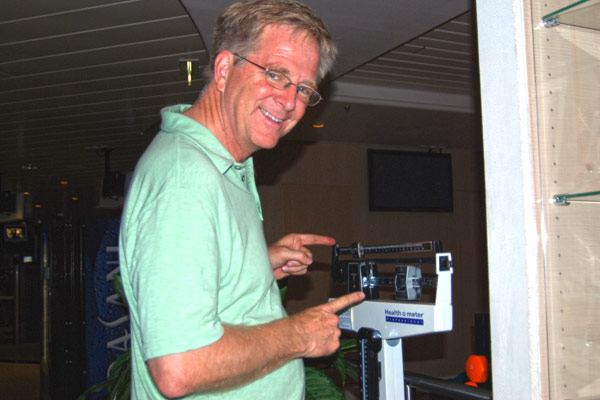
Everyone talks about the weight you gain living on a cruise ship. There’s free food and extremely tempting free deserts everywhere you turn at all hours of the day. They say the typical cruise passenger gains about a pound a day. My friends warned me that after two weeks at sea I’d put on “the seafaring 15.” Back in Barcelona, when I started this floating feast, I weighed in at 212 pounds. At Mykonos, after two weeks of cruise eating, I weighed myself again…nervous about the total.

When I started cruising, I weighed in at 212 pounds. Guess my weight at the end of my cruise and win a big fat prize.

What do you think I weighed? Try to be the first Facebook friend to guess my weight correctly. We’ll send an autographed copy of our new guidebook, Rick Steves’ Mediterranean Cruise Ports, and our Mediterranean Mosaic DVD (with eight TV shows) — which features the highlights of my time there — to the first person to get it right. So put your best guess in the comments below (one entry per person; for the complete rules, see Rick Steves’ Contest Rules). How much did I weigh at the end of my cruise? We’ll post the winner in 24 hours.


Mykonos

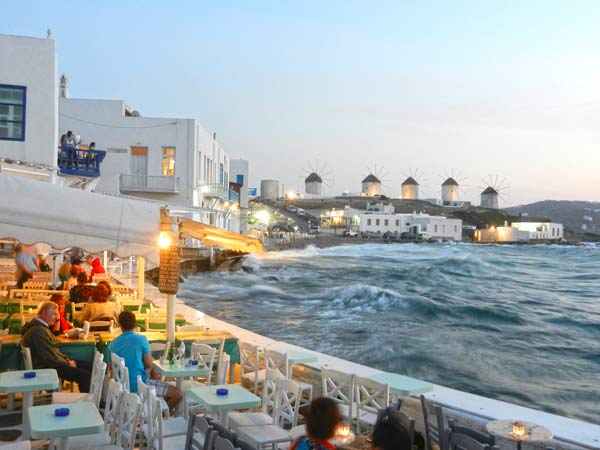
These four photos are from Mykonos in Greece. Mykonos is the classic Greek-island stop and, along with Santorini, it’s the most touristy — and the island most impacted by cruise ships. Being on Mykonos reminded me how great the Greek islands are — even when they’re extremely touristy. What’s your favorite discovered Greek isle…and your favorite undiscovered one?

Tiny Mykonos is inundated by cruisers every day through the season. There's room for one ship at the pier (with a five-minute shuttle-bus ride into town), and while we were there, two more ships dropped their anchors. It's striking to realize that each of these boats has about 3,000 passengers, making the total number of cruisers in port the same as the population of the entire island — 9,000.
The sea, the wind, the birds, and the weather-beaten little whitewashed churches all combine to give Mykonos a vibrant allure.
Everyone gathers in the cafés and pubs that line the colorful stretch of houses called "Little Venice." We were there to nurse an ouzo or other drink, and to watch the sun set to the rhythm of the sloppy, slamming waves.
We jumped ship in Mykonos three days before our cruise was over. Leaving our beautiful cruise ship early (as I had to get back to my office), we experienced the whitewashed town of Mykonos with three cruise ships in port —and then after they left. Of course, the town was touristy either way, but I thoroughly enjoyed just strolling around nearly all day. Watching the Equinox power away, glinting on the horizon in the setting sun, was both sad and thought-provoking. As it eventually disappeared in the misty horizon, it hit us that our world had changed: no more elevators that arrived with the first two notes of the song "Feelings;" no more friends that found everything "amazzzzing" and "phenomenal;" no more small talk with our crew who brought good, warm vibes from Bali, Macedonia, Nicaragua, the Philippines, and about 60 other countries; and no more new port in a new country arriving effortlessly with each sunrise.